Cardano Founder Says Monero Is ‘What Bitcoin Should Have Been’

bitcoinistОпубликовано 2026-05-14Обновлено 2026-05-14

Введение

Cardano founder Charles Hoskinson argues that Monero represents the "privacy-preserving cryptocurrency Bitcoin should have been," praising its technical design and steadfast commitment to cypherpunk principles. In an interview, he highlighted Monero's use of advanced features like ASIC-resistant puzzles, full-chain membership proofs, and ring signatures, calling it a pioneer in privacy at scale. Hoskinson noted that while privacy systems are often complex and built by specialists, Monero has successfully balanced strong privacy guarantees with usability without compromising its decentralized ethos. He emphasized the importance of such uncompromising projects in the broader crypto ecosystem, comparing different cryptocurrency communities to a "Justice League" where each member, like Monero, plays a distinct and vital role.

Cardano founder Charles Hoskinson said Monero represents the kind of privacy-preserving cryptocurrency Bitcoin might have become if stronger cryptographic tooling had been available at the time, praising the project’s technical design and its refusal to dilute its cypherpunk principles.

Speaking in an interview with David Gokhstein, the Cardano founder framed Monero not as a marginal privacy coin, but as one of the sector’s more important ideological and technical reference points. His comments centered less on price or market structure than on a broader debate over privacy, usability and what role uncompromising projects should play in crypto’s long-term direction.

“Honestly speaking, Monero is what Bitcoin should have been,” Hoskinson said. “They just didn’t have the technology at the time, and it’s a lot more complicated to run a privacy-preserving system. But there’s a lot to love in Monero, like the ASIC-resistant puzzles, the full-chain membership proofs, how they handle the view keys.”

Cardano Founder Praises Monero

Hoskinson’s argument was that privacy at scale is inherently harder to implement than transparent settlement. In his telling, Monero’s contribution is not limited to a single feature, but to a stack of design choices built around keeping privacy central while still maintaining a usable network.

He cited Monero’s work around ring signatures and privacy-preserving architecture as examples of a project that pushed crypto beyond transparent ledgers without abandoning decentralization. “These are smart things,” he said, adding that Monero “was a pioneer in ring signatures” and “a pioneer in a lot of privacy at scale.”

The praise is notable because it comes from one of the most visible founders in the broader crypto industry and touches on a recurring fault line in the sector: whether cryptocurrencies should prioritize auditability and regulatory legibility, or stronger default privacy for users. Hoskinson’s comments placed Monero firmly on the side of the latter, while acknowledging that this comes with trade-offs in complexity.

He also drew a distinction between cryptographic rigor and product usability, arguing that privacy systems are often built by specialists whose threat models can make products difficult for ordinary users to navigate.

“Because the thing about privacy is it’s built usually by cryptographers, and cryptographers are super weird paranoid people living in basements with no friends,” Hoskinson said. “And the reason they became a cryptographer is they think everybody’s out to get them.”

The line was delivered jokingly, but it supported a more serious point. According to Hoskinson, the challenge for privacy-focused systems is not only to achieve strong guarantees, but to make those guarantees accessible without weakening the underlying ethos.

“What the Monero community did, and they pioneered, was figuring out how to make it more usable, but they never violated once their cypherpunk ethos,” he said. “So you still mine it, and there’s still that decentralized mindset and all these other things.”

That framing matters because Monero has long occupied a distinct position in crypto. It is not merely a privacy feature bolted onto a larger smart-contract ecosystem; its identity is tied to default privacy, mining, and a community culture that tends to resist compromise. Hoskinson suggested that this kind of hardline position remains necessary, even in an industry increasingly shaped by institutions, compliance demands and public-chain analytics.

“You need people like that in the space to be part of that conversation and to be uncompromising in that conversation,” he said.

Hoskinson then used a superhero analogy to describe how different crypto communities can serve different functions. Not every project, in his view, needs to solve the same problem or make the same trade-offs. Some may focus on scalability, others on smart contracts, settlement, identity or privacy. The important point, he argued, is that privacy maximalists should have a seat in the room.

“What you want to do is you bring them together like a justice league,” Hoskinson said. “Everybody’s welcome in the Justice League. So there’s a Justice League of Privacy, and Monero is definitely part of that Justice League, and they’ve always had an important role, which should never be discounted.”

At press time, Monero traded at $394.45.
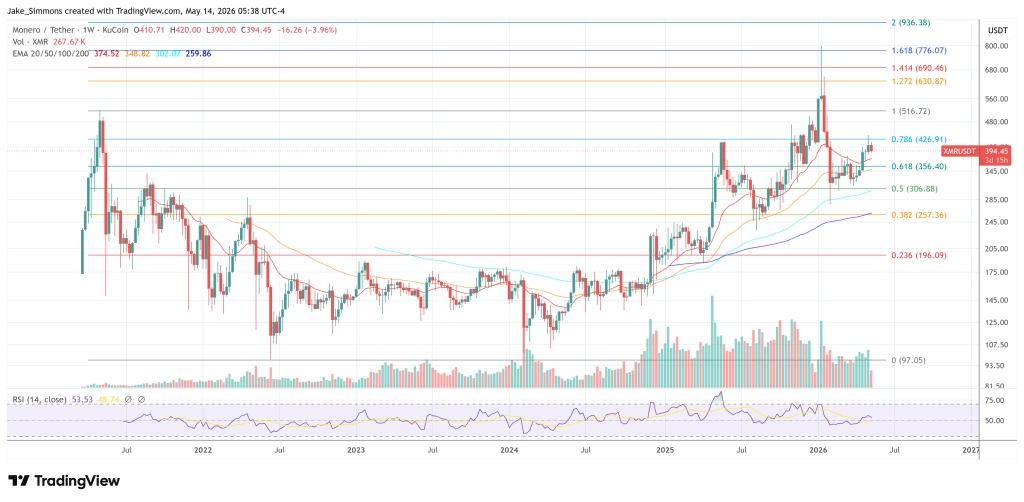
Monero faces the 0.786 Fib, 1-week chart | Source: XMRUSDT on TradingView.com

Связанные с этим вопросы

QWhat does Charles Hoskinson, the founder of Cardano, say Monero represents?

AHe says Monero represents the kind of privacy-preserving cryptocurrency Bitcoin might have become if stronger cryptographic tools had been available at its inception.

QAccording to Hoskinson, what is a key technical challenge that Monero tackled?

AHe states that implementing privacy at scale is inherently harder than transparent settlement, and Monero pushed crypto beyond transparent ledgers with technologies like ring signatures.

QWhat does Hoskinson identify as a common trade-off for privacy-focused systems like Monero?

AHe notes that while achieving strong privacy guarantees, these systems often come with increased complexity, which can make them more difficult for ordinary users to navigate.

QWhat aspect of the Monero community does Hoskinson specifically praise?

AHe praises the Monero community for figuring out how to make strong privacy more usable without ever violating their cypherpunk ethos, maintaining decentralization and principles like mining.

QWhat analogy does Charles Hoskinson use to describe the role of different crypto projects like Monero?

AHe uses a 'Justice League' analogy, stating that different projects serve different functions (like privacy, scalability, smart contracts) and all are welcome, with Monero being a key member of the 'Justice League of Privacy'.

Похожее

Xiaohongshu's Second Great Voyage, This Time Sailing Towards AI

Xiaohongshu's Second Voyage: Navigating Towards AI Since ChatGPT's emergence, Xiaohongshu's founder Mao Wenchao has been acutely aware of AI's potential threat, recognizing that the life advice people seek from chatbots overlaps directly with his platform's core business. Founded in 2013 as a PDF shopping guide for Chinese tourists, Xiaohongshu evolved into a massive community where millions share authentic, personal experiences—from product reviews to travel tips. This vast repository of "I've tried this" human judgment became its most valuable asset. However, the rise of AI, which delivers instant answers, challenges the very need for users to sift through numerous personal notes. Fearing its treasure trove of lived experience could become mere training data for others, Xiaohongshu is proactively adapting. In 2026, it established a dedicated AI division (Dots), launched RED Skill to turn user experiences into usable AI tools, and acquired the AI search product "Diandian." Its investments now extend to AI firms like MiniMax and hardware startups, moving upstream to address needs before they even become search queries. The platform's commercialization strategy is also evolving. With a newly acquired payment license and tools like the AIPS model to track consumer decision journeys, Xiaohongshu aims to seamlessly integrate recommendations with transactions, embedding commerce within AI-generated answers. Yet, a critical tension remains. While building smarter machines to organize and leverage its human experiences, Xiaohongshu must prevent AI from drowning out the authentic, flawed, and trustworthy "I've tried this" voices that built its community. Its core challenge is to harness AI's power without letting the map—the machine's perfect, synthesized answer—replace the territory of genuine human experience. This balance between technological advancement and preserving human trust defines its current journey and its future.

marsbit19 мин. назад

Xiaohongshu's Second Great Voyage, This Time Sailing Towards AI

marsbit19 мин. назад

SharpLink CEO: How to Understand Ethereum Developers Just Exceeded 1 Million?

SharpLink CEO reflects on the milestone of Ethereum surpassing 1 million historical developers, emphasizing that this figure represents the largest pool of technical talent ever assembled around an open, permissionless blockchain network. While approximately 232,000 developers remain active, the key question for the crypto industry is not which chain is fastest, but where the best builders choose to build long-term. Ethereum's advantage lies in a decade-long accumulation of infrastructure, standards, tools, liquidity, and a cohesive culture, making it the default operating system for programmable finance. This developer base is tackling complex challenges: the Glamsterdam upgrade aims to enhance scalability while preserving core principles; synchronous composability seeks to unify Rollup ecosystems; and significant efforts are underway for post-quantum security. Ethereum's deeper network effects stem from composability and shared standards (like the EVM and Solidity), creating a flywheel of more developers, tools, and liquidity. Three reinforcing strengths cement Ethereum's lead: credible neutrality (secured by ~900k validators), a modular architecture with interconnected Rollups, and a culture that attracts top researchers. The ecosystem is consolidating as the trusted coordination layer for internet-native finance, favored by large institutions valuing security and liquidity. The future of Ethereum is being built by this global community of founders and architects.

链捕手34 мин. назад

SharpLink CEO: How to Understand Ethereum Developers Just Exceeded 1 Million?

链捕手34 мин. назад

A Clod of Chinese Soil Chokes Two Japanese Giants

"Chinese Soil Chokes Japanese Giants" The production of a key electronic specialty gas, tungsten hexafluoride (WF6), vital for manufacturing AI chips, was halted by two leading Japanese producers—Kanto Denka and Central Glass. Their shutdown was not due to a technological failure but a sudden, critical shortage of a raw material they had long taken for granted: ultra-high-purity (6N-grade) tungsten powder, which is almost entirely sourced from China. Following a quiet Chinese export announcement in January 2026, tungsten powder shipments to Japan dropped to zero for months. Despite frantic efforts, Japanese companies found no viable alternative; imported powder was three times more expensive and lacked the required purity. Their existing stockpiles were exhausted by mid-2026. WF6 is essential for depositing tungsten into the microscopic contact holes of High Bandwidth Memory (HBM) chips, which are crucial for advanced processors like those from Nvidia. While Japanese firms had mastered producing ultra-pure WF6 gas, their entire supply chain relied on China's 6N tungsten powder—a dependency now revealed as a fatal vulnerability. China's dominance in this "soil" results from decades of painstaking R&D by companies like Xiamen Tungsten and China Tungsten & Hightech. They overcame immense technical hurdles, such as separating chemically similar molybdenum from tungsten, to achieve mass production of the world's purest tungsten powder. With their primary suppliers gone, Kanto Denka and Central Glass announced a permanent halt to WF6 production starting July 1, 2026. This immediately created a supply crisis for major semiconductor manufacturers like Samsung and SK Hynix, forcing them to urgently seek and certify new Chinese suppliers for WF6 itself. The reversal marks a dramatic shift: China has moved from exporting low-value raw materials to controlling the high-purity foundation of a critical global tech supply chain, upending a long-established industrial hierarchy.

marsbit1 ч. назад

A Clod of Chinese Soil Chokes Two Japanese Giants

marsbit1 ч. назад

Торговля

Спот
Фьючерсы

Популярные статьи

Тест по Bitcoin Биткоина

HTX Learn: Изучите Bitcoin halving и Заработаете Токены USDT

3.1k просмотров всегоОпубликовано 2024.04.16Обновлено 2024.04.16

Тест по Bitcoin  Биткоина

Что такое $BITCOIN

ЦИФРОВОЕ ЗОЛОТО ($BITCOIN): Комплексный анализ Введение в ЦИФРОВОЕ ЗОЛОТО ($BITCOIN) ЦИФРОВОЕ ЗОЛОТО ($BITCOIN) — это проект на основе блокчейна, работающий в сети Solana, который стремится объединить характеристики традиционных драгоценных металлов с инновациями децентрализованных технологий. Хотя он носит имя Биткойн, часто называемого “цифровым золотом” из-за его восприятия как средства хранения ценности, ЦИФРОВОЕ ЗОЛОТО является отдельным токеном, предназначенным для создания уникальной экосистемы в ландшафте Web3. Его цель — позиционировать себя как жизнеспособный альтернативный цифровой актив, хотя детали его применения и функциональности все еще развиваются. Что такое ЦИФРОВОЕ ЗОЛОТО ($BITCOIN)? ЦИФРОВОЕ ЗОЛОТО ($BITCOIN) — это токен криптовалюты, специально разработанный для использования в блокчейне Solana. В отличие от Биткойна, который выполняет широко признанную роль хранения ценности, этот токен, похоже, сосредоточен на более широких приложениях и характеристиках. Примечательные аспекты включают: Инфраструктура блокчейна: Токен построен на блокчейне Solana, известном своей способностью обрабатывать высокоскоростные и недорогие транзакции. Динамика предложения: ЦИФРОВОЕ ЗОЛОТО имеет максимальное предложение, ограниченное 100 квадриллионами токенов (100P $BITCOIN), хотя детали о его обращающемся предложении в настоящее время не раскрыты. Утилита: Хотя точные функциональные возможности не описаны, есть указания на то, что токен может быть использован для различных приложений, потенциально связанных с децентрализованными приложениями (dApps) или стратегиями токенизации активов. Кто создатель ЦИФРОВОГО ЗОЛОТА ($BITCOIN)? На данный момент личность создателей и команды разработчиков, стоящих за ЦИФРОВЫМ ЗОЛОТОМ ($BITCOIN), остается неизвестной. Эта ситуация типична для многих инновационных проектов в области блокчейна, особенно тех, которые связаны с децентрализованными финансами и феноменом мем-криптовалют. Хотя такая анонимность может способствовать культуре, ориентированной на сообщество, она усиливает опасения по поводу управления и ответственности. Кто инвесторы ЦИФРОВОГО ЗОЛОТА ($BITCOIN)? Доступная информация указывает на то, что у ЦИФРОВОГО ЗОЛОТА ($BITCOIN) нет известных институциональных спонсоров или значительных венчурных капиталовложений. Проект, похоже, функционирует по модели пирингового взаимодействия, сосредоточенной на поддержке и принятии сообществом, а не на традиционных путях финансирования. Его активность и ликвидность в основном сосредоточены на децентрализованных биржах (DEX), таких как PumpSwap, а не на устоявшихся централизованных торговых платформах, что еще больше подчеркивает его подход, ориентированный на grassroots. Как работает ЦИФРОВОЕ ЗОЛОТО ($BITCOIN) Операционные механизмы ЦИФРОВОГО ЗОЛОТА ($BITCOIN) можно подробно описать на основе его дизайна блокчейна и характеристик сети: Механизм консенсуса: Используя уникальный механизм доказательства истории (PoH) Solana в сочетании с моделью доказательства доли (PoS), проект обеспечивает эффективную валидацию транзакций, что способствует высокой производительности сети. Токеномика: Хотя конкретные дефляционные механизмы не были подробно описаны, большое максимальное предложение токенов подразумевает, что оно может быть предназначено для микротранзакций или нишевых случаев использования, которые еще предстоит определить. Интероперабельность: Существует потенциал для интеграции с более широкой экосистемой Solana, включая различные платформы децентрализованных финансов (DeFi). Однако детали относительно конкретных интеграций остаются неуточненными. Хронология ключевых событий Вот хронология, которая подчеркивает значимые вехи, касающиеся ЦИФРОВОГО ЗОЛОТА ($BITCOIN): 2023: Первоначальное развертывание токена происходит в блокчейне Solana, отмеченное его адресом контракта. 2024: ЦИФРОВОЕ ЗОЛОТО приобретает видимость, когда оно становится доступным для торговли на децентрализованных биржах, таких как PumpSwap, позволяя пользователям обменивать его на SOL. 2025: Проект наблюдает спорадическую торговую активность и потенциальный интерес к инициативам, возглавляемым сообществом, хотя на данный момент не зафиксировано никаких значительных партнерств или технических достижений. Критический анализ Сильные стороны Масштабируемость: Основная инфраструктура Solana поддерживает высокие объемы транзакций, что может повысить полезность $BITCOIN в различных сценариях транзакций. Доступность: Потенциально низкая цена торговли за токен может привлечь розничных инвесторов, способствуя более широкому участию благодаря возможностям дробного владения. Риски Отсутствие прозрачности: Отсутствие публично известных спонсоров, разработчиков или процесса аудита может вызвать скептицизм относительно устойчивости и надежности проекта. Волатильность рынка: Торговая активность сильно зависит от спекулятивного поведения, что может привести к значительной волатильности цен и неопределенности для инвесторов. Заключение ЦИФРОВОЕ ЗОЛОТО ($BITCOIN) является интригующим, но неоднозначным проектом в быстро развивающейся экосистеме Solana. Хотя он пытается использовать нарратив “цифрового золота”, его отход от установленной роли Биткойна как средства хранения ценности подчеркивает необходимость более четкого различения его предполагаемой утилиты и структуры управления. Будущее принятие и усвоение, вероятно, будут зависеть от решения текущей непрозрачности и более четкого определения его операционных и экономических стратегий. Примечание: Этот отчет охватывает синтезированную информацию, доступную на октябрь 2023 года, и с тех пор могут произойти события.

102 просмотров всегоОпубликовано 2025.05.13Обновлено 2025.05.13

Что такое $BITCOIN

Fractal Bitcoin: масштабирование Биткоина с помощью рекурсивной системы

Fractal Bitcoin — масштабное Layer-1-решнение, созданное на базе кода Биткоина, позволяющего достигать бесконечного масштабирования с помощью рекурсивного подхода.

2.3k просмотров всегоОпубликовано 2025.06.30Обновлено 2025.06.30

Fractal Bitcoin: масштабирование Биткоина с помощью рекурсивной системы

Обсуждения

Добро пожаловать в Сообщество HTX. Здесь вы сможете быть в курсе последних новостей о развитии платформы и получить доступ к профессиональной аналитической информации о рынке. Мнения пользователей о цене на BTC (BTC) представлены ниже.

活动图片