SharpLink CEO: How to Understand Ethereum Developers Just Exceeded 1 Million?

链捕手Опубликовано 2026-06-16Обновлено 2026-06-16

Введение

SharpLink CEO reflects on the milestone of Ethereum surpassing 1 million historical developers, emphasizing that this figure represents the largest pool of technical talent ever assembled around an open, permissionless blockchain network. While approximately 232,000 developers remain active, the key question for the crypto industry is not which chain is fastest, but where the best builders choose to build long-term. Ethereum's advantage lies in a decade-long accumulation of infrastructure, standards, tools, liquidity, and a cohesive culture, making it the default operating system for programmable finance. This developer base is tackling complex challenges: the Glamsterdam upgrade aims to enhance scalability while preserving core principles; synchronous composability seeks to unify Rollup ecosystems; and significant efforts are underway for post-quantum security. Ethereum's deeper network effects stem from composability and shared standards (like the EVM and Solidity), creating a flywheel of more developers, tools, and liquidity. Three reinforcing strengths cement Ethereum's lead: credible neutrality (secured by ~900k validators), a modular architecture with interconnected Rollups, and a culture that attracts top researchers. The ecosystem is consolidating as the trusted coordination layer for internet-native finance, favored by large institutions valuing security and liquidity. The future of Ethereum is being built by this global community of founders and architects.

Author: Joseph Chalom

Compiled by: Jiahuan, ChainCatcher

I just returned from Asia, where I spent time with Ethereum developers and ecosystem leaders. Special thanks to Nonce Classic, Four Pillars, and DSRV in Seoul, our friends at SNZ, and the recently opened Ethereum Community Center in Hong Kong. This center is Asia's first long-term operational physical Ethereum community space, supported by the Ethereum Foundation.

What impressed me most was not just the vibrancy, but also the rigor and ambition of the builders there. The high-caliber projects, experimental spirit, and long-term thinking emerging from the global Ethereum ecosystem were truly inspiring.

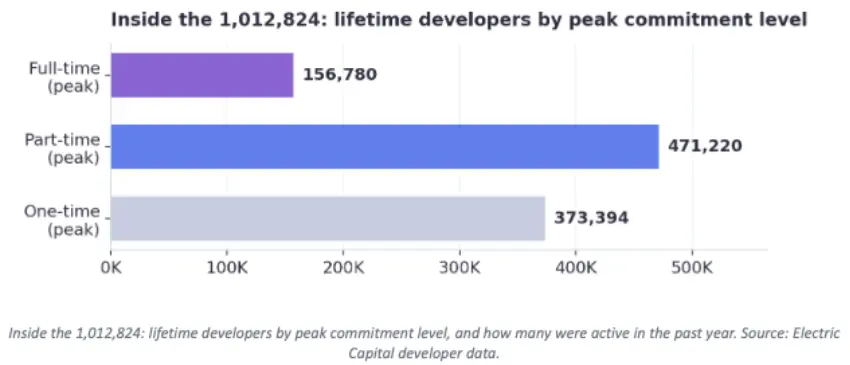
This also brought a number to life: data from Electric Capital shows that the total number of historical Ethereum developers has now exceeded one million, with 1,012,824 individuals having contributed to the ecosystem. No other ecosystem in crypto can compare.

A Milestone Worth Noting

One million is a round number, and round numbers can sometimes feel hollow. But this one is not. It represents the largest pool of technical talent ever assembled around an open, permissionless blockchain network. More importantly, this talent pool continues to deepen and widen.

Of this one million developers, approximately 232,000 remained active over the past twelve months.

Why Ethereum: The Real Important Question

For years, crypto discussions have revolved around speed, fees, and throughput. Every new chain claims to be "faster than Ethereum." But the core question in crypto has never been which chain is the fastest, but another:

"Where will the most skilled builders choose to build long-term?"

On this issue, Ethereum maintains a clear advantage. This advantage is not just technical; it's institutional, cultural, economic, and structural—the result of a decade of accumulation of developers, infrastructure, standards, tools, liquidity, research, applications, and social coordination that no other ecosystem can replicate.

Ethereum has become the default operating system for programmable finance and internet-native capital formation.

What Are These Million Builders Constructing, and Why It Reinforces the Moat

The significance of these million builders lies in what they are doing *right now*. The current focus is on the hardest, highest-stakes problems in the industry: core protocol scalability, privacy, quantum resistance, and the autonomous agent systems that will run on top of it.

Glamsterdam Upgrade: Innovating Without Breaking Core Principles. The Glamsterdam upgrade, expected in 2026, demonstrates how Ethereum progresses while holding firm to its core values. Core changes include enshrined proposer-builder separation (ePBS) and block-level access lists (BALs), unlocking parallel execution and higher throughput, and the potential to raise the gas limit, significantly increasing Layer 1 capacity.

Scaling for future demand while defending credibly neutral trust, security, and MEV fairness is itself an evolving moat.

Synchronous Composability: Making Many Rollups Feel Like One Chain. Composability has always been Ethereum's superpower; the next leap is extending it to Layer 2. Native Rollups and Based Rollups, combined with synchronous composability, address this. A contract on one rollup can call a contract on Mainnet or another rollup in a single atomic transaction—no bridges, no waiting.

Linea, Ethereum Economic Zone, Gnosis, Zisk, and the Ethereum Foundation are collaborating to combine this design with real-time proofs. The result is that dozens of rollups no longer operate like isolated networks but begin to function like a unified chain. This is a direct response to fragmentation criticism.

Quantum Resistance: Ethereum's Most Obvious Lead. No other mainstream ecosystem is more prepared for the post-quantum era. The "Lean Ethereum" roadmap, the Ethereum Foundation's Post-Quantum Security team established in early 2026, pq.ethereum.org, and over a dozen client teams already running weekly post-quantum interoperability devnets constitute a coordinated, open-source migration targeting completion around 2029.

When quantum risk becomes a reality, institutions hosting trillions of dollars in assets will care about one thing: which chain was prepared earliest and most thoroughly.

Moat Beyond Developers: Composability, Standards, and Trust

The concentration of developer talent compounds because of how Ethereum itself is built. Its deepest network effect is not liquidity, but the depth of composability: applications function like interoperable financial Lego bricks.

Lending, stablecoins, exchanges, wallets, tokenized assets, oracles, and Layer 2 rollups all interact through shared standards; developers never have to start from scratch. The EVM is crypto's application layer, and Solidity skills are transferable to Base, Arbitrum, Optimism, Polygon, zkSync, Scroll, Linea, and hundreds of other networks.

Learning the Ethereum tech stack maximizes optionality, which drives a flywheel effect: more developers, more tools, more liquidity, more institutions, which in turn attracts more developers to build composable protocols and assets. Liquidity begets liquidity, composability begets composability.

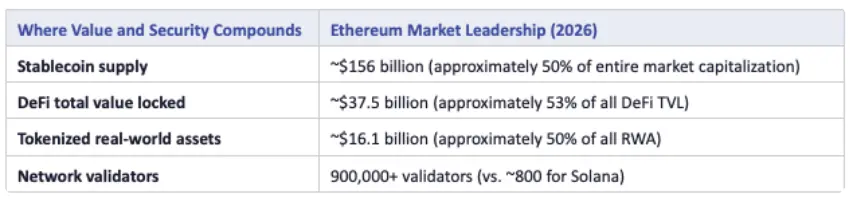
Moreover, Ethereum dominates where real value settles, not just where the loudest noise is made:

Three forces reinforce this lead.

Credible Neutrality: Ethereum is secured by over 900,000 validators, while Solana has around 800. Large institutions place immense value on this level of decentralization and platform neutrality.

Modularity: Rollups like Base, Arbitrum, and Optimism are not fragmenting Ethereum; they are expanding it into an increasingly interconnected modular internet economy that inherits Mainnet's security.

Culture: Ethereum attracts top researchers, cryptographers, and EIP standards authors far beyond any other ecosystem, setting the direction for the entire industry. This is perhaps the hardest advantage for other ecosystems to replicate.

There is Only One Ethereum

There's a fundamental difference between generating on-chain activity and being the long-term coordination layer for internet-native finance. The latter means being the layer trusted by the world's largest financial institutions.

Ethereum has firmly captured the mindshare of major asset holders, institutions that value trust, security, and liquidity above all. I saw this firsthand from the front row during my tenure at BlackRock.

In technology markets, ecosystems consolidate over time around standards, liquidity, and developer attention. This is Ethereum's moat.

After meeting these developers, builders, and ecosystem leaders in Seoul and Hong Kong, I am more convinced than ever of Ethereum's competitive advantage. I met the talent building the next generation of financial infrastructure—the founders and architects of our industry's future and agentic finance. These are the people and teams that will change the world.

Ethereum's future is happening now.

Связанные с этим вопросы

QAccording to the SharpLink CEO, what makes the milestone of 1 million historical Ethereum developers significant, beyond just being a large number?

AIt represents the largest technical talent pool ever assembled around an open, permissionless blockchain network. This talent pool is not only vast but also continues to deepen and broaden in expertise and scope.

QIn the CEO's view, what is the most fundamental question for the crypto industry, and what is the current answer to it?

AThe most fundamental question is not which chain is the fastest, but: 'Where will the best builders choose to build for the long term?' The clear answer, according to the article, is Ethereum.

QWhat three key technical frontiers is the article's author most impressed that Ethereum's developer community is tackling?

AThe author highlights three key areas: 1) Core protocol scalability, privacy, and MEV fairness through upgrades like Glamsterdam; 2) Achieving synchronized composability across multiple rollups; and 3) Preparing for post-quantum security through a coordinated, long-term roadmap.

QWhat does the author identify as the deepest network effect of Ethereum that goes beyond just developer count?

AThe deepest network effect is the depth of composability. Applications can interact like interoperable financial Lego bricks, thanks to shared standards like the EVM. This allows developers to build on existing infrastructure without starting from scratch, creating a powerful compounding effect.

QWhat three specific forces does the author argue are strengthening Ethereum's leading position, particularly for large institutions?

AThe three forces are: 1) Credible Neutrality, secured by a highly decentralized network of validators; 2) A Modular architecture where L2 rollups expand rather than fragment the ecosystem; and 3) A deeply ingrained Culture that attracts top researchers and standard-setters, which is the hardest advantage for competitors to replicate.

Похожее

The Shutdown of Claude Mythos Revealed the True Cost of Renting AI to Me

The sudden shutdown of Claude Mythos this week starkly highlights a critical, often overlooked risk for founders: when your core capability relies entirely on someone else's platform, your fate is not in your own hands. The key question becomes: who truly owns the intelligence your product depends on? For years, the debate around open-source models focused on cost. Now, the evidence is clear: fine-tuned open-source models can achieve frontier-level quality for specific, mission-critical tasks at a fraction of the cost. However, the deeper issue is control. Relying on a third-party API is like renting; it works until the landlord changes the rules, raises the rent, or asks you to leave—as Mythos experienced. The lesson is not to stop using frontier models—they are incredible infrastructure. The goal is ownership. Ownership means starting with a powerful open-source model and shaping it around what makes your company unique: your data, workflows, domain expertise, and definition of "good." Over time, the model becomes less generic and more reflective of your business, creating durable value. The optimistic conclusion is that AI's future doesn't hinge on one superior model. There is no single frontier. The frontier includes proprietary models, models fine-tuned on company-specific knowledge, specialized models for narrow problems, and intelligent routers orchestrating model ensembles. The most interesting development is not models getting smarter, but intelligence becoming increasingly customizable. The winning companies will be those that transform intelligence into a unique, owned asset. Looking ahead, the vision is not one model dominating all, but many teams owning the part of the frontier that matters most to them.

marsbit10 мин. назад

The Shutdown of Claude Mythos Revealed the True Cost of Renting AI to Me

marsbit10 мин. назад

Tiger Research: U.S. Strategic Bitcoin Reserve - Should the Market Be Happy or Disappointed?

Tiger Research analyzes the evolution of U.S. legislative efforts regarding a strategic Bitcoin reserve, concluding the market impact is limited in the short term but potentially positive long-term. The core event was a March 2025 executive order by former President Trump, which designated confiscated Bitcoin as a strategic reserve and promised not to sell existing holdings (approx. 190k BTC). As it contained no mandate to purchase new Bitcoin, the market reacted negatively, with prices dropping 5.7%. Legislative history shows a significant retreat from initial ambitions. The 2024 "BITCOIN Act" proposed mandatory purchases of 1 million BTC over five years. Reintroduced in 2025, it stalled due to high fiscal costs, concerns over dollar hegemony, and opposition from the Treasury Secretary. The current frontrunner, the 2026 "American Retirement and Monetary Advancement (ARMA) Act," is a compromise. It lacks any purchase requirement, instead focusing on consolidating existing government-held Bitcoin and legally prohibiting its sale for at least 20 years. While ARMA has higher passage odds due to bipartisan support and no purchase mandate, its immediate market effect is neutral. It eliminates potential government selling pressure but creates no new demand. The long-term significance is that formally establishing Bitcoin as a national reserve asset in law could later reignite debates on mandatory purchases. Therefore, the path to a government buyer is longer than initially priced by the market, but the directional narrative remains intact.

marsbit12 мин. назад

Tiger Research: U.S. Strategic Bitcoin Reserve - Should the Market Be Happy or Disappointed?

marsbit12 мин. назад

US Stock Market Trend (June 16): SpaceX Rises 42% in Two Days, New Fed Chairman Takes Office Today

**U.S. Stocks Trend (June 16): SpaceX Soars 42% in Two Days, New Fed Chair Takes Office Today** Markets surged on Monday following former President Trump's social media announcement of a completed U.S.-Iran deal to reopen the Strait of Hormuz, pending a June 19 signing. The news triggered a broad risk-on rally: oil prices crashed, tech stocks soared, bond yields fell, and defensive sectors lagged. **Market Performance:** The Nasdaq jumped 3.07%, led by semiconductor stocks like Micron (+9.2%). The S&P 500 gained 1.65%, and the Dow rose 0.92% to a record high. However, the Russell 2000 small-cap index underperformed (+0.72%). SpaceX continued its hot streak, rising another 5% pre-market after disclosures of large buys by an Australian billionaire and Cathie Wood's ARK. Boeing also rallied on the transportation optimism. Conversely, energy stocks like Chevron fell over 3% on the oil price plunge, with other defensive sectors also selling off. The day's action showed a clear rotation of funds from energy/defensive plays into AI and tech narratives. **Macro & Outlook:** The VIX fear index fell 8.37%. Treasury yields declined, and WTI crude dropped over 5%. Attention now shifts to a packed schedule: the Bank of Japan is widely expected to hike rates to 1.0% on Tuesday. The Fed's June meeting concludes Wednesday, marking new Chair Wash's debut. While rates are expected to hold, his tone on stubborn inflation and the "dot plot" will be crucial for gauging the 2024 rate path. The formal Iran deal signing is set for Friday. **Trend Perspective:** While the peace deal is a genuine positive, Monday's explosive rally may have gotten ahead of itself, pricing in a swift resolution to inflation concerns. The shortened trading week faces a triple test: BoJ tightening, the Fed's policy stance, and deal implementation details. Tech and semiconductors, which led the surge, remain vulnerable to any disappointment from these key events. The real price discovery begins with the central banks' communications this week.

marsbit34 мин. назад

US Stock Market Trend (June 16): SpaceX Rises 42% in Two Days, New Fed Chairman Takes Office Today

marsbit34 мин. назад

Xiaohongshu's Second Great Voyage, This Time Sailing Towards AI

Xiaohongshu's Second Voyage: Navigating Towards AI Since ChatGPT's emergence, Xiaohongshu's founder Mao Wenchao has been acutely aware of AI's potential threat, recognizing that the life advice people seek from chatbots overlaps directly with his platform's core business. Founded in 2013 as a PDF shopping guide for Chinese tourists, Xiaohongshu evolved into a massive community where millions share authentic, personal experiences—from product reviews to travel tips. This vast repository of "I've tried this" human judgment became its most valuable asset. However, the rise of AI, which delivers instant answers, challenges the very need for users to sift through numerous personal notes. Fearing its treasure trove of lived experience could become mere training data for others, Xiaohongshu is proactively adapting. In 2026, it established a dedicated AI division (Dots), launched RED Skill to turn user experiences into usable AI tools, and acquired the AI search product "Diandian." Its investments now extend to AI firms like MiniMax and hardware startups, moving upstream to address needs before they even become search queries. The platform's commercialization strategy is also evolving. With a newly acquired payment license and tools like the AIPS model to track consumer decision journeys, Xiaohongshu aims to seamlessly integrate recommendations with transactions, embedding commerce within AI-generated answers. Yet, a critical tension remains. While building smarter machines to organize and leverage its human experiences, Xiaohongshu must prevent AI from drowning out the authentic, flawed, and trustworthy "I've tried this" voices that built its community. Its core challenge is to harness AI's power without letting the map—the machine's perfect, synthesized answer—replace the territory of genuine human experience. This balance between technological advancement and preserving human trust defines its current journey and its future.

marsbit1 ч. назад

Xiaohongshu's Second Great Voyage, This Time Sailing Towards AI

marsbit1 ч. назад

Торговля

Спот
Фьючерсы

Популярные статьи

Manyu: восходящая мем-звезда на Ethereum, готовая открыть новую эру культуры Shiba

Manyu - это мемтокен на Ethereum, который приносит децентрализованную культурную и развлекательную ценность через вирусное влияние в соцсетях и вовлечённость сообщества.

2.0k просмотров всегоОпубликовано 2025.11.27Обновлено 2025.11.27

Manyu: восходящая мем-звезда на Ethereum, готовая открыть новую эру культуры Shiba

Неделя обучения по популярным токенам 14: Glamsterdam — самое ожидаемое обновление Ethereum в 2026 году

Ordinals/Runes по-прежнему стимулируют доходы от комиссий за блоки и активность разработчиков, рассматриваются как отправная точка «нативной эмиссии активов» в сети.

1.5k просмотров всегоОпубликовано 2026.04.29Обновлено 2026.04.29

Неделя обучения по популярным токенам 14: Glamsterdam — самое ожидаемое обновление Ethereum в 2026 году

Обсуждения

Добро пожаловать в Сообщество HTX. Здесь вы сможете быть в курсе последних новостей о развитии платформы и получить доступ к профессиональной аналитической информации о рынке. Мнения пользователей о цене на ETH (ETH) представлены ниже.

活动图片