Buffett Indicator Soars, Bitcoin Stands at a Macro Crossroads

marsbitОпубликовано 2026-02-26Обновлено 2026-02-26

Введение

Bitcoin is at a critical macro juncture, navigating a "triple bubble" environment of extreme equity valuations, stressed real estate, and a rapidly growing private credit market. Its near-term price direction hinges on whether credit stress triggers a systemic liquidation or if policymakers intervene with supportive measures first. In a credit-driven crash, Bitcoin could drop 20-40% rapidly as leverage unwinds, liquidity vanishes, and ETFs see outflows—similar to March 2020. Conversely, clear policy support (like Fed liquidity expansion or falling real yields) would likely make Bitcoin a high-beta outperformer, rallying faster than traditional risk assets, as seen in March 2023. Current signals are mixed: high-yield spreads remain tight, the Fed’s balance sheet is expanding slowly, real yields are elevated (~1.80%), stablecoin supply is flat, and Bitcoin ETFs are seeing outflows. The market awaits a catalyst—either a credit event or a policy response. Monitoring key metrics—Fed asset changes, stablecoin supply, high-yield spreads, and real yields—provides a framework for anticipating Bitcoin’s next major move. Timing and macro liquidity conditions, rather than narrative, are now the dominant drivers.

Bitcoin is entering a phase where macro rhythms matter more than narratives.

Equity markets are near historic highs, real yields remain elevated, and credit markets are expanding into increasingly opaque corners of the financial system. These conditions don't guarantee an immediate crisis, but together they form a backdrop for a potential window of high volatility in risk assets.

For Bitcoin, the core question is: will stress manifest in an underlying financial system with stretched asset valuations, and how quickly can policymakers move to contain it?

Macro strategist Michael Pento describes the current setup as a "triple bubble": equity valuations near historic extremes, real estate pressured by mortgage rates close to 6%, and private credit AUM racing toward $2 trillion. The label is catchy, but the framework is useful because it emphasizes sequence.

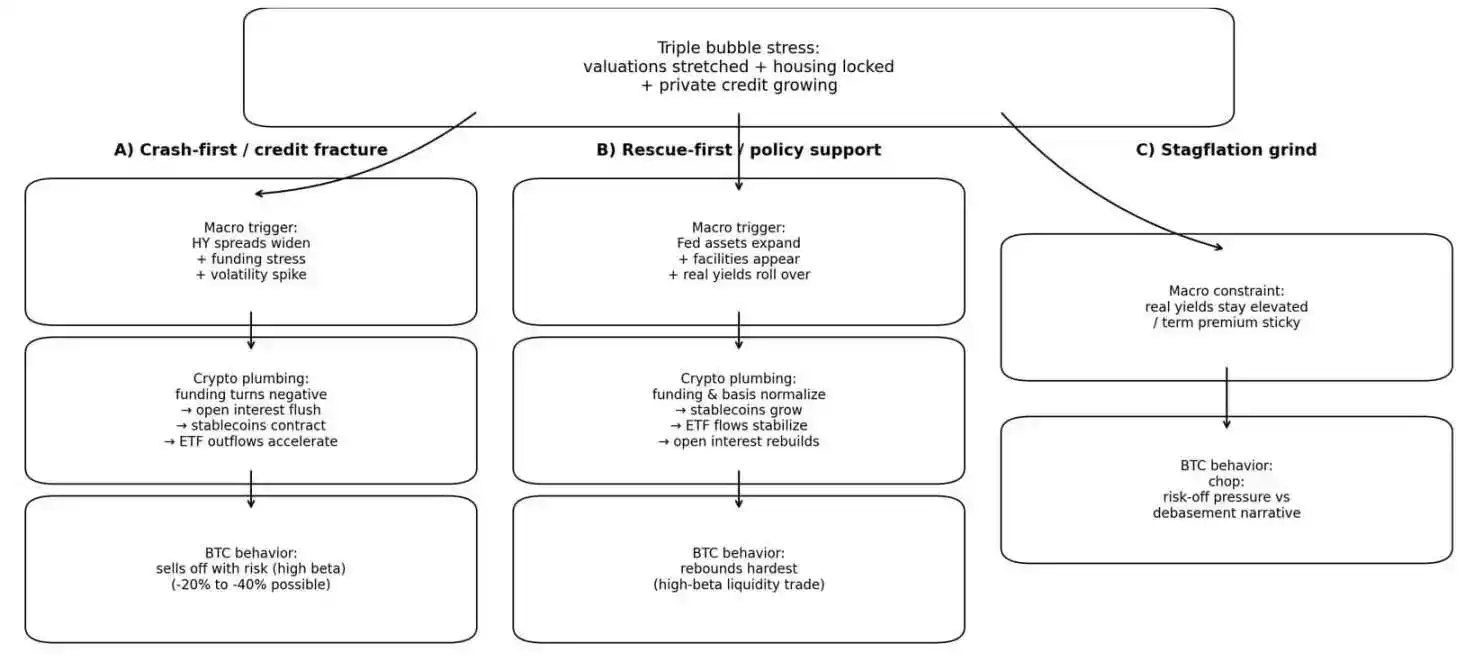
If credit cracks first, liquidity evaporates instantly, and Bitcoin is likely sold off alongside other assets. If policy support arrives before a crisis spreads, Bitcoin becomes a high-beta liquidity trade, rebounding faster than traditional risk assets.

Financial systems rarely collapse because valuations are too high. They break when credit and bond chains face forced selling. Bitcoin's around-the-clock liquidity means its swings during panic and rescue rallies are almost more violent than any other asset.

Recent data shows stress signals are accumulating but haven't yet triggered a break.

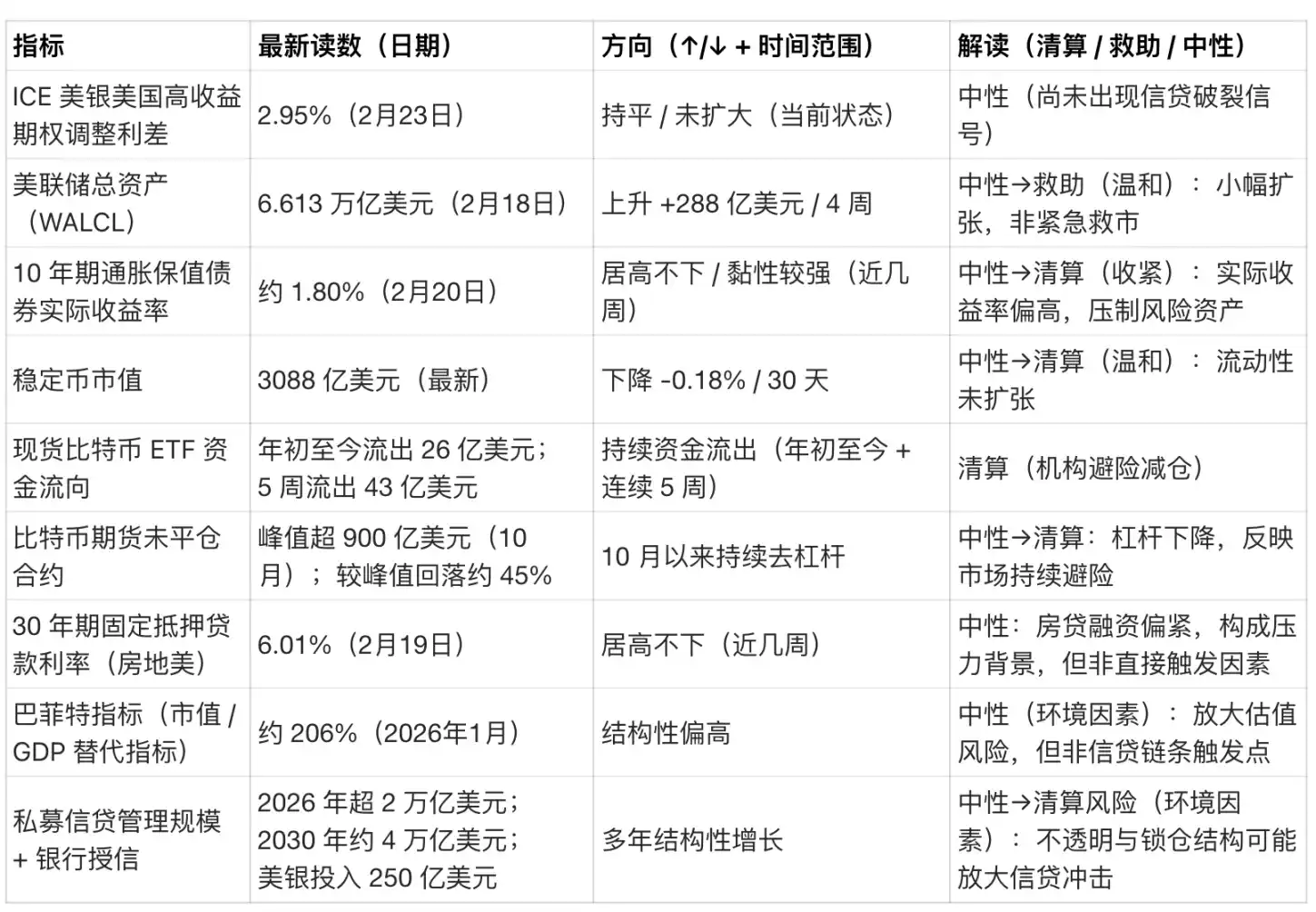
On February 23, the ICE BofA High Yield Index Option-Adjusted Spread was 2.95%, still tight by crisis standards.

On February 18, the Fed's balance sheet stood at $6.613 trillion, up about $28.8 billion over four weeks—a mild expansion, not emergency liquidity.

On February 20, the 10-year TIPS real yield was around 1.80%, a level high enough to pressure yieldless assets.

Stablecoin market cap was ~$308.8 billion, with a 30-day change of -0.18%, essentially flat.

Since early 2026, Bitcoin spot ETFs have seen net outflows of ~$2.6 billion, with outflows of ~$4.3 billion over the past five weeks.

Bitcoin Sells Off First, Reasons Discussed Later

Deflationary liquidations often start in credit markets, not stock indices.

High-yield bond spreads widen sharply, funding markets come under pressure, volatility spikes—cash becomes the only position everyone wants.

Bitcoin's behavior in such phases is predictable: perpetual funding rates turn negative, leverage unwinding causes open interest to plummet, liquidity exodus triggers stablecoin supply contraction, ETF outflows accelerate.

March 2020 is a classic reference. In a global liquidity shock, Bitcoin plunged nearly 40% on March 12, sold off alongside stocks, credit, and commodities as market participants scrambled for US dollar liquidity.

A credit-driven liquidation could easily see Bitcoin swing -20% to -40% in a matter of days.

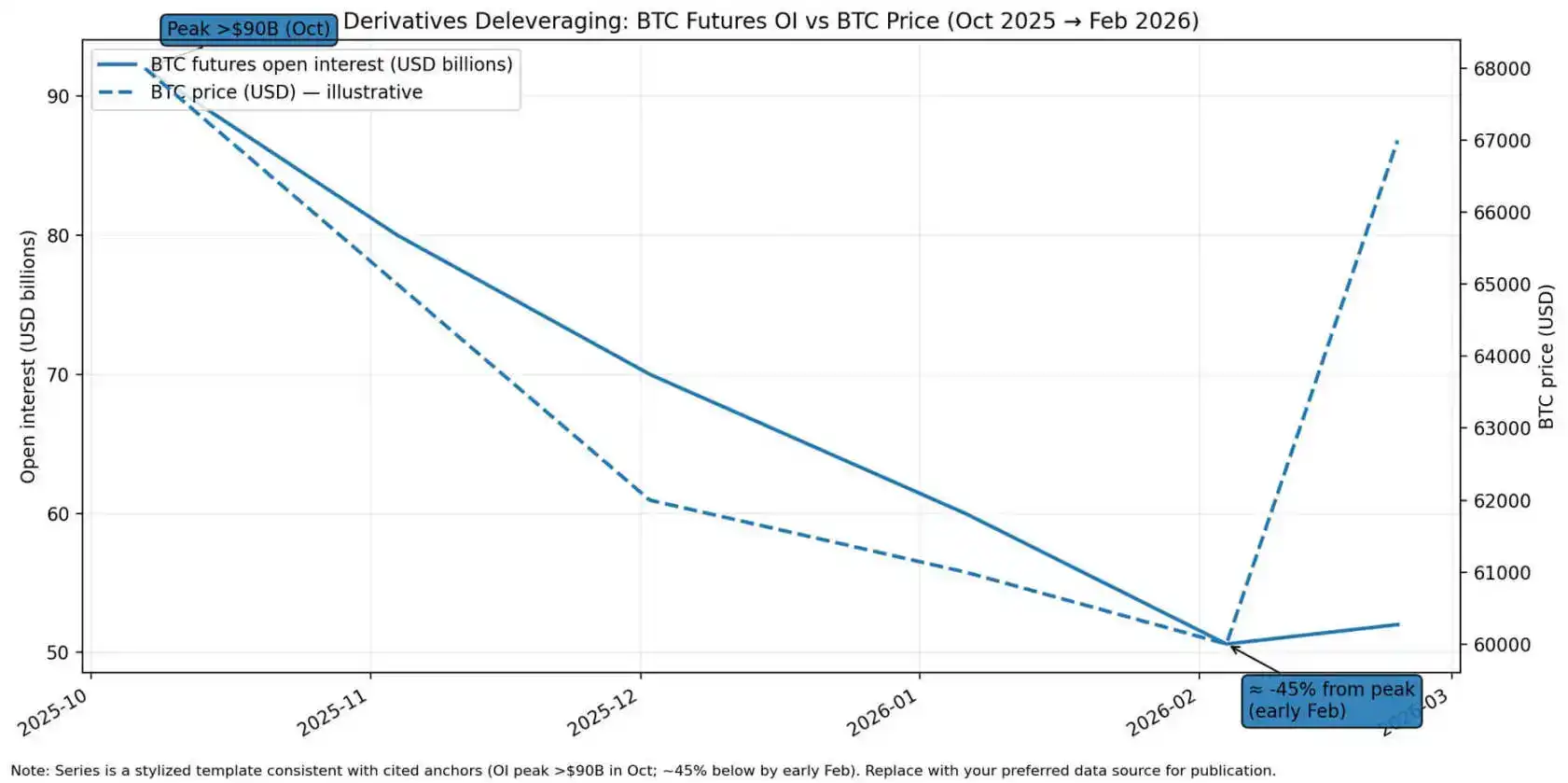
Investment firm VanEck noted in early February 2026 that Bitcoin futures open interest peaked at over $90 billion in October 2025 and has since shed more than 45% of that leverage. If credit stress truly emerges, there is room for further forced selling.

Rating agency Moody's expects private credit AUM to exceed $2 trillion in 2026 and approach $4 trillion by 2030. According to Reuters, Bank of America has deployed $25 billion into the space.

This growth concentrates credit risk in structures with less transparency, longer lock-ups, and weaker covenant protection.

If a credit event triggers forced selling of private credit portfolios, the ripple effects would hit public markets through margin calls and collateral pressure. Bitcoin, as the most liquid, always-traded risk asset, would disproportionately absorb the selling pressure.

Bitcoin futures open interest fell approximately 45% from its peak of over $90 billion in October 2025 to levels in early February 2026, while the Bitcoin price dropped from around $68,000 to near $60,000 before rebounding to around $67,000

Bitcoin Will Front-Run Policy Rescue Rallies

The opposite script begins with clear policy support.

Fed balance sheet expansion, emergency tools deployed, real yields falling. Bitcoin's reaction in this environment is equally predictable: funding rates and basis normalize, returning liquidity drives stablecoin supply higher, ETF flows stabilize or turn positive, open interest reaccumulates.

In clear rescue environments, Bitcoin often acts as a high-beta liquidity asset, recovering faster than traditional risk assets because it has no credit risk and no earnings disappointments. It is a liquidity claim on a fixed-supply monetary asset that benefits when real yields fall.

The banking turmoil of March 2023 is the template. As markets priced a policy pivot toward easing, Bitcoin rose 26% in a week and about 40% in ten days, front-running the Fed's eventual liquidity support.

In February 2026, Bitcoin surged from around $60k to over $70k in a single day, its largest one-day gain since March 2023, highlighting that macro risk sentiment remains the dominant driver in stress windows.

In March 2020, Bitcoin crashed with everything else, but the Fed also cut rates to zero within weeks, launched unlimited QE, and established emergency lending facilities.

Bitcoin rallied from its March 12 low and rose five-fold over the next year as real yields remained deeply negative and fiscal spending expanded massively.

The lesson: Bitcoin's reaction beta to the liquidity cycle is almost higher than any asset; timing matters more than narrative.

A flowchart shows three potential paths for Bitcoin under triple bubble stress: a 20% to 40% sell-off from credit breaking, a high-beta rally from policy rescue, or choppy price action from stagflation pulling between safe-haven pressure and monetary debasement narratives

When Neither Path is Clear

The messiest scenario: stubborn inflation, bond markets demanding higher term premiums, real yields staying high, which restricts policymakers' ability to rescue quickly without rekindling inflation fears.

In this environment, Bitcoin gets choppy. Safe-haven pressure and debasement hedging narratives pull against each other. Rallies fade when real yields are high or policy support is lacking.

The 10-year TIPS yield at 1.80% is far above the zero or negative real yields seen during Bitcoin's strongest rallies.

The Freddie Mac 30-year fixed mortgage rate averaged 6.01% on February 19.

The Buffett Indicator (Total Market Cap / GDP) is ~206%, which, according to Advisor Perspectives data, is the highest level in the indicator's history. This suggests little room for further equity multiple expansion unless earnings grow or discount rates fall.

If credit stress arrives but policy doesn't pivot quickly, Bitcoin gets stuck in a choppy格局 of neither liquidation nor rescue.

A Framework for Tracking the Shift

A simple tracking framework, updated weekly with four metrics:

  • Change in Fed Total Assets over 4-8 weeks;
  • 30-day change in Stablecoin Market Cap;
  • Change in High-Yield Spread over 2-4 weeks;
  • Change in 10-Year Real Yield over 2-4 weeks.

When metrics deteriorate sharply, Bitcoin tends to act like a high-beta asset in liquidity events;

When metrics improve, reflation expectations rise, Bitcoin tends to outperform.

Current readings show a neutral-to-negative liquidity environment.

  • Fed balance sheet expanding slightly but not flooding;
  • Stablecoin supply flat to slightly down;
  • Credit spreads still tight;
  • Real yields high and sticky;
  • Bitcoin spot ETFs seeing persistent outflows;
  • Derivatives open interest nearly halved from peak.

The market setup is like waiting for a catalyst: either credit stress triggering liquidation or policy support restarting the liquidity trade.

The Signal is in the Credit Chain

An actionable monitoring framework, focusing on credit and crypto plumbing:

  • High-Yield Spreads rising from lows → Credit market confidence fading;
  • Treasury Volatility & Term Premium rising → Bond market pricing policy constraint;
  • Fed Balance Sheet flat/falling + Spreads widening → Confirming no backstop.

Crypto-side signals:

  • Open Interest falling sharply → Forced selling;
  • Stablecoin Market Cap contracting → Liquidity exiting;
  • ETFs seeing persistent outflows → Institutional de-risking.

Rescue confirmation signals:

  • Fed Total Assets rising noticeably → Active liquidity provision;
  • 10-Year TIPS Yield falling → Real yields declining;
  • Stablecoin Supply growing + Derivative Funding Rates normalizing → Crypto liquidity returning.

The shift from liquidation to rescue is often fast. March 2020 is the example: Bitcoin crashed then rallied within weeks as policy support landed.

The greatest value of the triple bubble framework isn't predicting a crisis, but providing a sequence.

Credit breaking triggers liquidation, Bitcoin gets sold cheap;

Policy rescue brings liquidity explosion, Bitcoin front-runs traditional assets.

The current macro setup—overvalued, high real yields, tight credit spreads, flat stablecoin supply, persistent ETF outflows—suggests the market is pricing stress but hasn't seen the credit chain break that forces selling.

Bitcoin's next major move depends not on whether the bubble exists, but on whether credit breaks first, or the Fed rescues first.

Связанные с этим вопросы

QWhat is the 'triple bubble' framework mentioned in the article, and why is it significant for Bitcoin?

AThe 'triple bubble' framework, described by macro strategist Michael Pento, refers to three key areas of the economy at extreme valuations: stock market valuations near historical extremes, a real estate market pressured by ~6% mortgage rates, and private credit AUM surging toward $2 trillion. It is significant for Bitcoin because it provides a sequence of potential stress points. If credit markets break first, it could trigger a liquidity crisis and a sharp sell-off in Bitcoin. If policymakers provide support before a crisis spreads, Bitcoin could act as a high-beta liquidity trade and rally faster than traditional risk assets.

QHow did Bitcoin perform during the March 2020 liquidity crisis, and what was the eventual outcome?

ADuring the March 2020 global liquidity shock, Bitcoin's price plummeted nearly 40% on March 12th, as it was sold off alongside stocks, credit, and commodities while market participants scrambled for US dollar liquidity. However, the Federal Reserve responded within weeks by cutting rates to zero, launching unlimited quantitative easing, and establishing emergency lending facilities. Bitcoin subsequently recovered from its March 12th low and rose fivefold over the next year, fueled by deeply negative real yields and massive fiscal expansion.

QAccording to the article, what are the key indicators to monitor for tracking a potential shift in Bitcoin's macro environment?

AThe article proposes a simple weekly tracking framework based on four key indicators: the 4-8 week change in the Federal Reserve's total assets, the 30-day change in stablecoin market capitalization, the 2-4 week change in high-yield bond spreads, and the 2-4 week change in the 10-year real yield. A significant deterioration in these indicators often precedes Bitcoin behaving like a high-beta asset in a liquidity event, while an improvement and rising reflation expectations often lead to Bitcoin outperforming.

QWhat is the current macro backdrop for Bitcoin as described in the article, and what does it imply?

AThe current macro backdrop is characterized by neutral-to-negative liquidity conditions: the Fed's balance sheet is expanding slightly but not flooding the system with liquidity, stablecoin supply is flat or slightly down, credit spreads remain tight, real yields are high and stubborn, Bitcoin spot ETFs are seeing persistent outflows, and derivatives open interest has nearly halved from its peak. This implies the market is pricing in stress but has not yet seen a credit chain breakdown that would force a sell-off; it is waiting for a catalyst of either credit stress triggering liquidation or policy support restarting the liquidity trade.

QWhat are the potential signals of a credit-driven liquidation event versus a policy rescue scenario for Bitcoin?

ASignals of a credit-driven liquidation include: high-yield bond spreads widening from their lows (indicating fading credit market confidence), US Treasury volatility and term premium rising (bond market pricing in constrained policy), and the Fed's balance sheet staying flat/declining while spreads widen (confirming no backstop). Signals of a policy rescue scenario include: the Fed's total assets showing a clear weekly increase (active liquidity provision), the 10-year TIPS yield falling (declining real yields), and stablecoin supply growing coupled with normalized derivatives funding rates (return of crypto liquidity).

Похожее

Google and Amazon Simultaneously Invest Heavily in a Competitor: The Most Absurd Business Logic of the AI Era Is Becoming Reality

In a span of four days, Amazon announced an additional $25 billion investment, and Google pledged up to $40 billion—both direct competitors pouring over $65 billion into the same AI startup, Anthropic. Rather than a typical venture capital move, this signals the latest escalation in the cloud wars. The core of the deal is not equity but compute pre-orders: Anthropic must spend the majority of these funds on AWS and Google Cloud services and chips, effectively locking in massive future compute consumption. This reflects a shift in cloud market dynamics—enterprises now choose cloud providers based on which hosts the best AI models, not just price or stability. With OpenAI deeply tied to Microsoft, Anthropic’s Claude has become the only viable strategic asset for Google and Amazon to remain competitive. Anthropic’s annualized revenue has surged to $30 billion, and it is expanding into verticals like biotech, positioning itself as a cross-industry AI infrastructure layer. However, this funding comes with constraints: Anthropic’s independence is challenged as it balances two rival investors, its safety-first narrative faces pressure from regulatory scrutiny, and its path to IPO introduces new financial pressures. Globally, this accelerates a "tri-polar" closed-loop structure in AI infrastructure, with Microsoft-OpenAI, Google-Anthropic, and Amazon-Anthropic forming exclusive model-cloud alliances. In contrast, China’s landscape differs—investments like Alibaba and Tencent backing open-source model firm DeepSeek reflect a more decoupled approach, though closed-source models from major cloud providers still dominate. The $65 billion bet is ultimately about securing a seat at the table in an AI-defined future—where missing the model layer means losing the cloud war.

marsbit1 ч. назад

Google and Amazon Simultaneously Invest Heavily in a Competitor: The Most Absurd Business Logic of the AI Era Is Becoming Reality

marsbit1 ч. назад

Computing Power Constrained, Why Did DeepSeek-V4 Open Source?

DeepSeek-V4 has been released as a preview open-source model, featuring 1 million tokens of context length as a baseline capability—previously a premium feature locked behind enterprise paywalls by major overseas AI firms. The official announcement, however, openly acknowledges computational constraints, particularly limited service throughput for the high-end DeepSeek-V4-Pro version due to restricted high-end computing power. Rather than competing on pure scale, DeepSeek adopts a pragmatic approach that balances algorithmic innovation with hardware realities in China’s AI ecosystem. The V4-Pro model uses a highly sparse architecture with 1.6T total parameters but only activates 49B during inference. It performs strongly in agentic coding, knowledge-intensive tasks, and STEM reasoning, competing closely with top-tier closed models like Gemini Pro 3.1 and Claude Opus 4.6 in certain scenarios. A key strategic product is the Flash edition, with 284B total parameters but only 13B activated—making it cost-effective and accessible for mid- and low-tier hardware, including domestic AI chips from Huawei (Ascend), Cambricon, and Hygon. This design supports broader adoption across developers and SMEs while stimulating China's domestic semiconductor ecosystem. Despite facing talent outflow and intense competition in user traffic—with rivals like Doubao and Qianwen leading in monthly active users—DeepSeek has maintained technical momentum. The release also comes amid reports of a new funding round targeting a valuation exceeding $10 billion, potentially setting a new record in China’s LLM sector. Ultimately, DeepSeek-V4 represents a shift toward open yet realistic infrastructure development in the constrained compute landscape of Chinese AI, emphasizing engineering efficiency and domestic hardware compatibility over pure model scale.

marsbit2 ч. назад

Computing Power Constrained, Why Did DeepSeek-V4 Open Source?

marsbit2 ч. назад

Торговля

Спот
Фьючерсы

Популярные статьи

Тест по Bitcoin Биткоина

HTX Learn: Изучите Bitcoin halving и Заработаете Токены USDT

3.0k просмотров всегоОпубликовано 2024.04.16Обновлено 2024.04.16

Тест по Bitcoin  Биткоина

Что такое $BITCOIN

ЦИФРОВОЕ ЗОЛОТО ($BITCOIN): Комплексный анализ Введение в ЦИФРОВОЕ ЗОЛОТО ($BITCOIN) ЦИФРОВОЕ ЗОЛОТО ($BITCOIN) — это проект на основе блокчейна, работающий в сети Solana, который стремится объединить характеристики традиционных драгоценных металлов с инновациями децентрализованных технологий. Хотя он носит имя Биткойн, часто называемого “цифровым золотом” из-за его восприятия как средства хранения ценности, ЦИФРОВОЕ ЗОЛОТО является отдельным токеном, предназначенным для создания уникальной экосистемы в ландшафте Web3. Его цель — позиционировать себя как жизнеспособный альтернативный цифровой актив, хотя детали его применения и функциональности все еще развиваются. Что такое ЦИФРОВОЕ ЗОЛОТО ($BITCOIN)? ЦИФРОВОЕ ЗОЛОТО ($BITCOIN) — это токен криптовалюты, специально разработанный для использования в блокчейне Solana. В отличие от Биткойна, который выполняет широко признанную роль хранения ценности, этот токен, похоже, сосредоточен на более широких приложениях и характеристиках. Примечательные аспекты включают: Инфраструктура блокчейна: Токен построен на блокчейне Solana, известном своей способностью обрабатывать высокоскоростные и недорогие транзакции. Динамика предложения: ЦИФРОВОЕ ЗОЛОТО имеет максимальное предложение, ограниченное 100 квадриллионами токенов (100P $BITCOIN), хотя детали о его обращающемся предложении в настоящее время не раскрыты. Утилита: Хотя точные функциональные возможности не описаны, есть указания на то, что токен может быть использован для различных приложений, потенциально связанных с децентрализованными приложениями (dApps) или стратегиями токенизации активов. Кто создатель ЦИФРОВОГО ЗОЛОТА ($BITCOIN)? На данный момент личность создателей и команды разработчиков, стоящих за ЦИФРОВЫМ ЗОЛОТОМ ($BITCOIN), остается неизвестной. Эта ситуация типична для многих инновационных проектов в области блокчейна, особенно тех, которые связаны с децентрализованными финансами и феноменом мем-криптовалют. Хотя такая анонимность может способствовать культуре, ориентированной на сообщество, она усиливает опасения по поводу управления и ответственности. Кто инвесторы ЦИФРОВОГО ЗОЛОТА ($BITCOIN)? Доступная информация указывает на то, что у ЦИФРОВОГО ЗОЛОТА ($BITCOIN) нет известных институциональных спонсоров или значительных венчурных капиталовложений. Проект, похоже, функционирует по модели пирингового взаимодействия, сосредоточенной на поддержке и принятии сообществом, а не на традиционных путях финансирования. Его активность и ликвидность в основном сосредоточены на децентрализованных биржах (DEX), таких как PumpSwap, а не на устоявшихся централизованных торговых платформах, что еще больше подчеркивает его подход, ориентированный на grassroots. Как работает ЦИФРОВОЕ ЗОЛОТО ($BITCOIN) Операционные механизмы ЦИФРОВОГО ЗОЛОТА ($BITCOIN) можно подробно описать на основе его дизайна блокчейна и характеристик сети: Механизм консенсуса: Используя уникальный механизм доказательства истории (PoH) Solana в сочетании с моделью доказательства доли (PoS), проект обеспечивает эффективную валидацию транзакций, что способствует высокой производительности сети. Токеномика: Хотя конкретные дефляционные механизмы не были подробно описаны, большое максимальное предложение токенов подразумевает, что оно может быть предназначено для микротранзакций или нишевых случаев использования, которые еще предстоит определить. Интероперабельность: Существует потенциал для интеграции с более широкой экосистемой Solana, включая различные платформы децентрализованных финансов (DeFi). Однако детали относительно конкретных интеграций остаются неуточненными. Хронология ключевых событий Вот хронология, которая подчеркивает значимые вехи, касающиеся ЦИФРОВОГО ЗОЛОТА ($BITCOIN): 2023: Первоначальное развертывание токена происходит в блокчейне Solana, отмеченное его адресом контракта. 2024: ЦИФРОВОЕ ЗОЛОТО приобретает видимость, когда оно становится доступным для торговли на децентрализованных биржах, таких как PumpSwap, позволяя пользователям обменивать его на SOL. 2025: Проект наблюдает спорадическую торговую активность и потенциальный интерес к инициативам, возглавляемым сообществом, хотя на данный момент не зафиксировано никаких значительных партнерств или технических достижений. Критический анализ Сильные стороны Масштабируемость: Основная инфраструктура Solana поддерживает высокие объемы транзакций, что может повысить полезность $BITCOIN в различных сценариях транзакций. Доступность: Потенциально низкая цена торговли за токен может привлечь розничных инвесторов, способствуя более широкому участию благодаря возможностям дробного владения. Риски Отсутствие прозрачности: Отсутствие публично известных спонсоров, разработчиков или процесса аудита может вызвать скептицизм относительно устойчивости и надежности проекта. Волатильность рынка: Торговая активность сильно зависит от спекулятивного поведения, что может привести к значительной волатильности цен и неопределенности для инвесторов. Заключение ЦИФРОВОЕ ЗОЛОТО ($BITCOIN) является интригующим, но неоднозначным проектом в быстро развивающейся экосистеме Solana. Хотя он пытается использовать нарратив “цифрового золота”, его отход от установленной роли Биткойна как средства хранения ценности подчеркивает необходимость более четкого различения его предполагаемой утилиты и структуры управления. Будущее принятие и усвоение, вероятно, будут зависеть от решения текущей непрозрачности и более четкого определения его операционных и экономических стратегий. Примечание: Этот отчет охватывает синтезированную информацию, доступную на октябрь 2023 года, и с тех пор могут произойти события.

99 просмотров всегоОпубликовано 2025.05.13Обновлено 2025.05.13

Что такое $BITCOIN

Fractal Bitcoin: масштабирование Биткоина с помощью рекурсивной системы

Fractal Bitcoin — масштабное Layer-1-решнение, созданное на базе кода Биткоина, позволяющего достигать бесконечного масштабирования с помощью рекурсивного подхода.

2.2k просмотров всегоОпубликовано 2025.06.30Обновлено 2025.06.30

Fractal Bitcoin: масштабирование Биткоина с помощью рекурсивной системы

Обсуждения

Добро пожаловать в Сообщество HTX. Здесь вы сможете быть в курсе последних новостей о развитии платформы и получить доступ к профессиональной аналитической информации о рынке. Мнения пользователей о цене на BTC (BTC) представлены ниже.

活动图片