Blockchains quietly prepare for quantum threat as Bitcoin debates timeline

cointelegraphОпубликовано 2025-12-19Обновлено 2025-12-19

Введение

Blockchains are increasingly preparing for the potential threat of quantum computers, which could eventually break current cryptographic systems. While quantum machines capable of attacking networks like Bitcoin are still years away, several major blockchains—including Aptos and Solana—are proactively testing quantum-resistant upgrades. Ethereum’s Vitalik Buterin has emphasized the importance of early preparation, estimating a 20% chance of relevant quantum computing breakthroughs by 2030. Bitcoin, however, remains divided. Some developers and industry leaders dismiss near-term quantum risks as premature and fear such discussions may cause unnecessary panic or market instability. In contrast, investors and researchers argue that ignoring a low-probability, high-impact risk undermines long-term confidence. The debate reflects broader tensions around how Bitcoin should communicate and prepare for future threats without destabilizing its present security assumptions.

Quantum computers still cannot break Bitcoin, but several major blockchains are preparing for a future in which they might.

In the past week, Aptos proposed post-quantum signature support as Solana tested quantum-resistant transactions. Meanwhile, parts of the Bitcoin community renewed calls to accelerate work on quantum-safe upgrades.

These developments point to a growing anxiety across crypto. Investors argue that dismissal of quantum risk by influential voices is weighing on Bitcoin’s (BTC) price, which has dropped 24% over the past three months.

While altcoin blockchains are experimenting with post-quantum protections through opt-in upgrades and test networks, Bitcoin remains divided over how publicly and urgently it should address quantum risks.
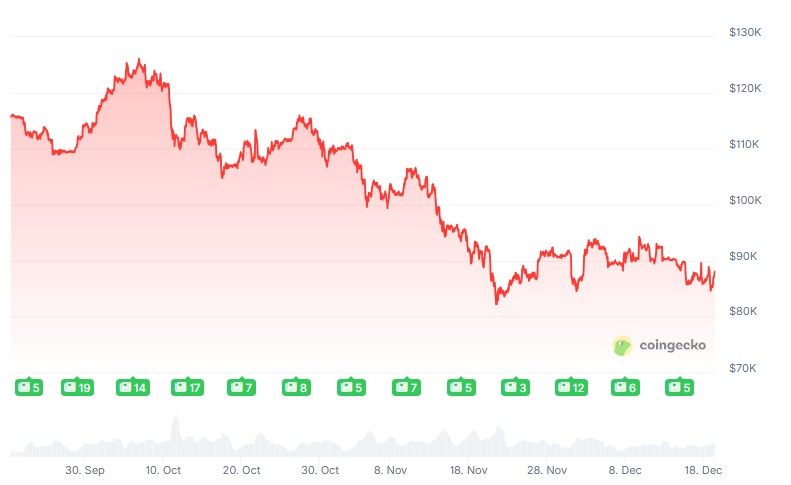
Some investors say dismissing quantum risk is affecting Bitcoin’s price. Source: CoinGecko

How blockchains are preparing without sounding the alarm

Ethereum has been clear about why quantum computing is now being treated as an engineering problem rather than a distant hypothetical.

Ethereum co-founder Vitalik Buterin has argued that even a low-probability outcome demands early preparation when the cost of failure is high and the time required to migrate global systems is measured in years.

Citing forecasting models, he has said there is roughly a 20% chance that quantum computers capable of breaking today’s public-key cryptography could emerge before 2030, with a median estimate closer to 2040. Buterin reportedly said no machines exist today that can break Bitcoin or Ethereum, but waiting for certainty is itself risky, as migrating a global network to post-quantum schemes can take years.
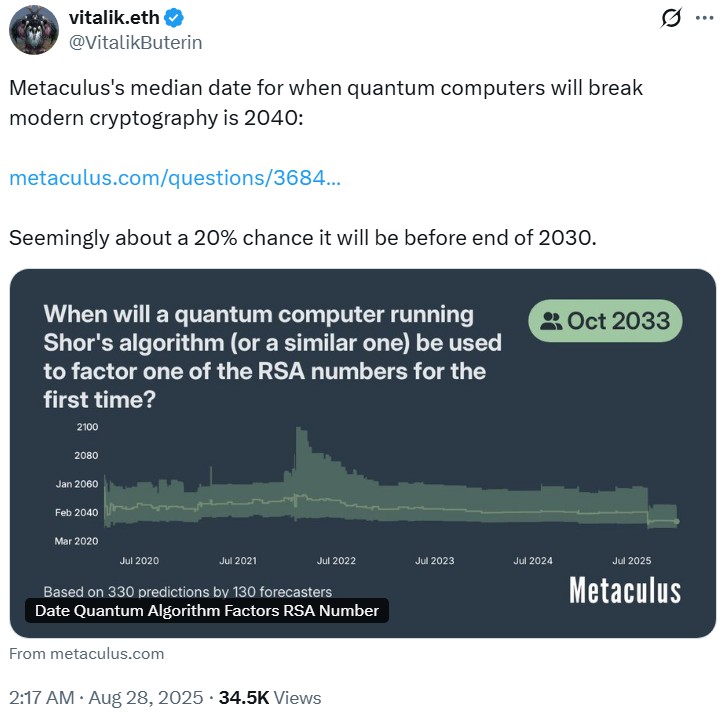
Prediction models forecast a 20% chance that powerful quantum computers are about five years away. Source: Vitalik Buterin

That framing has begun to echo across other major blockchains, particularly those that can experiment without reopening foundational debates.

Aptos has proposed adding post-quantum signature support at the account level through an opt-in upgrade that would leave existing accounts untouched. The proposal relies on a hash-based signature scheme and is positioned as future-proofing rather than a reaction to an imminent threat. Users can adopt the new scheme if they choose, without forcing a network-wide migration.

Related: What if quantum computers already broke Bitcoin?

Solana has taken a similar posture through testing rather than deployment. In partnership with post-quantum security firm Project Eleven, the network recently ran a dedicated testnet using quantum-resistant signatures to assess whether such schemes can be integrated without undermining performance or compatibility.
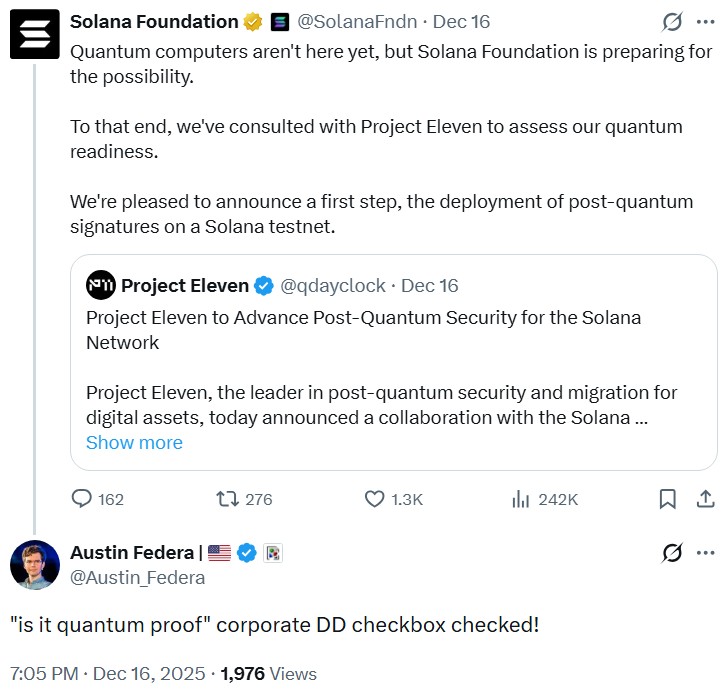
Quantum resistance is increasingly being treated as a due diligence consideration by investors. Source: Solana/Austin Federa

Bitcoin’s quantum debate is really about trust

Bitcoin relies on elliptic curve cryptography to verify ownership. Control over funds is proven through a private key, while only the corresponding public key is revealed onchain.

In theory, a sufficiently powerful quantum computer running Shor’s algorithm could work backwards from a public key to recover the private one, allowing an attacker to spend funds without triggering any obvious signs of theft. From the network’s perspective, those coins would simply move as if their owner had decided to transact.

Even proponents of post-quantum upgrades generally acknowledge that cryptographically relevant machines are still years away. But the dispute in Bitcoin’s community is about how Bitcoin should respond to a risk that is distant, uncertain and difficult to detect once it materializes.

On one side, developers and longtime Bitcoin cryptographers argue that framing quantum computing as an urgent concern does more harm than good.
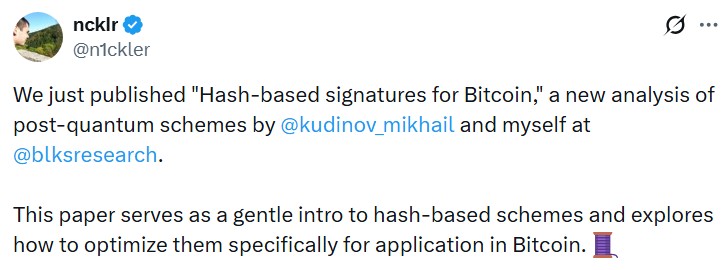
Despite the online debates, Bitcoin researchers are actively studying post-quantum schemes. Source: Jonas Nick

Blockstream CEO Adam Back has repeatedly dismissed near-term quantum fears, stressing that practical quantum attacks remain decades out. He claimed that amplifying quantum risks fuels panic and encourages markets to price in a threat that does not yet exist.

On the other side, investors and researchers argue that even a low-probability outcome matters for an asset whose value depends on long-term confidence. Castle Island Ventures partner Nic Carter has described the outright dismissal of quantum risk by influential developers as bearish.
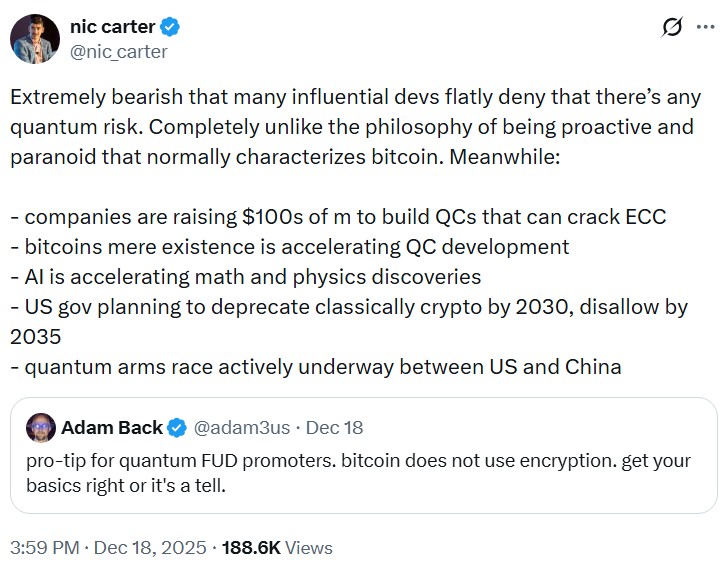
Nic Carter outlines why quantum risks make investors paranoid. Source: Nic Carter

Craig Warmke of the Bitcoin Policy Institute has similarly warned that perceived complacency is pushing some capital to diversify away from Bitcoin regardless of whether the underlying technical fears are precisely articulated.

That tension explains why proposals such as Bitcoin Improvement Proposal 360, which would introduce quantum-resistant signature options, provoke outsized reactions despite their early and tentative status.

Related: Bitcoin decouples from stocks in second half of 2025

Supporters see early work as a way to reduce uncertainty and signal preparedness. Critics see the same discussion as legitimizing a speculative threat and inviting confusion about Bitcoin’s resilience.

Why quantum uncertainty matters differently for Bitcoin

Quantum computers today cannot break Bitcoin or any major blockchain. What is already happening is that uncertainty around quantum risk is influencing how different networks choose to communicate and how investors interpret those choices.

Outside Bitcoin, post-quantum work has been framed as infrastructure. Opt-in upgrades and test networks allow blockchains to signal preparedness without forcing users or markets to reassess present-day security assumptions. That approach limits the reputational cost of early preparation while preserving flexibility if timelines change.

Bitcoin operates under different constraints. Because its value is closely tied to long-term assurances about security and durability, discussions about future-proofing its cryptography tend to attract immediate scrutiny. What might be treated as routine contingency planning elsewhere is more easily read as a comment on Bitcoin’s fundamentals.

Influential voices related to Bitcoin worry that emphasizing distant risks invites misunderstanding and panic. Investors worry that minimizing those risks signals a lack of contingency planning. Both sides are responding to how confidence is shaped in the absence of clear timelines.

The quantum debate suggests that for Bitcoin, managing how long-term risks are discussed may matter as much as managing the risks themselves.

Magazine: Big questions: Would Bitcoin survive a 10-year power outage?

Связанные с этим вопросы

QWhat are some major blockchains that are preparing for the quantum threat, and how are they approaching it?

AAptos has proposed adding post-quantum signature support through an opt-in upgrade at the account level, while Solana has tested quantum-resistant transactions on a dedicated testnet in partnership with Project Eleven. Ethereum's co-founder has also framed it as an engineering problem requiring early preparation.

QAccording to Vitalik Buterin, what is the estimated timeline for the emergence of quantum computers capable of breaking current cryptography?

ACiting forecasting models, Vitalik Buterin has said there is roughly a 20% chance that such quantum computers could emerge before 2030, with a median estimate closer to 2040.

QWhy is the quantum computing debate particularly contentious within the Bitcoin community?

AThe debate is about trust and how to respond to a distant and uncertain risk. Some developers argue that framing it as urgent causes unnecessary panic, while investors and researchers believe dismissing it undermines long-term confidence and affects Bitcoin's price, as its value is tied to security assurances.

QHow could a powerful quantum computer theoretically attack the Bitcoin network?

AA sufficiently powerful quantum computer running Shor's algorithm could work backwards from a public key to recover the corresponding private key. This would allow an attacker to spend funds without triggering obvious signs of theft, as the transaction would appear legitimate.

QHow does the approach to quantum risk differ between Bitcoin and other altcoin blockchains?

AAltcoins like Aptos and Solana treat post-quantum work as infrastructure upgrades, using opt-in features and testnets to signal preparedness without forcing a network-wide reassessment of current security. Bitcoin's discussions are more scrutinized because its value is closely tied to long-term security, making such talks easily misinterpreted as a comment on its fundamentals.

Похожее

Торговля

Спот
Фьючерсы

Популярные статьи

Тест по Bitcoin Биткоина

HTX Learn: Изучите Bitcoin halving и Заработаете Токены USDT

3.0k просмотров всегоОпубликовано 2024.04.16Обновлено 2024.04.16

Тест по Bitcoin  Биткоина

Что такое $BITCOIN

ЦИФРОВОЕ ЗОЛОТО ($BITCOIN): Комплексный анализ Введение в ЦИФРОВОЕ ЗОЛОТО ($BITCOIN) ЦИФРОВОЕ ЗОЛОТО ($BITCOIN) — это проект на основе блокчейна, работающий в сети Solana, который стремится объединить характеристики традиционных драгоценных металлов с инновациями децентрализованных технологий. Хотя он носит имя Биткойн, часто называемого “цифровым золотом” из-за его восприятия как средства хранения ценности, ЦИФРОВОЕ ЗОЛОТО является отдельным токеном, предназначенным для создания уникальной экосистемы в ландшафте Web3. Его цель — позиционировать себя как жизнеспособный альтернативный цифровой актив, хотя детали его применения и функциональности все еще развиваются. Что такое ЦИФРОВОЕ ЗОЛОТО ($BITCOIN)? ЦИФРОВОЕ ЗОЛОТО ($BITCOIN) — это токен криптовалюты, специально разработанный для использования в блокчейне Solana. В отличие от Биткойна, который выполняет широко признанную роль хранения ценности, этот токен, похоже, сосредоточен на более широких приложениях и характеристиках. Примечательные аспекты включают: Инфраструктура блокчейна: Токен построен на блокчейне Solana, известном своей способностью обрабатывать высокоскоростные и недорогие транзакции. Динамика предложения: ЦИФРОВОЕ ЗОЛОТО имеет максимальное предложение, ограниченное 100 квадриллионами токенов (100P $BITCOIN), хотя детали о его обращающемся предложении в настоящее время не раскрыты. Утилита: Хотя точные функциональные возможности не описаны, есть указания на то, что токен может быть использован для различных приложений, потенциально связанных с децентрализованными приложениями (dApps) или стратегиями токенизации активов. Кто создатель ЦИФРОВОГО ЗОЛОТА ($BITCOIN)? На данный момент личность создателей и команды разработчиков, стоящих за ЦИФРОВЫМ ЗОЛОТОМ ($BITCOIN), остается неизвестной. Эта ситуация типична для многих инновационных проектов в области блокчейна, особенно тех, которые связаны с децентрализованными финансами и феноменом мем-криптовалют. Хотя такая анонимность может способствовать культуре, ориентированной на сообщество, она усиливает опасения по поводу управления и ответственности. Кто инвесторы ЦИФРОВОГО ЗОЛОТА ($BITCOIN)? Доступная информация указывает на то, что у ЦИФРОВОГО ЗОЛОТА ($BITCOIN) нет известных институциональных спонсоров или значительных венчурных капиталовложений. Проект, похоже, функционирует по модели пирингового взаимодействия, сосредоточенной на поддержке и принятии сообществом, а не на традиционных путях финансирования. Его активность и ликвидность в основном сосредоточены на децентрализованных биржах (DEX), таких как PumpSwap, а не на устоявшихся централизованных торговых платформах, что еще больше подчеркивает его подход, ориентированный на grassroots. Как работает ЦИФРОВОЕ ЗОЛОТО ($BITCOIN) Операционные механизмы ЦИФРОВОГО ЗОЛОТА ($BITCOIN) можно подробно описать на основе его дизайна блокчейна и характеристик сети: Механизм консенсуса: Используя уникальный механизм доказательства истории (PoH) Solana в сочетании с моделью доказательства доли (PoS), проект обеспечивает эффективную валидацию транзакций, что способствует высокой производительности сети. Токеномика: Хотя конкретные дефляционные механизмы не были подробно описаны, большое максимальное предложение токенов подразумевает, что оно может быть предназначено для микротранзакций или нишевых случаев использования, которые еще предстоит определить. Интероперабельность: Существует потенциал для интеграции с более широкой экосистемой Solana, включая различные платформы децентрализованных финансов (DeFi). Однако детали относительно конкретных интеграций остаются неуточненными. Хронология ключевых событий Вот хронология, которая подчеркивает значимые вехи, касающиеся ЦИФРОВОГО ЗОЛОТА ($BITCOIN): 2023: Первоначальное развертывание токена происходит в блокчейне Solana, отмеченное его адресом контракта. 2024: ЦИФРОВОЕ ЗОЛОТО приобретает видимость, когда оно становится доступным для торговли на децентрализованных биржах, таких как PumpSwap, позволяя пользователям обменивать его на SOL. 2025: Проект наблюдает спорадическую торговую активность и потенциальный интерес к инициативам, возглавляемым сообществом, хотя на данный момент не зафиксировано никаких значительных партнерств или технических достижений. Критический анализ Сильные стороны Масштабируемость: Основная инфраструктура Solana поддерживает высокие объемы транзакций, что может повысить полезность $BITCOIN в различных сценариях транзакций. Доступность: Потенциально низкая цена торговли за токен может привлечь розничных инвесторов, способствуя более широкому участию благодаря возможностям дробного владения. Риски Отсутствие прозрачности: Отсутствие публично известных спонсоров, разработчиков или процесса аудита может вызвать скептицизм относительно устойчивости и надежности проекта. Волатильность рынка: Торговая активность сильно зависит от спекулятивного поведения, что может привести к значительной волатильности цен и неопределенности для инвесторов. Заключение ЦИФРОВОЕ ЗОЛОТО ($BITCOIN) является интригующим, но неоднозначным проектом в быстро развивающейся экосистеме Solana. Хотя он пытается использовать нарратив “цифрового золота”, его отход от установленной роли Биткойна как средства хранения ценности подчеркивает необходимость более четкого различения его предполагаемой утилиты и структуры управления. Будущее принятие и усвоение, вероятно, будут зависеть от решения текущей непрозрачности и более четкого определения его операционных и экономических стратегий. Примечание: Этот отчет охватывает синтезированную информацию, доступную на октябрь 2023 года, и с тех пор могут произойти события.

99 просмотров всегоОпубликовано 2025.05.13Обновлено 2025.05.13

Что такое $BITCOIN

Fractal Bitcoin: масштабирование Биткоина с помощью рекурсивной системы

Fractal Bitcoin — масштабное Layer-1-решнение, созданное на базе кода Биткоина, позволяющего достигать бесконечного масштабирования с помощью рекурсивного подхода.

2.2k просмотров всегоОпубликовано 2025.06.30Обновлено 2025.06.30

Fractal Bitcoin: масштабирование Биткоина с помощью рекурсивной системы

Обсуждения

Добро пожаловать в Сообщество HTX. Здесь вы сможете быть в курсе последних новостей о развитии платформы и получить доступ к профессиональной аналитической информации о рынке. Мнения пользователей о цене на BTC (BTC) представлены ниже.

活动图片