Bithumb Employee’s Mistakenly Sends $233-Worth of $BTC to Users; Could It Fuel $HYPER?

bitcoinistОпубликовано 2026-02-06Обновлено 2026-02-06

Введение

An employee at South Korea's Bithumb exchange mistakenly distributed 2,000 BTC (worth approximately $233 million) to users instead of a planned 2,000 KRW reward on February 6, 2026. This error caused Bitcoin's price on Bithumb to briefly trade about 10% below other exchanges due to liquidity fragmentation and user panic. The incident highlights operational risks in crypto trading, especially during periods of high volatility, with Bitcoin currently near $66K. Such events often shift market focus toward infrastructure solutions that offer faster execution, lower fees, and more reliable settlement. This context may benefit projects like Bitcoin Hyper ($HYPER), a Bitcoin Layer 2 solution that integrates the Solana Virtual Machine (SVM) for high-speed smart contracts and low-cost transactions. $HYPER's presale has reportedly raised $31.2 million, targeting investors seeking improved Bitcoin scalability and efficiency amid ongoing exchange-related uncertainties.

Trusted Editorial content, reviewed by leading industry experts and seasoned editors. Ad Disclosure

Quick Facts:

  • ➡️ Reports say a Bithumb employee mistakenly distributed 2,000 $BTC, triggering a brief ~10% $BTC price dislocation on that exchange versus others.
  • ➡️ Bitcoin remains volatile near ~$66K today, and operational mishaps can amplify spread widening, liquidity stress, and confidence-driven selling.
  • ➡️ Infrastructure narratives tend to strengthen in chaotic markets because users prioritize fast execution, low fees, and predictable settlement paths.
  • ➡️ Bitcoin Hyper positions itself as a Bitcoin Layer 2 with SVM execution to enable faster smart contracts and higher-throughput Bitcoin-adjacent apps.

A fresh shock just hit the crypto trading ‘trust layer.’

Reports circulating on Feb. 6, 2026, indicate employees at South Korea’s Bithumb mistakenly distributed 2,000 $BTC to hundreds of user accounts, apparently sending actual Bitcoin instead of a planned 2,000 KRW reward. Oops.

The immediate reaction wasn’t a global collapse, but a localized dislocation. Bitcoin’s price on Bithumb briefly traded ~10% below other venues as users scrambled and liquidity fragmented.

That highlights a reality most coverage misses: in stressed moments, execution and settlement mechanics become the trade. Not narratives.

If a venue glitches, even temporarily, traders start pricing in withdrawal risk, reversal risk, and ‘will my funds move when I need them to?’ anxiety. That’s when spreads widen, arbitrage gets messy, and confidence becomes as valuable as liquidity.

The backdrop is already fragile. Bitcoin is sitting around $66K today per CoinMarketCap, reflecting elevated volatility and a market still nursing drawdowns from late-2025 highs. Traders watching this setup will notice that in this kind of tape, operational mishaps don’t stay isolated, they become accelerants.

That’s exactly why the market keeps rotating back to infrastructure: faster execution, cheaper transactions, and fewer bottlenecks. That rotation is where Bitcoin Hyper ($HYPER) starts to look less like a speculative side quest and more like a ‘what if Bitcoin actually moved like a modern chain?’ bet.

Buy $HYPER here now.

Bitcoin Hyper Brings SVM-Speed Execution To Bitcoin Rails

The Bithumb episode is a stark reminder that users don’t just want number-go-up, they want reliable movement of value when things get chaotic. Bitcoin still settles like Bitcoin: secure, but slow and fee-variable during congestion.

The second-order effect? Simple. When UX breaks down at the venue layer, people look for alternatives that make using $BTC feel less like waiting and more like transacting.

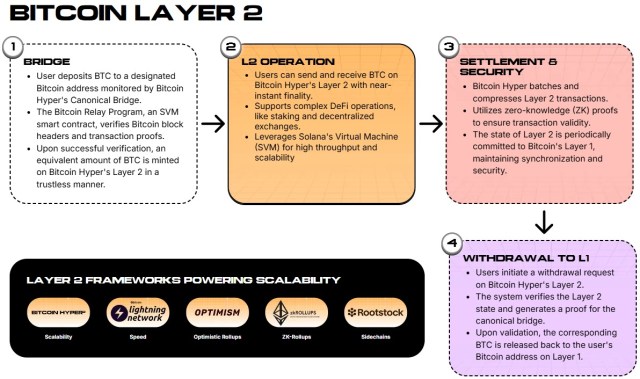
That’s the pitch behind Bitcoin Hyper. As Bitcoin’s ‘fastest L2 ever’, Bitcoin Hyper presents itself as a modular design where Bitcoin L1 handles settlement and a real-time SVM Layer 2 handles execution.

The goal? Extremely low-latency processing and low-cost transactions. The technical hook is the Solana Virtual Machine (SVM) integration, allowing it to support fast smart contracts while staying anchored to Bitcoin’s settlement guarantees.

The more interesting angle is developer gravity. By leaning into Rust tooling plus an SDK/API approach, Bitcoin Hyper essentially says: ‘Don’t wait for Bitcoin to become programmable, build high-throughput DeFi, payments, NFTs, and gaming on an execution layer designed for it.’

In a market where confidence is routinely stress-tested (sometimes by pure operational slapstick), infrastructure narratives can turn sticky fast.

Learn more about $HYPER here.

$HYPER Presale Gains Traction As Whales Accumulate

In a risk-off stretch, presales only work when they attach to a clear market need.

Bitcoin Hyper ($HYPER) attempts this by framing Bitcoin’s biggest constraints, slow transactions, higher fees under load, and limited programmability, as an addressable infrastructure gap.

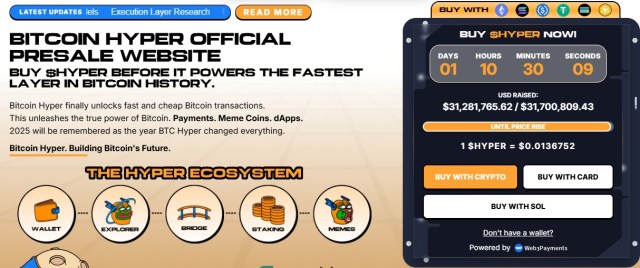
According to the official presale page, Bitcoin Hyper has raised $31.2M, with tokens currently priced at $0.013672.

Those aren’t small numbers for a market still digesting volatility in majors. (It suggests capital is still hunting asymmetric exposure, just more selectively.)

Practically, that signals some large buyers are willing to take presale exposure despite choppy macro and the ongoing “exchange risk” headlines. The risk, of course, is that whale buys aren’t always fundamentals, often just positioning.

On staking, the project advertises high APY (without publishing a specific rate). The key detail is structural: staking is planned to be immediate after TGE, with a 7-day vesting period for presale stakers, and rewards tied to community/governance participation.

That’s designed to encourage post-launch stickiness rather than pure flip behavior, though token emissions and real yield sustainability are always the caveat with any APY-forward pitch.

If the market stays volatile, traders will keep paying up for two things: speed and certainty. Bitcoin Hyper is aiming at both—on Bitcoin’s doorstep.

Visit the $HYPER presale now.

This article is not financial advice; crypto is volatile, presales are risky, and operational/security or regulatory events can change outcomes fast.

Editorial Process for bitcoinist is centered on delivering thoroughly researched, accurate, and unbiased content. We uphold strict sourcing standards, and each page undergoes diligent review by our team of top technology experts and seasoned editors. This process ensures the integrity, relevance, and value of our content for our readers.

patrubogdan

Follow

Full Profile

Related Posts

Binance’s SAFU Fund Added $233M in Bitcoin as LiquidChain’s Presale Gains Traction

Bitcoin Could See a 70% Crash to $38K: Could Be Time for $HYPER

Crypto Firms Propose Key Stablecoin Concessions To Advance CLARITY Act – Report

RWA Perpetuals Record $15B in Volume, Putting LiquidChain’s $LIQUID Presale in Focus

Solana ($SOL) Price Prediction 2026 Turns Bearish: Can It Recover, Or Should We Look at SUBBD Token?

$2.1B in Bitcoin Options Expire Today as Traders Watch Volatility And $BMIC’s Presale Narrative Builds

Связанные с этим вопросы

QWhat was the nature of the operational error at Bithumb, and what was its immediate market impact?

AA Bithumb employee mistakenly distributed 2,000 $BTC to users instead of a planned 2,000 KRW reward. This caused a localized price dislocation, with Bitcoin's price on Bithumb briefly trading approximately 10% below prices on other exchanges.

QAccording to the article, why do infrastructure narratives tend to strengthen during chaotic market events?

AInfrastructure narratives strengthen because users prioritize fast execution, low fees, and predictable settlement paths when confidence in major trading venues is shaken by operational mishaps.

QWhat is the core technical proposition of Bitcoin Hyper ($HYPER) as described in the article?

ABitcoin Hyper is a Bitcoin Layer 2 that uses the Solana Virtual Machine (SVM) for execution to enable faster smart contracts and higher-throughput applications, while using Bitcoin L1 for secure settlement.

QHow much funding had the $HYPER presale raised at the time of writing, and what was the token price?

AThe $HYPER presale had raised $31.2 million, with tokens priced at $0.013672.

QWhat key risk does the article highlight for investors considering the $HYPER presale or similar crypto investments?

AThe article highlights that crypto is volatile, presales are risky, and that operational, security, or regulatory events can rapidly change outcomes.

Похожее

The Recursive AI Anthropic Warned About: Tian Yuandong's New Company Has Just Taken the "First Step"

Anthropic recently highlighted the rapid progress toward "recursive self-improvement," where AI systems autonomously design and train their successors. In response, Recursive Superintelligence, a new company co-founded by former Meta researcher Tian Yuan Dong, has publicly demonstrated its first step toward automating AI research. The company released a system designed to autonomously execute the full AI research cycle: generating ideas, implementing code, running experiments, and learning from results. It validated this approach by achieving state-of-the-art results on three diverse benchmarks: 1. **NanoChat Autoresearch:** Optimizing a small language model's validation loss under a fixed 5-minute GPU budget, improving upon the community's best result. 2. **NanoGPT Speedrun:** Reducing the time to train a GPT model to a specific loss on 8 H100 GPUs from 79.7 seconds to 77.5 seconds, beating a highly optimized, human-driven community effort. 3. **SOL-ExecBench:** Improving the overall score on NVIDIA's suite of 235 GPU kernel optimization tasks by 18%, closing the gap to the hardware limit. The system discovered novel optimizations in this highly specialized domain without direct human expertise. Recursive's system operates as a general framework, capable of parallel exploration and cross-task knowledge transfer while incorporating safeguards against reward hacking. The company, backed by $650M in funding and a star-studded team including Richard Socher and Alexey Dosovitskiy, aims to create AI that recursively enhances its own research capabilities. This development represents an early but concrete move toward a new paradigm where AI accelerates its own advancement. It occurs alongside Anthropic's warnings about the need for industry coordination and potential pauses when recursive self-improvement thresholds are reached, highlighting the dual trajectory of rapid technical progress and growing calls for careful stewardship.

marsbit4 мин. назад

The Recursive AI Anthropic Warned About: Tian Yuandong's New Company Has Just Taken the "First Step"

marsbit4 мин. назад

The Gold Buy-on-the-Dip Guide: Watch Interest Rates, Not Just War

"Gold Buying Guide: Focus on Interest Rates, Not Just War" Four months ago, gold buyers likely didn't anticipate buying at a peak that even a war couldn't sustain. After hitting a record high of $5,596 on January 29, gold entered a bear market just 91 days later, its fastest decline since 2008. A key trigger was the Fed's hawkish shift, highlighting that monetary policy, not geopolitics, is the primary driver. The article argues that the traditional "buy gold in turmoil" script has changed. While the US-Iran conflict initially boosted prices, the sustained rally in oil prices heightened inflation fears, forcing central banks to maintain or consider tighter policy. Since gold yields no interest, higher rates increase its opportunity cost, eroding its appeal. This dynamic was evident when gold fell sharply on May 18 despite positive peace talks, as lower oil prices eased inflation and thus rate hike pressures. The recent sell-off is also part of a broader market deleveraging. Correlations between gold, Nasdaq, and Bitcoin spiked as leveraged investors sold liquid assets to cover losses, creating a synchronized downturn. Historically, gold bottoms align with policy shifts, not conflict resolutions. The 2008 and 2022 bear markets ended with shifts to extreme easing and peak inflation expectations, respectively. For potential buyers, the author suggests monitoring three signals: 1) Peak interest rate hike expectations, 2) Reopening of the Strait of Hormuz (to ease oil/inflation pressure), and 3) A return to net inflows for Gold ETFs, indicating the end of forced selling. While predicting the exact bottom is impossible, the author's personal strategy involves scaling into a position across price levels like $4000, $3700, and $3500, committing no more than 30% of the intended total allocation initially, and adding the remainder only if key signals emerge. The core conclusion: In turbulent times, watching interest rates is more crucial than watching wars.

marsbit10 мин. назад

The Gold Buy-on-the-Dip Guide: Watch Interest Rates, Not Just War

marsbit10 мин. назад

Recent On-Chain Review: No Clear Narrative Under U.S. Stock Market Pressure, Just Hype

This article analyzes the current state of the Solana meme coin and community token ecosystem, highlighting a market caught between two dominant forces: attention-based PvP and a gradual return to community-centric projects. The first part explores the "Attention PvP" dynamic, where success is driven by celebrity endorsements, viral events, and speed. Examples include $JOTCHUA, which surged after its meme creator's social media activity, and $WORLDCUP, which outperformed a similar Base chain project ($PITCH) largely due to influencer support. The recent "pump.fun GO" feature, allowing bounty tasks for token promotion, is critiqued for fostering sensationalist and often negative stunts—like people getting token tickers tattooed on their bodies for rewards—reminiscent of old internet shock content. In contrast, the article points to a resurgence of organic, community-driven tokens that survive market volatility through strong holder bases and shared ideology, not just hype. Influencer Ansem is cited, arguing that durable meme coins rely on communities willing to endure losses and promote their core message daily. Examples given are older tokens like $neet (anti-work ethos), $troll, $buttcoin, and $triplet, which have maintained relative price stability. A prime example of this community-build model is the new project $KINS, the token for the browser-based MMORPG Kintara. Its success stems not from advanced graphics but from consistently delivering updates, fostering player trust, and creating genuine engagement (e.g., in-game economies, events, property auctions). It has attracted a growing player base and even notable KOLs as participants, demonstrating that sustainable growth can come from building trust rather than orchestrating pumps. The article concludes by questioning whether the market is ultimately a game of mutual trust or mutual deception, expressing hope that such reflection might lead to a healthier ecosystem.

marsbit10 мин. назад

Recent On-Chain Review: No Clear Narrative Under U.S. Stock Market Pressure, Just Hype

marsbit10 мин. назад

On-Chain Scene on Opening Day: $20 Billion Already Staked, How Do On-Chain Contracts Know Who Wins?

On the opening day of the 2026 World Cup, over $2 billion had already been wagered on just the "tournament winner" contracts on platforms like Polymarket and Kalshi. This article explores how these blockchain-based prediction markets actually function once the games begin. It breaks down the massive volume and explains how single-game and tournament-long contracts are priced, with values moving between 1-99 cents to reflect implied probabilities. A key mechanism highlighted is "elimination zeroing," where a team's "champion yes" contract immediately settles to zero once they are mathematically eliminated. The core technical question answered is: how does a smart contract "know" who won a real-world match? The answer lies in oracles. The article details two primary paradigms: UMA's "optimistic oracle" (used by most of Polymarket), which allows a challenge period after a proposed result, and Chainlink's multi-source data aggregation (used by FIFA partners like ADI Predictstreet), which automates settlement with minimal dispute windows. Finally, the article injects a note of caution, citing research estimating that a significant portion of historical trading volume on these platforms might be "wash trading" to inflate numbers. It concludes by contrasting the legal status of these "event contracts" under CFTC rules in the U.S. versus traditional, state-regulated sports betting. As the tournament progresses, the real-time operation of this multi-billion dollar machine—its settlements, eliminations, and underlying mechanisms—becomes a story as compelling as the football itself.

marsbit25 мин. назад

On-Chain Scene on Opening Day: $20 Billion Already Staked, How Do On-Chain Contracts Know Who Wins?

marsbit25 мин. назад

Торговля

Спот
Фьючерсы

Популярные статьи

Как купить S

Добро пожаловать на HTX.com! Мы сделали приобретение Sonic (S) простым и удобным. Следуйте нашему пошаговому руководству и отправляйтесь в свое крипто-путешествие.Шаг 1: Создайте аккаунт на HTXИспользуйте свой адрес электронной почты или номер телефона, чтобы зарегистрироваться и бесплатно создать аккаунт на HTX. Пройдите удобную регистрацию и откройте для себя весь функционал.Создать аккаунтШаг 2: Перейдите в Купить криптовалюту и выберите свой способ оплатыКредитная/Дебетовая Карта: Используйте свою карту Visa или Mastercard для мгновенной покупки Sonic (S).Баланс: Используйте средства с баланса вашего аккаунта HTX для простой торговли.Третьи Лица: Мы добавили популярные способы оплаты, такие как Google Pay и Apple Pay, для повышения удобства.P2P: Торгуйте напрямую с другими пользователями на HTX.Внебиржевая Торговля (OTC): Мы предлагаем индивидуальные услуги и конкурентоспособные обменные курсы для трейдеров.Шаг 3: Хранение Sonic (S)После приобретения вами Sonic (S) храните их в своем аккаунте на HTX. В качестве альтернативы вы можете отправить их куда-либо с помощью перевода в блокчейне или использовать для торговли с другими криптовалютами.Шаг 4: Торговля Sonic (S)С легкостью торгуйте Sonic (S) на спотовом рынке HTX. Просто зайдите в свой аккаунт, выберите торговую пару, совершайте сделки и следите за ними в режиме реального времени. Мы предлагаем удобный интерфейс как для начинающих, так и для опытных трейдеров.

1.4k просмотров всегоОпубликовано 2025.01.15Обновлено 2026.06.02

Как купить S

Sonic: Обновления под руководством Андре Кронье – новая звезда Layer-1 на фоне спада рынка

Он решает проблемы масштабируемости, совместимости между блокчейнами и стимулов для разработчиков с помощью технологических инноваций.

2.3k просмотров всегоОпубликовано 2025.04.09Обновлено 2025.04.09

Sonic: Обновления под руководством Андре Кронье – новая звезда Layer-1 на фоне спада рынка

HTX Learn: Пройдите обучение по "Sonic" и разделите 1000 USDT

HTX Learn — ваш проводник в мир перспективных проектов, и мы запускаем специальное мероприятие "Учитесь и Зарабатывайте", посвящённое этим проектам. Наше новое направление .

1.8k просмотров всегоОпубликовано 2025.04.10Обновлено 2025.04.10

HTX Learn: Пройдите обучение по "Sonic" и разделите 1000 USDT

Обсуждения

Добро пожаловать в Сообщество HTX. Здесь вы сможете быть в курсе последних новостей о развитии платформы и получить доступ к профессиональной аналитической информации о рынке. Мнения пользователей о цене на S (S) представлены ниже.

活动图片