Bitcoin’s Security Model May Shift As Quantum Computing Moves Forward: Analyst

bitcoinistОпубликовано 2026-01-08Обновлено 2026-01-08

Введение

Coinbase research lead David Duong warns that quantum computing advancements could threaten Bitcoin's security and economic model. Two primary risks exist: quantum computers could break cryptographic signatures to steal funds from addresses with exposed public keys (about 33% of Bitcoin's supply), and they could dominate mining by solving proofs of work much faster. While current quantum machines are not yet capable, experts are preparing for "Q-day" by developing quantum-resistant cryptography and promoting best practices like avoiding address reuse. The transition would require broad consensus and remains a complex, long-term challenge rather than an immediate threat.

A Coinbase research lead has warned that advances in quantum computing could pose wider risks to Bitcoin than simple wallet theft.

According to David Duong, the company’s global head of investment research, future quantum machines might be able to break the cryptographic signatures that secure transactions and could also give quantum-powered miners a big speed edge — two separate threats that would touch both user funds and Bitcoin’s economic model.

Quantum Risk Moves Beyond Keys

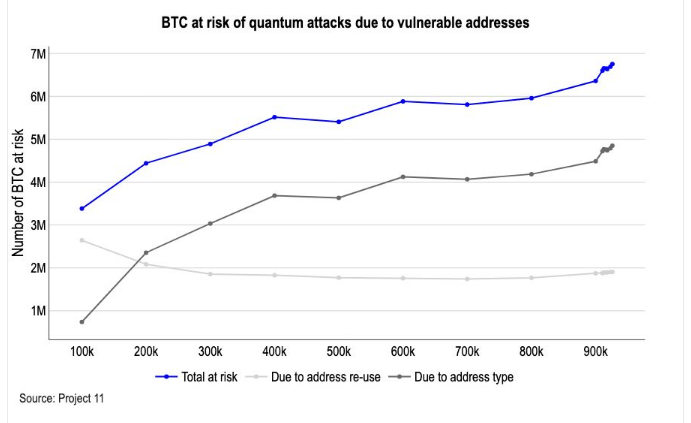
Duong said about one-third of the Bitcoin supply may be structurally exposed because their public keys are already visible on the blockchain. That figure is close to 33%, or about 6.51 million BTC, held in address types where public keys are revealed and could, in theory, be derived into private keys by a powerful enough quantum computer. Reports have highlighted that this exposure comes mostly from address reuse and older wallet formats.

Experts Say Two Main Technical Threats Exist

One threat is to signatures. Quantum algorithms such as Shor’s could, at scale, recover private keys from public keys, letting attackers sign transactions and drain funds.

The second is a possible mining problem: a sufficiently fast quantum miner might find proofs of work much faster than classic rigs, upsetting incentives and block production. Duong and others stress the signature risk is nearer-term in theory, because it only requires cracking signatures tied to revealed public keys.

What The Industry Is Doing

Based on reports, the conversation has already reached fund managers and standards bodies. Some institutional filings have started to flag quantum risk, and NIST and other bodies are pushing work on post-quantum cryptography for broader systems.

BTCUSD trading at $92,010 on the 24-hour chart: TradingView

Engineers in the crypto space are looking at migration paths that would swap in quantum-resistant schemes, though any such change to Bitcoin would be complex and would require wide agreement.

A Long-Term Problem, Not An Immediate One

Duong and other commentators note that today’s quantum machines are far too small and noisy to crack Bitcoin’s cryptography. The warnings are about a possible future point often called “Q-day,” when a machine large and stable enough could run Shor’s and related algorithms at scale. Timelines vary widely among experts; some expect decades, others say the gap is shrinking faster than many predicted.

According to industry sources, coins that remain in addresses that have already allowed vulnerability of public keys are the most exposed if a well-architectured quantum machine is deployed. That makes best practices — like avoiding address reuse and moving old balances to fresh, quantum-resistant addresses once those are available — sensible steps. But there is no simple, one-click fix for the whole ecosystem, experts say.

Featured image from Peter Hansen/Getty Images, chart from TradingView

Связанные с этим вопросы

QWhat are the two main quantum computing threats to Bitcoin mentioned by the Coinbase research lead?

AThe two main threats are: 1) Quantum algorithms like Shor's could recover private keys from public keys, allowing attackers to steal funds. 2) A quantum-powered miner could find proofs of work much faster, disrupting Bitcoin's incentives and block production.

QApproximately how much Bitcoin is structurally exposed to quantum risk due to visible public keys?

AApproximately 33% of the Bitcoin supply, or about 6.51 million BTC, is structurally exposed because their public keys are already visible on the blockchain.

QWhat is the industry doing to address the potential threat of quantum computing to cryptography?

AThe industry is looking at migration paths to quantum-resistant cryptographic schemes. Standards bodies like NIST are pushing work on post-quantum cryptography, and some institutional filings have started to flag quantum risk.

QWhy is the signature risk from quantum computing considered a nearer-term threat than the mining risk?

AThe signature risk is considered nearer-term in theory because it only requires cracking the cryptographic signatures tied to public keys that are already revealed on the blockchain, whereas the mining risk requires a machine fast enough to consistently outperform the entire network.

QWhat are some recommended best practices for users to protect their Bitcoin from future quantum threats?

ARecommended best practices include avoiding address reuse and moving old balances to fresh, quantum-resistant addresses once they become available and are considered secure.

Похожее

Polymarket's "2028 Presidential Election" Volume King Is... LeBron James???

An article from Odaily Planet Daily, authored by Azuma, discusses a peculiar phenomenon observed on the prediction market platform Polymarket regarding the "2028 US Presidential Election" event. Despite having a real-time probability of less than 1%, unlikely candidates such as NBA star LeBron James (with $48.41 million in trading volume), celebrity Kim Kardashian ($33.84 million), and even ineligible figures like Elon Musk ($23.14 million) and New York City Mayor Zohran Mamdani ($18.39 million) account for approximately 70% of the total trading volume. In contrast, high-probability candidates like Vice President JD Vance ($10.58 million), California Governor Gavin Newsom ($15.71 million), and Secretary of State Marco Rubio ($9.32 million) have significantly lower trading activity. The article explains that this counterintuitive trend is not driven by irrational speculation but by rational strategies. Polymarket offers a 4% annualized holding reward for certain markets, including the 2028 election, to maintain long-term pricing accuracy. This yield exceeds the current 5-year US Treasury rate (3.98%), attracting large investors ("whales") to hold "NO" shares on low-probability candidates for risk-free returns. Additionally, some users utilize a platform feature that allows converting a set of "NO" shares into corresponding "YES" shares for better liquidity or pricing efficiency, rather than directly buying "YES" shares for their preferred candidates. Thus, the seemingly absurd trading activity is strategically motivated.

marsbit14 мин. назад

Polymarket's "2028 Presidential Election" Volume King Is... LeBron James???

marsbit14 мин. назад

Dialogue with ViaBTC CEO Yang Haipo: Is the Essence of Blockchain a Libertarian Experiment?

"ViaBTC CEO Yang Haipo: Blockchain as a Hardcore Libertarian Experiment" In a deep-dive interview, ViaBTC CEO Yang Haipo reframes the essence of blockchain, arguing it is not merely a new technology or infrastructure but a hardcore libertarian experiment. This experiment, born from the 2008 financial crisis and decades of cypherpunk ideology, tests a fundamental question: to what extent can freedom and self-organization exist without centralized trust? The discussion highlights the experiment's verified outcomes. On one hand, it has proven its core value of censorship resistance, providing critical financial lifelines for entities like WikiLeaks and individuals in hyperinflationary or sanctioned countries via tools like stablecoins. However, Yang points out a key paradox: the most successful product, USDT, is itself a centralized compromise, showing users prioritize a less-controlled pipeline over pure decentralization. On the other hand, the experiment has exposed the severe costs of this freedom—a "dark forest" without safeguards. Events like the collapses of LUNA, Celsius, and FTX, resulting in massive wealth destruction and prison sentences for founders, underscore the system's fragility and the inherent risks of an unregulated environment. Yang observes that despite decentralized protocols, human nature inevitably recreates centralized power structures, speculative frenzies, and narrative-driven cycles (from ICOs to Meme coins), where emotion and belonging often trump technological substance. Looking forward, he believes blockchain's future is significant but niche. Its real value lies in serving specific, real-world needs for financial sovereignty and bypassing traditional controls, not as a universal infrastructure replacing all centralized systems. For the average participant, Yang's crucial advice is to cultivate independent judgment. True freedom is not holding a crypto wallet, but possessing a mind resilient to groupthink and narrative hype in a high-risk, often irrational market.

marsbit28 мин. назад

Dialogue with ViaBTC CEO Yang Haipo: Is the Essence of Blockchain a Libertarian Experiment?

marsbit28 мин. назад

Торговля

Спот
Фьючерсы

Популярные статьи

Тест по Bitcoin Биткоина

HTX Learn: Изучите Bitcoin halving и Заработаете Токены USDT

3.0k просмотров всегоОпубликовано 2024.04.16Обновлено 2024.04.16

Тест по Bitcoin  Биткоина

Что такое $BITCOIN

ЦИФРОВОЕ ЗОЛОТО ($BITCOIN): Комплексный анализ Введение в ЦИФРОВОЕ ЗОЛОТО ($BITCOIN) ЦИФРОВОЕ ЗОЛОТО ($BITCOIN) — это проект на основе блокчейна, работающий в сети Solana, который стремится объединить характеристики традиционных драгоценных металлов с инновациями децентрализованных технологий. Хотя он носит имя Биткойн, часто называемого “цифровым золотом” из-за его восприятия как средства хранения ценности, ЦИФРОВОЕ ЗОЛОТО является отдельным токеном, предназначенным для создания уникальной экосистемы в ландшафте Web3. Его цель — позиционировать себя как жизнеспособный альтернативный цифровой актив, хотя детали его применения и функциональности все еще развиваются. Что такое ЦИФРОВОЕ ЗОЛОТО ($BITCOIN)? ЦИФРОВОЕ ЗОЛОТО ($BITCOIN) — это токен криптовалюты, специально разработанный для использования в блокчейне Solana. В отличие от Биткойна, который выполняет широко признанную роль хранения ценности, этот токен, похоже, сосредоточен на более широких приложениях и характеристиках. Примечательные аспекты включают: Инфраструктура блокчейна: Токен построен на блокчейне Solana, известном своей способностью обрабатывать высокоскоростные и недорогие транзакции. Динамика предложения: ЦИФРОВОЕ ЗОЛОТО имеет максимальное предложение, ограниченное 100 квадриллионами токенов (100P $BITCOIN), хотя детали о его обращающемся предложении в настоящее время не раскрыты. Утилита: Хотя точные функциональные возможности не описаны, есть указания на то, что токен может быть использован для различных приложений, потенциально связанных с децентрализованными приложениями (dApps) или стратегиями токенизации активов. Кто создатель ЦИФРОВОГО ЗОЛОТА ($BITCOIN)? На данный момент личность создателей и команды разработчиков, стоящих за ЦИФРОВЫМ ЗОЛОТОМ ($BITCOIN), остается неизвестной. Эта ситуация типична для многих инновационных проектов в области блокчейна, особенно тех, которые связаны с децентрализованными финансами и феноменом мем-криптовалют. Хотя такая анонимность может способствовать культуре, ориентированной на сообщество, она усиливает опасения по поводу управления и ответственности. Кто инвесторы ЦИФРОВОГО ЗОЛОТА ($BITCOIN)? Доступная информация указывает на то, что у ЦИФРОВОГО ЗОЛОТА ($BITCOIN) нет известных институциональных спонсоров или значительных венчурных капиталовложений. Проект, похоже, функционирует по модели пирингового взаимодействия, сосредоточенной на поддержке и принятии сообществом, а не на традиционных путях финансирования. Его активность и ликвидность в основном сосредоточены на децентрализованных биржах (DEX), таких как PumpSwap, а не на устоявшихся централизованных торговых платформах, что еще больше подчеркивает его подход, ориентированный на grassroots. Как работает ЦИФРОВОЕ ЗОЛОТО ($BITCOIN) Операционные механизмы ЦИФРОВОГО ЗОЛОТА ($BITCOIN) можно подробно описать на основе его дизайна блокчейна и характеристик сети: Механизм консенсуса: Используя уникальный механизм доказательства истории (PoH) Solana в сочетании с моделью доказательства доли (PoS), проект обеспечивает эффективную валидацию транзакций, что способствует высокой производительности сети. Токеномика: Хотя конкретные дефляционные механизмы не были подробно описаны, большое максимальное предложение токенов подразумевает, что оно может быть предназначено для микротранзакций или нишевых случаев использования, которые еще предстоит определить. Интероперабельность: Существует потенциал для интеграции с более широкой экосистемой Solana, включая различные платформы децентрализованных финансов (DeFi). Однако детали относительно конкретных интеграций остаются неуточненными. Хронология ключевых событий Вот хронология, которая подчеркивает значимые вехи, касающиеся ЦИФРОВОГО ЗОЛОТА ($BITCOIN): 2023: Первоначальное развертывание токена происходит в блокчейне Solana, отмеченное его адресом контракта. 2024: ЦИФРОВОЕ ЗОЛОТО приобретает видимость, когда оно становится доступным для торговли на децентрализованных биржах, таких как PumpSwap, позволяя пользователям обменивать его на SOL. 2025: Проект наблюдает спорадическую торговую активность и потенциальный интерес к инициативам, возглавляемым сообществом, хотя на данный момент не зафиксировано никаких значительных партнерств или технических достижений. Критический анализ Сильные стороны Масштабируемость: Основная инфраструктура Solana поддерживает высокие объемы транзакций, что может повысить полезность $BITCOIN в различных сценариях транзакций. Доступность: Потенциально низкая цена торговли за токен может привлечь розничных инвесторов, способствуя более широкому участию благодаря возможностям дробного владения. Риски Отсутствие прозрачности: Отсутствие публично известных спонсоров, разработчиков или процесса аудита может вызвать скептицизм относительно устойчивости и надежности проекта. Волатильность рынка: Торговая активность сильно зависит от спекулятивного поведения, что может привести к значительной волатильности цен и неопределенности для инвесторов. Заключение ЦИФРОВОЕ ЗОЛОТО ($BITCOIN) является интригующим, но неоднозначным проектом в быстро развивающейся экосистеме Solana. Хотя он пытается использовать нарратив “цифрового золота”, его отход от установленной роли Биткойна как средства хранения ценности подчеркивает необходимость более четкого различения его предполагаемой утилиты и структуры управления. Будущее принятие и усвоение, вероятно, будут зависеть от решения текущей непрозрачности и более четкого определения его операционных и экономических стратегий. Примечание: Этот отчет охватывает синтезированную информацию, доступную на октябрь 2023 года, и с тех пор могут произойти события.

99 просмотров всегоОпубликовано 2025.05.13Обновлено 2025.05.13

Что такое $BITCOIN

Fractal Bitcoin: масштабирование Биткоина с помощью рекурсивной системы

Fractal Bitcoin — масштабное Layer-1-решнение, созданное на базе кода Биткоина, позволяющего достигать бесконечного масштабирования с помощью рекурсивного подхода.

2.2k просмотров всегоОпубликовано 2025.06.30Обновлено 2025.06.30

Fractal Bitcoin: масштабирование Биткоина с помощью рекурсивной системы

Обсуждения

Добро пожаловать в Сообщество HTX. Здесь вы сможете быть в курсе последних новостей о развитии платформы и получить доступ к профессиональной аналитической информации о рынке. Мнения пользователей о цене на BTC (BTC) представлены ниже.

活动图片