Bitcoin's Bull-Bear Range Battle Continues, HYPE Faces Critical Test of Wave V Support | Invited Analysis

Odaily星球日报Опубликовано 2026-04-20Обновлено 2026-04-20

Введение

The market is experiencing directional uncertainty with both opportunities and risks. HYPE's daily V-wave structure is at a critical juncture, with the $40.17 support level being pivotal for its future trajectory. A break below this level, followed by an inability to surpass the recent high of $45.76, could signal the end of the current upward structure. The short-term strategy for HYPE is to "follow the trend and buy on dips," using a 30% position size and a 30/60-minute trading cycle, entering long upon confirmed support holds with model signals. Bitcoin's market structure is reinterpreted, with the rally from the $60,000 low now considered a larger D-wave rebound within a medium-term correction, facing a key test between $73,500 and $79,000. A break above the upper bound may lead to limited upside, while a drop below could see a decline toward $69,500. Core resistance lies at $79,000–$80,600 and $83,500–$84,500, with support at $73,500, $69,500, and $65,000–$66,000. The medium-term strategy maintains a 60% short position from $89,000, to be exited if price stabilizes above the multi-empty band. Short-term tactics involve 30% positions for "spread" opportunities, with two scenarios: selling on rallies near $76,500–$79,000 (Scheme A) or shorting on a breakdown below $73,500 (Scheme B), both with strict stop-losses. A复盘 of HYPE's recent short trade showed a 6.80% gain from a long entry at $41.59 (based on model buy signals) and exit at $44.42 (triggered by top signals). Key...

This week, the market is seeking direction amid fluctuations, with opportunities and risks coexisting. HYPE's daily Wave V structure faces a critical validation point, where the success or failure of the $40.17 support will determine the subsequent trend; BTC, meanwhile, hovers between the continuation of the D-wave rebound and resistance zone pressure, with the bull-bear battle in the $73,500~$79,000 range remaining the core focus.

Following the trend and adhering strictly to discipline are key to steady progress in complex market conditions.

Summary of Core Trading Views for This Week:

• Analysis of HYPE's current price structure. (Details in Part 1)

• HYPE's market forecast and short-term trading strategy for this week. (Details in Part 2)

• Analysis of BTC's multi-timeframe price structure. (Details in Part 3)

• BTC's market forecast and medium-to-short-term trading strategies for this week. (Details in Part 4)

Market Validation of Last Week's Trading Strategies and Core Views:

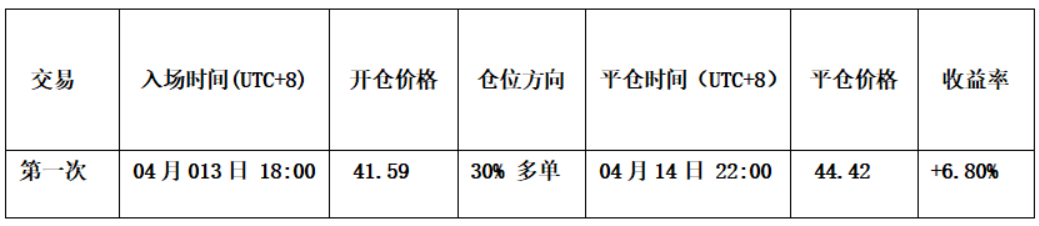
• HYPE Short-term Trading Results: HYPE completed one short-term long position trade (1x leverage) last week, achieving a cumulative return of approximately 6.80%. (Details in Table 1)

• Market Validation of HYPE Price Forecast: In our previous article, we indicated that the rebound starting from the April 2nd low of $34.44 for HYPE could potentially be a daily Wave V uptrend in terms of wave structure. The current market movement validates our previous view. Last week, the market rebound reached a high of $45.75, successfully breaking through the March 18th Wave III high of $43.78 and setting a new high for the current upward trend.

• Validation of BTC Medium-term Trading Results: Bitcoin followed the established medium-term strategy last week, continuing to hold the short position established at $89,000 (1x leverage). As of last week's close (approx. $73,800), the profit is approximately 17.08%, with a maximum profit of about 32.58% during the period.

• Market Validation of BTC Price Forecast: In last week's article, we stated that the market would maintain a wide-range volatile consolidation pattern. The current market movement validates our previous forecast.

I. HYPE: Price Structure Analysis

HYPE_4-hour K-line Chart

Figure 1

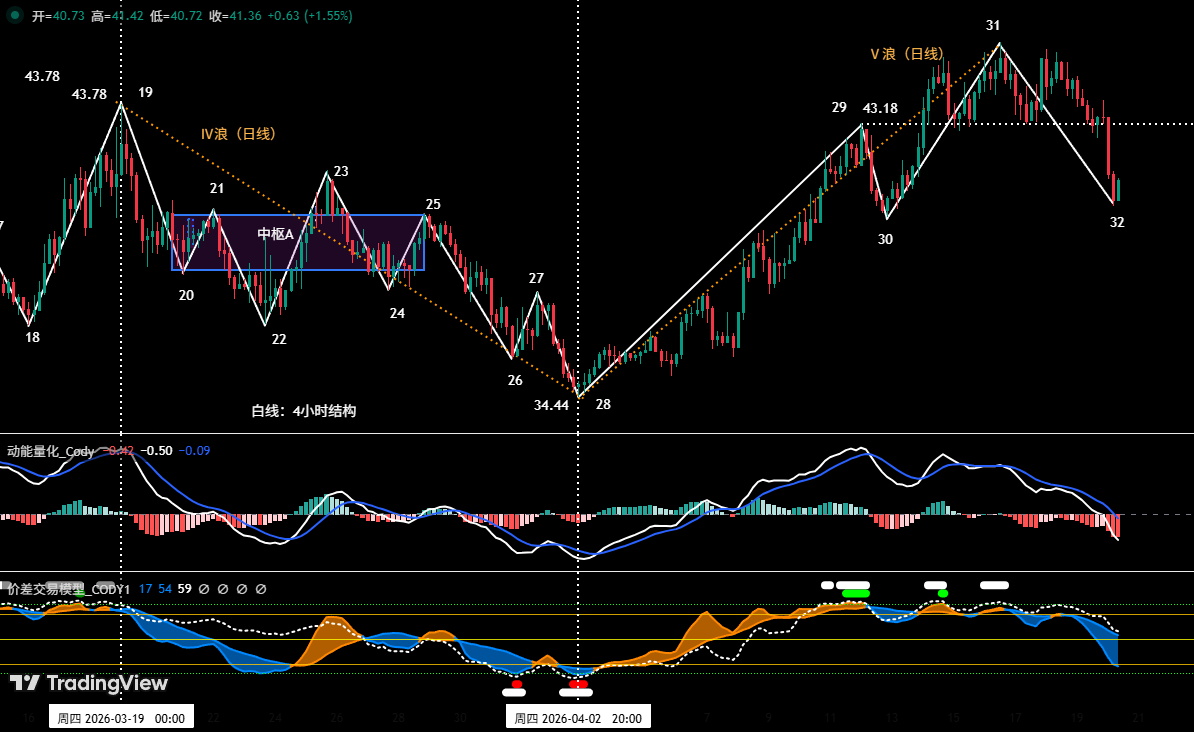
1. As shown in (Figure 1), HYPE reached a new high of $45.76 on April 16th, setting a new rebound high since the January 21st low of $20.46, and has broken through the previous high of $43.78 from March 18th (the Wave III high). Therefore, the upward movement starting from the April 2nd low of $34.44 can tentatively be viewed as a daily Wave V uptrend structure, currently in progress.

2. As shown in (Figure 1), this daily Wave V can be further subdivided in the 4-hour cycle into an upward structure consisting of 4 segments: 28-29, 29-30, 30-31, and 31-32.

3. The market is currently running the 31-32 correction segment.

• In HYPE's 4-hour structure, our self-built momentum量化 model监测到, two momentum signal lines have simultaneously moved below the zero axis, indicating that this correction segment may be weak, and the correction time might be extended.

• Currently, the potential correction endpoint (i.e., endpoint 32) is approaching the previous support level of $40.17 (i.e., endpoint 30).

II. HYPE Market Forecast and Short-term Trading Strategy for This Week

1. HYPE Market Forecast for This Week:

As shown in (Figure 1), focus on whether endpoint 32 breaks below endpoint 30 (i.e., $40.17):

• If it holds above, expect boxed consolidation between $40.17-$45.76;

• If it breaks below this support level, and the subsequent rebound high fails to exceed $45.76 (i.e., endpoint 31), it would form the classic technical pattern of "correction breaking previous low, but subsequent rebound not making a new high." This would mean there is a high probability that the daily Wave V uptrend structure starting from the April 2nd low has already completed and ended at $45.76.

2. HYPE Short-term Trading Strategy for This Week:

• Based on the forecast of the overall upward trend, adhere to the strategy of "follow the trend, buy on dips".

• According to signals from our self-built量化模型, use the 30-minute/60-minute cycle as the operation period, utilizing 30% of position size to capture long entry opportunities.

• Entry Strategy: HYPE faces correction demand early this week. If the price pulls back near the key support of $40.17 and shows signals confirming it is holding above support, combined with bottom buy signals triggered by the two major models, consider entering long positions, strictly adhering to stop-loss discipline.

III. Bitcoin Multi-Timeframe Price Structure Analysis

1. BTC Daily Level Wave Division: (Based on行情 after the October 6, 2025 high)

Bitcoin _ Daily K-line Chart:

Figure 2

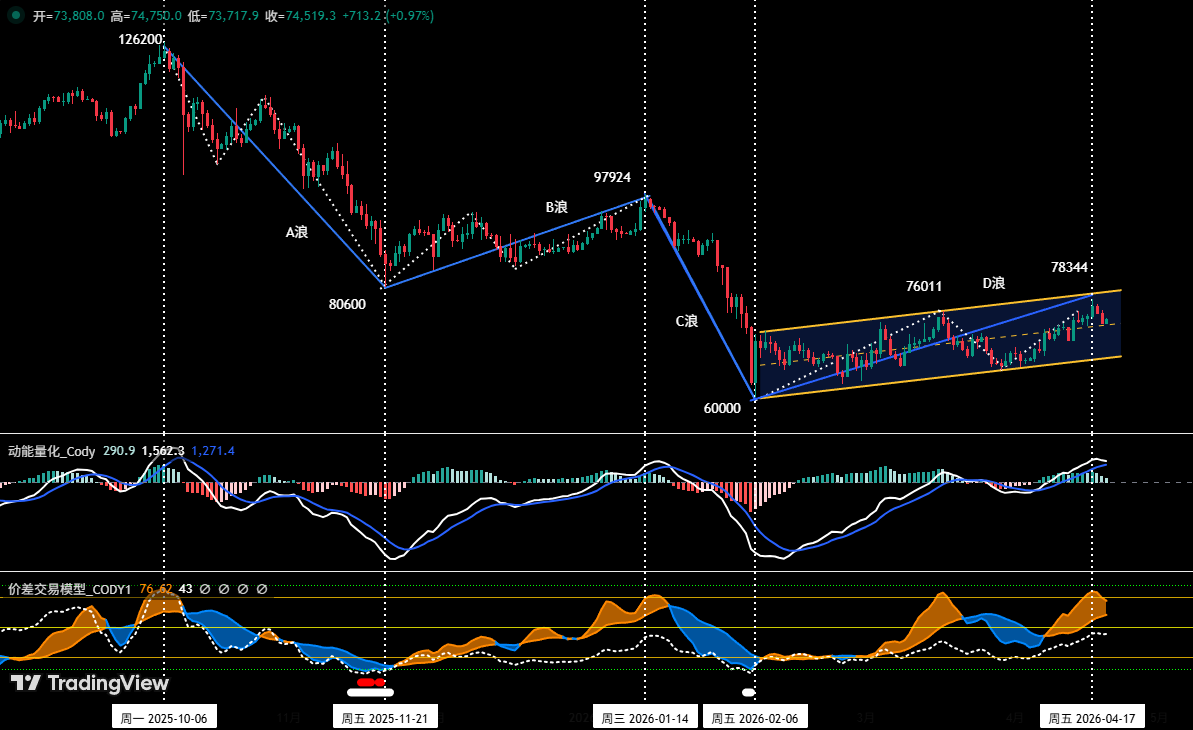
As shown in (Figure 2), since Bitcoin's rebound starting from the February 6th low of $60,000 not only reached a new rebound high of $78,333 on April 17th but has run for about 73 trading days as of April 19th, its duration and magnitude have significantly exceeded the previously forecasted "C-2 wave rebound within the C-wave correction" (e.g., its持续反弹时间已远超 the 54-day B-wave rebound). Therefore, based on Elliott Wave Theory analysis principles, the original framework may need adjustment. We are more inclined to redefine this upward move starting from $60,000 as a larger-level "D-wave rebound," which better aligns with the客观事实 of the current market exchanging time for space and the extended rebound cycle.

The specific medium-term correction wave division can be optimized as follows:

• A-wave correction (impulsive decline): Started from the October 6, 2025 high of $126,200, ended at the November 21, 2025 low of $80,600, lasting about 46 days, with a maximum decline of ~36%. This wave established the medium-term correction pattern.

• B-wave rebound (complex correction): Started from the November 21, 2025 low of $80,600, ended at the January 14, 2026 high of $97,924, lasting about 54 days, with a maximum gain of ~21.5%. This was a correction against the A-wave decline.

• C-wave correction (main decline wave): Started from the January 14, 2026 high of $97,924, rapidly declined to the February 6, 2026 low of $60,000, lasting about 22 days, with a maximum decline of ~38.7%. This wave completed the main spatial part of the correction.

• D-wave rebound (currently ongoing/possibly in final stages): Started from the February 6, 2026 low of $60,000. As of April 19th, it has run for about 73 days, with a maximum gain of ~30.6% (from $60,000 to $78,333). The characteristics of this rebound are prolonged duration, complex structure, and it currently faces the test of a critical time window and price resistance zone (e.g., $79,000-$80,600). If the D-wave holds, after the coin price rebound ends, it may be followed by a corresponding "E-wave" correction.

2. BTC: In-Depth Price Structure Analysis

Bitcoin _4-hour K-line Chart

Figure 3

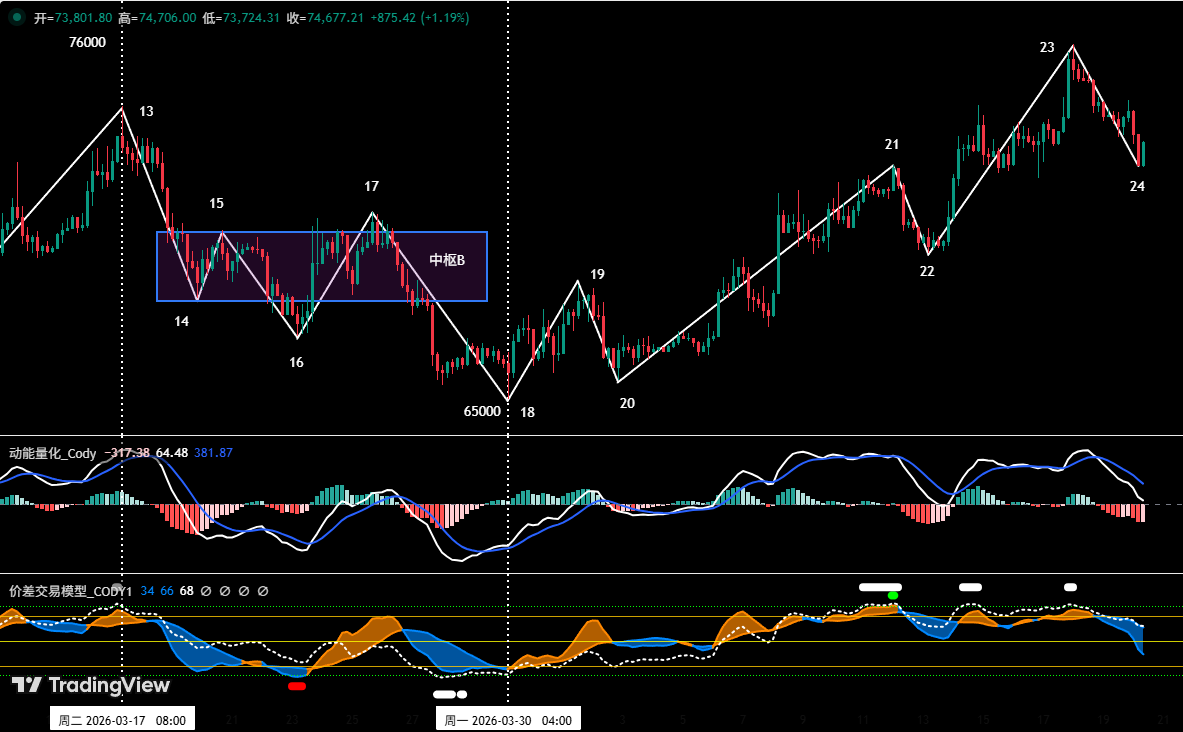
• Based on行情演变 after the March 30th low of $65,000.

• As shown in (Figure 3), BTC started a震荡上行 trend from the March 30th low. From endpoint 18 to endpoint 24, it consists of a 6-segment structure: 18-19, 19-20, 20-21, 21-22, 22-23, 23-24.

• The chart shows: From endpoint 18 to endpoint 23, the market has run a relatively clear 5-wave rebound structure, and is currently running the 23-24 segment. From our self-built spread trading model, recent top warning signals have been continuously issued (green and white dots in the chart), indicating that technical indicators are in severe overbought territory, and the market has short-term correction需求.

IV. Bitcoin Market Forecast and Trading Strategy for This Week

1. BTC Market Forecast for This Week:

• Core View for the Week:

Currently maintaining consolidation within the $73,500~$79,000 range, focus on the bull-bear battle near the upper and lower bounds of this range. If the rebound breaks above the upper bound, the market will experience a震荡反弹, but with limited upside; if it effectively breaks below the lower bound, the coin price may further test the key support near $69,500.

2. Core Resistance Levels:

• First Resistance Zone: $79,000~$80,600 area (near the November 2025 low)

• Second Resistance Zone: $83,500~$84,500 area (previous multi-empty筹码密集成交区)

3. Core Support Levels:

• First Support Level: Near $73,500 (previous important support level)

• Second Support Level: Near $69,500 (previous important support level)

• Third Support Zone: $65,000~$66,000 area (near the lower轨 of the consolidation range)

4. Trading Strategy for This Week (Excluding突发消息影响):(04.20~04.26)

1. Medium-term Strategy:

Bitcoin _ Daily K-line Chart: (Position Monitoring Model)

Figure 4

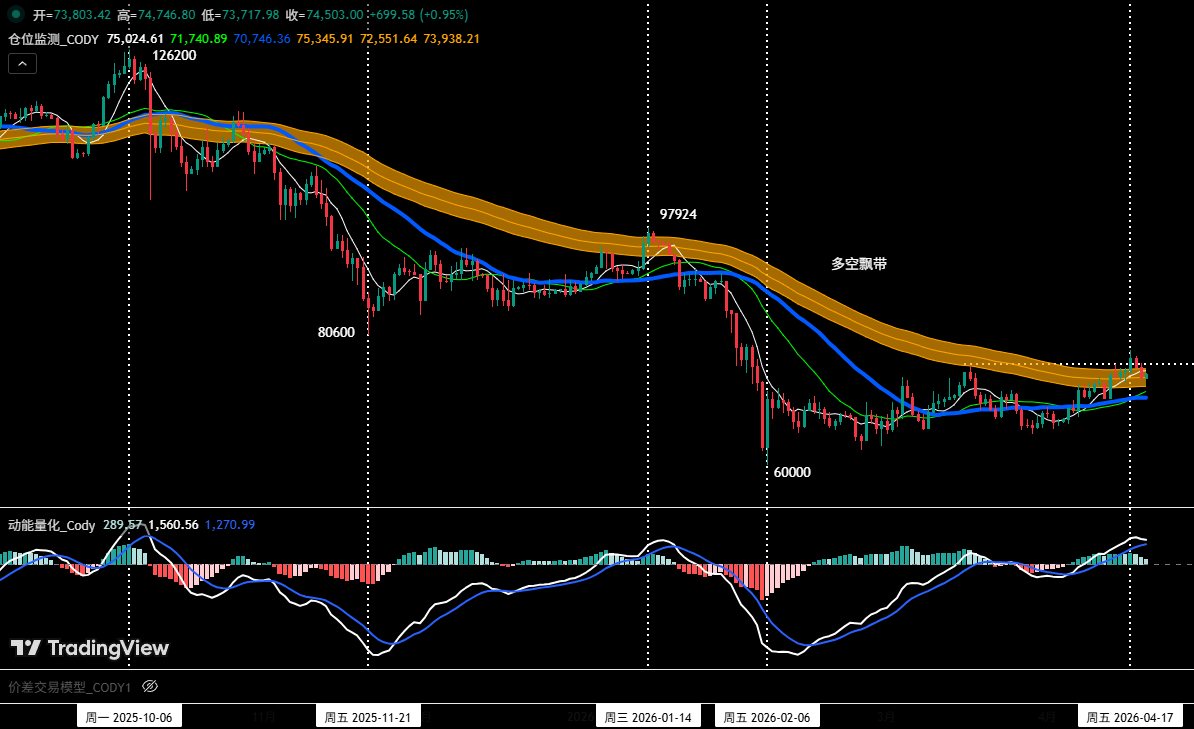
Position Monitoring Model: As shown in (Figure 4), currently, the coin price is震荡 near the bull-bear ribbon. According to our strategy rules, we are暂时 holding the 60% short position established at $89,000 (January 28th).

• If the coin price反弹 effectively stabilizes above the bull-bear ribbon this week, clear all medium-term positions.

2. Short-term Strategy: Use 30% of position size, set stop-loss points, and look for "spread" opportunities based on support and resistance levels. (Use the 30-minute/60-minute cycle as the operation period).

3. Based on the forecast of a medium-term bearish trend, currently adhere to the operational principle of "follow the trend and go short". To dynamically respond to the market's complex evolution and combined with signals from our self-built trading model, we will formulate two short-term operation plans, A/B:

Plan A: Rebound meets resistance, sell high.

• Entry: When the coin price rebounds to the $76,500~$79,000 area, triggers resistance signals, and combines with model top signals, establish a 30% short position.

• Risk Control: Initial stop-loss set above $80,600.

• Exit: When the coin price falls near important support levels and combines with model signals, gradually close positions to take profits.

Plan B: Follow the breakout short.

• Entry: If the coin price continues to adjust and effectively breaks below the support near $73,500, combined with model top signals,顺势 establish a 30% short position.

• Risk Control: Initial stop-loss set above $74,500.

• Exit: When falling to support levels and combined with model signals, gradually close positions to take profits.

V. HYPE: Operation Review

1. Short-term Operation Review: (See Table 1)

We strictly followed the operation plan, based on trading signals issued by our self-built spread trading model and momentum量化 model, and completed one short-term (long) operation last week, achieving a cumulative trading profit of 6.80%.

2. HYPE Short-term Trade Details Summary: (Leverage*1x)

Table 1

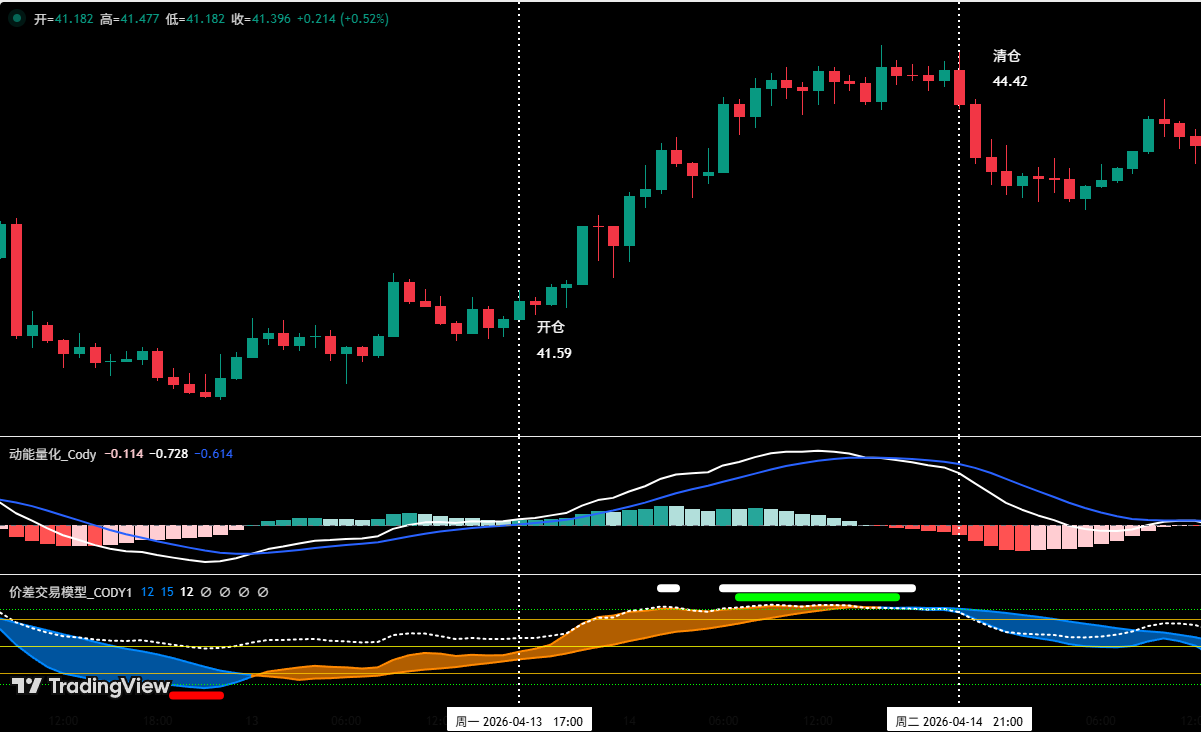
3. Short-term Trade Review: (See Figure 5)

• Entry Strategy: First, based on the judgment of the market's Wave V uptrend; second, the spread trading model had already issued early bottom warning signals (good points in the chart); third, the two momentum lines in the momentum model simultaneously moved above the zero axis, and the two major models issued共振上涨 signals. We established a 30% long position at $41.59.

• Exit Strategy: When the price rose near $45 and encountered resistance,同时 the spread trading model triggered strong top warning signals (green dot + white dot), therefore, we closed all positions near $44.42.

• Summary: This trade successfully profited approximately 6.80%.

HYPE_60-minute K-line Chart: (Momentum Quant Model + Spread Trading Model)

Figure 5 (Short-term Trade Illustration)

VI. Special Notes:​​

1. When opening a position: Immediately set the initial stop-loss level.

2. When profit reaches 1%: Move the stop-loss to the entry cost price (breakeven point), ensuring capital safety.

3. When profit reaches 2%​​: Move the stop-loss to the position of 1% profit.

4. Continuous tracking: Thereafter, for every additional 1% profit the coin price makes, move the stop-loss level同步 by 1%, dynamically protecting and locking in profits.

Financial markets change rapidly, all market analysis and trading strategies require dynamic adjustment. All views, analysis models, and operational strategies involved in this article are derived from personal technical analysis, intended solely for personal trading log purposes, and do not constitute any investment advice or operational basis. The market involves risks, investment requires caution, please do not make decisions based solely on this.

Связанные с этим вопросы

QWhat is the key support level for HYPE that will determine its future trend according to the analysis?

AThe key support level for HYPE is $40.17. If the price holds above this level, it is expected to maintain a range-bound consolidation between $40.17 and $45.76. A break below this support, followed by an inability to surpass the previous high of $45.76, would indicate a high probability that the daily V rally has concluded.

QHow is Bitcoin's current price action from the February 6 low of $60,000 redefined in the wave analysis?

AThe rally from the February 6 low of $60,000 is now redefined as a larger-degree 'D-wave rebound' within the broader corrective structure. This is because its duration (approximately 73 days as of April 19) and price magnitude (a ~30.6% gain to $78,333) have significantly exceeded the characteristics of a typical C-2 wave rebound, suggesting a more prolonged and complex corrective phase.

QWhat are the two main short-term trading strategies proposed for Bitcoin this week?

AThe two main short-term trading strategies for Bitcoin are: 1) Plan A: Sell on rallies (go short) when the price rebounds to the $76,500–$79,000 resistance zone and shows signs of rejection, with a stop-loss above $80,600. 2) Plan B: A breakout short, entering a short position if the price effectively breaks below the $73,500 support level, with a stop-loss set above $74,500.

QWhat was the result of the previous short-term HYPE trade mentioned in the article?

AThe previous short-term HYPE trade resulted in a profit of approximately 6.80%. A 30% long position was opened at $41.59 based on bullish signals from proprietary models and was closed at $44.42 when the price encountered resistance and the models generated strong top warning signals.

QWhat is the core trading range that Bitcoin is expected to maintain this week, and what are the critical levels to watch?

ABitcoin is expected to maintain a core trading range between $73,500 and $79,000 this week. Critical levels to watch are the resistance zones at $79,000–$80,600 and $83,500–$84,500, and the support levels at $73,500, $69,500, and $65,000–$66,000.

Похожее

Can Alibaba Cloud Rewrite Itself?

Over the past five months, Alibaba Cloud's MaaS (Model as a Service) revenue has surged 15x, marking a strategic overhaul where the company is shifting its 17-year-old system designed for "humans using cloud" to a new paradigm centered on "Agents consuming Tokens." At its recent summit, Alibaba Cloud announced a full-stack upgrade encompassing "chip-cloud-model-inference," all optimized for AI Agents. Key launches include the new AI product portal "QianWen Cloud," hyper-node servers powered by the in-house AI chip Zhenwu M890, and the latest flagship model, Qwen3.7-Max. Senior VP Liu Weiguang described this as building "China's largest AI factory," where chips are raw materials, the cloud is the workshop, models are machines, and the inference platform is the assembly line, with Tokens as the final product. The company is now emphasizing its chip strategy, unveiling the Zhenwu M890 and a two-year roadmap for future chips. With over 560,000 chips deployed across 400+ clients, Alibaba Cloud aims to control the marginal cost per Token, mirroring Google's integration of TPU and Gemini for optimal cost-performance. The cloud infrastructure itself is being rewritten. Traditional cloud interfaces are being transformed into standardized, Agent-callable Skills. A new scheduling logic focuses on "task scheduling" over "resource scheduling" to handle the unpredictable, elastic workloads of Agents. Liu noted that AI applications now automatically provision cloud resources, with one customer's daily automated provisioning equaling two weeks of manual work. For models, the focus has shifted from conversational prowess to execution capability. Qwen3.7-Max demonstrated this by autonomously writing and optimizing a production-grade AI compute kernel for the new Zhenwu M890 chip over 35 hours, achieving a 10x performance improvement. The underlying Bailian platform was upgraded for efficiency, and it maintains an open ecosystem, hosting third-party models. This restructuring extends beyond technology to sales, organization, and metrics. Alibaba Cloud has established dedicated MaaS sales teams, separated from traditional IaaS, with new KPIs focusing on high-quality Tokens that solve real problems, the number of core business systems integrated with models, and the efficiency of Agent task completion. The underlying bet is clear: AI represents an opportunity orders of magnitude larger than before. Despite the uncertainty, Alibaba Cloud is aggressively rebuilding its entire system, betting on an AI-driven future where Tokens could become its largest product line.

marsbit47 мин. назад

Can Alibaba Cloud Rewrite Itself?

marsbit47 мин. назад

Those Who Rushed into SpaceX's Private Secondary Market Are Bewildered in the Greatest Wealth Creation Wave Ever

Investors are rushing into SpaceX’s private secondary market ahead of its historic IPO, but many are finding confusion instead of clarity. While early backers like Darsana Capital are poised for astronomical returns—turning a $600M bet into roughly $150B—other buyers face uncertainty about whether they actually own SpaceX shares at all. The frenzy stems from AI-driven FOMO, as soaring valuations for private companies like OpenAI and SpaceX create intense demand for pre-IPO exposure. This has fueled a booming but opaque secondary market, where special purpose vehicles (SPVs) layer investments, adding fees and obscuring ownership. Some investors are three or four layers removed from the actual stock, unable to verify their holdings. With companies staying private longer—SpaceX for 24 years—secondary trading has grown complex and risky. Platforms have faced fraud, bankruptcy, and regulatory scrutiny. Now, firms like Anthropic and OpenAI are publicly rejecting unauthorized transfers, warning that shares sold through certain platforms may be invalid. SpaceX’s IPO filing in June will finally reveal the official shareholder list, resolving these uncertainties. Until then, buying into SpaceX through secondary channels remains a high-stakes gamble—a blind box in a market overflowing with capital and complexity.

marsbit59 мин. назад

Those Who Rushed into SpaceX's Private Secondary Market Are Bewildered in the Greatest Wealth Creation Wave Ever

marsbit59 мин. назад

Warsh's First Conundrum: Rate Cuts, Inflation, and a Fractured Fed

Walsh's First Dilemma: Rate Cuts, Inflation, and a Divided Fed Kevin Warsh officially assumed the Fed Chairmanship on May 15th, inheriting a central bank deeply divided over inflation. Contrary to market expectations of a dovish stance due to his appointment by President Trump, Warsh's historical record shows early and consistent hawkish concerns about inflation. The Fed he leads is fractured, with three FOMC members recently dissenting against even hinting at future rate cuts. The immediate challenge is surging inflation. While the Iran-related oil shock is a temporary factor, core CPI and services inflation are accelerating, showing signs of becoming entrenched—echoing the Fed's 2022 "transitory" misstep. Warsh faces the task of building consensus within a committee where several members believe policy may not be restrictive enough, especially if the neutral interest rate (r-star) is higher than currently estimated. Politically, Warsh is caught between Trump's desire for rate cuts and the economic reality of persistent price pressures. Any move perceived as bowing to political pressure could undermine Fed independence. Market implications are significant. Long-term Treasury yields (e.g., 30-year at 5.19%) could rise further, especially if the June FOMC statement hints at possible tightening. Tech stocks face continued valuation pressure from higher rates. The key variable is progress in Iran negotiations; a breakthrough before the June meeting could temporarily ease oil-driven inflation, but stubborn services inflation would remain. All eyes are on Warsh's first post-FOMC press conference on June 17th. His wording on inflation and policy will reveal how much the market has mispriced his stance and the Fed's likely path forward.

marsbit1 ч. назад

Warsh's First Conundrum: Rate Cuts, Inflation, and a Fractured Fed

marsbit1 ч. назад

Торговля

Спот
Фьючерсы

Популярные статьи

Тест по Bitcoin Биткоина

HTX Learn: Изучите Bitcoin halving и Заработаете Токены USDT

3.0k просмотров всегоОпубликовано 2024.04.16Обновлено 2024.04.16

Тест по Bitcoin  Биткоина

Что такое $BITCOIN

ЦИФРОВОЕ ЗОЛОТО ($BITCOIN): Комплексный анализ Введение в ЦИФРОВОЕ ЗОЛОТО ($BITCOIN) ЦИФРОВОЕ ЗОЛОТО ($BITCOIN) — это проект на основе блокчейна, работающий в сети Solana, который стремится объединить характеристики традиционных драгоценных металлов с инновациями децентрализованных технологий. Хотя он носит имя Биткойн, часто называемого “цифровым золотом” из-за его восприятия как средства хранения ценности, ЦИФРОВОЕ ЗОЛОТО является отдельным токеном, предназначенным для создания уникальной экосистемы в ландшафте Web3. Его цель — позиционировать себя как жизнеспособный альтернативный цифровой актив, хотя детали его применения и функциональности все еще развиваются. Что такое ЦИФРОВОЕ ЗОЛОТО ($BITCOIN)? ЦИФРОВОЕ ЗОЛОТО ($BITCOIN) — это токен криптовалюты, специально разработанный для использования в блокчейне Solana. В отличие от Биткойна, который выполняет широко признанную роль хранения ценности, этот токен, похоже, сосредоточен на более широких приложениях и характеристиках. Примечательные аспекты включают: Инфраструктура блокчейна: Токен построен на блокчейне Solana, известном своей способностью обрабатывать высокоскоростные и недорогие транзакции. Динамика предложения: ЦИФРОВОЕ ЗОЛОТО имеет максимальное предложение, ограниченное 100 квадриллионами токенов (100P $BITCOIN), хотя детали о его обращающемся предложении в настоящее время не раскрыты. Утилита: Хотя точные функциональные возможности не описаны, есть указания на то, что токен может быть использован для различных приложений, потенциально связанных с децентрализованными приложениями (dApps) или стратегиями токенизации активов. Кто создатель ЦИФРОВОГО ЗОЛОТА ($BITCOIN)? На данный момент личность создателей и команды разработчиков, стоящих за ЦИФРОВЫМ ЗОЛОТОМ ($BITCOIN), остается неизвестной. Эта ситуация типична для многих инновационных проектов в области блокчейна, особенно тех, которые связаны с децентрализованными финансами и феноменом мем-криптовалют. Хотя такая анонимность может способствовать культуре, ориентированной на сообщество, она усиливает опасения по поводу управления и ответственности. Кто инвесторы ЦИФРОВОГО ЗОЛОТА ($BITCOIN)? Доступная информация указывает на то, что у ЦИФРОВОГО ЗОЛОТА ($BITCOIN) нет известных институциональных спонсоров или значительных венчурных капиталовложений. Проект, похоже, функционирует по модели пирингового взаимодействия, сосредоточенной на поддержке и принятии сообществом, а не на традиционных путях финансирования. Его активность и ликвидность в основном сосредоточены на децентрализованных биржах (DEX), таких как PumpSwap, а не на устоявшихся централизованных торговых платформах, что еще больше подчеркивает его подход, ориентированный на grassroots. Как работает ЦИФРОВОЕ ЗОЛОТО ($BITCOIN) Операционные механизмы ЦИФРОВОГО ЗОЛОТА ($BITCOIN) можно подробно описать на основе его дизайна блокчейна и характеристик сети: Механизм консенсуса: Используя уникальный механизм доказательства истории (PoH) Solana в сочетании с моделью доказательства доли (PoS), проект обеспечивает эффективную валидацию транзакций, что способствует высокой производительности сети. Токеномика: Хотя конкретные дефляционные механизмы не были подробно описаны, большое максимальное предложение токенов подразумевает, что оно может быть предназначено для микротранзакций или нишевых случаев использования, которые еще предстоит определить. Интероперабельность: Существует потенциал для интеграции с более широкой экосистемой Solana, включая различные платформы децентрализованных финансов (DeFi). Однако детали относительно конкретных интеграций остаются неуточненными. Хронология ключевых событий Вот хронология, которая подчеркивает значимые вехи, касающиеся ЦИФРОВОГО ЗОЛОТА ($BITCOIN): 2023: Первоначальное развертывание токена происходит в блокчейне Solana, отмеченное его адресом контракта. 2024: ЦИФРОВОЕ ЗОЛОТО приобретает видимость, когда оно становится доступным для торговли на децентрализованных биржах, таких как PumpSwap, позволяя пользователям обменивать его на SOL. 2025: Проект наблюдает спорадическую торговую активность и потенциальный интерес к инициативам, возглавляемым сообществом, хотя на данный момент не зафиксировано никаких значительных партнерств или технических достижений. Критический анализ Сильные стороны Масштабируемость: Основная инфраструктура Solana поддерживает высокие объемы транзакций, что может повысить полезность $BITCOIN в различных сценариях транзакций. Доступность: Потенциально низкая цена торговли за токен может привлечь розничных инвесторов, способствуя более широкому участию благодаря возможностям дробного владения. Риски Отсутствие прозрачности: Отсутствие публично известных спонсоров, разработчиков или процесса аудита может вызвать скептицизм относительно устойчивости и надежности проекта. Волатильность рынка: Торговая активность сильно зависит от спекулятивного поведения, что может привести к значительной волатильности цен и неопределенности для инвесторов. Заключение ЦИФРОВОЕ ЗОЛОТО ($BITCOIN) является интригующим, но неоднозначным проектом в быстро развивающейся экосистеме Solana. Хотя он пытается использовать нарратив “цифрового золота”, его отход от установленной роли Биткойна как средства хранения ценности подчеркивает необходимость более четкого различения его предполагаемой утилиты и структуры управления. Будущее принятие и усвоение, вероятно, будут зависеть от решения текущей непрозрачности и более четкого определения его операционных и экономических стратегий. Примечание: Этот отчет охватывает синтезированную информацию, доступную на октябрь 2023 года, и с тех пор могут произойти события.

99 просмотров всегоОпубликовано 2025.05.13Обновлено 2025.05.13

Что такое $BITCOIN

Fractal Bitcoin: масштабирование Биткоина с помощью рекурсивной системы

Fractal Bitcoin — масштабное Layer-1-решнение, созданное на базе кода Биткоина, позволяющего достигать бесконечного масштабирования с помощью рекурсивного подхода.

2.3k просмотров всегоОпубликовано 2025.06.30Обновлено 2025.06.30

Fractal Bitcoin: масштабирование Биткоина с помощью рекурсивной системы

Обсуждения

Добро пожаловать в Сообщество HTX. Здесь вы сможете быть в курсе последних новостей о развитии платформы и получить доступ к профессиональной аналитической информации о рынке. Мнения пользователей о цене на BTC (BTC) представлены ниже.

活动图片