Bitcoin treasuries stall in Q4, but largest holders keep stacking sats

cointelegraphОпубликовано 2025-12-11Обновлено 2025-12-11

Введение

The adoption of Bitcoin treasuries slowed sharply in Q4 2025, with only nine new companies adding BTC to their balance sheets compared to 53 in the previous quarter. While 117 companies adopted Bitcoin in 2025, most hold relatively small amounts. However, the largest corporate holders, such as Strategy, continued accumulating Bitcoin, with Strategy purchasing $962 million worth in a single day. Overall, public companies hold over 1 million BTC ($90.2B), representing 4.7% of the total supply, while spot Bitcoin ETFs hold an additional 1.49 million BTC. Some firms, like Metaplanet, paused purchases, and others, like Satsuma Technology, sold portions of their holdings. Ether treasury investments also declined, with cumulative ETH acquisitions falling 81% over three months.

Bitcoin treasury adoption slowed sharply in the fourth quarter of 2025, even as the biggest corporate holders continued to quietly add to their stacks while smaller players stepped back.

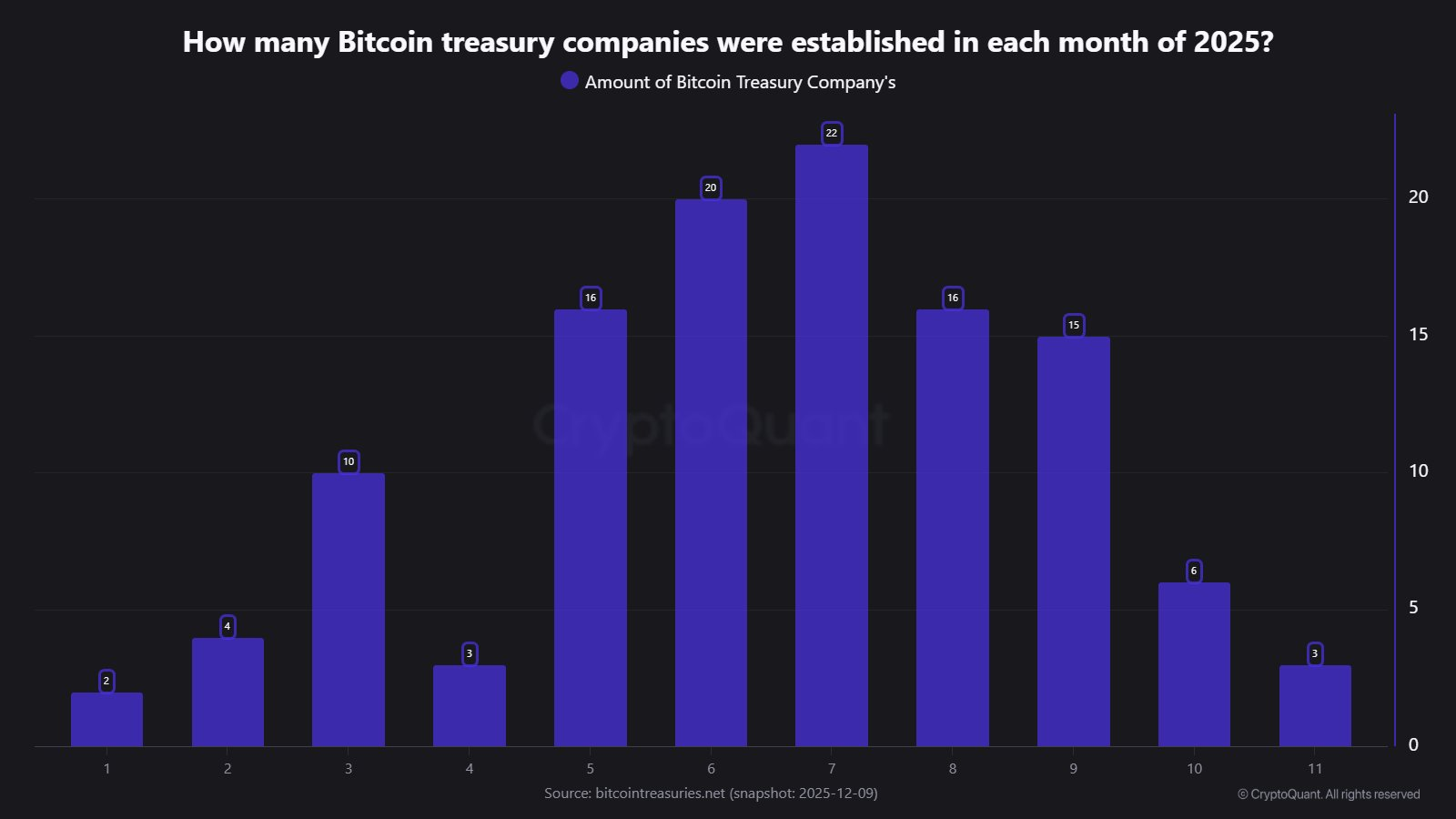
The number of new Bitcoin (BTC) treasury companies declined from its peak of 53 new companies in the third quarter to just nine companies adding Bitcoin to their balance sheet in the fourth quarter of 2025 so far, with a total of 117 new companies adopting Bitcoin this year, according to blockchain data platform CryptoQuant.

“Despite the growth in numbers during 2025, most Bitcoin Treasury companies hold relatively small amounts,” CryptoQuant wrote in a Thursday X post.

Still, the accumulation data shows that the most well-funded corporate treasuries continue to scoop up the Bitcoin supply despite a decline in buying by smaller companies and retail participants.

New Bitcoin treasury companies per month, 2025 year-to-date chart. Source: CryptoQuant

Some Bitcoin treasury firms have stopped accumulating this quarter. Japanese investment company Metaplanet, for instance, hasn’t purchased any Bitcoin in over two months.

Some companies are even selling their Bitcoin stacks. United Kingdom-based, Bitcoin-focused tech company Satsuma Technology sold 579 Bitcoin for around $53 million, leaving the company with 620 Bitcoin on its balance sheet, according to a Wednesday announcement.

Related: Bitcoin treads water at $90K as whales eat the Ethereum dip: Finance Redefined

Largest corporate holders continue their quiet Bitcoin accumulation

Despite the broader slowdown, some of the largest corporations continue to scoop up more of the Bitcoin supply.

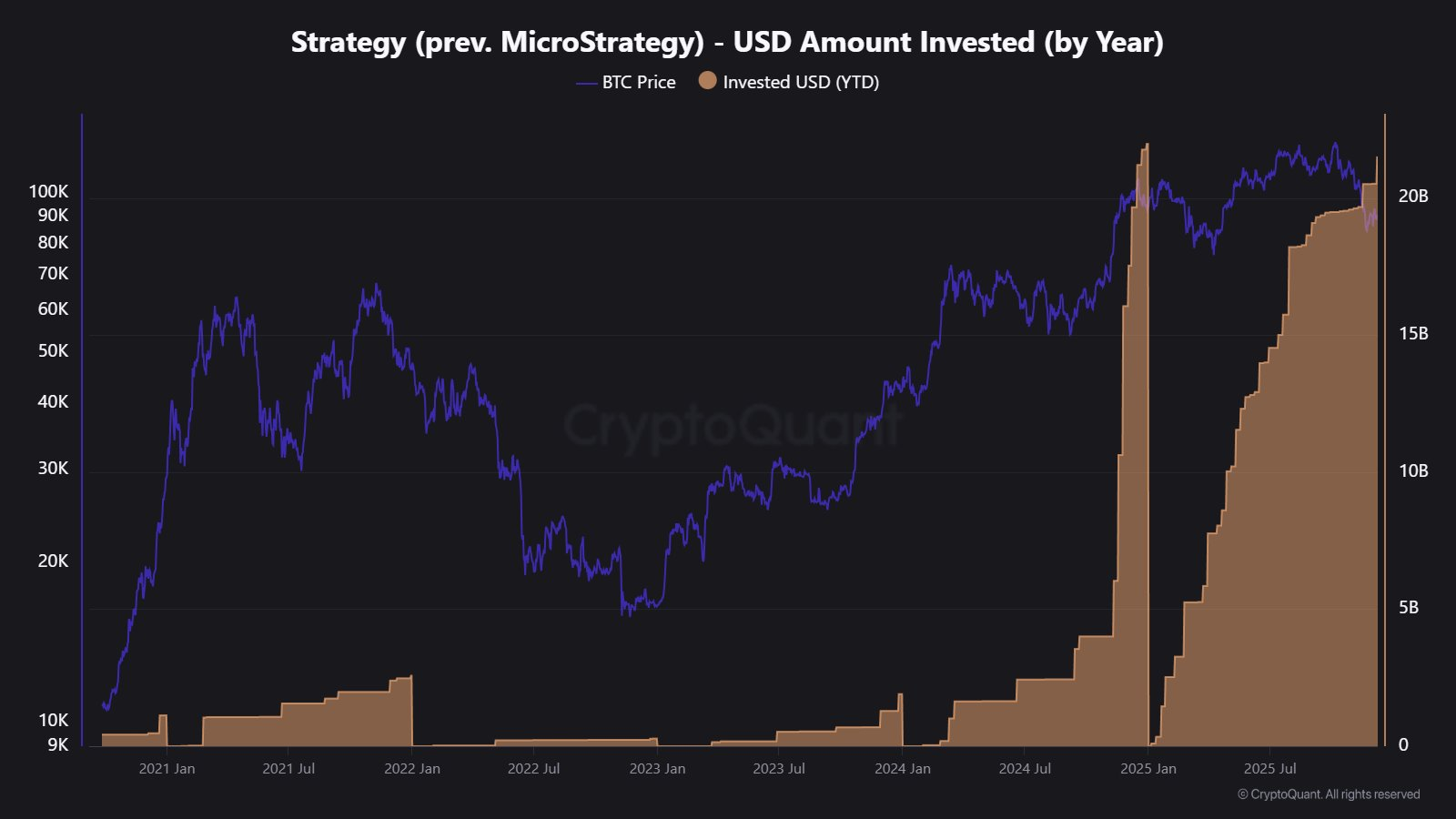
Strategy, the largest corporate Bitcoin holder, purchased $962 million of BTC on Monday, in its biggest purchase since July. The company is now just $500 million shy of matching the $21.97 billion worth of Bitcoin it acquired in 2024, according to CryptoQuant.

Strategy, US dollar amount invested. Source: CryptoQuant

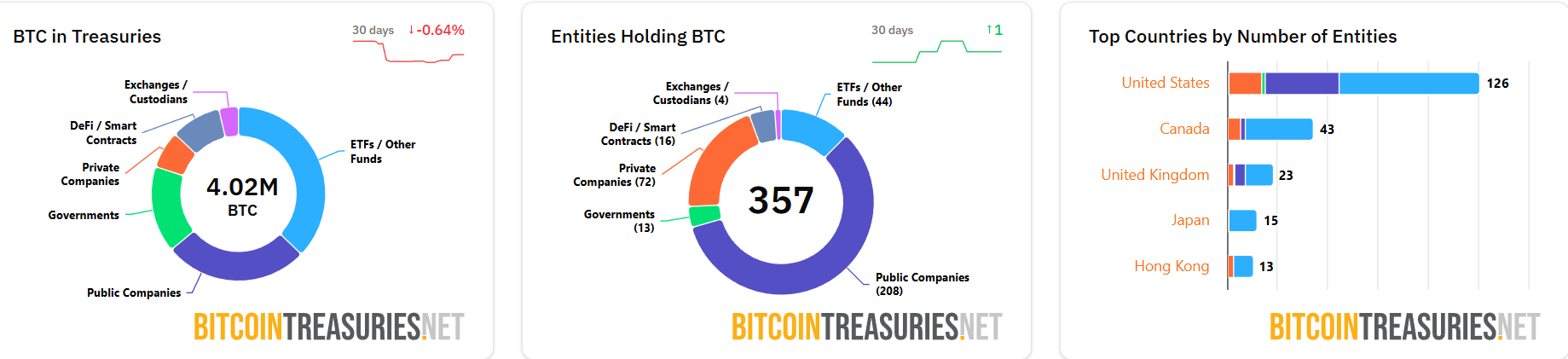
Over 1 million Bitcoin worth $90.2 billion is already held in public company treasuries, representing 4.7% of the total supply, according to data from BitcoinTreasuries.NET.

An additional 1.49 million Bitcoin, or 7% of the supply, is held by spot Bitcoin exchange-traded funds.

Bitcoin holdings in treasuries. Source: BitcoinTreasuries.NET

Related: Silk Road-linked Bitcoin wallets move $3M to new address

DATs slow crypto purchases as Ether treasury investments fall 81%

Digital asset treasury (DAT) acquisitions are also slowing down. Ripple-backed Evernorth Holdings has been inactive since the end of October, when it acquired $950 million XRP (XRP) tokens.

Evernorth’s XRP holdings were facing nearly $80 million in unrealized losses weeks after the purchases amid the market decline and growing pressure on DATs.

BitMine Immersion Technologies, the largest corporate Ether (ETH) holder, has also slowed its Ether acquisitions in recent months from a peak of $2.6 billion in July to just $296 million of ETH in December.

Cumulative investments from Ether treasury firms fell by 81% in the past three months, from 1.97 million ETH acquired in August to 370,000 ETH in November.

Magazine: Mysterious Mr Nakamoto author — Finding Satoshi would hurt Bitcoin

Похожее

Breaking: OpenAI Undergoes Major Reorganization, President Brockman Assumes Command

OpenAI has announced a major internal reorganization just months before its anticipated IPO. The company is merging its three flagship product lines—ChatGPT, Codex, and the API platform—into a single, unified product organization. The most significant leadership change involves co-founder and President Greg Brockman moving from a background technical role to take full, permanent control over all product strategy. This follows the indefinite medical leave of AGI Deployment CEO Fidji Simo. Additionally, ChatGPT's longtime lead, Nick Turley, has been reassigned to enterprise products, with former Instagram executive Ashley Alexander taking over consumer offerings. The consolidation, internally framed as a strategic move towards an "Agentic Future," aims to break down internal silos and create a cohesive "Super App." This planned desktop application would integrate ChatGPT's conversational abilities, Codex's coding power, and a rumored internal web browser named "Atlas" to autonomously perform complex user tasks. The reorganization occurs amid significant internal and external pressures. OpenAI has recently seen a wave of high-profile departures, including Sora co-lead Bill Peebles and other senior technical leaders, leading to concerns about a thinning executive bench. Externally, rival Anthropic recently secured funding at a staggering $900 billion valuation, surpassing OpenAI's own. Google's upcoming I/O developer conference also poses a competitive threat. Analysts suggest the dramatic restructure is a pre-IPO move to present a clearer, more focused narrative to Wall Street—streamlining operations and demonstrating decisive leadership under Brockman to counter internal turbulence and intense market competition.

marsbit55 мин. назад

Breaking: OpenAI Undergoes Major Reorganization, President Brockman Assumes Command

marsbit55 мин. назад

Two Survival Structures of Market Makers and Arbitrageurs

Market makers and arbitrageurs represent two distinct survival structures in high-frequency trading. Market makers primarily use limit orders (makers) to profit from the bid-ask spread, enjoying high capital efficiency (nominally 100%) but bearing inventory risk. This "inventory risk" arises from passive, fragmented, and discontinuous order fills in the limit order book (LOB). This risk, while a potential cost, can also contribute to excess profit if managed within control boundaries, allowing for mean reversion. Market makers essentially sell "time" (uncertainty over execution timing) to the market for price control and low fees. In contrast, cross-exchange arbitrageurs typically use market orders (takers) to exploit price differences or funding rates, resulting in lower nominal capital efficiency (requiring capital on both exchanges) and higher transaction costs. Their risk exposure stems from asymmetries in exchange rules (e.g., minimum order sizes), execution latency, and infrastructure risks (e.g., ADL, oracle drift). These exposures are active, exogenous gaps that primarily erode profits rather than contribute to them. Arbitrageurs essentially sell "space" (capital sunk across venues) for localized, immediate certainty. Both strategies engage in a trade-off between execution friction and residual risk. Optimal systems allow for temporary, controlled risk exposure rather than enforcing zero exposure at all costs. Their evolution converges towards hybrid models: arbitrageurs may use maker orders to reduce costs, while market makers may use taker orders or hedges for risk management. Ultimately, both use different forms of risk exposure—market makers exposing inventory, arbitrageurs immobilizing capital—to extract marginal, hard-won certainty from the market.

链捕手55 мин. назад

Two Survival Structures of Market Makers and Arbitrageurs

链捕手55 мин. назад

Who Will Define the Rules of the AI Era? Anthropic Discusses the 2028 US-China AI Landscape

This article, based on Anthropic's analysis, outlines the intensifying systemic competition between the U.S./allies and China for AI leadership by 2028. It argues that access to advanced computing power ("compute") is the critical bottleneck, where the U.S. currently holds a significant advantage through chip export controls and allied innovation. However, China's AI labs remain competitive by exploiting policy loopholes—via chip smuggling, overseas data center access, and "model distillation" attacks to copy U.S. model capabilities—keeping them close to the frontier. The piece presents two contrasting scenarios for 2028. In the first, decisive U.S. action to tighten compute controls and curb distillation locks in a 12-24 month AI capability lead, cementing democratic influence over global AI norms, security, and economic infrastructure. In the second, policy inaction allows China to achieve near-parity through continued access to U.S. technology, enabling Beijing to promote its AI stack globally and integrate advanced AI into its military and governance systems, altering the strategic balance. Anthropic contends that maintaining a decisive U.S. lead is essential for shaping safe AI development and governance. The core recommendation is for U.S. policymakers to urgently close compute and model access loopholes while promoting global adoption of the U.S. AI technology stack to secure a lasting strategic advantage.

marsbit2 ч. назад

Who Will Define the Rules of the AI Era? Anthropic Discusses the 2028 US-China AI Landscape

marsbit2 ч. назад

Торговля

Спот
Фьючерсы

Популярные статьи

Как купить SATS

Добро пожаловать на HTX.com! Мы сделали приобретение SATS (SATS) простым и удобным. Следуйте нашему пошаговому руководству и отправляйтесь в свое крипто-путешествие.Шаг 1: Создайте аккаунт на HTXИспользуйте свой адрес электронной почты или номер телефона, чтобы зарегистрироваться и бесплатно создать аккаунт на HTX. Пройдите удобную регистрацию и откройте для себя весь функционал.Создать аккаунтШаг 2: Перейдите в Купить криптовалюту и выберите свой способ оплатыКредитная/Дебетовая Карта: Используйте свою карту Visa или Mastercard для мгновенной покупки SATS (SATS).Баланс: Используйте средства с баланса вашего аккаунта HTX для простой торговли.Третьи Лица: Мы добавили популярные способы оплаты, такие как Google Pay и Apple Pay, для повышения удобства.P2P: Торгуйте напрямую с другими пользователями на HTX.Внебиржевая Торговля (OTC): Мы предлагаем индивидуальные услуги и конкурентоспособные обменные курсы для трейдеров.Шаг 3: Хранение SATS (SATS)После приобретения вами SATS (SATS) храните их в своем аккаунте на HTX. В качестве альтернативы вы можете отправить их куда-либо с помощью перевода в блокчейне или использовать для торговли с другими криптовалютами.Шаг 4: Торговля SATS (SATS)С легкостью торгуйте SATS (SATS) на спотовом рынке HTX. Просто зайдите в свой аккаунт, выберите торговую пару, совершайте сделки и следите за ними в режиме реального времени. Мы предлагаем удобный интерфейс как для начинающих, так и для опытных трейдеров.

582 просмотров всегоОпубликовано 2024.03.29Обновлено 2025.03.21

Как купить SATS

Обсуждения

Добро пожаловать в Сообщество HTX. Здесь вы сможете быть в курсе последних новостей о развитии платформы и получить доступ к профессиональной аналитической информации о рынке. Мнения пользователей о цене на SATS (SATS) представлены ниже.

活动图片