Bitcoin Sharpe Ratio Currently Falling Faster Than Price — What’s Happening?

bitcoinistОпубликовано 2026-01-31Обновлено 2026-01-31

Введение

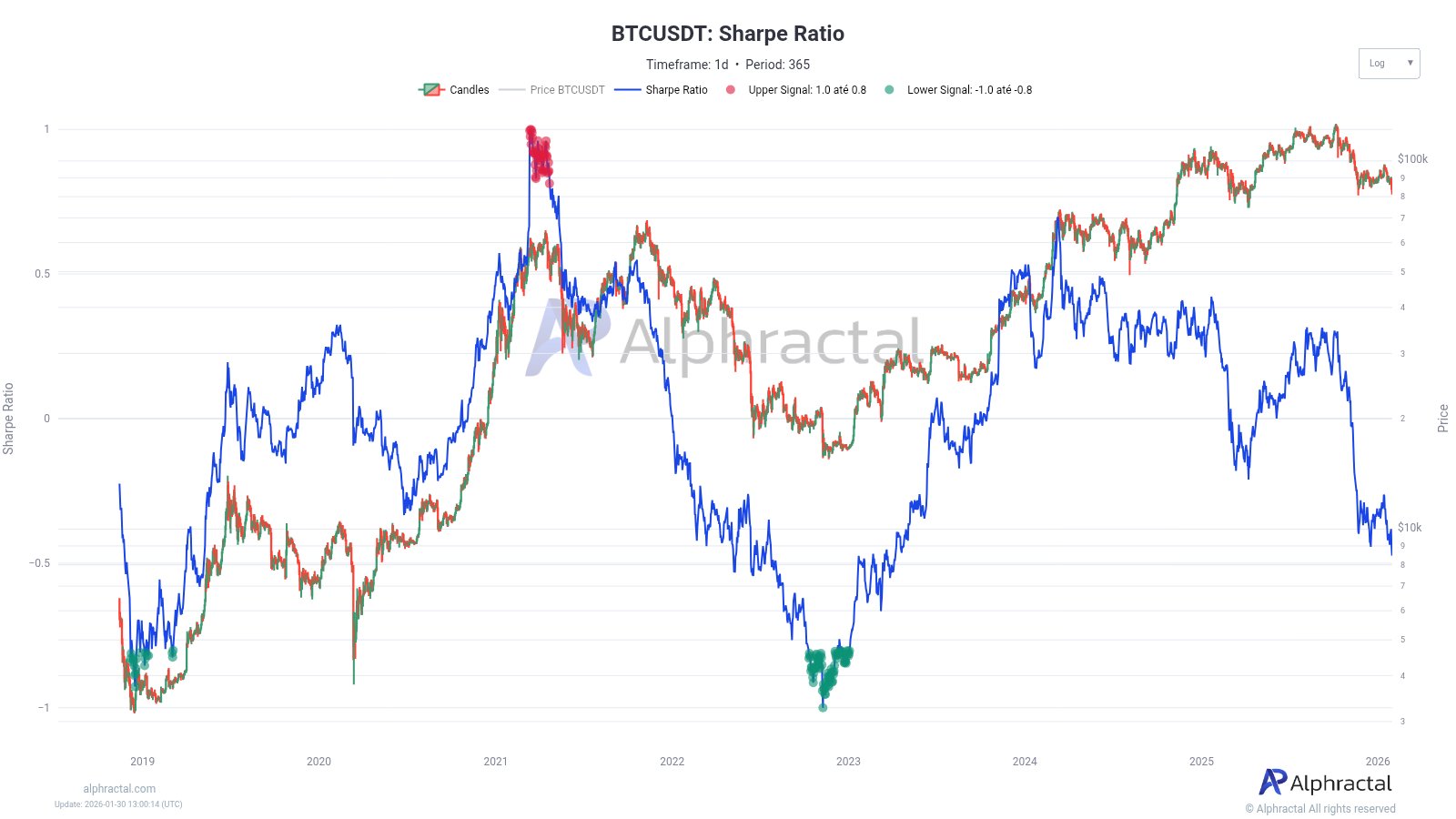
Bitcoin's price has dropped to around $81,000, reinforcing bearish sentiment amid factors like geopolitical tensions and liquidation cascades. According to Joao Wedson, founder of Alphractal, the Bitcoin Sharpe Ratio—a measure of risk-adjusted returns—is declining faster than the price itself, indicating the market is taking on more risk for diminishing returns. This ratio turned negative earlier in the year, yet BTC's price continued to rally briefly before the current downturn. Historically, such a rapid decline in the Sharpe Ratio often leads to extended periods of sideways or negative momentum. Wedson warns that if Bitcoin loses the $81,000 support, a deeper capitulation similar to 2022 could occur, potentially driving the price down to $65,500. As of now, BTC has slightly recovered to above $83,000 but remains down nearly 8% over the past week.

If there has been any doubt about the arrival of the bear market, the latest drop in the Bitcoin price to around $81,000 somewhat made it more believable. While different triggers, including geopolitical tensions, Microsoft’s earnings miss, and liquidation cascades, have been credited for this drop, the premier cryptocurrency seems to be struggling catch any break at the moment.

Interestingly, the latest decline not only shattered the remains of the Bitcoin price bullish structure but also tilted the on-chain framework towards an even more bearish outlook. With both technical and on-chain data looking less optimistic, the bears appear to be winning the battle for dominance in the BTC market.

This Metric Changes First, BTC Price Reacts Later: Crypto Founder

In a January 30 post on the X platform, Alphractal’s founder and CEO, Joao Wedson, revealed that the Bitcoin Sharpe Ratio is declining at a rate faster than the BTC price. The relevant indicator here is the Sharpe Ratio, which assesses the risk-adjusted returns of a particular cryptocurrency (Bitcoin, in this case).

This on-chain metric basically tracks the amount of profit an investment offers per unit of risk (considering risk is measured by volatility), with a high value signaling a higher risk-adjusted performance. Meanwhile, a negative Sharpe Ratio indicates that the returns being realized on an investment are not commensurate with the risk being taken.

Wedson wrote in his post on X:

Simply put: the market is taking more risk for less return.

Source: @joao_wedson on X

Indeed, the Bitcoin Sharpe Ratio slipped into the negative territory a few days into the new year. However, BTC’s price action still enjoyed an incredible run of form — running to as high as $97,000 — after this shift, placing less significance on the on-chain observation.

What’s more interesting is that the Sharpe Ratio is falling and weakening at a pace faster than the Bitcoin price. Historically, this rate of decline has often coincided with extended periods of momentum loss and sideways price movement. In fact, Wedson concluded that the risk-adjusted metrics need to change before price can react positively.

Bitcoin Price Could Fall To $65,500 If This Happens

In a case where the premier cryptocurrency continues its downward spiral, Wedson has projected a target for the BTC price. In an older post on X, the Alphractal founder had revealed that the Bitcoin price cannot lose the $81,000 level under any circumstances.

The on-chain expert stated that a capitulation phase similar to the one seen in 2022 could unfold if the market leader breaks below the $81,000 level. Based on the Fibonacci-Adjusted Market Mean Price, Wedson identified $65,500 as the next major support level.

The $81,000 came under focus as the Bitcoin price approached this level during its decline on Thursday, January 29. As of this writing, though, BTC has recovered above the $83,000 mark, with the price still down by nearly 8% on the weekly timeframe.

The price of BTC on the daily timeframe | Source: BTCUSDT chart on TradingView

Связанные с этим вопросы

QWhat is the Bitcoin Sharpe Ratio and what does its decline indicate?

AThe Bitcoin Sharpe Ratio is an on-chain metric that assesses the risk-adjusted returns of Bitcoin. It measures the amount of profit an investment offers per unit of risk, with risk measured by volatility. A decline, especially into negative territory, indicates that the market is taking more risk for less return, signaling a lower risk-adjusted performance.

QAccording to Joao Wedson, what is the relationship between the Sharpe Ratio's decline and the BTC price?

AJoao Wedson observed that the Bitcoin Sharpe Ratio is currently declining at a rate faster than the BTC price itself. Historically, this rapid rate of decline has often coincided with extended periods of momentum loss and sideways price movement. He concluded that the risk-adjusted metrics need to change before the price can react positively.

QWhat critical price level did Wedson identify for Bitcoin, and what is the consequence of losing it?

AWedson identified $81,000 as a critical level that Bitcoin cannot lose under any circumstances. He stated that if the price breaks below this level, a capitulation phase similar to the one seen in 2022 could unfold.

QIf Bitcoin breaks below $81,000, what is the next major support level projected by Wedson?

ABased on the Fibonacci-Adjusted Market Mean Price, Wedson projected that the next major support level for Bitcoin would be $65,500 if it breaks below the $81,000 level.

QWhat were some of the triggers mentioned for the latest drop in Bitcoin's price?

AThe article mentions several triggers for the latest Bitcoin price drop, including geopolitical tensions, Microsoft’s earnings miss, and liquidation cascades.

Похожее

The Niche Consensus Among Elites: Has College Become an Expensive Waste?

**Summary:** A growing "anti-college" movement is gaining traction among elite circles in Silicon Valley, challenging the traditional value of a four-year university degree. Proponents argue that college has become an expensive, slow, and increasingly irrelevant waste of time, especially in the fast-paced tech world where opportunities pass by quickly. The movement is led by figures like billionaire Peter Thiel, who criticizes universities for high costs, ideological indoctrination, and stifling true innovation. His "Thiel Fellowship" pays young people to drop out and pursue ventures. Companies like Palantir Technologies (co-founded by Thiel) fuel this trend with programs like the "Meritocracy Fellowship," which offers high school graduates paid internships as an alternative to immediate college enrollment, promising a practical "Palantir Degree." Key drivers include: 1. **Economics:** Skyrocketing student debt versus the allure of immediate, high-paying tech jobs or startup funding. 2. **Technology:** AI and online tools lowering barriers to self-education and product development, making formal instruction seem inefficient. 3. **Culture:** A backlash against perceived "woke" ideology and DEI policies in universities, coupled with a belief that these institutions suppress meritocracy and masculine drive. The movement is notably male-dominated. Critics, like economist David Deming, warn against overgeneralizing from dropout success stories (survivorship bias). He emphasizes that genuine autodidacts are rare, corporate training is narrowly focused, and the "college wage premium" remains high for most people. University liberal arts education, he argues, builds adaptable problem-solving skills and broad perspectives. The debate highlights a deeper crisis in education. The core model of the modern university appears increasingly mismatched with the speed of the information age. The movement signals a shift in the locus of learning from institutional "education" to personal, active "learning" powered by the internet and AI. Ultimately, this may not mean the end of university, but rather a painful evolution. The future likely holds more hybrid, personalized, and lifelong learning pathways. The central question becomes: in a world changing faster than any curriculum, how do we best learn?

marsbit3 мин. назад

The Niche Consensus Among Elites: Has College Become an Expensive Waste?

marsbit3 мин. назад

From Subsidies to Token-Based Pricing to Price Cuts: Is OpenAI Sparking a Price War? Is the Inflection Point for Token Economics Nearing?

The commercialization of generative AI is facing a critical inflection point as a potential price war looms. According to The Wall Street Journal, OpenAI is considering a significant cut to its token fees to compete with rival Anthropic, signaling a shift from a growth-at-all-costs model focused on token consumption. This move comes as both companies, reportedly losing billions on compute, prepare for IPOs, and as enterprise customers face "bill shock" from switching to usage-based token billing. Reports indicate poor ROI, with one analysis finding only 18 cents of every dollar spent on AI tokens generates user-facing value. The industry's initial phases—from flat-rate subscriptions to aggressive subsidies—have given way to a reckoning with real costs. Analysts debate the future: some predict a bifurcation between premium, high-cost models for complex tasks and cheaper alternatives for routine work, while others believe overall spending will still rise as agentic AI increases tokens per task. Notably, Chinese model DeepSeek's low-cost API is gaining traction with U.S. enterprises, adding competitive pressure. The core challenge is redefining value beyond token volume ("tokenmaxxing") toward measurable productivity ("valuemaxxing"), as the entire AI value chain, from cloud providers to chipmakers, feels the ripple effects of unsustainable pricing.

marsbit7 мин. назад

From Subsidies to Token-Based Pricing to Price Cuts: Is OpenAI Sparking a Price War? Is the Inflection Point for Token Economics Nearing?

marsbit7 мин. назад

Торговля

Спот
Фьючерсы

Популярные статьи

Как купить S

Добро пожаловать на HTX.com! Мы сделали приобретение Sonic (S) простым и удобным. Следуйте нашему пошаговому руководству и отправляйтесь в свое крипто-путешествие.Шаг 1: Создайте аккаунт на HTXИспользуйте свой адрес электронной почты или номер телефона, чтобы зарегистрироваться и бесплатно создать аккаунт на HTX. Пройдите удобную регистрацию и откройте для себя весь функционал.Создать аккаунтШаг 2: Перейдите в Купить криптовалюту и выберите свой способ оплатыКредитная/Дебетовая Карта: Используйте свою карту Visa или Mastercard для мгновенной покупки Sonic (S).Баланс: Используйте средства с баланса вашего аккаунта HTX для простой торговли.Третьи Лица: Мы добавили популярные способы оплаты, такие как Google Pay и Apple Pay, для повышения удобства.P2P: Торгуйте напрямую с другими пользователями на HTX.Внебиржевая Торговля (OTC): Мы предлагаем индивидуальные услуги и конкурентоспособные обменные курсы для трейдеров.Шаг 3: Хранение Sonic (S)После приобретения вами Sonic (S) храните их в своем аккаунте на HTX. В качестве альтернативы вы можете отправить их куда-либо с помощью перевода в блокчейне или использовать для торговли с другими криптовалютами.Шаг 4: Торговля Sonic (S)С легкостью торгуйте Sonic (S) на спотовом рынке HTX. Просто зайдите в свой аккаунт, выберите торговую пару, совершайте сделки и следите за ними в режиме реального времени. Мы предлагаем удобный интерфейс как для начинающих, так и для опытных трейдеров.

1.4k просмотров всегоОпубликовано 2025.01.15Обновлено 2026.06.02

Как купить S

Sonic: Обновления под руководством Андре Кронье – новая звезда Layer-1 на фоне спада рынка

Он решает проблемы масштабируемости, совместимости между блокчейнами и стимулов для разработчиков с помощью технологических инноваций.

2.3k просмотров всегоОпубликовано 2025.04.09Обновлено 2025.04.09

Sonic: Обновления под руководством Андре Кронье – новая звезда Layer-1 на фоне спада рынка

HTX Learn: Пройдите обучение по "Sonic" и разделите 1000 USDT

HTX Learn — ваш проводник в мир перспективных проектов, и мы запускаем специальное мероприятие "Учитесь и Зарабатывайте", посвящённое этим проектам. Наше новое направление .

1.8k просмотров всегоОпубликовано 2025.04.10Обновлено 2025.04.10

HTX Learn: Пройдите обучение по "Sonic" и разделите 1000 USDT

Обсуждения

Добро пожаловать в Сообщество HTX. Здесь вы сможете быть в курсе последних новостей о развитии платформы и получить доступ к профессиональной аналитической информации о рынке. Мнения пользователей о цене на S (S) представлены ниже.

活动图片