Bitcoin Sell-Side Risk Ratio Falls To Lowest Since Oct ’23: What It Means

bitcoinistОпубликовано 2026-01-14Обновлено 2026-01-14

Введение

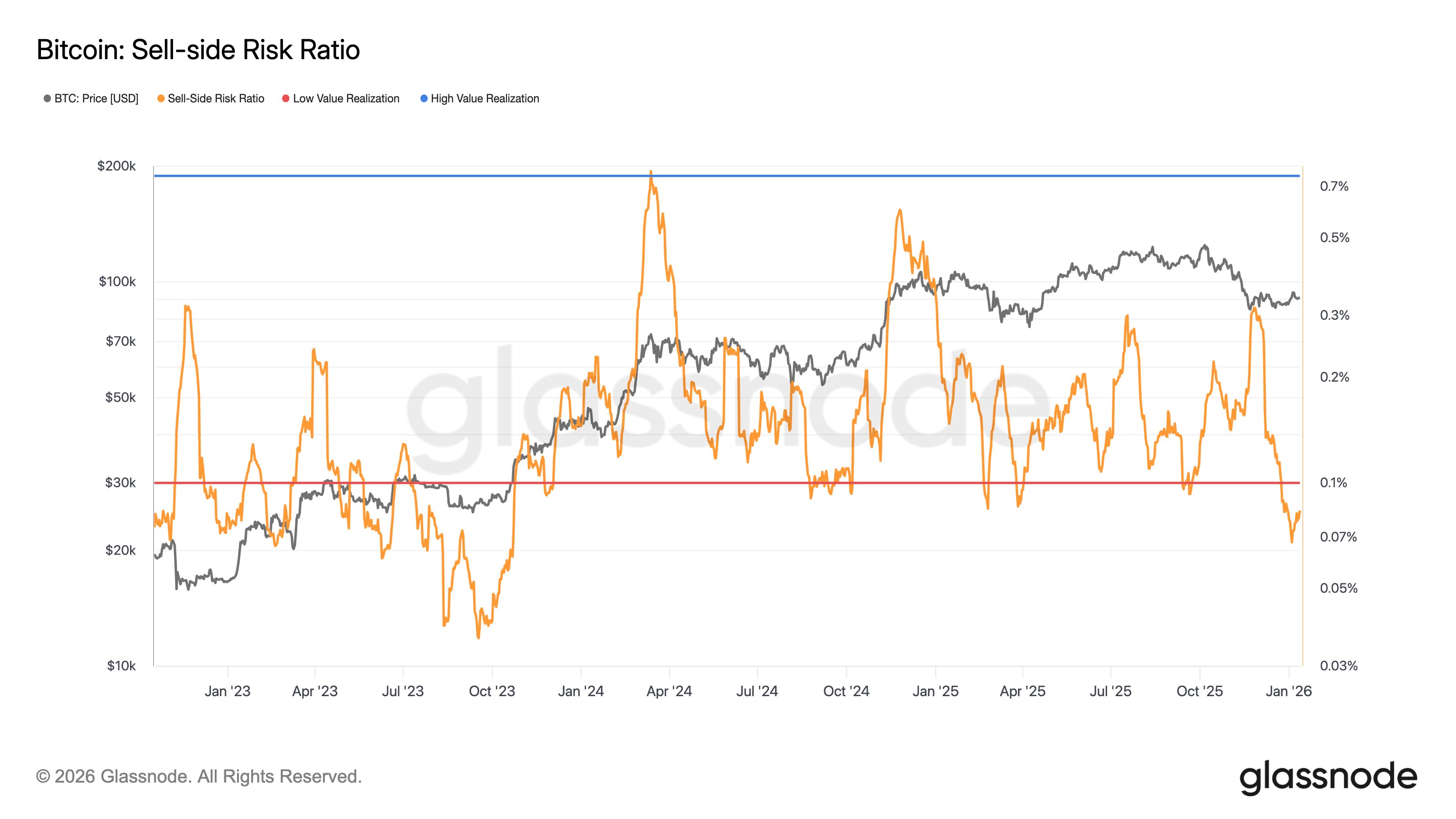
Bitcoin's Sell-Side Risk Ratio has recently plummeted to its lowest level since October 2023, indicating subdued investor conviction behind selling at current price levels. This on-chain metric, which measures the ratio of realized profits and losses against Bitcoin's Realized Cap, had spiked during November's price crash but has since declined sharply. The drop suggests reduced market activity and lower volatility. Additionally, retail investor demand remains weak, with a key metric tracking small transactions staying negative despite recent price gains. At the time of writing, Bitcoin is trading around $94,300, up over 3% in 24 hours.

On-chain data shows the Bitcoin Sell-Side Risk Ratio has plummeted recently. Here’s what this could suggest for the cryptocurrency.

Bitcoin Sell-Side Risk Ratio Has Fallen To Multi-Year Lows

In a new post on X, Glassnode analyst Chris Beamish has talked about the latest trend in the Bitcoin Sell-Side Risk Ratio, an on-chain indicator that keeps track of the ratio between the sum of all profits and losses realized on the network and the cryptocurrency’s Realized Cap.

The Realized Cap here refers to a capitalization model that calculates BTC’s total value by assuming that the value of each coin in circulation is equal to the price at which it was last transacted on the blockchain.

The last transfer price of any token is likely to represent its cost basis, so the Realized Cap measures the sum of the cost bases of the total BTC supply. In other words, it represents the total amount of capital that the investors have put into the cryptocurrency.

As such, the Sell-Side Risk Ratio tells us about how the amount of profit and loss that Bitcoin investors are realizing compares against the total capital stored in the asset.

Now, here is the chart for the indicator shared by Beamish that shows how its value has changed over the last few years:

The value of the metric seems to have plummeted in recent weeks | Source: @ChrisBeamish_ on X

As displayed in the above graph, the Bitcoin Sell-Side Risk Ratio shot up to a notable value with the price crash in November. This suggests that investors took a large amount of profit and loss alongside the volatility.

Since this high, the indicator’s value has seen a steep drop and has returned to the lowest level since October 2023. The analyst has noted that this points to “subdued conviction behind distribution at current price levels.”

Typically, market volatility tends to be low when these conditions form, so it only remains to be seen how the price of the cryptocurrency will develop in the near future.

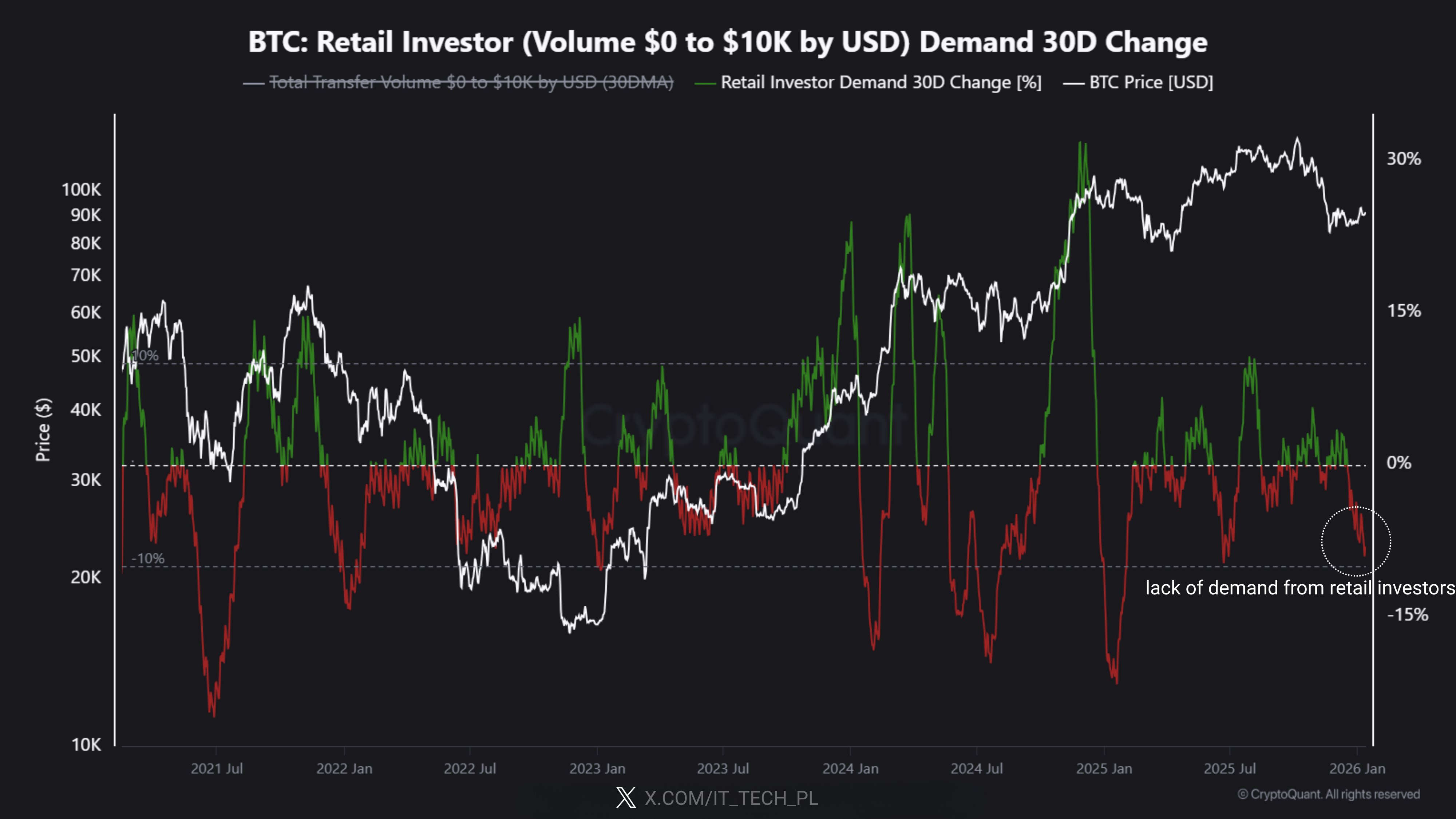
In some other news, demand from the Bitcoin retail investors has been missing recently, as CryptoQuant author IT Tech has pointed out in an X post. The indicator cited by IT Tech is the 30-day change in the Retail Investor Demand, measuring the percentage change in the volume associated with the small hands (transactions valued at less than $10,000).

Looks like the value of the indicator has been negative recently | Source: @IT_Tech_PL on X

As is visible in the chart, the 30-day change in the Bitcoin Retail Investor Demand has been declining inside the negative zone recently, implying that the activity of the retail entities has been going down. The indicator’s trend hasn’t changed even after the recent recovery surge.

BTC Price

At the time of writing, Bitcoin is trading around $94,300, up more than 3% over the last 24 hours.

The trend in the price of the coin over the last month | Source: BTCUSDT on TradingView

Связанные с этим вопросы

QWhat is the Bitcoin Sell-Side Risk Ratio and what does it measure?

AThe Bitcoin Sell-Side Risk Ratio is an on-chain indicator that tracks the ratio between the sum of all profits and losses realized on the network and Bitcoin's Realized Cap. It measures how the amount of profit and loss that Bitcoin investors are realizing compares against the total capital stored in the asset.

QWhat does the recent drop in Bitcoin Sell-Side Risk Ratio to October 2023 lows indicate?

AThe recent drop in the Bitcoin Sell-Side Risk Ratio to the lowest level since October 2023 indicates 'subdued conviction behind distribution at current price levels,' suggesting reduced selling pressure and typically low market volatility during such conditions.

QWhat is Bitcoin's Realized Cap and how is it calculated?

ABitcoin's Realized Cap is a capitalization model that calculates BTC's total value by assuming that the value of each coin in circulation is equal to the price at which it was last transacted on the blockchain. It represents the sum of the cost bases of the total BTC supply, measuring the total amount of capital investors have put into the cryptocurrency.

QWhat does the trend in Bitcoin Retail Investor Demand indicate according to the article?

AAccording to the article, the 30-day change in Bitcoin Retail Investor Demand has been declining in the negative zone recently, indicating that retail investor activity (transactions valued at less than $10,000) has been decreasing, and this trend hasn't changed even after the recent price surge.

QWhat was Bitcoin's price at the time of writing and how much had it increased?

AAt the time of writing, Bitcoin was trading around $94,300, up more than 3% over the last 24 hours.

Похожее

U.S. Stock Market Trend: Nasdaq Plunges 3.5% Intraday Before a Remarkable Recovery, All Eyes on CPI Tomorrow

"US Stock Market Trends: Nasdaq Plunges 3.5% Before Dramatic Recovery, Eyes on Tomorrow's CPI" On Tuesday, US markets experienced a wild swing. The Nasdaq initially surged nearly 0.7% before plummeting to a 3.5% intraday loss following a post by Donald Trump on Truth Social. He stated that Iran had shot down a US Apache helicopter in the Strait of Hormuz and that the US "must...respond." The index, however, staged a remarkable recovery in the final two hours, closing down only 0.97%, as subsequent remarks from Trump and Vice President Vance suggested a potential Iran deal within days. The S&P 500 fell 0.26%, while the Dow Jones gained 0.17%, supported by its non-tech components. This incident marked the first loss of a US military asset since tensions with Iran escalated in late February. Despite the event, crude oil prices fell sharply (WTI -3.93%) due to expectations of a near-term deal, OPEC+ plans to increase output, and fears that strong jobs data could lead to Fed rate hikes. Market attention is now laser-focused on the May CPI data release Wednesday morning. This report is seen as critical evidence for whether hot job growth is fueling inflation and will heavily influence expectations for the Federal Reserve's upcoming meeting. A hotter-than-expected reading could trigger further sell-offs, particularly in tech, while a cooler print could spark a significant rebound. The article notes a clear sector rotation, with money flowing out of tech (Nasdaq down over 5% in a week) into defensive sectors like healthcare and consumer staples. Other assets like gold and Bitcoin also remain under pressure. The overarching sentiment is one of "war fatigue," with markets desperately awaiting concrete results from the prolonged Iran negotiations rather than reacting to each new headline.

marsbit8 мин. назад

U.S. Stock Market Trend: Nasdaq Plunges 3.5% Intraday Before a Remarkable Recovery, All Eyes on CPI Tomorrow

marsbit8 мин. назад

Second Only to GPUs and Memory: MLCCs Are Becoming the Next Billion-Dollar Windfall for AI Computing Power

After GPU and memory, MLCC (Multi-Layer Ceramic Capacitors) is emerging as the next critical component in AI compute, potentially a multi-billion-dollar market. The article highlights a significant, industry-wide price increase for MLCCs, driven not by inventory cycles but by a fundamental, structural demand surge from AI and automotive sectors. AI servers require exponentially more MLCCs than traditional servers—from 2,000 to over 350,000 units per high-end AI rack—primarily to stabilize power for increasingly powerful, low-voltage GPUs. A key AI server's MLCC cost can reach thousands of dollars, making it the third-largest cost component after GPUs and memory. This demand is compounded by the automotive shift to EVs and advanced ADAS. Supply, however, struggles to keep up. Manufacturing high-end MLCCs involves extreme precision and faces six major barriers: proprietary technology, long customer certification cycles (12-18 months for AI), high capital intensity, patent thickets, specialized talent, and massive scale. Industry capacity grows at only ~10% annually, creating a persistent supply-demand gap projected to last until 2030. Three companies dominate this high-end market. **Murata** (40% global share) is the stable leader. **Samsung Electro-Mechanics** offers the highest growth elasticity with aggressive expansion. **Taiyo Yuden** is the purest MLCC play. While their current P/E ratios appear high, they are expected to compress rapidly as earnings surge, powered by significant pricing power and operational leverage. Key risks include a potential slowdown in AI capex, high valuations, competition from Chinese manufacturers in lower tiers, yen appreciation, and consumer electronics weakness. The article concludes that MLCCs are transforming from a commoditized component into a strategic, capacity-constrained asset essential for the AI-powered future.

marsbit38 мин. назад

Second Only to GPUs and Memory: MLCCs Are Becoming the Next Billion-Dollar Windfall for AI Computing Power

marsbit38 мин. назад

The First to Bring an AI OS to 1.4 Billion People Might Actually Be WeChat?

WeChat has introduced a significant AI update, allowing mini-program developers to integrate their services with WeChat AI. Developers can choose an "automatic mode," where WeChat AI autonomously analyzes and operates mini-programs without additional coding, or a "development mode" for creating customized skills. This move effectively transforms WeChat's vast ecosystem—including millions of mini-programs, WeChat Pay, and official accounts—into an execution layer for AI. The technical documentation reveals that WeChat's approach aligns with industry standards like MCP (Model Context Protocol) and incorporates practical lessons from AI-agent development. Key design principles include a clear "attention weight" system for API calls and a "fact + action" response structure to ensure reliable operations. Unlike Apple's Siri, which struggles with third-party app integration, WeChat's centralized control over mini-program code provides a "God's-eye view," enabling seamless AI orchestration across services. This development revives the concept of "WeChat OS," where the app could function as a natural-language-operated platform for daily tasks—from booking flights to ordering food—all within a chat interface. While challenges remain in areas like payment security and user trust, WeChat's existing service network and massive user base position it uniquely to advance AI agents from conversation to actionable assistance, potentially making complex tasks feel effortless for its 1.432 billion monthly active users.

marsbit1 ч. назад

The First to Bring an AI OS to 1.4 Billion People Might Actually Be WeChat?

marsbit1 ч. назад

Торговля

Спот
Фьючерсы

Популярные статьи

Тест по Bitcoin Биткоина

HTX Learn: Изучите Bitcoin halving и Заработаете Токены USDT

3.1k просмотров всегоОпубликовано 2024.04.16Обновлено 2024.04.16

Тест по Bitcoin  Биткоина

Что такое $BITCOIN

ЦИФРОВОЕ ЗОЛОТО ($BITCOIN): Комплексный анализ Введение в ЦИФРОВОЕ ЗОЛОТО ($BITCOIN) ЦИФРОВОЕ ЗОЛОТО ($BITCOIN) — это проект на основе блокчейна, работающий в сети Solana, который стремится объединить характеристики традиционных драгоценных металлов с инновациями децентрализованных технологий. Хотя он носит имя Биткойн, часто называемого “цифровым золотом” из-за его восприятия как средства хранения ценности, ЦИФРОВОЕ ЗОЛОТО является отдельным токеном, предназначенным для создания уникальной экосистемы в ландшафте Web3. Его цель — позиционировать себя как жизнеспособный альтернативный цифровой актив, хотя детали его применения и функциональности все еще развиваются. Что такое ЦИФРОВОЕ ЗОЛОТО ($BITCOIN)? ЦИФРОВОЕ ЗОЛОТО ($BITCOIN) — это токен криптовалюты, специально разработанный для использования в блокчейне Solana. В отличие от Биткойна, который выполняет широко признанную роль хранения ценности, этот токен, похоже, сосредоточен на более широких приложениях и характеристиках. Примечательные аспекты включают: Инфраструктура блокчейна: Токен построен на блокчейне Solana, известном своей способностью обрабатывать высокоскоростные и недорогие транзакции. Динамика предложения: ЦИФРОВОЕ ЗОЛОТО имеет максимальное предложение, ограниченное 100 квадриллионами токенов (100P $BITCOIN), хотя детали о его обращающемся предложении в настоящее время не раскрыты. Утилита: Хотя точные функциональные возможности не описаны, есть указания на то, что токен может быть использован для различных приложений, потенциально связанных с децентрализованными приложениями (dApps) или стратегиями токенизации активов. Кто создатель ЦИФРОВОГО ЗОЛОТА ($BITCOIN)? На данный момент личность создателей и команды разработчиков, стоящих за ЦИФРОВЫМ ЗОЛОТОМ ($BITCOIN), остается неизвестной. Эта ситуация типична для многих инновационных проектов в области блокчейна, особенно тех, которые связаны с децентрализованными финансами и феноменом мем-криптовалют. Хотя такая анонимность может способствовать культуре, ориентированной на сообщество, она усиливает опасения по поводу управления и ответственности. Кто инвесторы ЦИФРОВОГО ЗОЛОТА ($BITCOIN)? Доступная информация указывает на то, что у ЦИФРОВОГО ЗОЛОТА ($BITCOIN) нет известных институциональных спонсоров или значительных венчурных капиталовложений. Проект, похоже, функционирует по модели пирингового взаимодействия, сосредоточенной на поддержке и принятии сообществом, а не на традиционных путях финансирования. Его активность и ликвидность в основном сосредоточены на децентрализованных биржах (DEX), таких как PumpSwap, а не на устоявшихся централизованных торговых платформах, что еще больше подчеркивает его подход, ориентированный на grassroots. Как работает ЦИФРОВОЕ ЗОЛОТО ($BITCOIN) Операционные механизмы ЦИФРОВОГО ЗОЛОТА ($BITCOIN) можно подробно описать на основе его дизайна блокчейна и характеристик сети: Механизм консенсуса: Используя уникальный механизм доказательства истории (PoH) Solana в сочетании с моделью доказательства доли (PoS), проект обеспечивает эффективную валидацию транзакций, что способствует высокой производительности сети. Токеномика: Хотя конкретные дефляционные механизмы не были подробно описаны, большое максимальное предложение токенов подразумевает, что оно может быть предназначено для микротранзакций или нишевых случаев использования, которые еще предстоит определить. Интероперабельность: Существует потенциал для интеграции с более широкой экосистемой Solana, включая различные платформы децентрализованных финансов (DeFi). Однако детали относительно конкретных интеграций остаются неуточненными. Хронология ключевых событий Вот хронология, которая подчеркивает значимые вехи, касающиеся ЦИФРОВОГО ЗОЛОТА ($BITCOIN): 2023: Первоначальное развертывание токена происходит в блокчейне Solana, отмеченное его адресом контракта. 2024: ЦИФРОВОЕ ЗОЛОТО приобретает видимость, когда оно становится доступным для торговли на децентрализованных биржах, таких как PumpSwap, позволяя пользователям обменивать его на SOL. 2025: Проект наблюдает спорадическую торговую активность и потенциальный интерес к инициативам, возглавляемым сообществом, хотя на данный момент не зафиксировано никаких значительных партнерств или технических достижений. Критический анализ Сильные стороны Масштабируемость: Основная инфраструктура Solana поддерживает высокие объемы транзакций, что может повысить полезность $BITCOIN в различных сценариях транзакций. Доступность: Потенциально низкая цена торговли за токен может привлечь розничных инвесторов, способствуя более широкому участию благодаря возможностям дробного владения. Риски Отсутствие прозрачности: Отсутствие публично известных спонсоров, разработчиков или процесса аудита может вызвать скептицизм относительно устойчивости и надежности проекта. Волатильность рынка: Торговая активность сильно зависит от спекулятивного поведения, что может привести к значительной волатильности цен и неопределенности для инвесторов. Заключение ЦИФРОВОЕ ЗОЛОТО ($BITCOIN) является интригующим, но неоднозначным проектом в быстро развивающейся экосистеме Solana. Хотя он пытается использовать нарратив “цифрового золота”, его отход от установленной роли Биткойна как средства хранения ценности подчеркивает необходимость более четкого различения его предполагаемой утилиты и структуры управления. Будущее принятие и усвоение, вероятно, будут зависеть от решения текущей непрозрачности и более четкого определения его операционных и экономических стратегий. Примечание: Этот отчет охватывает синтезированную информацию, доступную на октябрь 2023 года, и с тех пор могут произойти события.

99 просмотров всегоОпубликовано 2025.05.13Обновлено 2025.05.13

Что такое $BITCOIN

Fractal Bitcoin: масштабирование Биткоина с помощью рекурсивной системы

Fractal Bitcoin — масштабное Layer-1-решнение, созданное на базе кода Биткоина, позволяющего достигать бесконечного масштабирования с помощью рекурсивного подхода.

2.3k просмотров всегоОпубликовано 2025.06.30Обновлено 2025.06.30

Fractal Bitcoin: масштабирование Биткоина с помощью рекурсивной системы

Обсуждения

Добро пожаловать в Сообщество HTX. Здесь вы сможете быть в курсе последних новостей о развитии платформы и получить доступ к профессиональной аналитической информации о рынке. Мнения пользователей о цене на BTC (BTC) представлены ниже.

活动图片