Bitcoin reclaims $70K – But BTC bulls are still taking the hit

ambcryptoОпубликовано 2026-03-19Обновлено 2026-03-19

Введение

Bitcoin briefly reclaimed the $70,000 level after bouncing from the $65,000-$66,500 support zone. However, the rebound lacks conviction, with low trading volume, muted funding rates, and a significant drop in Open Interest indicating weak buyer participation. The advance is primarily driven by short covering rather than fresh demand. Despite the price increase, long liquidations of $395 million vastly exceeded short liquidations, causing more pain for bulls. Repeated rejections near key resistance levels ($71,400-$75,600) and the 50-day EMA suggest persistent selling pressure. Without a strong close above $73,000-$74,500, BTC remains vulnerable to a pullback toward the $65,000 support zone.

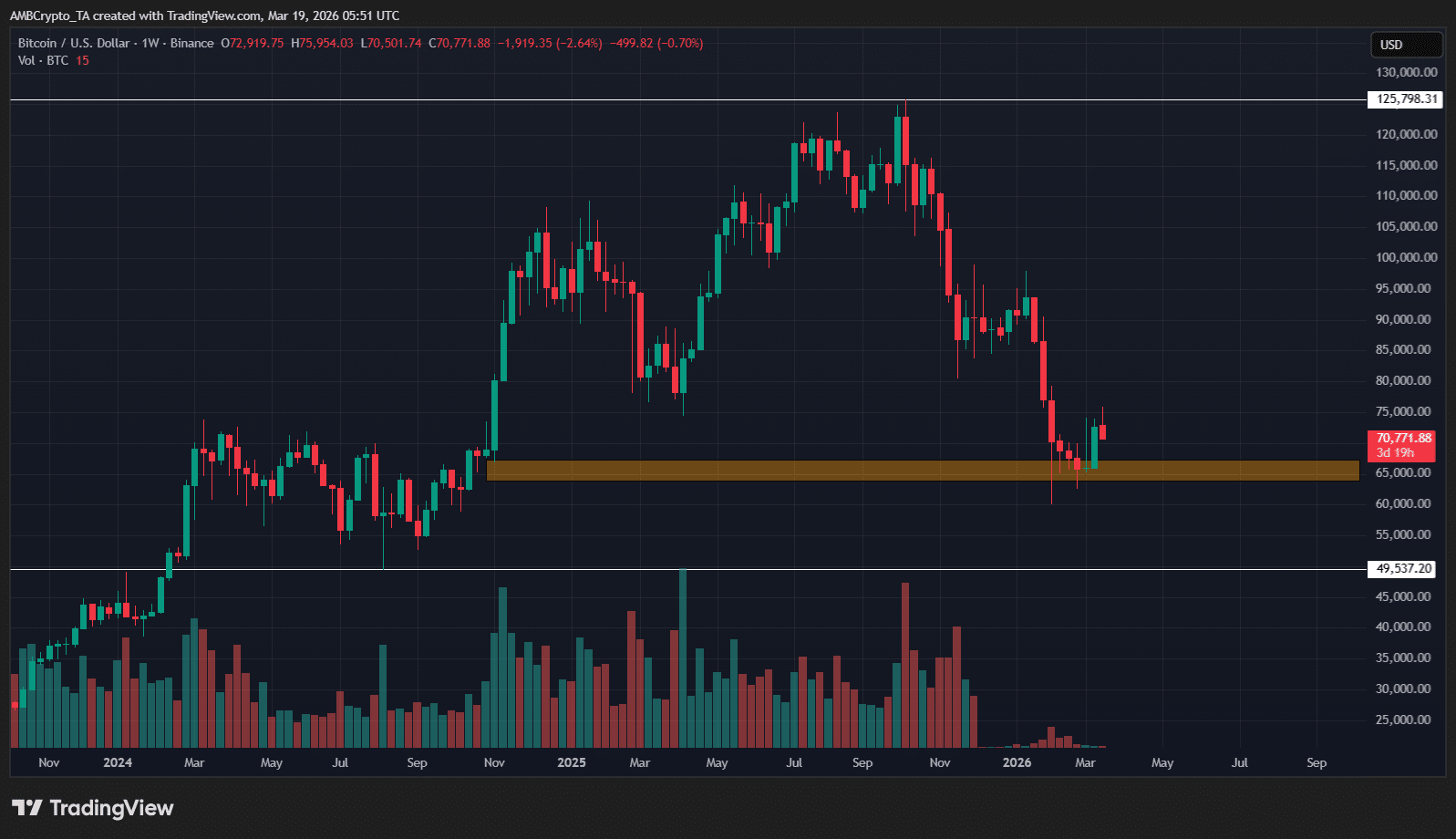
Bitcoin [BTC] traded near $70,800 at press time after rebounding from the $65,000 demand zone, which aligned with the highlighted support band between $64,500 and $66,500.

Initially, price reacted strongly within this zone, forming a base after multiple tests, while buyers stepped in to absorb selling pressure. As a result, recent candles showed a short-term recovery, with price pushing back above $70,000.

Source: TradingView

However, this rebound remains tentative, as price struggles to extend toward the $71,400–$75,600 supply region. Upper wicks on recent candles suggest early signs of rejection, while bodies lack strong follow-through.

Meanwhile, volume remained relatively muted during the advance, contrasting with heavier participation seen during prior declines.

Bitcoin’s upside lacks conviction as derivatives cool off

As momentum builds gradually, the $65,000–$66,500 zone continues to define the current value area. Unless buyers sustain pressure above $71,000 and push toward $74,000, the price may rotate back to retest support, maintaining a range-bound structure.

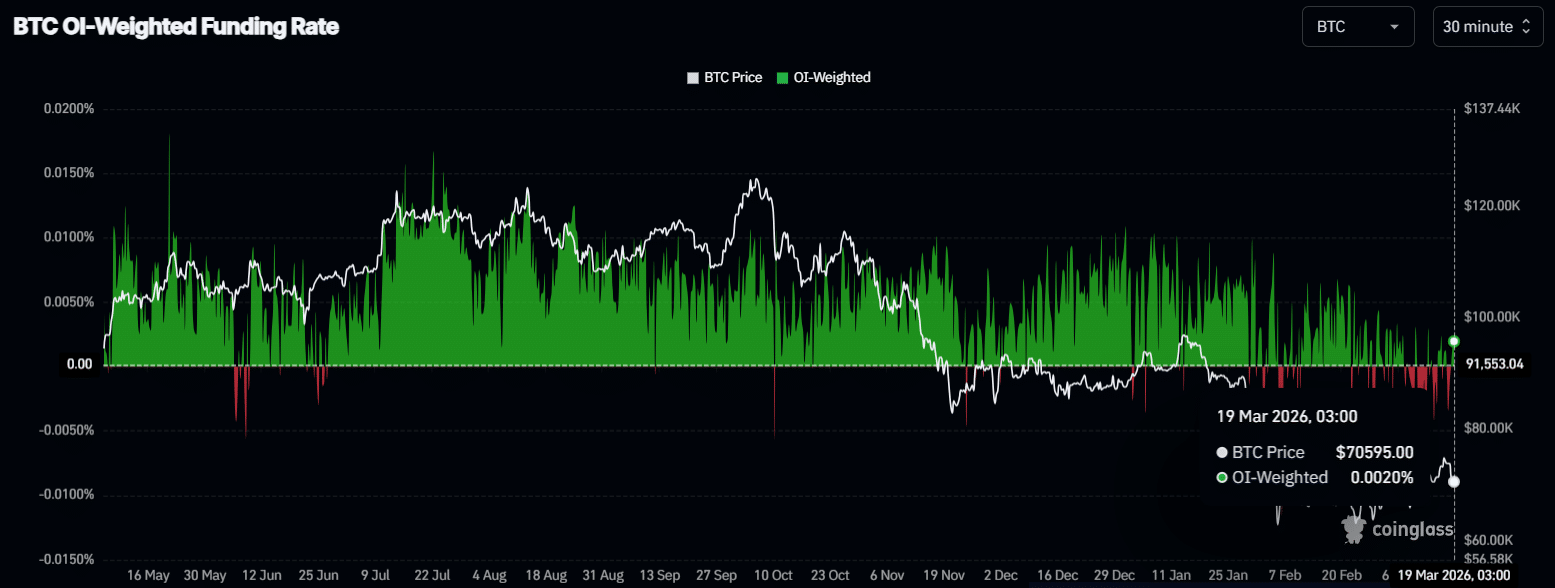
Bitcoin edges higher, yet derivatives positioning reveals a fragile foundation beneath the move. Initially, Funding Rates remained mildly positive, with Binance at 0.0001% and the OI-Weighted average near 0.0020%, signaling restrained participation rather than aggressive bidding.

Source: CoinGlass

As price lifts, this subdued backdrop suggests that the move leans on short trimming, not fresh demand.

At the same time, liquidation data reinforced this imbalance, as only $74 million in shorts closed against $395 million in long liquidations. Despite the price being high, the pain is being felt by the bulls, which usually precedes a deeper flush.

Meanwhile, Open Interest dropped to approximately $48.5 billion, down 4.8% in 24 hours, reflecting position closure.

As this unfolds, momentum fades quickly after each upward push, with long positions unwinding soon after. Without a sustained rebuild in Open Interest alongside price strength, the advance risks fading, leaving Bitcoin vulnerable to another pullback.

Bitcoin’s structure remains fragile

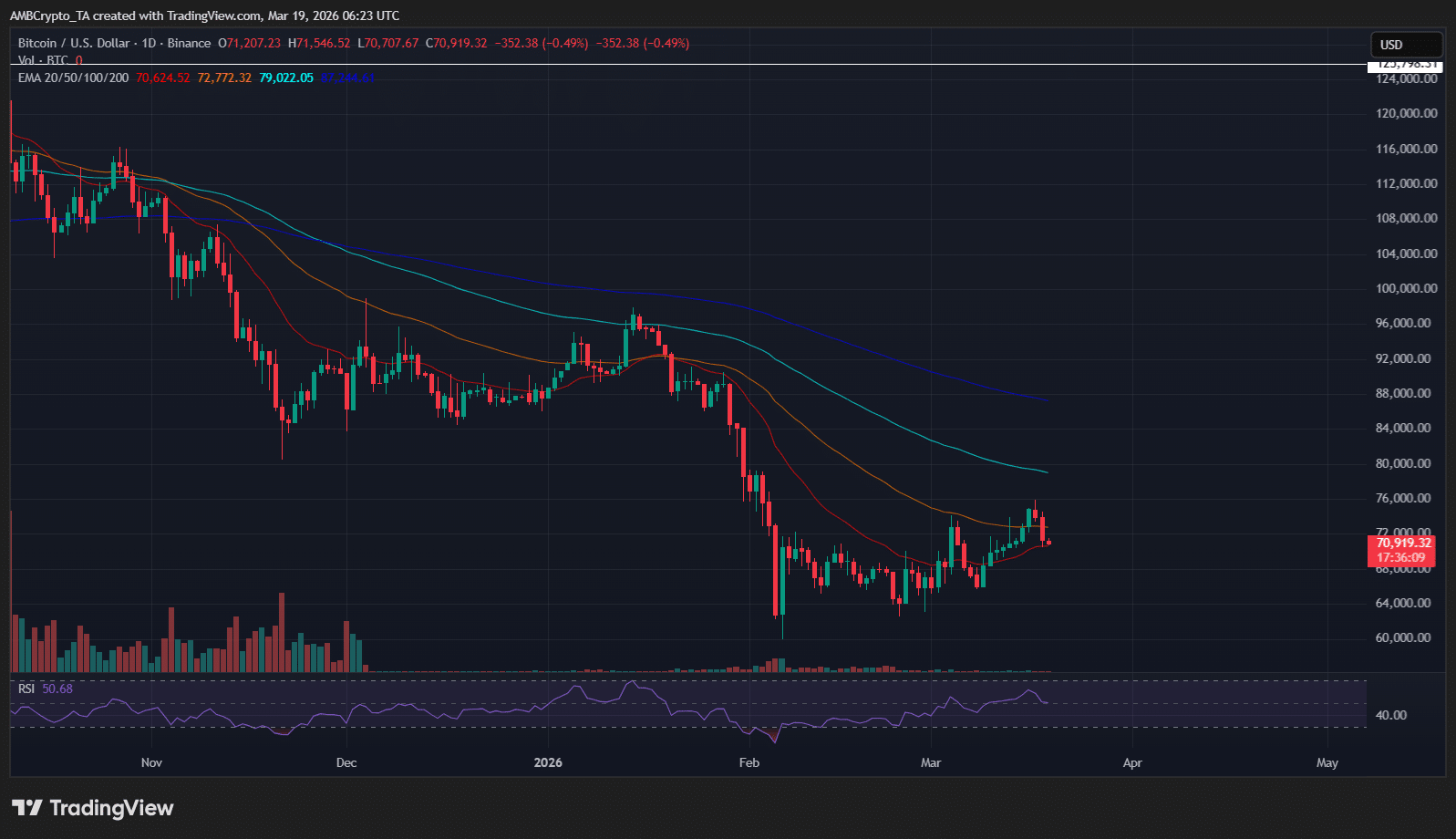
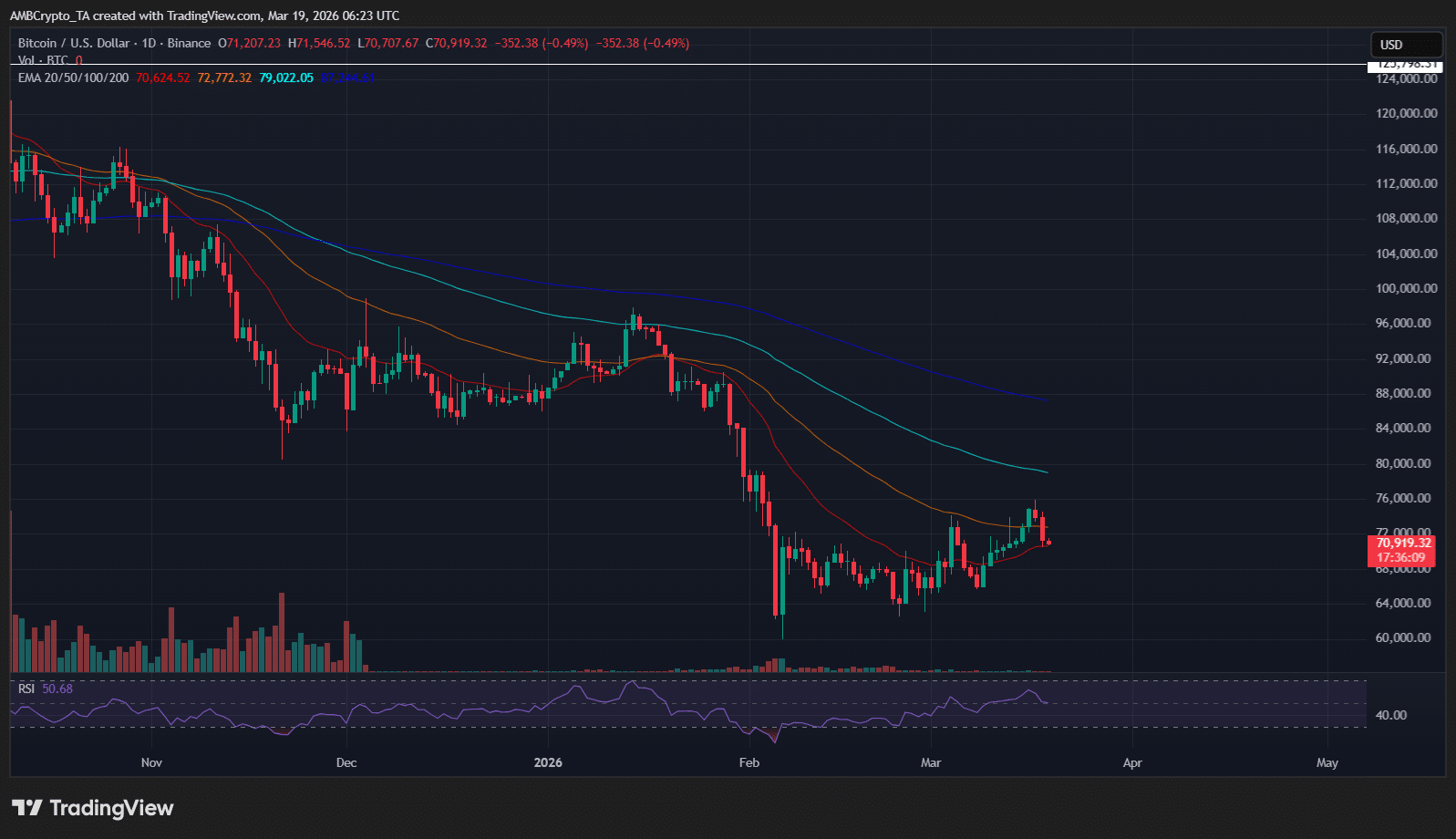
Price hovered just above the 20-day EMA at $70,624 at the time of writing, yet momentum remained uncertain. Initially, BTC attempted to stabilize after rebounding from sub-$65,000 levels, forming a short-term base.

However, as price approached the 50-day EMA at $72,772, repeated rejections emerged, with upper wicks near $74,500 signaling persistent supply.

Source: TradingView

The structure reflects hesitation rather than strength, as candles failed to close decisively above key moving averages. The RSI held near 50.68, indicating neutral momentum and a lack of strong directional bias.

For now, buying pressure appears limited, with no clear expansion in participation.

Unless price reclaims the $73,000–$74,500 zone with conviction, the move risks fading, while it may gradually rotate back toward deeper support levels established earlier.


Final Summary

  • Bitcoin’s rebound above $70,000 shows weak conviction, as muted volume, soft funding, and $395 million in longs outweigh limited short covering.
    Bitcoin remains capped below $71,400–$75,600 resistance, and without a strong close above $73,000–$74,500, a downside toward $65,000–$66,500 stays likely.

Связанные с этим вопросы

QWhat was the key demand zone that Bitcoin rebounded from according to the article?

ABitcoin rebounded from the $65,000 demand zone, which aligned with the support band between $64,500 and $66,500.

QWhat does the data on liquidations reveal about who was most affected during the price move?

AThe liquidation data shows that the pain was felt by the bulls, with $395 million in long liquidations compared to only $74 million in short liquidations.

QWhy does the article suggest that Bitcoin's recent price advance lacks conviction and is at risk of fading?

AThe advance lacks conviction due to muted volume, a drop in Open Interest, subdued funding rates, and the fact that the move appears to be driven by short trimming rather than fresh demand. Without a sustained rebuild in Open Interest, the move risks fading.

QWhat are the two key resistance levels that Bitcoin needs to overcome to avoid a pullback, as mentioned in the final summary?

ABitcoin needs to achieve a strong close above the $73,000–$74,500 zone and break through the $71,400–$75,600 supply region to avoid a pullback.

QWhat did the RSI level and the position relative to the 20-day and 50-day EMAs indicate about Bitcoin's momentum?

AThe RSI held near 50.68, indicating neutral momentum and a lack of strong directional bias. The price was hovering just above the 20-day EMA at $70,624 but faced repeated rejections at the 50-day EMA at $72,772, signaling hesitation.

Похожее

Gensyn AI: Don't Let AI Repeat the Mistakes of the Internet

In recent months, the rapid growth of the AI industry has attracted significant talent from the crypto sector. A persistent question among researchers intersecting both fields is whether blockchain can become a foundational part of AI infrastructure. While many previous AI and Crypto projects focused on application layers (like AI Agents, on-chain reasoning, data markets, and compute rentals), few achieved viable commercial models. Gensyn differentiates itself by targeting the most critical and expensive layer of AI: model training. Gensyn aims to organize globally distributed GPU resources into an open AI training network. Developers can submit training tasks, nodes provide computational power, and the network verifies results while distributing incentives. The core issue addressed is not decentralization for its own sake, but the increasing centralization of compute power among tech giants. In the era of large models, access to GPUs (like the H100) has become a decisive bottleneck, dictating the pace of AI development. Major AI companies are heavily dependent on large cloud providers for compute resources. Gensyn's approach is significant for several reasons: 1) It operates at the core infrastructure layer (model training), the most resource-intensive and technically demanding part of the AI value chain. 2) It proposes a more open, collaborative model for compute, potentially increasing resource utilization by dynamically pooling idle GPUs, similar to early cloud computing logic. 3) Its technical moat lies in solving complex challenges like verifying training results, ensuring node honesty, and maintaining reliability in a distributed environment—making it more of a deep-tech infrastructure company. 4) It targets a validated, high-growth market with genuine demand, rather than pursuing blockchain integration without purpose. Ultimately, the boundaries between Crypto and AI are blurring. AI requires global resource coordination, incentive mechanisms, and collaborative systems—areas where crypto-native solutions excel. Gensyn represents a step toward making advanced training capabilities more accessible and collaborative, moving beyond a niche controlled by a few giants. If successful, it could evolve into a fundamental piece of AI infrastructure, where the most enduring value in the AI era is often created.

marsbit10 ч. назад

Gensyn AI: Don't Let AI Repeat the Mistakes of the Internet

marsbit10 ч. назад

Why is China's AI Developing So Fast? The Answer Lies Inside the Labs

A US researcher's visit to China's top AI labs reveals distinct cultural and organizational factors driving China's rapid AI development. While talent, data, and compute are similar to the West, Chinese labs excel through a pragmatic, execution-focused culture: less emphasis on individual stardom and conceptual debate, and more on teamwork, engineering optimization, and mastering the full tech stack. A key advantage is the integration of young students and researchers who approach model-building with fresh perspectives and low ego, prioritizing collective progress over personal credit. This contrasts with the US culture of self-promotion and "star scientist" narratives. Chinese labs also exhibit a strong "build, don't buy" mentality, preferring to develop core capabilities—like data pipelines and environments—in-house rather than relying on external services. The ecosystem feels more collaborative than tribal, with mutual respect among labs. While government support exists, its scale is unclear, and technical decisions appear driven by labs, not state mandates. Chinese companies across sectors, from platforms to consumer tech, are building their own foundational models to control their tech destiny, reflecting a broader cultural drive for technological sovereignty. Demand for AI is emerging, with spending patterns potentially mirroring cloud infrastructure more than traditional SaaS. Despite challenges like a less mature data industry and GPU shortages, Chinese labs are propelled by vast talent, rapid iteration, and deep integration with the open-source community. The competition is evolving beyond a pure model race into a contest of organizational execution, developer ecosystems, and industrial pragmatism.

marsbit11 ч. назад

Why is China's AI Developing So Fast? The Answer Lies Inside the Labs

marsbit11 ч. назад

3 Years, 5 Times: The Rebirth of a Century-Old Glass Factory

Corning, a 175-year-old glass company, is experiencing a dramatic revival as a key player in AI infrastructure, driven by surging demand for high-performance optical fiber in data centers. AI data centers require vastly more fiber than traditional ones—5 to 10 times as much per rack—to handle high-speed data transmission between GPUs. This structural demand shift, coupled with supply constraints from the lengthy expansion cycle for fiber preforms, has created a significant supply-demand gap. Nvidia has invested in Corning, along with Lumentum and Coherent, in a $4.5 billion total commitment to secure the optical supply chain for AI. Corning's competitive edge lies in its expertise in producing ultra-low-loss, high-density, and bend-resistant specialty fiber, which is critical for 800G+ and future 1.6T data rates. Its deep involvement in co-packaged optics (CPO) with partners like Nvidia further solidifies its position. While not the largest fiber manufacturer globally, Corning's revenue from enterprise/data center clients now exceeds 40% of its optical communications sales, and it has secured multi-year supply agreements with major hyperscalers including Meta and Nvidia. Financially, Corning's optical communications revenue has surged, doubling from $1.3 billion in 2023 to over $3 billion in 2025. Its stock price has risen nearly 6-fold since late 2023. Key future catalysts include the rollout of Nvidia's CPO products and the scale of undisclosed customer agreements. However, risks include high current valuations and potential disruption from next-generation technologies like hollow-core fiber. The company's long-term bet on light over electricity, maintained even through the telecom bubble crash, is now being validated by the AI boom.

marsbit12 ч. назад

3 Years, 5 Times: The Rebirth of a Century-Old Glass Factory

marsbit12 ч. назад

Торговля

Спот
Фьючерсы

Популярные статьи

Тест по Bitcoin Биткоина

HTX Learn: Изучите Bitcoin halving и Заработаете Токены USDT

3.0k просмотров всегоОпубликовано 2024.04.16Обновлено 2024.04.16

Тест по Bitcoin  Биткоина

Что такое $BITCOIN

ЦИФРОВОЕ ЗОЛОТО ($BITCOIN): Комплексный анализ Введение в ЦИФРОВОЕ ЗОЛОТО ($BITCOIN) ЦИФРОВОЕ ЗОЛОТО ($BITCOIN) — это проект на основе блокчейна, работающий в сети Solana, который стремится объединить характеристики традиционных драгоценных металлов с инновациями децентрализованных технологий. Хотя он носит имя Биткойн, часто называемого “цифровым золотом” из-за его восприятия как средства хранения ценности, ЦИФРОВОЕ ЗОЛОТО является отдельным токеном, предназначенным для создания уникальной экосистемы в ландшафте Web3. Его цель — позиционировать себя как жизнеспособный альтернативный цифровой актив, хотя детали его применения и функциональности все еще развиваются. Что такое ЦИФРОВОЕ ЗОЛОТО ($BITCOIN)? ЦИФРОВОЕ ЗОЛОТО ($BITCOIN) — это токен криптовалюты, специально разработанный для использования в блокчейне Solana. В отличие от Биткойна, который выполняет широко признанную роль хранения ценности, этот токен, похоже, сосредоточен на более широких приложениях и характеристиках. Примечательные аспекты включают: Инфраструктура блокчейна: Токен построен на блокчейне Solana, известном своей способностью обрабатывать высокоскоростные и недорогие транзакции. Динамика предложения: ЦИФРОВОЕ ЗОЛОТО имеет максимальное предложение, ограниченное 100 квадриллионами токенов (100P $BITCOIN), хотя детали о его обращающемся предложении в настоящее время не раскрыты. Утилита: Хотя точные функциональные возможности не описаны, есть указания на то, что токен может быть использован для различных приложений, потенциально связанных с децентрализованными приложениями (dApps) или стратегиями токенизации активов. Кто создатель ЦИФРОВОГО ЗОЛОТА ($BITCOIN)? На данный момент личность создателей и команды разработчиков, стоящих за ЦИФРОВЫМ ЗОЛОТОМ ($BITCOIN), остается неизвестной. Эта ситуация типична для многих инновационных проектов в области блокчейна, особенно тех, которые связаны с децентрализованными финансами и феноменом мем-криптовалют. Хотя такая анонимность может способствовать культуре, ориентированной на сообщество, она усиливает опасения по поводу управления и ответственности. Кто инвесторы ЦИФРОВОГО ЗОЛОТА ($BITCOIN)? Доступная информация указывает на то, что у ЦИФРОВОГО ЗОЛОТА ($BITCOIN) нет известных институциональных спонсоров или значительных венчурных капиталовложений. Проект, похоже, функционирует по модели пирингового взаимодействия, сосредоточенной на поддержке и принятии сообществом, а не на традиционных путях финансирования. Его активность и ликвидность в основном сосредоточены на децентрализованных биржах (DEX), таких как PumpSwap, а не на устоявшихся централизованных торговых платформах, что еще больше подчеркивает его подход, ориентированный на grassroots. Как работает ЦИФРОВОЕ ЗОЛОТО ($BITCOIN) Операционные механизмы ЦИФРОВОГО ЗОЛОТА ($BITCOIN) можно подробно описать на основе его дизайна блокчейна и характеристик сети: Механизм консенсуса: Используя уникальный механизм доказательства истории (PoH) Solana в сочетании с моделью доказательства доли (PoS), проект обеспечивает эффективную валидацию транзакций, что способствует высокой производительности сети. Токеномика: Хотя конкретные дефляционные механизмы не были подробно описаны, большое максимальное предложение токенов подразумевает, что оно может быть предназначено для микротранзакций или нишевых случаев использования, которые еще предстоит определить. Интероперабельность: Существует потенциал для интеграции с более широкой экосистемой Solana, включая различные платформы децентрализованных финансов (DeFi). Однако детали относительно конкретных интеграций остаются неуточненными. Хронология ключевых событий Вот хронология, которая подчеркивает значимые вехи, касающиеся ЦИФРОВОГО ЗОЛОТА ($BITCOIN): 2023: Первоначальное развертывание токена происходит в блокчейне Solana, отмеченное его адресом контракта. 2024: ЦИФРОВОЕ ЗОЛОТО приобретает видимость, когда оно становится доступным для торговли на децентрализованных биржах, таких как PumpSwap, позволяя пользователям обменивать его на SOL. 2025: Проект наблюдает спорадическую торговую активность и потенциальный интерес к инициативам, возглавляемым сообществом, хотя на данный момент не зафиксировано никаких значительных партнерств или технических достижений. Критический анализ Сильные стороны Масштабируемость: Основная инфраструктура Solana поддерживает высокие объемы транзакций, что может повысить полезность $BITCOIN в различных сценариях транзакций. Доступность: Потенциально низкая цена торговли за токен может привлечь розничных инвесторов, способствуя более широкому участию благодаря возможностям дробного владения. Риски Отсутствие прозрачности: Отсутствие публично известных спонсоров, разработчиков или процесса аудита может вызвать скептицизм относительно устойчивости и надежности проекта. Волатильность рынка: Торговая активность сильно зависит от спекулятивного поведения, что может привести к значительной волатильности цен и неопределенности для инвесторов. Заключение ЦИФРОВОЕ ЗОЛОТО ($BITCOIN) является интригующим, но неоднозначным проектом в быстро развивающейся экосистеме Solana. Хотя он пытается использовать нарратив “цифрового золота”, его отход от установленной роли Биткойна как средства хранения ценности подчеркивает необходимость более четкого различения его предполагаемой утилиты и структуры управления. Будущее принятие и усвоение, вероятно, будут зависеть от решения текущей непрозрачности и более четкого определения его операционных и экономических стратегий. Примечание: Этот отчет охватывает синтезированную информацию, доступную на октябрь 2023 года, и с тех пор могут произойти события.

99 просмотров всегоОпубликовано 2025.05.13Обновлено 2025.05.13

Что такое $BITCOIN

Fractal Bitcoin: масштабирование Биткоина с помощью рекурсивной системы

Fractal Bitcoin — масштабное Layer-1-решнение, созданное на базе кода Биткоина, позволяющего достигать бесконечного масштабирования с помощью рекурсивного подхода.

2.2k просмотров всегоОпубликовано 2025.06.30Обновлено 2025.06.30

Fractal Bitcoin: масштабирование Биткоина с помощью рекурсивной системы

Обсуждения

Добро пожаловать в Сообщество HTX. Здесь вы сможете быть в курсе последних новостей о развитии платформы и получить доступ к профессиональной аналитической информации о рынке. Мнения пользователей о цене на BTC (BTC) представлены ниже.

活动图片