Bitcoin Price May Slide To $58,000, Galaxy Digital Warns

bitcoinistОпубликовано 2026-02-03Обновлено 2026-02-03

Введение

Galaxy Digital warns that Bitcoin's recent selloff may continue, potentially driving the cryptocurrency down toward $58,000 in the coming weeks or months. Analyst Alex Thorn points to on-chain data, weakening technical levels, and a lack of positive catalysts as key reasons for concern. The selloff, which saw a 15% drop late last month and triggered over $2 billion in long liquidations, pushed BTC below several important investor cost bases. Historically, drawdowns of this magnitude often extend toward 50% from the peak, which would imply a fall to approximately $63,000. Key levels to watch are the 200-week moving average and the realized price, both near the $58,000-$56,000 zone, which have acted as a gravitational pull in past cycles. Additionally, recent outflows from U.S. spot Bitcoin ETFs and a noticeable ownership "gap" in the $82,000–$70,000 range suggest there is light support, increasing the potential for a deeper decline. At the time of writing, Bitcoin traded at $78,301.

Galaxy Digital is warning that the Bitcoin selloff may not be finished, arguing that on-chain data, weakening technical levels, and a thin catalyst calendar leave BTC vulnerable to a deeper retracement toward the high-$50,000s over the coming weeks or months.

In a client note dated Feb. 1, 2026, Galaxy researcher Alex Thorn framed last week’s drawdown as more than a brief shakeout. Bitcoin fell 15% from Monday, Jan. 28 through Saturday, Jan. 31, with the move accelerating into the weekend. Saturday alone saw a 10% slide that, according to the note, triggered one of the largest liquidation events on record, wiping out more than $2 billion in long positions across futures venues.

Why The Next Weeks, Months Look Bearish For Bitcoin

The selloff pushed BTC as low as $75,644 on Coinbase and briefly drove the spot price below several widely watched investor cost bases. Thorn noted that BTC dipped as much as 10% beneath the average cost basis of US spot ETFs, estimated around $84,000 based on the prices at which creations occurred, before recovering some ground. At one point, BTC also pierced Strategy’s average cost basis of $76,037, and nearly revisited the 1-year low of $74,420 set during the April 2025 “Tariff Tantrum.”

At the time of writing, Thorn pegged Bitcoin at roughly 38% below its Oct. 6, 2025 all-time high of $126,296. Historically, he argued, that magnitude matters: with the exception of 2017, the asset has not typically stopped at a 40% drawdown from peak without extending toward 50% within three months. A 50% decline from the October high would imply a move toward roughly $63,000.

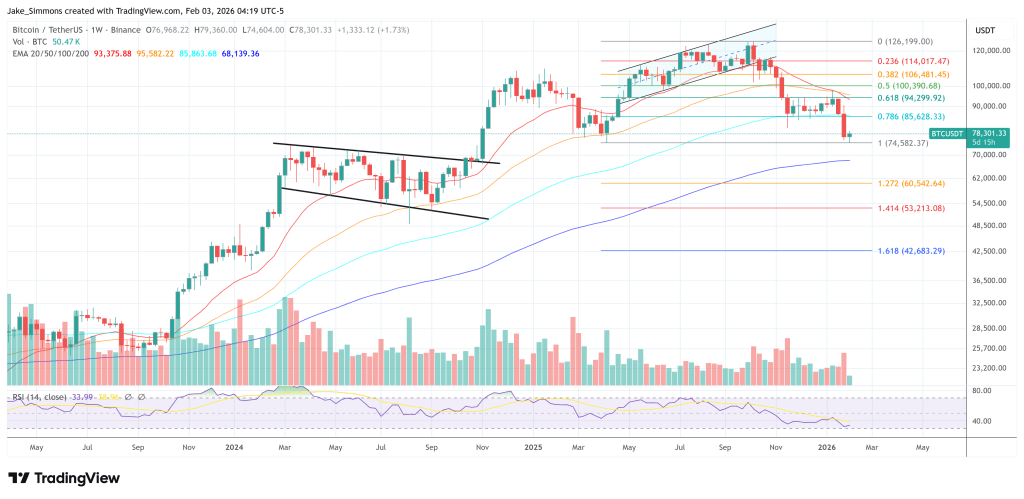
Thorn’s central roadmap was defined by two long-term reference points that have repeatedly acted as “gravity” in prior cycles after key supports failed. Bitcoin lost its 50-week moving average in November 2025, and the note argued that, in previous bull markets, losing that level often preceded a deeper mean reversion to the 200-week moving average which currently sits around the $58,000 price mark.

Meanwhile, realized price, an on-chain proxy for the average cost basis of coins based on their last movement, is around $56,000. Both metrics rise over time if BTC trades above them.

The note pointed to ETF positioning as an additional stress test. US spot Bitcoin ETFs, launched in January 2024, had amassed $54 billion in net inflows as of the week ending Jan. 30, 2026, down from a peak of $62.2 billion in early October 2025. Thorn highlighted that the prior two weeks were the second- and third-worst for ETF flows, with combined outflows of $2.8 billion, even as ETF holders largely remained in place through the broader drawdown.

On-chain distribution data also suggested to Galaxy that the $82,000–$70,000 region could be lightly defended, increasing the odds of a downward probe. Thorn described a noticeable ownership “gap” in that band, and argued that price often seeks out zones where demand has previously been established, particularly after sharp deleveraging events.

Thorn also flagged a deteriorating narrative backdrop. “Catalysts remain hard to find. Narratives are working against Bitcoin. There’s little evidence of significant accumulation,” he wrote, adding that BTC’s recent failure to track gold and silver amid macro uncertainty has undercut the “debasement hedge” framing.

Even so, the note stopped short of calling a clean break into the $50,000s inevitable. Thorn emphasized that long-term holder profit-taking, described as exceptionally heavy in 2024 and 2025, has begun to abate, a condition that has historically coincided with late-stage selloffs.

For traders, Galaxy’s framing sets up a tactical question: whether the current ETF cost basis area near $84,000 can hold as a near-term anchor, or whether the supply gap below turns into a vacuum that pulls BTC toward the $70,000 handle. If that gives way, the more consequential test is whether realized price and the 200-week moving average in the high $50,000s again function as the kind of cycle-defined floor Galaxy believes long-term investors have historically treated as an entry zone.

At press time, Bitcoin traded at $78,301.

Bitcoin remains above the 1.0 Fib, 1-week chart | Source: BTCUSDT on TradingView.com

Связанные с этим вопросы

QAccording to Galaxy Digital, what are the key factors that make Bitcoin vulnerable to a deeper price retracement?

AGalaxy Digital warns that on-chain data, weakening technical levels, and a thin catalyst calendar leave Bitcoin vulnerable to a deeper retracement.

QWhat two long-term technical reference points does Alex Thorn identify as potential 'gravity' for Bitcoin's price?

AAlex Thorn identifies the 200-week moving average (around $58,000) and the realized price (around $56,000) as key long-term reference points that have acted as 'gravity' in prior cycles.

QHow did the recent selloff affect Bitcoin's price relative to the average cost basis of US spot ETFs?

ADuring the selloff, Bitcoin's price dipped as much as 10% beneath the average cost basis of US spot ETFs, which is estimated to be around $84,000, before recovering some ground.

QWhat does Alex Thorn cite as a historical precedent that suggests a 40% drawdown from the peak could extend to 50%?

AThorn argues that, with the exception of the 2017 cycle, Bitcoin has not typically stopped at a 40% drawdown from its peak without extending toward a 50% decline within three months.

QWhat does the on-chain distribution data suggest about the $82,000–$70,000 price region?

AThe on-chain distribution data suggests that the $82,000–$70,000 region has a noticeable ownership 'gap,' meaning it could be lightly defended and increases the odds of a downward price probe.

Похожее

Day 6 of the rsETH Incident: DeFi United Secures Approximately $100 Million in Intentional Commitments, but a $50 Million Gap Remains

On April 18, Kelp DAO’s rsETH LayerZero bridge was exploited, resulting in the unauthorized minting of 116.5k rsETH (approx. $292M). The attacker borrowed around $190M on Aave V3. The Arbitrum Security Council froze 30,766 ETH linked to the incident. DeFi United, a cross-protocol rescue initiative led by Awe, was formed to cover a total shortfall of 112.2k rsETH ($258M). As of April 24, several protocols have pledged around $100M in support, though most commitments are still under DAO voting or discussion. Key pledges include: - Golem: 1,000 ETH ($2.3M) - Aave founder Stani Kulechov: 5,000 ETH ($11.5M) - EtherFi: up to 5,000 ETH ($11.5M) - Lido: up to 2,500 stETH ($5.75M), contingent on full coverage - Mantle: proposed a $69M loan to Aave DAO under specific terms The remaining shortfall is estimated at $50M. Aave’s treasury and safety module (~$236M combined) can cover the worst-case bad debt scenario ($230M). Three potential loss distribution paths were outlined by DefiLlama’s 0xngmi: 1. Uniform 18.5% haircut for all rsETH holders: Aave bad debt ~$216M 2. Only protect Mainnet, abandon L2: bad debt up to $341M 3. Repay only pre-attack holders: technically difficult, ~$91M net loss KelpDAO has not yet announced a specific plan. The success of DeFi United depends heavily on KelpDAO’s final decision on loss allocation.

marsbit41 мин. назад

Day 6 of the rsETH Incident: DeFi United Secures Approximately $100 Million in Intentional Commitments, but a $50 Million Gap Remains

marsbit41 мин. назад

Kicked Out of PayPal, Musk Aims for a Comeback in the Crypto Market

Elon Musk's X (formerly Twitter) has launched its "Smart Cashtags" feature, generating approximately $1 billion in trading volume within days of its April 2026 pilot launch. The feature allows users to click on stock or crypto tickers (or even full Solana token contract addresses) in posts to view real-time price charts and discussions without leaving the app. Initially available to iPhone users in the US and Canada, with a partnership in Canada enabling direct trading via the Wealthsimple app. This move is part of Musk's broader "Everything App" vision, spearheaded by the upcoming X Money platform. Analysts, such as Mizuho's Dan Dolev, see this as a potential disruptor to the US payments market, even prompting a downgrade of PayPal's stock. X Money's beta offers services like 6% APY on deposits, cashback, and P2P transfers, with speculation it may later incorporate crypto trading and stablecoin settlements for faster transactions. However, the ambitious plan faces significant regulatory scrutiny. Senator Elizabeth Warren has questioned the sustainability of the high 6% yield and raised concerns over X's banking partner, Cross River Bank, which has a history of regulatory violations. Additional risks involve the "GENIUS Act," which may create loopholes for stablecoin issuance without full FDIC insurance coverage, potentially leaving users unprotected. The integration of social trading on a platform with over 500 million users could inject new liquidity and retail interest into the crypto market. Yet, it also amplifies risks like herd mentality and the blurring of lines between entertainment and financial speculation. Musk's return to finance, after his ouster from PayPal, hinges on balancing innovation with regulatory compliance.

marsbit2 ч. назад

Kicked Out of PayPal, Musk Aims for a Comeback in the Crypto Market

marsbit2 ч. назад

Торговля

Спот
Фьючерсы

Популярные статьи

Тест по Bitcoin Биткоина

HTX Learn: Изучите Bitcoin halving и Заработаете Токены USDT

3.0k просмотров всегоОпубликовано 2024.04.16Обновлено 2024.04.16

Тест по Bitcoin  Биткоина

Что такое $BITCOIN

ЦИФРОВОЕ ЗОЛОТО ($BITCOIN): Комплексный анализ Введение в ЦИФРОВОЕ ЗОЛОТО ($BITCOIN) ЦИФРОВОЕ ЗОЛОТО ($BITCOIN) — это проект на основе блокчейна, работающий в сети Solana, который стремится объединить характеристики традиционных драгоценных металлов с инновациями децентрализованных технологий. Хотя он носит имя Биткойн, часто называемого “цифровым золотом” из-за его восприятия как средства хранения ценности, ЦИФРОВОЕ ЗОЛОТО является отдельным токеном, предназначенным для создания уникальной экосистемы в ландшафте Web3. Его цель — позиционировать себя как жизнеспособный альтернативный цифровой актив, хотя детали его применения и функциональности все еще развиваются. Что такое ЦИФРОВОЕ ЗОЛОТО ($BITCOIN)? ЦИФРОВОЕ ЗОЛОТО ($BITCOIN) — это токен криптовалюты, специально разработанный для использования в блокчейне Solana. В отличие от Биткойна, который выполняет широко признанную роль хранения ценности, этот токен, похоже, сосредоточен на более широких приложениях и характеристиках. Примечательные аспекты включают: Инфраструктура блокчейна: Токен построен на блокчейне Solana, известном своей способностью обрабатывать высокоскоростные и недорогие транзакции. Динамика предложения: ЦИФРОВОЕ ЗОЛОТО имеет максимальное предложение, ограниченное 100 квадриллионами токенов (100P $BITCOIN), хотя детали о его обращающемся предложении в настоящее время не раскрыты. Утилита: Хотя точные функциональные возможности не описаны, есть указания на то, что токен может быть использован для различных приложений, потенциально связанных с децентрализованными приложениями (dApps) или стратегиями токенизации активов. Кто создатель ЦИФРОВОГО ЗОЛОТА ($BITCOIN)? На данный момент личность создателей и команды разработчиков, стоящих за ЦИФРОВЫМ ЗОЛОТОМ ($BITCOIN), остается неизвестной. Эта ситуация типична для многих инновационных проектов в области блокчейна, особенно тех, которые связаны с децентрализованными финансами и феноменом мем-криптовалют. Хотя такая анонимность может способствовать культуре, ориентированной на сообщество, она усиливает опасения по поводу управления и ответственности. Кто инвесторы ЦИФРОВОГО ЗОЛОТА ($BITCOIN)? Доступная информация указывает на то, что у ЦИФРОВОГО ЗОЛОТА ($BITCOIN) нет известных институциональных спонсоров или значительных венчурных капиталовложений. Проект, похоже, функционирует по модели пирингового взаимодействия, сосредоточенной на поддержке и принятии сообществом, а не на традиционных путях финансирования. Его активность и ликвидность в основном сосредоточены на децентрализованных биржах (DEX), таких как PumpSwap, а не на устоявшихся централизованных торговых платформах, что еще больше подчеркивает его подход, ориентированный на grassroots. Как работает ЦИФРОВОЕ ЗОЛОТО ($BITCOIN) Операционные механизмы ЦИФРОВОГО ЗОЛОТА ($BITCOIN) можно подробно описать на основе его дизайна блокчейна и характеристик сети: Механизм консенсуса: Используя уникальный механизм доказательства истории (PoH) Solana в сочетании с моделью доказательства доли (PoS), проект обеспечивает эффективную валидацию транзакций, что способствует высокой производительности сети. Токеномика: Хотя конкретные дефляционные механизмы не были подробно описаны, большое максимальное предложение токенов подразумевает, что оно может быть предназначено для микротранзакций или нишевых случаев использования, которые еще предстоит определить. Интероперабельность: Существует потенциал для интеграции с более широкой экосистемой Solana, включая различные платформы децентрализованных финансов (DeFi). Однако детали относительно конкретных интеграций остаются неуточненными. Хронология ключевых событий Вот хронология, которая подчеркивает значимые вехи, касающиеся ЦИФРОВОГО ЗОЛОТА ($BITCOIN): 2023: Первоначальное развертывание токена происходит в блокчейне Solana, отмеченное его адресом контракта. 2024: ЦИФРОВОЕ ЗОЛОТО приобретает видимость, когда оно становится доступным для торговли на децентрализованных биржах, таких как PumpSwap, позволяя пользователям обменивать его на SOL. 2025: Проект наблюдает спорадическую торговую активность и потенциальный интерес к инициативам, возглавляемым сообществом, хотя на данный момент не зафиксировано никаких значительных партнерств или технических достижений. Критический анализ Сильные стороны Масштабируемость: Основная инфраструктура Solana поддерживает высокие объемы транзакций, что может повысить полезность $BITCOIN в различных сценариях транзакций. Доступность: Потенциально низкая цена торговли за токен может привлечь розничных инвесторов, способствуя более широкому участию благодаря возможностям дробного владения. Риски Отсутствие прозрачности: Отсутствие публично известных спонсоров, разработчиков или процесса аудита может вызвать скептицизм относительно устойчивости и надежности проекта. Волатильность рынка: Торговая активность сильно зависит от спекулятивного поведения, что может привести к значительной волатильности цен и неопределенности для инвесторов. Заключение ЦИФРОВОЕ ЗОЛОТО ($BITCOIN) является интригующим, но неоднозначным проектом в быстро развивающейся экосистеме Solana. Хотя он пытается использовать нарратив “цифрового золота”, его отход от установленной роли Биткойна как средства хранения ценности подчеркивает необходимость более четкого различения его предполагаемой утилиты и структуры управления. Будущее принятие и усвоение, вероятно, будут зависеть от решения текущей непрозрачности и более четкого определения его операционных и экономических стратегий. Примечание: Этот отчет охватывает синтезированную информацию, доступную на октябрь 2023 года, и с тех пор могут произойти события.

99 просмотров всегоОпубликовано 2025.05.13Обновлено 2025.05.13

Что такое $BITCOIN

Fractal Bitcoin: масштабирование Биткоина с помощью рекурсивной системы

Fractal Bitcoin — масштабное Layer-1-решнение, созданное на базе кода Биткоина, позволяющего достигать бесконечного масштабирования с помощью рекурсивного подхода.

2.2k просмотров всегоОпубликовано 2025.06.30Обновлено 2025.06.30

Fractal Bitcoin: масштабирование Биткоина с помощью рекурсивной системы

Обсуждения

Добро пожаловать в Сообщество HTX. Здесь вы сможете быть в курсе последних новостей о развитии платформы и получить доступ к профессиональной аналитической информации о рынке. Мнения пользователей о цене на BTC (BTC) представлены ниже.

活动图片