Bitcoin On-Chain Users Evaporate by 30%, ETFs Bleed $4.5 Billion: Where Is It Headed in the Next 3 Months?

marsbitОпубликовано 2026-02-24Обновлено 2026-02-24

Введение

Bitcoin's on-chain activity shows a concerning six-month decline in active addresses, dropping approximately 31% since August 2025 to around 536,000, while transaction counts remain stable. This divergence suggests reduced participation breadth despite sustained network throughput, indicating concentration among fewer entities like institutions and exchanges. Low transaction fees (averaging $0.24) reflect weak block space demand, contrasting with Bitcoin’s role as a macro-sensitive asset traded largely via ETFs and derivatives. U.S. Bitcoin ETFs have seen significant outflows ($45 billion year-to-date), shifting activity off-chain. Three scenarios emerge: continued stagnation in a risk-averse macro climate; recovery if ETF flows reverse and active addresses rebound; or structural evolution where Bitcoin becomes a settlement layer with reduced retail participation, while stablecoins dominate daily crypto transactions.

Author: Oluwapelumi Adejumo

Compiled by: Deep Tide TechFlow

Deep Tide Guide: Trading volume hasn't collapsed, but active addresses have been shrinking for six months, hitting a five-year low. This divergence of "superficial prosperity, internal emptiness" is a counter-signal to the structural health of a bull market.

The article uses three sets of data from Glassnode, Santiment, and CryptoQuant for cross-validation, proposing three future scenarios, providing a suitable reference framework for judging BTC's trend at present.

Full Text Below:

Bitcoin's network activity has been weakening for six consecutive months, but this trend is not reflected in the core metrics that many traders first look at.

The clearer signal is not trading volume—which has remained largely stable—but the breadth of participation. Even as the network continues to process a similar number of transactions, the number of active on-chain addresses has been consistently declining.

In a market where price discovery is increasingly happening in ETFs and derivatives, this split is crucial. It means: Bitcoin's on-chain footprint is narrowing, while market exposure remains active elsewhere.

As the bear market persists, this trend has become increasingly difficult to ignore.

Glassnode data shows that in mid-August 2025, the eight-day moving average of Bitcoin active addresses was approximately 778,680. As of February 23, this number had dropped to about 535,942, a decline of approximately 31%.

CryptoQuant has also marked low network activity for six consecutive months, describing the current phase as a period of sustained weakness in on-chain participation.
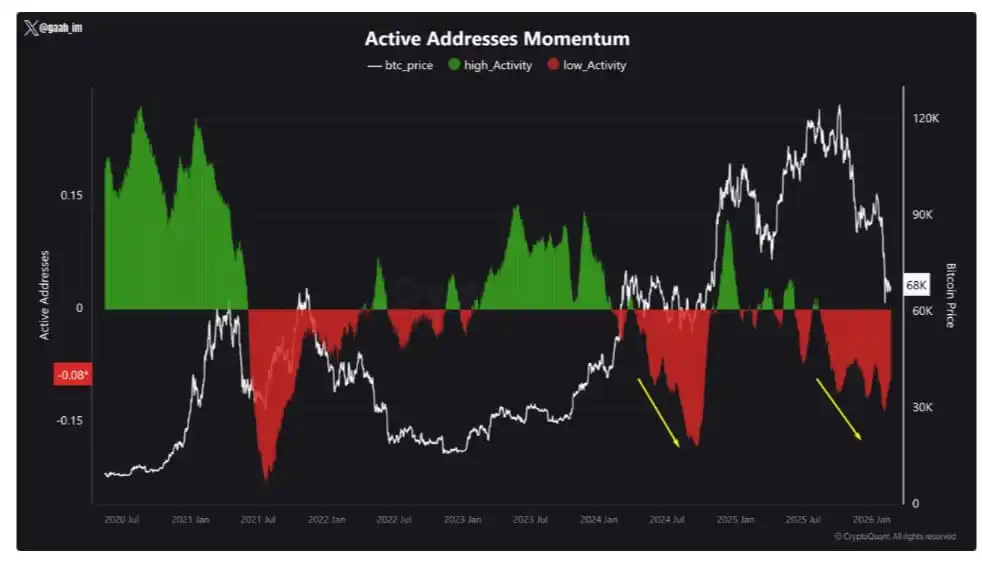
Bitcoin Active Addresses Momentum

Source: CryptoQuant

The last time the market showed a similar pattern was in 2024—Bitcoin subsequently experienced a correction of about 30%.

This doesn't mean it will necessarily repeat now, but it reinforces a historical pattern: prolonged network weakness often coincides with phases of weakening market confidence.

Breadth Declining, But Throughput Not Collapsing

Bitcoin's transaction count has not declined in sync with the number of active addresses.

In mid-August 2025, the average daily transaction count was about 444,000. Data from Blockchain.com shows the recent 30-day average is about 439,000.

Intraday data still fluctuates, ranging from about 289,000 to 702,000 transactions, but the overall throughput trend has not collapsed.

This divergence is key to understanding the current situation.

If transaction volume remains stable while active addresses decrease, it indicates that fewer entities are handling the same amount of on-chain activity.

This situation can have multiple causes, none of which involve a retail influx. Exchanges and custodians can batch withdrawals; large holders can consolidate transfers; institutional flows can be processed through fewer wallets; operational activities can also cause temporary spikes in transaction count without representing a true return of users.

The result is: the chain still looks busy, but the underlying number of participants is shrinking.

This is why the decline in breadth is more telling than raw throughput. A flat transaction count can mask a market where activity is increasingly concentrated among repeat traders, large institutions, and operational flows.

In this landscape, Bitcoin's chain still functions normally, but the breadth of user participation it represents is becoming less genuine.

Blockchain analytics firm Santiment provides a more stark description from a longer time perspective.

The firm states that since February 2021, the number of unique addresses initiating Bitcoin transactions has decreased by 42%, and new address creation has decreased by 47%.
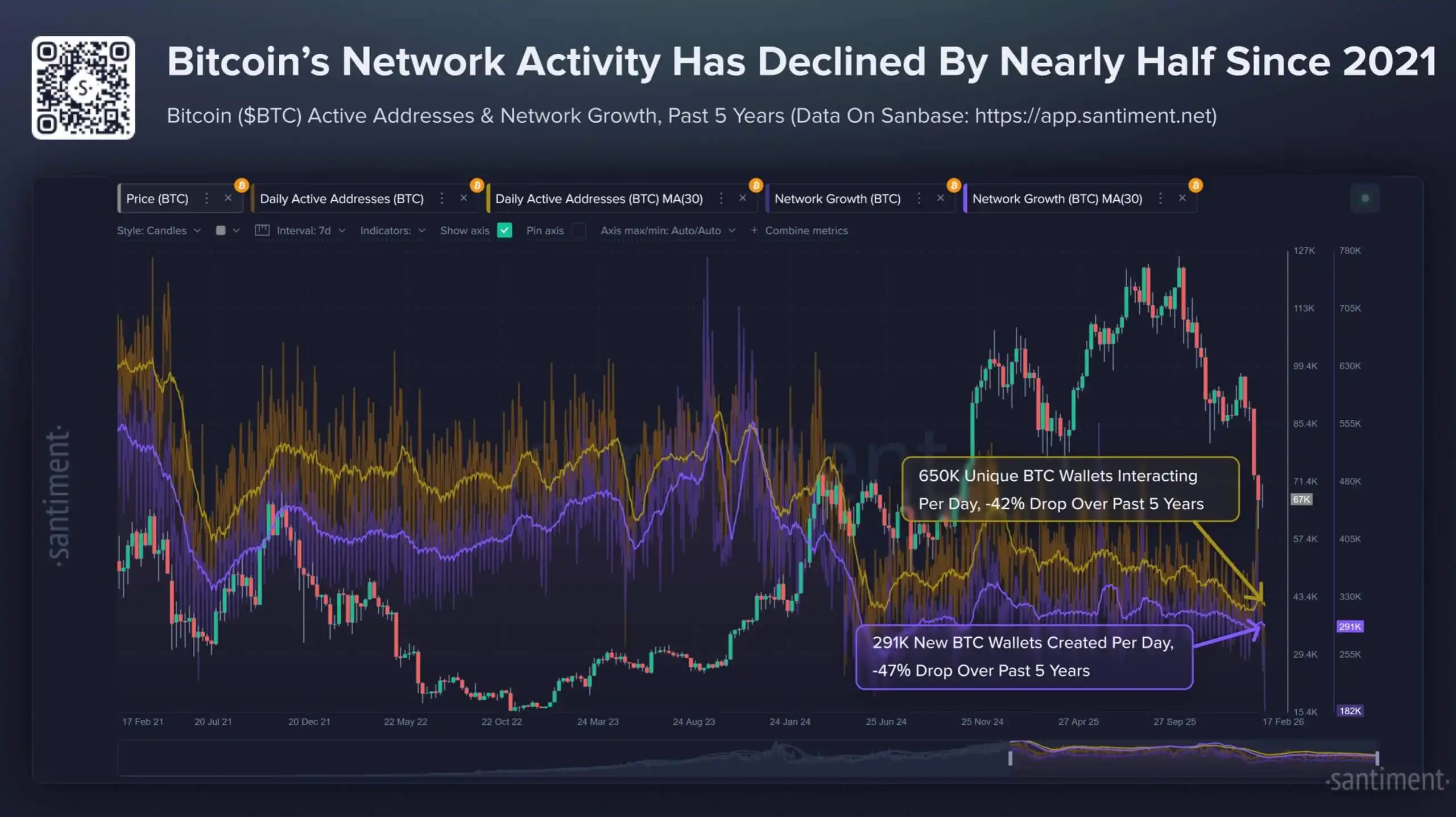
Santiment does not characterize this as evidence that crypto is dead or that a multi-year bear market is locked in, but it does describe a bearish divergence that has run through 2025—market capitalization rising while Bitcoin's utility metrics weaken.

This tension is now evident in the six-month trend. Price and market narrative can continue to hold, but the chain itself is getting quieter.

Low Fees Point to Shrinking Block Space Demand

Fee data further confirms that Bitcoin's Layer 1 is in a state of weak demand.

mempool.space data shows the network's recent average transaction fee is approximately $0.24, or about 1.8 sats/vB.

For a network that has seen sustained block space competition during past cycle peaks, this is a low level. At the current transaction pace, this fee level implies daily fee revenue of less than $100,000.

In comparison, the block subsidy is still about 450 BTC daily, with fee revenue constituting a very small portion.
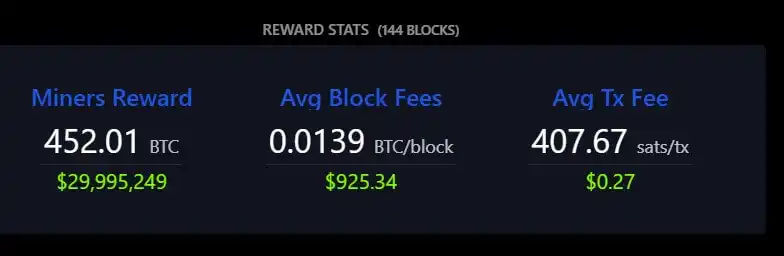
Bitcoin Average Block Fees

Source: Mempool.space

This is not an immediate security issue, nor does it mean Bitcoin's security model is under near-term pressure.

This is because the block subsidy still dominates miner revenue. But it does point to a long-term reality that Bitcoin has not yet been forced to confront at this stage of the cycle.

The topic of transitioning to a fee-supported security budget returns every cycle, but in the current environment, this transition is not being tested—because fee demand itself is weak.

Practically speaking, the quiet fee market is postponing this discussion further.

The chain is not facing sustained congestion pressure, and users are not fiercely bidding for block inclusion. This can change quickly during volatility events, speculative waves, or new demand shocks, but it hasn't happened yet.

For now, block space is in a state of明显 low usage compared to past bull phases, consistent with the broader context of declining participation breadth.
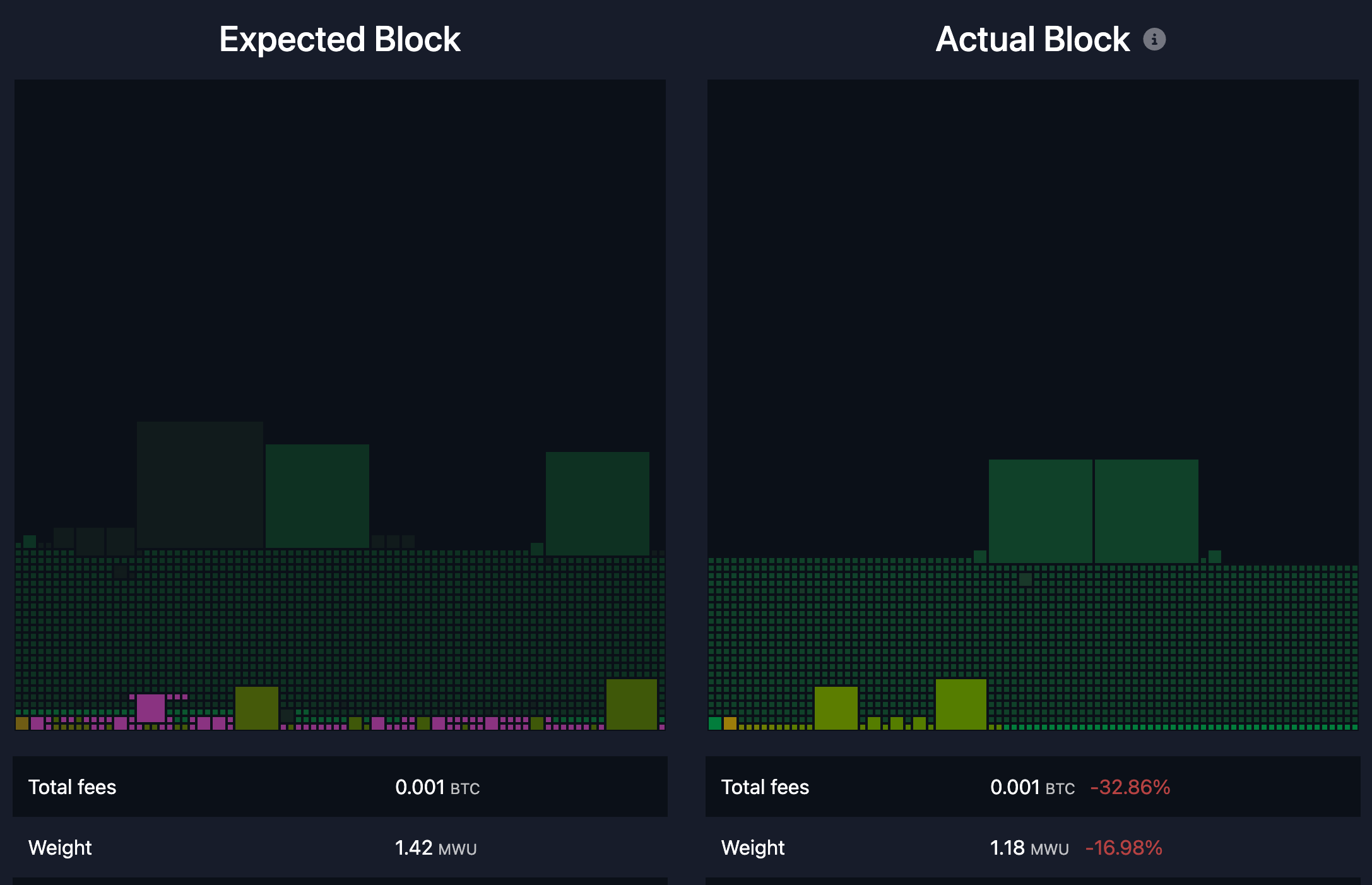
Bitcoin's Empty Mempool

Source: Mononaut

CryptoQuant's assessment also aligns with this fee environment—low network activity is typically associated with declining market interest in the asset and periods of general losses.

When interest wanes, new participants decrease, self-initiated transfers reduce, and fee pressure subsides.

Bitcoin can still be actively traded as a financial asset, but the chain itself no longer reflects broad user participation.

Macro Environment and ETF Flows Are Changing How Bitcoin Trades

The macro background helps explain why this trend persists.

Bitcoin is increasingly behaving like a macro-sensitive high-beta asset, especially prominent during risk-off periods.

Over the past year, US inflation has cooled, with January 2026 CPI year-over-year growth at 2.4%; the Fed's target rate range was cited as 3.50% to 3.75% at the end of January.

In a simpler market environment, cooling inflation might support a clearer risk asset rally.

However, market attention is focused on multiple volatility catalysts—including uncertainty around tariff policies. This factor has driven sharp swings in rates and the dollar, keeping overall risk appetite persistently unstable.

In such an environment, both retail and institutional investors tend to reduce their operational frequency. Retail participation declines, trader turnover decreases. Institutions can maintain exposure but prefer adjusting positions through products that don't require on-chain movement.

This is precisely why spot Bitcoin ETFs have become the star of the key narrative.

Coinperps data shows that US Bitcoin ETFs have seen net outflows for multiple consecutive weeks, with cumulative outflows of approximately $3.8 billion over the past five weeks, and about $4.5 billion year-to-date.
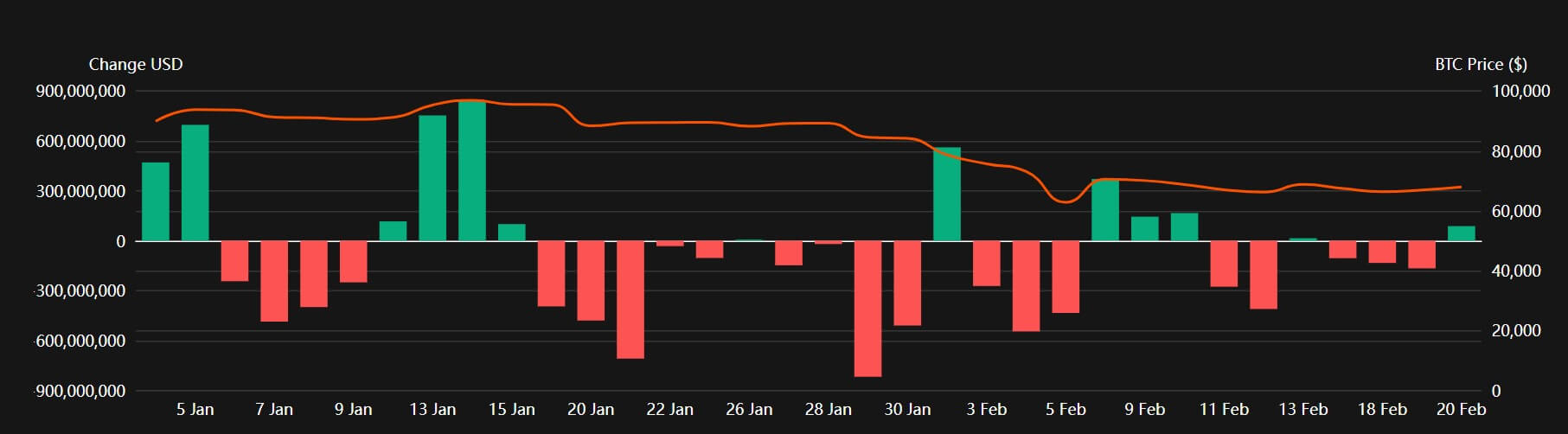
2026 US Bitcoin ETF Daily Flow Trends

Source: Coinperps

This shifts activity from self-custodied wallets to brokerage accounts.

It also explains how the market can remain active while the chain gets quieter. Exposure is still changing hands, but more of the turnover is happening off-chain.

This is a significant shift in Bitcoin's role. It is increasingly resembling a financial product wrapped in an institutional shell, while Layer 1 is used more selectively for settlement, storage, and periodic transfers.

Meanwhile, the daily trading energy in crypto is increasingly concentrated elsewhere, especially in stablecoins.

Coin Metrics lists stablecoins as a core driver of on-chain activity, with the total stablecoin supply nearing $300 billion and transaction volume continuously climbing.

If stablecoin rails on other chains absorb more daily settlement demand, Bitcoin's Layer 1 naturally becomes more functionally singular.

This itself does not weaken Bitcoin's investment thesis, but it does change its form.

Three Scenarios for the Next Three to Six Months

The current six-month decline in network breadth outlines three possible paths for Bitcoin's future trajectory.

The first is continued apathy, which looks like the baseline scenario in a risk-averse market environment.

In this scenario, active addresses remain low (450,000 to 600,000 range), transaction counts remain volatile but don't collapse, fees stay low, and ETF flows remain flat or slightly negative.

Here, Bitcoin may still experience sharp volatility due to macro headlines, but on-chain participation does not confirm a broad recovery. The asset trades more like a macro tool than a network entering a new expansion phase.

The second is a liquidity thaw, the more optimistic path.

If inflation continues to cool and easing expectations stabilize risk appetite, ETF flows could shift from net outflows to sustained net inflows. In this environment, growth in active addresses would be a key confirmation signal.

A recovery to 650,000 to 800,000 active addresses would mean participation breadth is recovering, not just price momentum returning. This looks more like a classic cyclical recovery—price increases supported by growth in on-chain user participation.

The third is a structural substitution scenario, perhaps the one most worth watching.

In this scenario, Bitcoin's price rises, but on-chain breadth remains persistently weak. ETFs, derivatives, and custodial settlement continue to dominate, while stablecoins on other parts of crypto absorb more trading demand.

Here, Bitcoin increasingly resembles a digital macro asset and settlement layer, rather than a chain with broad daily retail activity.

This scenario would mark an evolution in Bitcoin's role, reflecting the deep changes it has undergone compared to years past.


Связанные с этим вопросы

QWhat is the current trend in Bitcoin's on-chain user activity according to the article?

ABitcoin's on-chain user activity has been declining for six consecutive months, with active addresses dropping by approximately 31% from around 778,680 in mid-August 2025 to about 535,942 by February 23, as per Glassnode data.

QHow does the transaction volume on Bitcoin's blockchain compare to the decline in active addresses?

ATransaction volume has remained relatively stable, with daily average transactions around 444,000 in mid-August 2025 and approximately 439,000 over the past 30 days, indicating that fewer entities are handling the same amount of on-chain activity.

QWhat does the low network fee environment indicate about Bitcoin's current state?

ALow network fees, averaging around $0.24 per transaction, indicate weak demand for block space and reduced user participation, reflecting a broader decline in on-chain activity rather than network congestion.

QHow have Bitcoin ETFs impacted on-chain activity and market exposure?

ABitcoin ETFs have shifted market exposure off-chain, with continuous net outflows totaling approximately $4.5 billion year-to-date, reducing the need for on-chain transactions as trading occurs through brokerage accounts rather than self-custodied wallets.

QWhat are the three possible scenarios for Bitcoin's performance over the next three to six months as outlined in the article?

AThe three scenarios are: 1) Continued Apathy, with low active addresses and stable transactions; 2) Liquidity Thaw, where improved macro conditions lead to ETF inflows and renewed on-chain participation; and 3) Structural Substitution, where Bitcoin evolves into a macro asset with limited daily on-chain activity, driven by ETFs and derivatives.

Похожее

You Bet on the News, the Pros Read the Rules: The True Cognitive Gap in Losing Money on Polymarket

The article explains that the key to profiting on Polymarket, a prediction market platform, lies not just predicting real-world events correctly, but in meticulously understanding the specific rules that govern how each market will be resolved. It illustrates this with examples, such as a market on Venezuela's 2026 leader, where the official rules defining "officially holds" the office overruled the intuitive answer of who was in practical control. Other examples include debates over the definition of a "token" or what constitutes an "agreement." The core argument is that a "reality vs. rules" gap creates pricing discrepancies that savvy traders ("车头" or "whales") exploit. The platform has a formal dispute resolution process managed by UMA token holders to settle ambiguous outcomes. This process involves proposal submission, a challenge window, a discussion period, and a final vote. However, the article highlights a critical flaw in this system compared to a traditional court: the lack of separation between the arbiters (UMA voters) and the interested parties (traders with financial stakes in the outcome). This conflict of interest undermines the discussion phase, leads to herd mentality, and results in opaque final decisions without explanatory rulings. Consequently, the system lacks a body of precedent, making it difficult for users to learn from past disputes. The ultimate takeaway is that success on Polymarket requires a lawyer-like scrutiny of the rules to identify and capitalize on the cognitive gap between how events appear and how they are contractually defined for settlement.

marsbit1 ч. назад

You Bet on the News, the Pros Read the Rules: The True Cognitive Gap in Losing Money on Polymarket

marsbit1 ч. назад

Торговля

Спот
Фьючерсы

Популярные статьи

Тест по Bitcoin Биткоина

HTX Learn: Изучите Bitcoin halving и Заработаете Токены USDT

3.0k просмотров всегоОпубликовано 2024.04.16Обновлено 2024.04.16

Тест по Bitcoin  Биткоина

Что такое $BITCOIN

ЦИФРОВОЕ ЗОЛОТО ($BITCOIN): Комплексный анализ Введение в ЦИФРОВОЕ ЗОЛОТО ($BITCOIN) ЦИФРОВОЕ ЗОЛОТО ($BITCOIN) — это проект на основе блокчейна, работающий в сети Solana, который стремится объединить характеристики традиционных драгоценных металлов с инновациями децентрализованных технологий. Хотя он носит имя Биткойн, часто называемого “цифровым золотом” из-за его восприятия как средства хранения ценности, ЦИФРОВОЕ ЗОЛОТО является отдельным токеном, предназначенным для создания уникальной экосистемы в ландшафте Web3. Его цель — позиционировать себя как жизнеспособный альтернативный цифровой актив, хотя детали его применения и функциональности все еще развиваются. Что такое ЦИФРОВОЕ ЗОЛОТО ($BITCOIN)? ЦИФРОВОЕ ЗОЛОТО ($BITCOIN) — это токен криптовалюты, специально разработанный для использования в блокчейне Solana. В отличие от Биткойна, который выполняет широко признанную роль хранения ценности, этот токен, похоже, сосредоточен на более широких приложениях и характеристиках. Примечательные аспекты включают: Инфраструктура блокчейна: Токен построен на блокчейне Solana, известном своей способностью обрабатывать высокоскоростные и недорогие транзакции. Динамика предложения: ЦИФРОВОЕ ЗОЛОТО имеет максимальное предложение, ограниченное 100 квадриллионами токенов (100P $BITCOIN), хотя детали о его обращающемся предложении в настоящее время не раскрыты. Утилита: Хотя точные функциональные возможности не описаны, есть указания на то, что токен может быть использован для различных приложений, потенциально связанных с децентрализованными приложениями (dApps) или стратегиями токенизации активов. Кто создатель ЦИФРОВОГО ЗОЛОТА ($BITCOIN)? На данный момент личность создателей и команды разработчиков, стоящих за ЦИФРОВЫМ ЗОЛОТОМ ($BITCOIN), остается неизвестной. Эта ситуация типична для многих инновационных проектов в области блокчейна, особенно тех, которые связаны с децентрализованными финансами и феноменом мем-криптовалют. Хотя такая анонимность может способствовать культуре, ориентированной на сообщество, она усиливает опасения по поводу управления и ответственности. Кто инвесторы ЦИФРОВОГО ЗОЛОТА ($BITCOIN)? Доступная информация указывает на то, что у ЦИФРОВОГО ЗОЛОТА ($BITCOIN) нет известных институциональных спонсоров или значительных венчурных капиталовложений. Проект, похоже, функционирует по модели пирингового взаимодействия, сосредоточенной на поддержке и принятии сообществом, а не на традиционных путях финансирования. Его активность и ликвидность в основном сосредоточены на децентрализованных биржах (DEX), таких как PumpSwap, а не на устоявшихся централизованных торговых платформах, что еще больше подчеркивает его подход, ориентированный на grassroots. Как работает ЦИФРОВОЕ ЗОЛОТО ($BITCOIN) Операционные механизмы ЦИФРОВОГО ЗОЛОТА ($BITCOIN) можно подробно описать на основе его дизайна блокчейна и характеристик сети: Механизм консенсуса: Используя уникальный механизм доказательства истории (PoH) Solana в сочетании с моделью доказательства доли (PoS), проект обеспечивает эффективную валидацию транзакций, что способствует высокой производительности сети. Токеномика: Хотя конкретные дефляционные механизмы не были подробно описаны, большое максимальное предложение токенов подразумевает, что оно может быть предназначено для микротранзакций или нишевых случаев использования, которые еще предстоит определить. Интероперабельность: Существует потенциал для интеграции с более широкой экосистемой Solana, включая различные платформы децентрализованных финансов (DeFi). Однако детали относительно конкретных интеграций остаются неуточненными. Хронология ключевых событий Вот хронология, которая подчеркивает значимые вехи, касающиеся ЦИФРОВОГО ЗОЛОТА ($BITCOIN): 2023: Первоначальное развертывание токена происходит в блокчейне Solana, отмеченное его адресом контракта. 2024: ЦИФРОВОЕ ЗОЛОТО приобретает видимость, когда оно становится доступным для торговли на децентрализованных биржах, таких как PumpSwap, позволяя пользователям обменивать его на SOL. 2025: Проект наблюдает спорадическую торговую активность и потенциальный интерес к инициативам, возглавляемым сообществом, хотя на данный момент не зафиксировано никаких значительных партнерств или технических достижений. Критический анализ Сильные стороны Масштабируемость: Основная инфраструктура Solana поддерживает высокие объемы транзакций, что может повысить полезность $BITCOIN в различных сценариях транзакций. Доступность: Потенциально низкая цена торговли за токен может привлечь розничных инвесторов, способствуя более широкому участию благодаря возможностям дробного владения. Риски Отсутствие прозрачности: Отсутствие публично известных спонсоров, разработчиков или процесса аудита может вызвать скептицизм относительно устойчивости и надежности проекта. Волатильность рынка: Торговая активность сильно зависит от спекулятивного поведения, что может привести к значительной волатильности цен и неопределенности для инвесторов. Заключение ЦИФРОВОЕ ЗОЛОТО ($BITCOIN) является интригующим, но неоднозначным проектом в быстро развивающейся экосистеме Solana. Хотя он пытается использовать нарратив “цифрового золота”, его отход от установленной роли Биткойна как средства хранения ценности подчеркивает необходимость более четкого различения его предполагаемой утилиты и структуры управления. Будущее принятие и усвоение, вероятно, будут зависеть от решения текущей непрозрачности и более четкого определения его операционных и экономических стратегий. Примечание: Этот отчет охватывает синтезированную информацию, доступную на октябрь 2023 года, и с тех пор могут произойти события.

99 просмотров всегоОпубликовано 2025.05.13Обновлено 2025.05.13

Что такое $BITCOIN

Fractal Bitcoin: масштабирование Биткоина с помощью рекурсивной системы

Fractal Bitcoin — масштабное Layer-1-решнение, созданное на базе кода Биткоина, позволяющего достигать бесконечного масштабирования с помощью рекурсивного подхода.

2.2k просмотров всегоОпубликовано 2025.06.30Обновлено 2025.06.30

Fractal Bitcoin: масштабирование Биткоина с помощью рекурсивной системы

Обсуждения

Добро пожаловать в Сообщество HTX. Здесь вы сможете быть в курсе последних новостей о развитии платформы и получить доступ к профессиональной аналитической информации о рынке. Мнения пользователей о цене на BTC (BTC) представлены ниже.

活动图片