Bitcoin nears $72K – But here’s why BTC’s setup looks extremely fragile

AmbcryptoОпубликовано 2026-03-26Обновлено 2026-05-11

Введение

Structural weakness remains intact, with no confirmed emergence of a momentum-backed rally.

Bitcoin’s [BTC] recent push toward $72,000 may therefore reflect a temporary move higher, one that risks trapping overly aggressive long traders.

In derivatives markets, positioning has turned notably bullish. The OI-Weighted Funding Rate has climbed to 0.0054%, marking its most optimistic level since the 23rd of February.

This suggests that a significant share of Bitcoin’s $50.64 billion in Open Interest is concentrated in long positions.

Under typical market conditions, such positioning would reinforce a bullish outlook. In the current context, however, it raises the risk of overcrowding, where excessive long exposure leaves the market vulnerable to a reversal.

A familiar setup pointing to a trap

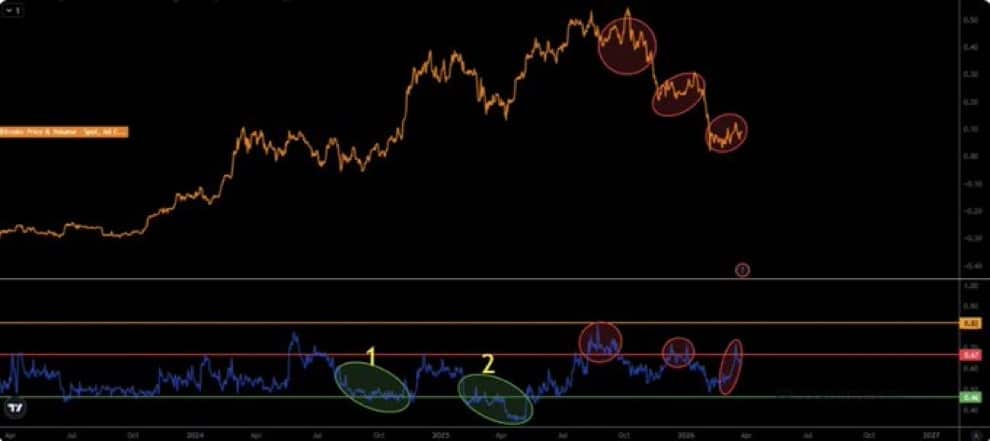
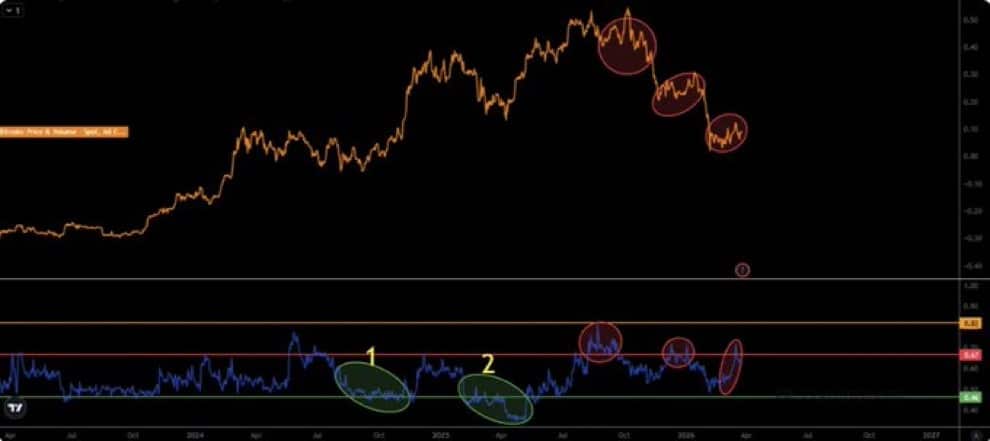
Data from a CryptoQuant chart, published by a pseudonymous analyst tracking Bitcoin’s supply-demand dynamics using price and volume indicators, points to a recurring imbalance.

Similar structures appeared ahead of the October 2024 rally to $109,588 and the April 2026 rally to $126,199, identified as Zone 1 and Zone 2. In both cases, the imbalance temporarily eased before price continuation.

Source: CryptoQuant

However, the current formation near $72,000 more closely resembles the imbalance zones that preceded sharp declines to $90,000 and later $80,000. In those instances, the imbalance signaled exhaustion rather than continuation.

With this pattern now repeating, the implication is clear: the ongoing rally may not be structurally sound. Instead, it may represent a short-lived advance before a broader downside move, likely driven by long liquidations.

Weak fundamentals limit upside

Beyond technical structure, Bitcoin’s macro and on-chain backdrop does not support a sustained rally.

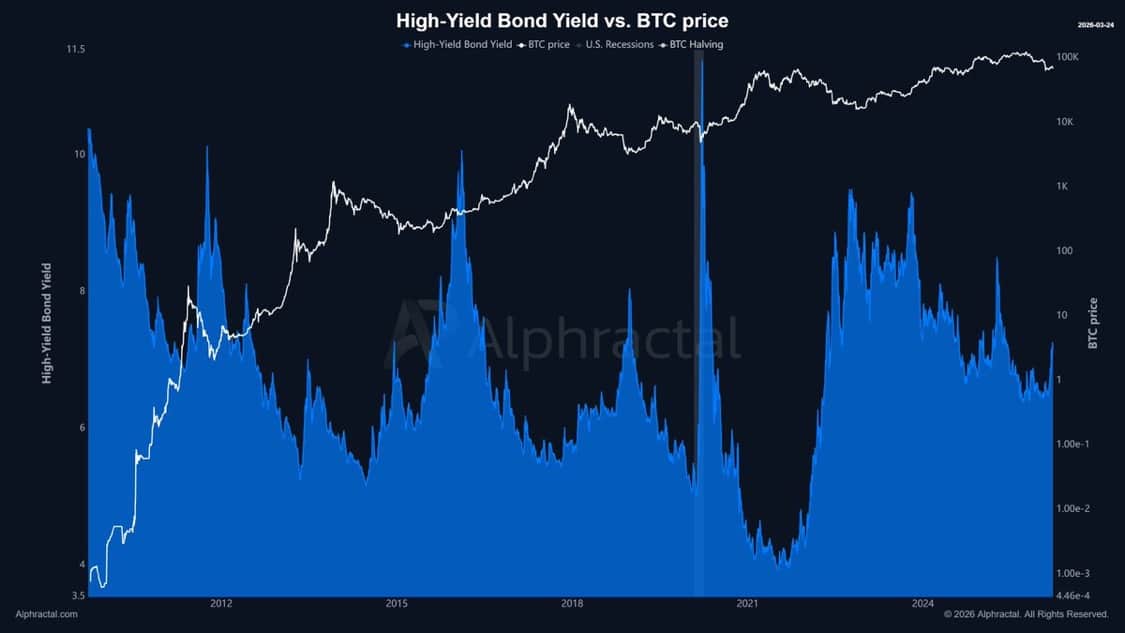
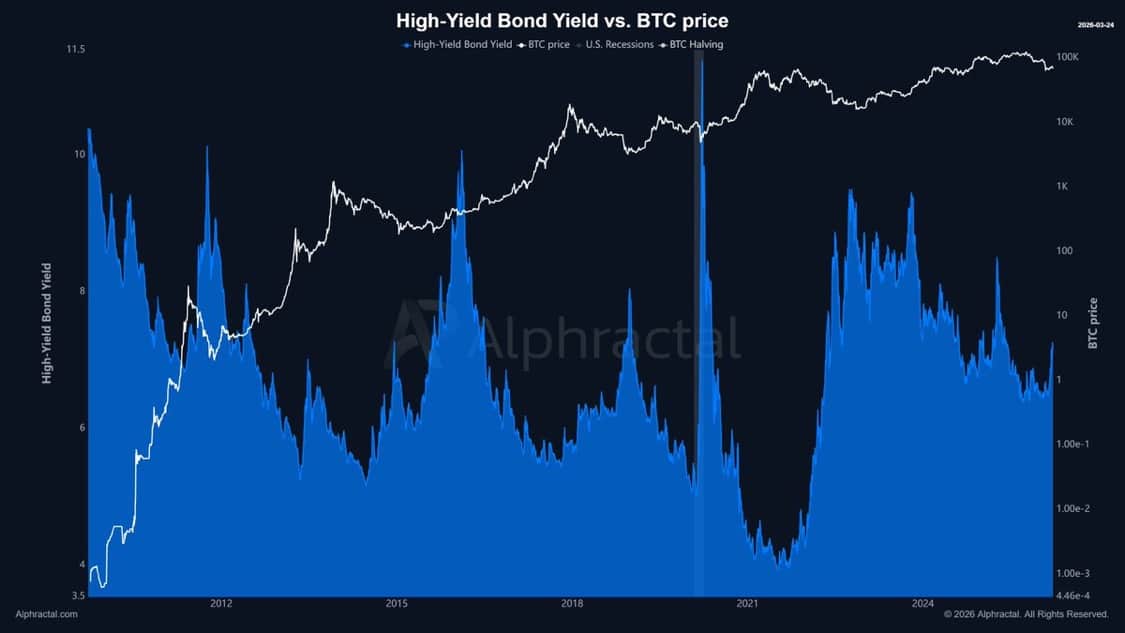
High-yield bond yields continue to rise, reflecting increasing caution among investors. These bonds, issued by lower-rated companies, must offer higher returns to compensate for elevated risk.

When yields climb, it often signals tightening financial conditions and reduced risk appetite.

Historically, such environments have aligned with periods of weakness in Bitcoin, often preceding notable drawdowns. The current rise in yields suggests that broader market conditions remain unfavorable for sustained crypto upside.

Source: Alphractal

At the same time, Spot market activity shows limited participation from retail traders. Trading frequency remains largely neutral, extending a multi-month trend of subdued engagement.

In a strong bullish phase, expanding retail activity typically acts as a key driver of momentum. Its absence indicates that the current move lacks the depth and breadth needed to sustain higher prices.

Accumulation lacks confirmation

While some accumulation is visible in the Spot market, it remains insufficient to confirm a trend reversal.

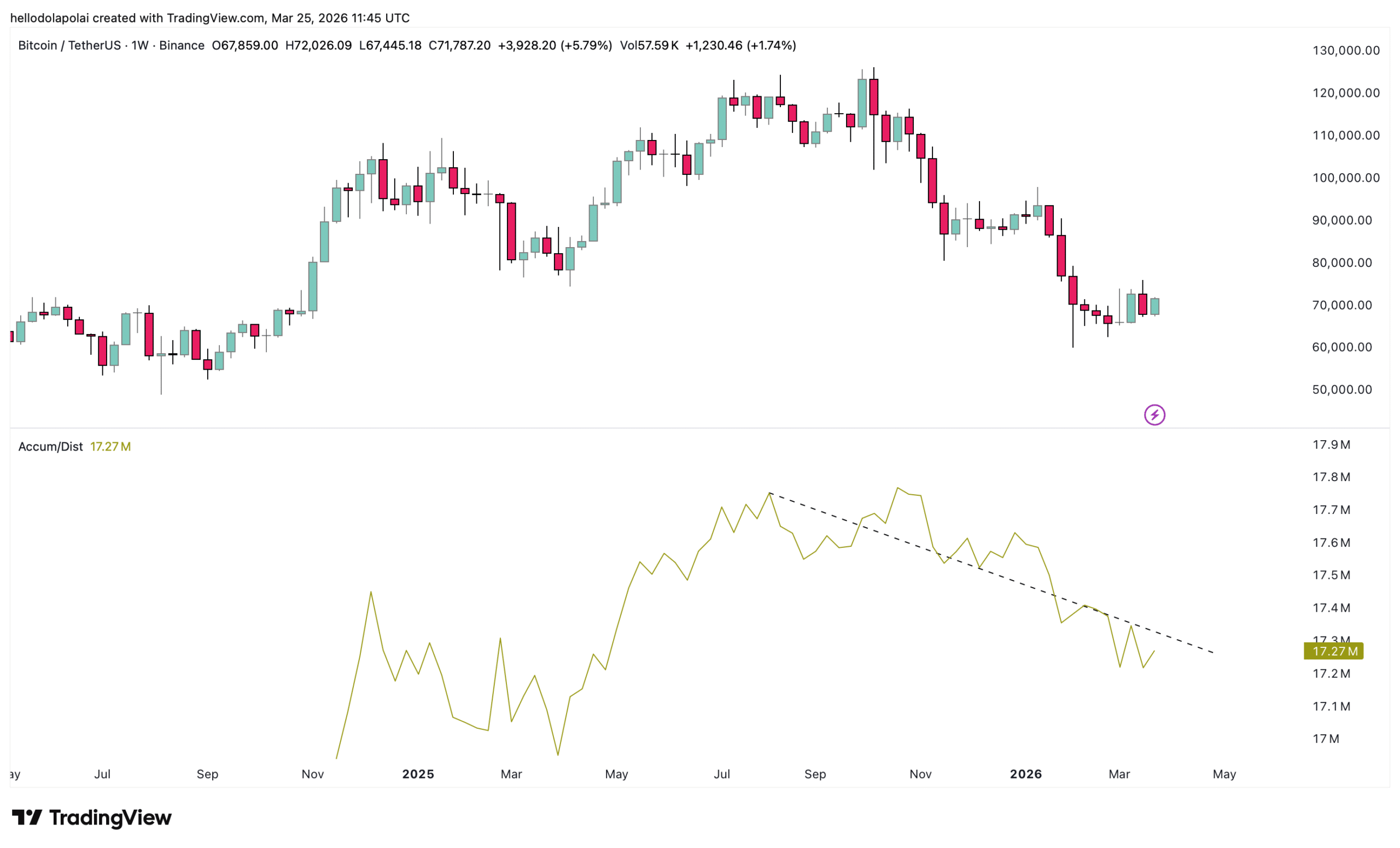
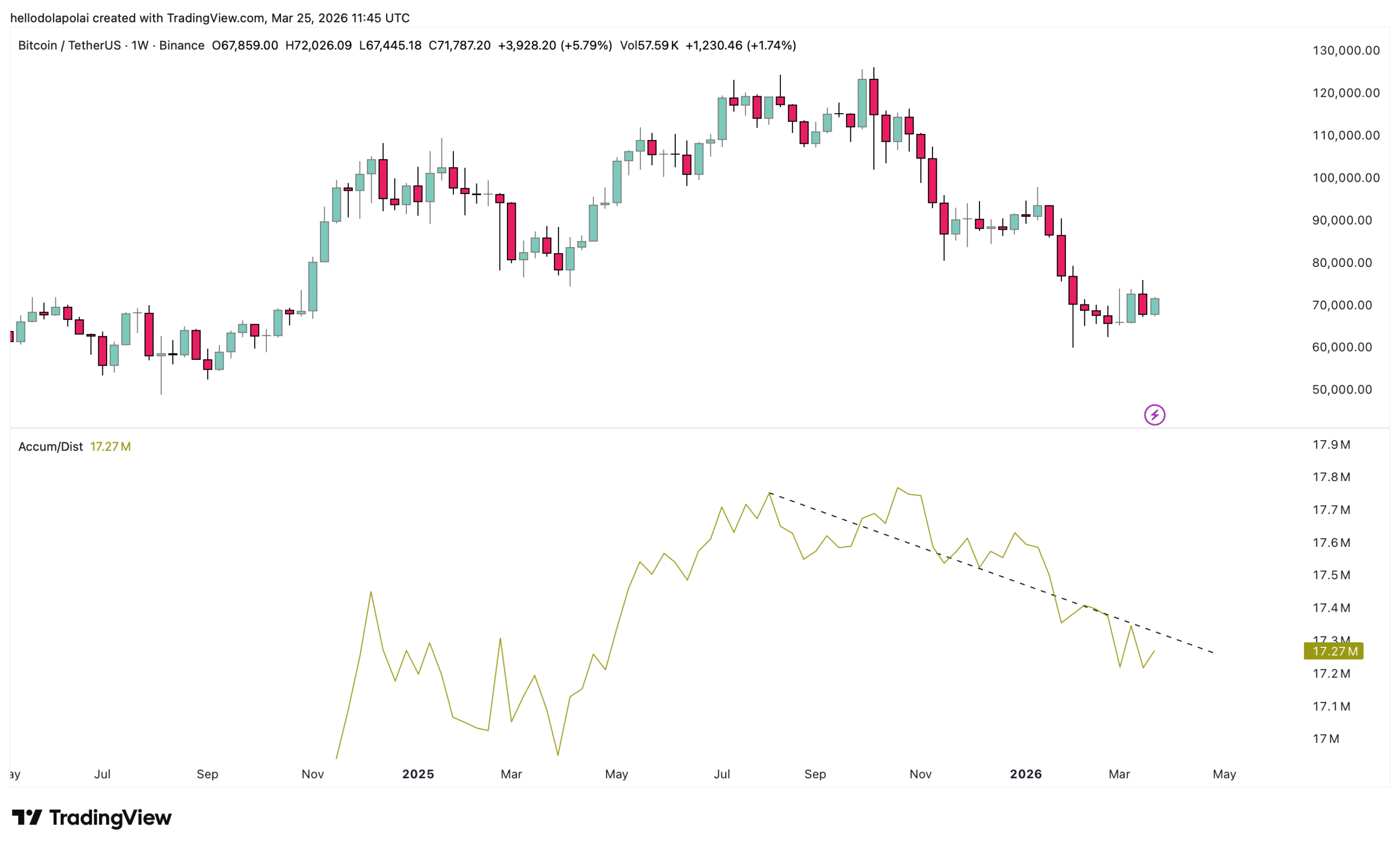
The Accumulation/Distribution (A/D) indicator shows a modest uptick, suggesting that some investors are beginning to buy. However, this signal remains preliminary.

For a confirmed bullish shift, the indicator must break above its resistance trendline and sustain upward movement. Until then, the current accumulation phase reflects early positioning rather than conviction.

Source: TradingView

In its present state, Bitcoin’s structure, positioning, and fundamentals point to a fragile rally. Without stronger confirmation, the move toward $72,000 risks being remembered not as a breakout, but as a trap.

Final Summary

  • Bitcoin’s supply-demand dynamics continue to follow a recurring fractal pattern that previously preceded sharp declines from the $90,000 and $80,000 regions.
  • Structural weakness remains intact, with no confirmed emergence of a momentum-backed rally.

Связанные с этим вопросы

QWhy does Bitcoin's current push toward $72,000 look fragile according to the article?

AThe article states that the push is fragile because it reflects a temporary move higher that risks trapping overly aggressive long traders. The market shows signs of overcrowding with excessive long exposure, making it vulnerable to a reversal, and the current formation resembles imbalance zones that preceded sharp declines in the past.

QWhat does the high OI-Weighted Funding Rate of 0.0054% indicate about market positioning?

AThe high OI-Weighted Funding Rate indicates that positioning in derivatives markets has turned notably bullish, with a significant share of Bitcoin's open interest concentrated in long positions. This creates a risk of overcrowding, which can lead to a market reversal if long positions are liquidated.

QHow do high-yield bond yields relate to Bitcoin's performance, as mentioned in the article?

ARising high-yield bond yields reflect increasing caution among investors and tightening financial conditions, which historically align with periods of weakness in Bitcoin. The current rise in yields suggests unfavorable broader market conditions for sustained crypto upside.

QWhat is the significance of the Accumulation/Distribution (A/D) indicator in the current market context?

AThe A/D indicator shows a modest uptick, suggesting some investors are beginning to buy, but it remains insufficient to confirm a trend reversal. For a confirmed bullish shift, the indicator must break above its resistance trendline and sustain upward movement, which hasn't happened yet.

QWhat recurring pattern in Bitcoin's supply-demand dynamics does the article highlight as a warning sign?

AThe article highlights a recurring fractal pattern where similar imbalance structures appeared ahead of sharp declines, such as the drops to $90,000 and $80,000. The current formation near $72,000 resembles these imbalance zones that signaled exhaustion rather than continuation, indicating potential downside risk.

Похожее

The AI Agent Era Accelerates Its Arrival: Questflow Defines a New Paradigm of Financial Intelligence with On-Chain AI Brokerage

The AI Agent era is accelerating, with the CB Insights AI 100 list highlighting global investment confidence. The focus has shifted from whether AI works to its speed of deployment and ability to manage complex workflows, with autonomous AI Agents driving this transformation. At the forefront is Questflow, a Singapore-based startup redefining financial intelligence through its on-chain AI brokerage. Unlike tools that merely provide data dashboards, Questflow deploys AI Agents that proactively scan markets, form judgments, and execute trades via a conversational interface—operating 24/7 without requiring manual confirmation for each decision. This embodies the new AI paradigm of agents capable of executing multi-step workflows autonomously. Questflow's mission is to democratize institutional-grade trading intelligence. Historically reserved for the ultra-wealthy, this capability is now accessible starting from just $1 through Questflow's "AI Clone + Copy Trade" model. The platform charges only a 1% execution fee, aligning its incentives directly with users and eliminating traditional management or performance fees. The timing is opportune, aligning with key trends identified by CB Insights: the scalable deployment of AI Agents, accelerated AI adoption in financial services, and the maturation of on-chain infrastructure. With robust liquidity on platforms like Hyperliquid and Polymarket, alongside advancements in AI reasoning and non-custodial wallet security, Questflow is positioned to merge the roles of broker, fund, and exchange into a single, accessible platform for millions.

链捕手17 мин. назад

The AI Agent Era Accelerates Its Arrival: Questflow Defines a New Paradigm of Financial Intelligence with On-Chain AI Brokerage

链捕手17 мин. назад

Why Pricing Social Interactions is Doomed to Fail?

Titled "Why Putting a Price on Social Interaction Is Doomed to Fail," this article critiques attempts to monetize social networks directly through SocialFi models, arguing their inevitable failure stems from a fundamental misunderstanding of media dynamics. Using Marshall McLuhan's theory of "hot" and "cold" media, the author posits that social networks are inherently "cold" media. Their value isn't contained in individual posts but is co-created through user participation, interpretation, and fragmented, ongoing interaction (e.g., replies, shares). This ambiguity and need for user involvement are core to their function. The article asserts that SocialFi projects like Friend.tech failed because introducing real-time, tradable financial pricing (a definitive "hot" signal) into this "cold" environment doesn't add a layer—it replaces the medium's essence. The unambiguous price signal overshadows and nullifies the nuanced, participatory social signal. Users become traders, not participants, and when speculative profits vanish, the underlying social ecosystem—never genuinely cultivated—collapses entirely. This principle extends beyond crypto. The author argues platforms like Twitter have gradually "heated up" through metrics (likes, retweets counts, algorithmically defined value), shifting users from participants to performers and eroding organic engagement. The solution isn't to abandon capital but to manage its entry point. Successful models like Substack, Patreon, or Bandcamp allow capital to "condense" at specific, isolated nodes (e.g., subscriptions, one-time payments) without permeating and "heating" every social interaction. They preserve the core "cold," participatory medium while enabling monetization at designated boundaries. The NFT boom and bust serves as a stark parallel: the ancient "cold" medium of collecting (valued for story, community, gradual accumulation) was rapidly destroyed by platforms that introduced real-time floor prices, rarity scores, and trading dashboards, transforming collectors into speculators and vaporizing cultural value when prices fell. The core lesson: "Liquidity equals heat." Injecting high liquidity and definitive pricing into a "cold" participatory medium doesn't optimize it; it fundamentally alters and destroys its value-creating mechanism. The future lies not in pricing every social gesture but in finding precise, non-invasive points for capital to condense without overheating the entire ecosystem.

marsbit25 мин. назад

Why Pricing Social Interactions is Doomed to Fail?

marsbit25 мин. назад

Jensen Huang's CMU Speech: In the AI Era, Don't Just Watch, Build

Jensen Huang, CEO of NVIDIA and a first-generation immigrant, delivered the commencement address to Carnegie Mellon University's class of 2026. He shared his personal journey from a humble background to founding NVIDIA, emphasizing resilience, learning from failure, and the responsibility that comes with leadership. Huang framed the present moment as the dawn of the AI revolution, a shift he believes is more profound than previous computing waves. He described AI as fundamentally resetting computing—moving from human-written software to machines that understand, reason, and use tools. This will create a new industry for generating intelligence and transform every sector. While acknowledging AI's potential to automate tasks and displace some jobs, Huang distinguished between the *tasks* of a job and its core *purpose*. He argued AI will augment human capability, not replace humans. The real risk, he stated, is not AI itself, but people being left behind by those who effectively use AI. He presented AI as a generational opportunity for massive infrastructure investment—in chip factories, data centers, energy grids, and advanced manufacturing—that could re-industrialize nations like the U.S. and bridge the digital divide by making computing and intelligent tools accessible to all. Huang called for a balanced approach: advancing AI safely and responsibly, establishing prudent policies, ensuring broad access, and encouraging universal participation. He urged the graduates not to fear the future but to engage with optimism and ambition, reminding them of CMU's motto, "My heart is in the work." His core message was clear: this is their moment to actively build and shape the AI-powered future, not merely observe it.

marsbit1 ч. назад

Jensen Huang's CMU Speech: In the AI Era, Don't Just Watch, Build

marsbit1 ч. назад

Торговля

Спот
Фьючерсы

Популярные статьи

Тест по Bitcoin Биткоина

HTX Learn: Изучите Bitcoin halving и Заработаете Токены USDT

3.0k просмотров всегоОпубликовано 2024.04.16Обновлено 2024.04.16

Тест по Bitcoin  Биткоина

Что такое $BITCOIN

ЦИФРОВОЕ ЗОЛОТО ($BITCOIN): Комплексный анализ Введение в ЦИФРОВОЕ ЗОЛОТО ($BITCOIN) ЦИФРОВОЕ ЗОЛОТО ($BITCOIN) — это проект на основе блокчейна, работающий в сети Solana, который стремится объединить характеристики традиционных драгоценных металлов с инновациями децентрализованных технологий. Хотя он носит имя Биткойн, часто называемого “цифровым золотом” из-за его восприятия как средства хранения ценности, ЦИФРОВОЕ ЗОЛОТО является отдельным токеном, предназначенным для создания уникальной экосистемы в ландшафте Web3. Его цель — позиционировать себя как жизнеспособный альтернативный цифровой актив, хотя детали его применения и функциональности все еще развиваются. Что такое ЦИФРОВОЕ ЗОЛОТО ($BITCOIN)? ЦИФРОВОЕ ЗОЛОТО ($BITCOIN) — это токен криптовалюты, специально разработанный для использования в блокчейне Solana. В отличие от Биткойна, который выполняет широко признанную роль хранения ценности, этот токен, похоже, сосредоточен на более широких приложениях и характеристиках. Примечательные аспекты включают: Инфраструктура блокчейна: Токен построен на блокчейне Solana, известном своей способностью обрабатывать высокоскоростные и недорогие транзакции. Динамика предложения: ЦИФРОВОЕ ЗОЛОТО имеет максимальное предложение, ограниченное 100 квадриллионами токенов (100P $BITCOIN), хотя детали о его обращающемся предложении в настоящее время не раскрыты. Утилита: Хотя точные функциональные возможности не описаны, есть указания на то, что токен может быть использован для различных приложений, потенциально связанных с децентрализованными приложениями (dApps) или стратегиями токенизации активов. Кто создатель ЦИФРОВОГО ЗОЛОТА ($BITCOIN)? На данный момент личность создателей и команды разработчиков, стоящих за ЦИФРОВЫМ ЗОЛОТОМ ($BITCOIN), остается неизвестной. Эта ситуация типична для многих инновационных проектов в области блокчейна, особенно тех, которые связаны с децентрализованными финансами и феноменом мем-криптовалют. Хотя такая анонимность может способствовать культуре, ориентированной на сообщество, она усиливает опасения по поводу управления и ответственности. Кто инвесторы ЦИФРОВОГО ЗОЛОТА ($BITCOIN)? Доступная информация указывает на то, что у ЦИФРОВОГО ЗОЛОТА ($BITCOIN) нет известных институциональных спонсоров или значительных венчурных капиталовложений. Проект, похоже, функционирует по модели пирингового взаимодействия, сосредоточенной на поддержке и принятии сообществом, а не на традиционных путях финансирования. Его активность и ликвидность в основном сосредоточены на децентрализованных биржах (DEX), таких как PumpSwap, а не на устоявшихся централизованных торговых платформах, что еще больше подчеркивает его подход, ориентированный на grassroots. Как работает ЦИФРОВОЕ ЗОЛОТО ($BITCOIN) Операционные механизмы ЦИФРОВОГО ЗОЛОТА ($BITCOIN) можно подробно описать на основе его дизайна блокчейна и характеристик сети: Механизм консенсуса: Используя уникальный механизм доказательства истории (PoH) Solana в сочетании с моделью доказательства доли (PoS), проект обеспечивает эффективную валидацию транзакций, что способствует высокой производительности сети. Токеномика: Хотя конкретные дефляционные механизмы не были подробно описаны, большое максимальное предложение токенов подразумевает, что оно может быть предназначено для микротранзакций или нишевых случаев использования, которые еще предстоит определить. Интероперабельность: Существует потенциал для интеграции с более широкой экосистемой Solana, включая различные платформы децентрализованных финансов (DeFi). Однако детали относительно конкретных интеграций остаются неуточненными. Хронология ключевых событий Вот хронология, которая подчеркивает значимые вехи, касающиеся ЦИФРОВОГО ЗОЛОТА ($BITCOIN): 2023: Первоначальное развертывание токена происходит в блокчейне Solana, отмеченное его адресом контракта. 2024: ЦИФРОВОЕ ЗОЛОТО приобретает видимость, когда оно становится доступным для торговли на децентрализованных биржах, таких как PumpSwap, позволяя пользователям обменивать его на SOL. 2025: Проект наблюдает спорадическую торговую активность и потенциальный интерес к инициативам, возглавляемым сообществом, хотя на данный момент не зафиксировано никаких значительных партнерств или технических достижений. Критический анализ Сильные стороны Масштабируемость: Основная инфраструктура Solana поддерживает высокие объемы транзакций, что может повысить полезность $BITCOIN в различных сценариях транзакций. Доступность: Потенциально низкая цена торговли за токен может привлечь розничных инвесторов, способствуя более широкому участию благодаря возможностям дробного владения. Риски Отсутствие прозрачности: Отсутствие публично известных спонсоров, разработчиков или процесса аудита может вызвать скептицизм относительно устойчивости и надежности проекта. Волатильность рынка: Торговая активность сильно зависит от спекулятивного поведения, что может привести к значительной волатильности цен и неопределенности для инвесторов. Заключение ЦИФРОВОЕ ЗОЛОТО ($BITCOIN) является интригующим, но неоднозначным проектом в быстро развивающейся экосистеме Solana. Хотя он пытается использовать нарратив “цифрового золота”, его отход от установленной роли Биткойна как средства хранения ценности подчеркивает необходимость более четкого различения его предполагаемой утилиты и структуры управления. Будущее принятие и усвоение, вероятно, будут зависеть от решения текущей непрозрачности и более четкого определения его операционных и экономических стратегий. Примечание: Этот отчет охватывает синтезированную информацию, доступную на октябрь 2023 года, и с тех пор могут произойти события.

99 просмотров всегоОпубликовано 2025.05.13Обновлено 2025.05.13

Что такое $BITCOIN

Fractal Bitcoin: масштабирование Биткоина с помощью рекурсивной системы

Fractal Bitcoin — масштабное Layer-1-решнение, созданное на базе кода Биткоина, позволяющего достигать бесконечного масштабирования с помощью рекурсивного подхода.

2.2k просмотров всегоОпубликовано 2025.06.30Обновлено 2025.06.30

Fractal Bitcoin: масштабирование Биткоина с помощью рекурсивной системы

Обсуждения

Добро пожаловать в Сообщество HTX. Здесь вы сможете быть в курсе последних новостей о развитии платформы и получить доступ к профессиональной аналитической информации о рынке. Мнения пользователей о цене на BTC (BTC) представлены ниже.

活动图片