Bitcoin Hashrate Continues To Fall, Now Lowest Since September

bitcoinistОпубликовано 2026-01-20Обновлено 2026-01-20

Введение

Bitcoin's network hashrate, a key indicator of total mining computational power, has continued its recent decline. The 7-day average hashrate has now dropped to 978.8 EH/s, its lowest level since early September. This follows an all-time high set in mid-October, after which miners began to decommission equipment as BTC's price turned bearish. Despite a recent price recovery to around $93,000, miner sentiment remains weak. This sustained drop in hashrate is now directly impacting Bitcoin's mining difficulty. With average block times currently at 10.43 minutes—slower than the target 10 minutes—the network is estimated to see a 4.15% reduction in difficulty in its next automated adjustment. This adjustment, still a few days away, could change if miner activity shifts. The declining hashrate reflects a broader trend of reduced miner optimism and operational scaling back.

On-chain data shows the Bitcoin Hashrate has continued to decline, with its 7-day average value hitting lows not seen since early September.

Bitcoin Hashrate Has Been Sliding Down

The Bitcoin “Hashrate” refers to a measure of the total amount of computing power that the miners as a whole have connected to the network. It’s denoted in units of hashes per second (H/s) or, more practically, in exahashes per second (EH/s). This indicator can be useful for gauging the sentiment shared by the miners. Growth in the network Hashrate can signal that this cohort is either responding to a period of profitability or expanding in anticipation of future price action. On the other hand, a decline can signal a weakening of sentiment.

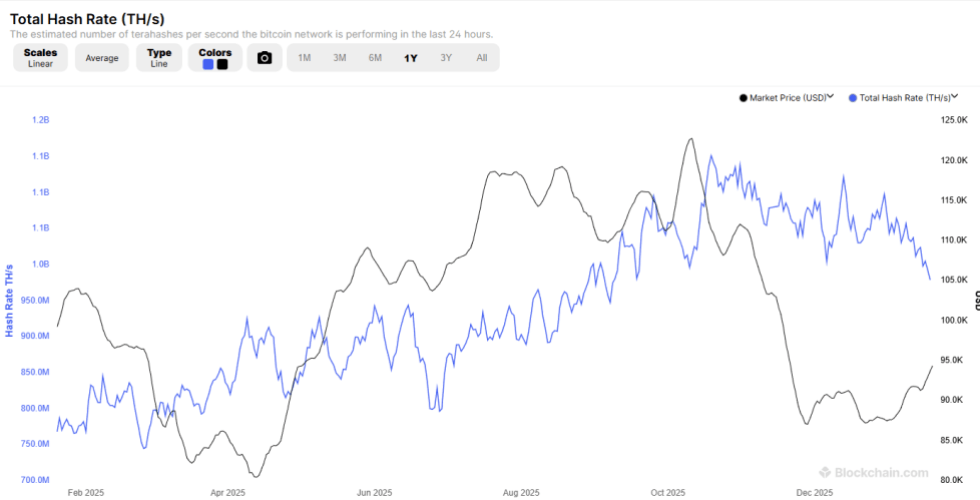
As the chart below from Blockchain.com shows, the 7-day average value of the Bitcoin Hashrate has been following the latter kind of trajectory in recent months.

The trend in the 7-day average value of the indicator over the last 12 months | Source: Blockchain.com

The Hashrate set a new all-time high (ATH) in mid-October, but miners moved to decommissioning power as the cryptocurrency’s price went through its bearish shift in that month. Recently, BTC has shown some recovery, but that doesn’t appear to have changed opinion among the miners, as the metric’s value has only continued to go down.

Currently, the 7-day average Bitcoin Hashrate is sitting at 978.8 EH/s, which is the lowest level since the first half of September. The recent low levels are on a path to affect another BTC-network-related metric: the Difficulty. The Difficulty is a feature built into the blockchain that controls how hard it is for miners to mine blocks. This metric automatically changes its value about every two weeks based on how fast miners have been performing their duty since the last adjustment.

Satoshi coded in a simple rule for the network to follow: block time should converge to 10 minutes. If miners take an average time faster than this to find a block, the chain raises its Difficulty in the next adjustment. Similarly, a decrease instead happens if the validators are slower at their job.

As miners have reduced their computing power over the last few months, their pace has been going down, and the network has been adjusting the Difficulty lower.

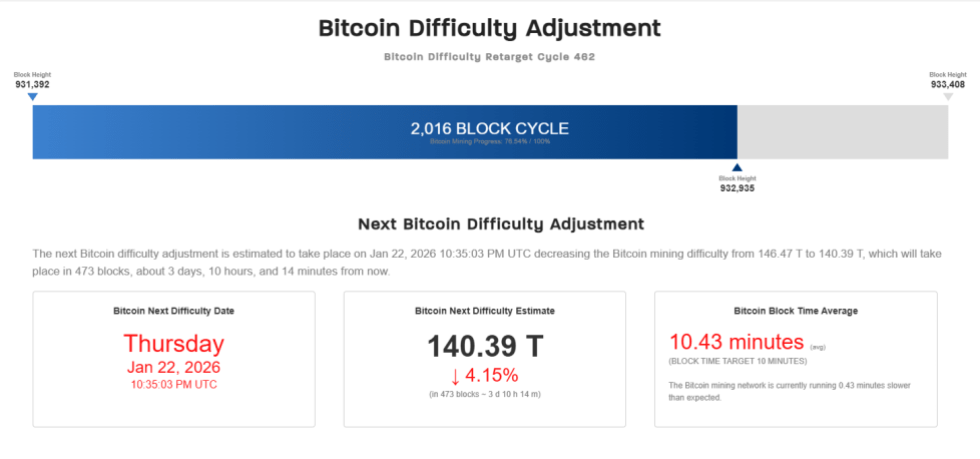
With the Hashrate decline only continuing recently, the network is once again moving toward another relaxation in Difficulty, as data from CoinWarz suggests.

The details related to the upcoming Difficulty adjustment | Source: CoinWarz

The average Bitcoin block time has stood at 10.43 minutes since the last adjustment, which is notably slower than the standard rate. As a result, the network is estimated to reduce the Difficulty by 4.15%.

With the adjustment still being a few days away, however, this figure could change depending on whether miners expand or decommission in the coming days.

BTC Price

At the time of writing, Bitcoin is floating around $93,000, up 2.5% in the last seven days.

Looks like the price of the coin has plummeted over the past day | Source: BTCUSDT on TradingView

Связанные с этим вопросы

QWhat does the Bitcoin Hashrate measure and why is it significant?

AThe Bitcoin Hashrate measures the total amount of computing power that miners have connected to the network, denoted in hashes per second (H/s) or exahashes per second (EH/s). It is significant because it gauges miner sentiment: growth indicates profitability or expansion in anticipation of price increases, while a decline signals weakening sentiment.

QWhat recent trend has been observed in the 7-day average Bitcoin Hashrate?

AThe 7-day average Bitcoin Hashrate has been declining, recently hitting 978.8 EH/s, which is the lowest level since the first half of September.

QHow does the decline in Hashrate affect Bitcoin's Difficulty?

AThe decline in Hashrate slows down the pace of block mining, causing the network to adjust the Difficulty lower. Currently, it is estimated to decrease by 4.15% in the upcoming adjustment due to the average block time being 10.43 minutes, slower than the standard 10 minutes.

QWhat is the relationship between block time and Difficulty adjustment in Bitcoin?

ASatoshi Nakamoto designed the Bitcoin network to target a 10-minute block time. If miners take less than 10 minutes on average to find blocks, Difficulty increases in the next adjustment; if they take longer, Difficulty decreases to maintain the target block time.

QWhat is Bitcoin's current price and recent performance mentioned in the article?

AAt the time of writing, Bitcoin is floating around $93,000, up 2.5% in the last seven days, though it has plummeted over the past day.

Похожее

Exploring Bitcoin Valuation in 2026 from Macro and On-Chain Structural Perspectives

Tiger Research analyzes Bitcoin's valuation outlook for 2026 from macro and on-chain perspectives. Despite a 27% price drop in Q1, the macro environment remains supportive. Global M2 hit a record $13.44 trillion, but Chinese liquidity, which contributed over 60% of M2 growth, has limited access to Bitcoin markets. The Iran conflict pushed oil prices higher, raising March CPI to 3.3% and narrowing the Fed's rate cut path. However, the easing direction remains intact. Bitcoin ETF flows turned positive in March after five months of outflows, and corporate accumulation continues. On-chain metrics show a shift from undervaluation to early equilibrium. Key indicators like MVRV-Z and NUPL have exited panic zones. The critical resistance is at $78k, the long-term holder cost basis, while the key support is at $54k. Although transaction counts increased, active addresses and average transfer size declined, indicating superficial growth rather than real network expansion. BTCFi ecosystem growth has weakened, leading to a -10% adjustment in fundamental metrics. The 12-month price target is set at $143k, based on a $132.5k neutral benchmark adjusted by -10% (fundamentals) and +20% (macro). This represents a 103% upside from current levels. Short-term catalysts include a break above $78k, sustained ETF inflows, and a Fed policy shift post-geopolitical de-escalation.

marsbit8 мин. назад

Exploring Bitcoin Valuation in 2026 from Macro and On-Chain Structural Perspectives

marsbit8 мин. назад

Anthropic Starts Poaching Scientists? $27K Weekly Onsite Stipend to Fix Claude's Expert-Level Errors

Anthropic has launched a new STEM Fellow program, offering $3,800 per week for a three-month, in-person residency in San Francisco. The role targets experts from science, technology, engineering, and mathematics (STEM) fields—machine learning experience is helpful but not required. Instead, Anthropic values scientific judgment and a willingness to learn quickly. Fellows will work with Claude models and internal tools under the guidance of an Anthropic researcher. Example projects include a materials scientist identifying errors in Claude’s reasoning or a climate scientist integrating atmospheric modeling software with Claude. The goal is to have experts "tell Claude where it's wrong" and improve its scientific capabilities. This initiative is part of Anthropic’s broader strategy to strengthen its scientific ecosystem, following earlier programs like the AI Safety Fellows and AI for Science programs. The company acknowledges that current AI models, while powerful, still produce high-confidence errors and lack end-to-end research autonomy. The program aims to embed domain expertise directly into model development, turning scientists into "high-level reviewers" for AI. Anthropic CEO Dario Amodei has previously emphasized AI’s potential to accelerate scientific breakthroughs, particularly in biology and healthcare. The company believes that the next phase of AI competition will depend not on scaling parameters, but on integrating human expertise to refine model accuracy and reliability.

marsbit38 мин. назад

Anthropic Starts Poaching Scientists? $27K Weekly Onsite Stipend to Fix Claude's Expert-Level Errors

marsbit38 мин. назад

On the Eve of X Money's Launch, Musk Dismantles the Referee First

"X Money Launches After Dismantling Regulator: Musk's 9-Day Power Play" In February 2025, a team from the "Department of Government Efficiency" (DOGE), led by Elon Musk, entered the Consumer Financial Protection Bureau (CFPB) headquarters. Shortly after, the CFPB was effectively dismantled—its funding frozen, activities suspended, and nearly 90% of staff laid off. This move came just nine days after X announced a partnership with Visa and as X Money prepared to launch. The article contrasts this with the decade-long regulatory battles faced by companies like Coinbase and PayPal. Coinbase spent over $75 million in political contributions and endured a major SEC lawsuit to operate legally. PayPal complied with strict state and federal rules for its stablecoin PYUSD, including 100% reserve requirements and monthly audits. However, Musk’s approach was different. After the CFPB introduced a rule placing large digital payment apps under federal oversight, Musk tweeted "Delete CFPB." Within months, the rule was revoked by Congress. Meanwhile, DOGE operatives gained "god-tier" access to CFPB databases, potentially obtaining sensitive competitive information from rivals like Apple, Google, and PayPal. The article also highlights a "suspicious exemption clause" in the GENIUS Act, which allows private companies like X to issue stablecoins with fewer restrictions. Senator Elizabeth Warren questioned whether Musk, who was a senior presidential advisor during the Act’s drafting, influenced this clause. X Money offers a 6% APY on deposits, despite FDIC warnings that stablecoin users are not insured. As X Money launches to 600 million monthly users, the article questions the fairness of a system where Musk can bypass regulations that others spent years and millions to comply with. The dismantling of the CFPB and the alleged regulatory advantages raise concerns about the future of equitable rule-making in the U.S. financial system.

marsbit47 мин. назад

On the Eve of X Money's Launch, Musk Dismantles the Referee First

marsbit47 мин. назад

Торговля

Спот
Фьючерсы

Популярные статьи

Тест по Bitcoin Биткоина

HTX Learn: Изучите Bitcoin halving и Заработаете Токены USDT

3.0k просмотров всегоОпубликовано 2024.04.16Обновлено 2024.04.16

Тест по Bitcoin  Биткоина

Что такое $BITCOIN

ЦИФРОВОЕ ЗОЛОТО ($BITCOIN): Комплексный анализ Введение в ЦИФРОВОЕ ЗОЛОТО ($BITCOIN) ЦИФРОВОЕ ЗОЛОТО ($BITCOIN) — это проект на основе блокчейна, работающий в сети Solana, который стремится объединить характеристики традиционных драгоценных металлов с инновациями децентрализованных технологий. Хотя он носит имя Биткойн, часто называемого “цифровым золотом” из-за его восприятия как средства хранения ценности, ЦИФРОВОЕ ЗОЛОТО является отдельным токеном, предназначенным для создания уникальной экосистемы в ландшафте Web3. Его цель — позиционировать себя как жизнеспособный альтернативный цифровой актив, хотя детали его применения и функциональности все еще развиваются. Что такое ЦИФРОВОЕ ЗОЛОТО ($BITCOIN)? ЦИФРОВОЕ ЗОЛОТО ($BITCOIN) — это токен криптовалюты, специально разработанный для использования в блокчейне Solana. В отличие от Биткойна, который выполняет широко признанную роль хранения ценности, этот токен, похоже, сосредоточен на более широких приложениях и характеристиках. Примечательные аспекты включают: Инфраструктура блокчейна: Токен построен на блокчейне Solana, известном своей способностью обрабатывать высокоскоростные и недорогие транзакции. Динамика предложения: ЦИФРОВОЕ ЗОЛОТО имеет максимальное предложение, ограниченное 100 квадриллионами токенов (100P $BITCOIN), хотя детали о его обращающемся предложении в настоящее время не раскрыты. Утилита: Хотя точные функциональные возможности не описаны, есть указания на то, что токен может быть использован для различных приложений, потенциально связанных с децентрализованными приложениями (dApps) или стратегиями токенизации активов. Кто создатель ЦИФРОВОГО ЗОЛОТА ($BITCOIN)? На данный момент личность создателей и команды разработчиков, стоящих за ЦИФРОВЫМ ЗОЛОТОМ ($BITCOIN), остается неизвестной. Эта ситуация типична для многих инновационных проектов в области блокчейна, особенно тех, которые связаны с децентрализованными финансами и феноменом мем-криптовалют. Хотя такая анонимность может способствовать культуре, ориентированной на сообщество, она усиливает опасения по поводу управления и ответственности. Кто инвесторы ЦИФРОВОГО ЗОЛОТА ($BITCOIN)? Доступная информация указывает на то, что у ЦИФРОВОГО ЗОЛОТА ($BITCOIN) нет известных институциональных спонсоров или значительных венчурных капиталовложений. Проект, похоже, функционирует по модели пирингового взаимодействия, сосредоточенной на поддержке и принятии сообществом, а не на традиционных путях финансирования. Его активность и ликвидность в основном сосредоточены на децентрализованных биржах (DEX), таких как PumpSwap, а не на устоявшихся централизованных торговых платформах, что еще больше подчеркивает его подход, ориентированный на grassroots. Как работает ЦИФРОВОЕ ЗОЛОТО ($BITCOIN) Операционные механизмы ЦИФРОВОГО ЗОЛОТА ($BITCOIN) можно подробно описать на основе его дизайна блокчейна и характеристик сети: Механизм консенсуса: Используя уникальный механизм доказательства истории (PoH) Solana в сочетании с моделью доказательства доли (PoS), проект обеспечивает эффективную валидацию транзакций, что способствует высокой производительности сети. Токеномика: Хотя конкретные дефляционные механизмы не были подробно описаны, большое максимальное предложение токенов подразумевает, что оно может быть предназначено для микротранзакций или нишевых случаев использования, которые еще предстоит определить. Интероперабельность: Существует потенциал для интеграции с более широкой экосистемой Solana, включая различные платформы децентрализованных финансов (DeFi). Однако детали относительно конкретных интеграций остаются неуточненными. Хронология ключевых событий Вот хронология, которая подчеркивает значимые вехи, касающиеся ЦИФРОВОГО ЗОЛОТА ($BITCOIN): 2023: Первоначальное развертывание токена происходит в блокчейне Solana, отмеченное его адресом контракта. 2024: ЦИФРОВОЕ ЗОЛОТО приобретает видимость, когда оно становится доступным для торговли на децентрализованных биржах, таких как PumpSwap, позволяя пользователям обменивать его на SOL. 2025: Проект наблюдает спорадическую торговую активность и потенциальный интерес к инициативам, возглавляемым сообществом, хотя на данный момент не зафиксировано никаких значительных партнерств или технических достижений. Критический анализ Сильные стороны Масштабируемость: Основная инфраструктура Solana поддерживает высокие объемы транзакций, что может повысить полезность $BITCOIN в различных сценариях транзакций. Доступность: Потенциально низкая цена торговли за токен может привлечь розничных инвесторов, способствуя более широкому участию благодаря возможностям дробного владения. Риски Отсутствие прозрачности: Отсутствие публично известных спонсоров, разработчиков или процесса аудита может вызвать скептицизм относительно устойчивости и надежности проекта. Волатильность рынка: Торговая активность сильно зависит от спекулятивного поведения, что может привести к значительной волатильности цен и неопределенности для инвесторов. Заключение ЦИФРОВОЕ ЗОЛОТО ($BITCOIN) является интригующим, но неоднозначным проектом в быстро развивающейся экосистеме Solana. Хотя он пытается использовать нарратив “цифрового золота”, его отход от установленной роли Биткойна как средства хранения ценности подчеркивает необходимость более четкого различения его предполагаемой утилиты и структуры управления. Будущее принятие и усвоение, вероятно, будут зависеть от решения текущей непрозрачности и более четкого определения его операционных и экономических стратегий. Примечание: Этот отчет охватывает синтезированную информацию, доступную на октябрь 2023 года, и с тех пор могут произойти события.

99 просмотров всегоОпубликовано 2025.05.13Обновлено 2025.05.13

Что такое $BITCOIN

Fractal Bitcoin: масштабирование Биткоина с помощью рекурсивной системы

Fractal Bitcoin — масштабное Layer-1-решнение, созданное на базе кода Биткоина, позволяющего достигать бесконечного масштабирования с помощью рекурсивного подхода.

2.2k просмотров всегоОпубликовано 2025.06.30Обновлено 2025.06.30

Fractal Bitcoin: масштабирование Биткоина с помощью рекурсивной системы

Обсуждения

Добро пожаловать в Сообщество HTX. Здесь вы сможете быть в курсе последних новостей о развитии платформы и получить доступ к профессиональной аналитической информации о рынке. Мнения пользователей о цене на BTC (BTC) представлены ниже.

活动图片