Bitcoin Enters the Public Bond Market, Moody's Issues World's First Rating for Crypto-Collateralized Bond

marsbitОпубликовано 2026-04-01Обновлено 2026-04-01

Введение

Moody's Ratings has assigned a Ba2 provisional credit rating to a $100 million Bitcoin-backed municipal bond issued by the New Hampshire Business Finance Authority, marking the first time a major rating agency has assessed a cryptocurrency-collateralized public bond. The bond, structured by Wave Digital Assets, is fully collateralized by Bitcoin held in regulated cold storage and requires 160% over-collateralization. It includes automatic liquidation triggers if the collateral value falls below 140% of the debt exposure. Moody's conservative assessment incorporated a 72% advance rate and short liquidation windows, simulating a 28% Bitcoin price drop. The Ba2 rating reflects the structure's risk mitigation measures rather than a dismissal of Bitcoin itself. This issuance represents a new phase in institutional crypto adoption—using Bitcoin as rated collateral in public debt markets—potentially paving the way for more regulated, large-scale institutional crypto financing.

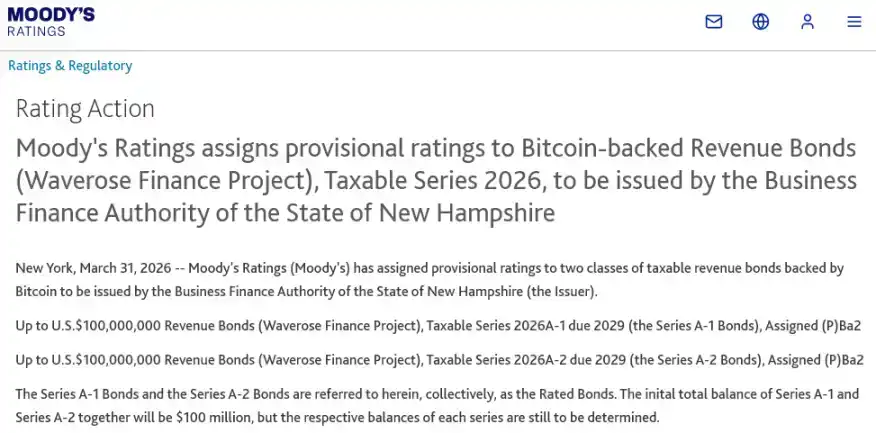
On March 31, Moody's Ratings assigned a provisional credit rating of Ba2 to a Bitcoin-collateralized bond issued by the New Hampshire Business Finance Authority (BFA). This marks the first time in history that a traditional rating agency has conducted a credit assessment for a Bitcoin-collateralized municipal bond.
What is This Bond

This is a $100 million Bitcoin-backed taxable revenue bond linked to the Waverose Finance Project, divided into two series, 2026A-1 and 2026A-2, both maturing in 2029.

The bond was structured by Wave Digital Assets, with Rosemawr Management serving as the investment manager and Orrick providing legal services. The fees BFA receives from the transaction will be used to create a "Bitcoin Economic Development Fund."

The core of the bond structure lies in its independence from any entity's cash flow, relying directly on Bitcoin as collateral for repayment. The Bitcoin collateral is custodied by BitGo Trust Company, Inc. and held in regulated cold storage.

When the borrower needs to pay interest or repay principal, the collateral will be liquidated to cover the expenses. The bond also includes a clause relatively favorable to holders. Series A-2 holders are entitled to receive an additional share of BTC profits after full repayment of principal and interest if the price of Bitcoin is higher than the pricing date at maturity.

Compared to Bitcoin lending tools on platforms like Coinbase, the most significant aspect of this bond is that it provides cryptocurrencies with their first opportunity to enter the public bond market for financing. Borrowers no longer rely on private loans from centralized platforms but instead, through publicly rated bonds with traditional credit ratings, leverage institutional funds on a large scale and at low cost within a compliant framework.

How Institutions Assess Bitcoin's Risks

Moody's stated in its report that the provisional rating primarily reflects risks related to collateral, structure, and operations, with Bitcoin's high volatility being the primary consideration.

To hedge against price fluctuations, the issuance structure introduced a 1.6x over-collateralization requirement, meaning the value of BTC collateral must always remain at least 160% of the debt exposure.

If the collateral ratio falls to the 1.4x trigger line (i.e., LTV deteriorates to approximately 71%), a mandatory full redemption mechanism will be triggered, causing the bond to mature early and the Bitcoin to be liquidated for repayment.

In other words, for every $100 borrowed, at least $160 worth of Bitcoin must be collateralized. If the collateral value shrinks to below $140, the system triggers forced repayment, the bond matures early, and the Bitcoin is sold to repay the debt.

To assess conservatism, Moody's used a 72% advance rate and a shorter liquidation window in its rating report, simulating an extreme scenario where Bitcoin's price drops approximately 28% from the pricing date. Tests showed that the 1.6x initial over-collateralization and 1.4x trigger mechanism still provide sufficient protection, supporting the Ba2 rating outcome.

This parameter design is quite conservative, but for an asset with historical drawdowns often exceeding 50%, this conservatism may also be a prerequisite for Moody's willingness to issue a rating.

Another noteworthy detail is that although this bond bears the name of the New Hampshire Business Finance Authority, it has no connection to the state's public credit. Moody's explicitly stated in its report that no public funds from the state can be used to repay this bond.

The issuer acts as a "conduit issuer" in the structure, providing issuance channels and nominal endorsement but assuming no credit guarantee responsibility.

This structure is not uncommon in the traditional municipal bond field and is often used for financing special projects such as healthcare and education.

Why This Transaction is Important

To understand the historical significance of this bond, it must be viewed in a broader context.

Over the past few years, institutional attitudes toward Bitcoin have gone through three stages: from exclusion, to holding it as an asset (BTC reserves on corporate balance sheets), to using it as collateral for financing (pledging BTC for fiat loans). This bond represents the beginning of the fourth stage: Bitcoin, as the underlying collateral for publicly rated debt instruments, has entered the track of traditional public financial markets.

This track signifies three things: opening a window for institutional investors to indirectly gain Bitcoin exposure through compliant channels; prompting Moody's to begin establishing a rating methodology for crypto collateral, attracting more rating agencies to follow suit; proving that Bitcoin can, under certain conditions, serve as the underlying logic for "interest-bearing assets," not just zero-interest holdings.

This bond is not an isolated event. Concurrently, the U.S. Department of Labor, pursuant to President Trump's executive order, released a proposal to expand the availability of digital assets in retirement investment portfolios; multiple states are considering "Bitcoin strategic reserve" legislation; New Hampshire is also the first state in the U.S. to pass a cryptocurrency reserve law.

The Ba2 rating, frankly, is "junk bond" level, but this label itself can be misleading. In Moody's rating sequence, Ba2 is the second tier of speculative grade, still quite distant from the bottom (C/D).

Tesla did not receive investment-grade ratings from S&P and Moody's until between 2022 and 2023; Ford still maintains a speculative grade (Ba1) in Moody's system and barely holds the lowest investment grade with a negative outlook in S&P's system. This does not prevent them from being important allocation targets for institutional investors.

Secondly, the fact that this bond received Ba2 rather than a lower rating itself indicates that the 1.6x over-collateralization plus the forced liquidation mechanism passed the relevant scenario simulations in Moody's stress tests. Thus, Ba2 reflects the conservatism of the structural design, not a simple dismissal of the Bitcoin asset itself.

Looking at historical precedents, the first MBS (mortgage-backed security) and the first green bond similarly started at similar points when entering the rating system. As pricing experience accumulated and structures matured, ratings often improved accordingly. In this sense, Ba2 is merely a starting point.


Связанные с этим вопросы

QWhat is the significance of Moody's assigning a Ba2 rating to the Bitcoin-backed bond issued by New Hampshire BFA?

AIt is the first time a traditional rating agency has provided a credit assessment for a Bitcoin-collateralized municipal bond, marking Bitcoin's entry into the public debt market with institutional recognition.

QHow does the bond structure mitigate the risk associated with Bitcoin's price volatility?

AThe bond requires 160% over-collateralization, with a forced full redemption triggered if the collateral value drops to 140% of the debt exposure, ensuring repayment even if Bitcoin's price declines significantly.

QWhat role does the New Hampshire Business Finance Authority play in this bond issuance?

AIt acts as a conduit issuer, providing the issuance channel and nominal endorsement but assuming no credit guarantee responsibility; no public funds from the state are used for bond repayment.

QWhat additional benefit do Series A-2 bondholders receive under certain conditions?

AIf Bitcoin's price is higher than the pricing date at maturity, Series A-2 holders are entitled to an additional BTC profit share after full principal and interest payments.

QWhy is the Ba2 rating considered a starting point rather than a final assessment for such bonds?

ASimilar to historical precedents like the first MBS or green bonds, ratings often improve as pricing experience accumulates and structures mature; Ba2 reflects conservative design rather than outright rejection of Bitcoin.

Похожее

Apple's Desired On-Device AI Sees a Dark Horse Emerge: The First Cognitive Model is Born, 4B Matches GPT-5.4

A Chinese company, Tomorrow's Journey (Nextie), has introduced what it is calling the industry's first "cognitive model" for edge devices. Named New Journey Alpha, this 4-billion-parameter model reportedly matches the performance of trillion-parameter giants like GPT-5.4 in group intelligence tasks such as debate and collective decision-making. The development follows Andrej Karpathy's vision of stripping vast factual knowledge from large language models to retain only a smaller "cognitive core" capable of reasoning, planning, and knowing its own limits. This approach directly addresses the soaring computational costs and token expenses hindering AI's widespread deployment, as highlighted by incidents like Amazon shutting down an internal AI tool due to prohibitive costs. Trained via reinforcement learning on a corpus of academic papers from 1800-2020 to enhance generalization, the model enables three key advancements: 1) Improved decision quality in multi-agent systems, 2) Drastically reduced compute costs, allowing for cost-effective cloud or on-device (e.g., MacBook) deployment, and 3) The feasibility of "proactive" AI agents that act autonomously without user prompts, unlocking new commercial possibilities beyond today's reactive models. Built by the former Microsoft Xiaoice team—known for creating a 3.6B model that outperformed a 65B Llama model—the company is now focusing on the multi-agent systems sector, a field gaining significant investor interest. The model's economic impact is profound; by achieving high-level performance with minimal parameters, it fundamentally alters the cost structure of AI services, challenging the prevailing model of ever-larger parameter counts.

marsbit1 ч. назад

Apple's Desired On-Device AI Sees a Dark Horse Emerge: The First Cognitive Model is Born, 4B Matches GPT-5.4

marsbit1 ч. назад

OpenAI's 'Blueprint for the Future': Making AI Beneficial for Every Person on the Planet

A new transformative technology emerges every few generations. OpenAI draws a parallel with the advent of electricity in the 1920s, which initially brought convenience but ultimately enabled unprecedented progress in medicine, engineering, and living standards by empowering people to create new possibilities. AI is poised to recreate this phenomenon. Its true significance lies not in the technology itself, but in what people can achieve with it—from understanding a medical bill or starting a business to aiding scientific discovery. OpenAI believes AI should be universally accessible, allowing everyone to use it according to their own needs. This future, however, is not guaranteed. While transformative tech can centralize power, OpenAI's philosophy is that AI must serve humanity, augmenting human capabilities and broadly distributing its benefits. The company's first commitment is to build AI for human service, aiming to empower the many rather than concentrate power in a few. Safety, alignment with human intent, and oversight are paramount. OpenAI is optimistic about AI's potential to expand human welfare but remains clear-eyed about risks. The goal is to help people achieve more, not to replace them. Full automation is not the desired future; human judgment, values, and direction will become even more critical. OpenAI outlines three core goals: 1. Build automated AI researchers to accelerate and increasingly automate the research process itself, maintaining close human collaboration. The internal projection is that by March 2028, a significant portion of their research will be conducted by AI systems working alongside human researchers. 2. Accelerate economic development by advancing science, boosting productivity, and fostering growth, while ensuring the fruits are widely shared. 3. Provide a personal AGI for everyone on Earth, allowing individuals to benefit from this transformative technology in their own way. The company is entering its third phase, moving from foundational AGI research (Phase 1) to product deployment and learning from real-world use (Phase 2). The current challenge is making advanced AI abundant, affordable, safe, practical, and usable for all individuals and organizations. OpenAI concludes that a widely distributed power structure leads to a more resilient, adaptable, and free society. A positive AI future should not be controlled by a handful of entities but built, benefited from, and owned by many. If realized correctly, AI can become a cornerstone for enhancing global productivity, creativity, scientific advancement, and economic opportunity, fulfilling the mission to ensure AGI benefits all of humanity.

marsbit2 ч. назад

OpenAI's 'Blueprint for the Future': Making AI Beneficial for Every Person on the Planet

marsbit2 ч. назад

Arthur Hayes' New Article: AI Bubble Nears Bursting, Crypto Market Faces Short-Term Pressure

In a new essay, Arthur Hayes argues that the AI market bubble is approaching a rupture, which will place significant short-term pressure on crypto assets. He identifies rising oil prices, a trio of massive tech IPOs (SpaceX, Anthropic, OpenAI), and potential anti-AI political rhetoric from Trump as the three key catalysts for a correction. Hayes posits that the prolonged blockage of the Strait of Hormuz will drive energy prices higher, increasing operational costs for data centers and squeezing AI company profits. Simultaneously, the market may struggle to absorb the upcoming wave of multi-trillion dollar tech IPOs. Furthermore, with high inflation hurting his election chances, Trump could pivot to attacking the AI sector with proposals for heavy taxation and regulation to win over voters, spooking the market. Hayes notes that nearly all new dollar liquidity since 2022 has flowed into the AI sector, leaving little for Bitcoin, explaining its recent underperformance. He believes an AI stock crash would trigger a broad risk-off sentiment and credit contraction, dragging down crypto in the near term. Consequently, his fund, Maelstrom, has sold all AI-related stocks and non-core cryptocurrencies, retaining only Bitcoin and Ethereum while building positions in traditional energy stocks. He anticipates Bitcoin will bottom and resume its bull run only after the AI bubble pops and a new monetary easing cycle begins.

marsbit2 ч. назад

Arthur Hayes' New Article: AI Bubble Nears Bursting, Crypto Market Faces Short-Term Pressure

marsbit2 ч. назад

Торговля

Спот
Фьючерсы

Популярные статьи

Как купить S

Добро пожаловать на HTX.com! Мы сделали приобретение Sonic (S) простым и удобным. Следуйте нашему пошаговому руководству и отправляйтесь в свое крипто-путешествие.Шаг 1: Создайте аккаунт на HTXИспользуйте свой адрес электронной почты или номер телефона, чтобы зарегистрироваться и бесплатно создать аккаунт на HTX. Пройдите удобную регистрацию и откройте для себя весь функционал.Создать аккаунтШаг 2: Перейдите в Купить криптовалюту и выберите свой способ оплатыКредитная/Дебетовая Карта: Используйте свою карту Visa или Mastercard для мгновенной покупки Sonic (S).Баланс: Используйте средства с баланса вашего аккаунта HTX для простой торговли.Третьи Лица: Мы добавили популярные способы оплаты, такие как Google Pay и Apple Pay, для повышения удобства.P2P: Торгуйте напрямую с другими пользователями на HTX.Внебиржевая Торговля (OTC): Мы предлагаем индивидуальные услуги и конкурентоспособные обменные курсы для трейдеров.Шаг 3: Хранение Sonic (S)После приобретения вами Sonic (S) храните их в своем аккаунте на HTX. В качестве альтернативы вы можете отправить их куда-либо с помощью перевода в блокчейне или использовать для торговли с другими криптовалютами.Шаг 4: Торговля Sonic (S)С легкостью торгуйте Sonic (S) на спотовом рынке HTX. Просто зайдите в свой аккаунт, выберите торговую пару, совершайте сделки и следите за ними в режиме реального времени. Мы предлагаем удобный интерфейс как для начинающих, так и для опытных трейдеров.

1.4k просмотров всегоОпубликовано 2025.01.15Обновлено 2026.06.02

Как купить S

Sonic: Обновления под руководством Андре Кронье – новая звезда Layer-1 на фоне спада рынка

Он решает проблемы масштабируемости, совместимости между блокчейнами и стимулов для разработчиков с помощью технологических инноваций.

2.3k просмотров всегоОпубликовано 2025.04.09Обновлено 2025.04.09

Sonic: Обновления под руководством Андре Кронье – новая звезда Layer-1 на фоне спада рынка

HTX Learn: Пройдите обучение по "Sonic" и разделите 1000 USDT

HTX Learn — ваш проводник в мир перспективных проектов, и мы запускаем специальное мероприятие "Учитесь и Зарабатывайте", посвящённое этим проектам. Наше новое направление .

1.8k просмотров всегоОпубликовано 2025.04.10Обновлено 2025.04.10

HTX Learn: Пройдите обучение по "Sonic" и разделите 1000 USDT

Обсуждения

Добро пожаловать в Сообщество HTX. Здесь вы сможете быть в курсе последних новостей о развитии платформы и получить доступ к профессиональной аналитической информации о рынке. Мнения пользователей о цене на S (S) представлены ниже.

活动图片














