‘Bitcoin Demand Boom Is Fading’ — CryptoQuant Calls The Start Of Bear Market

bitcoinistОпубликовано 2025-12-21Обновлено 2025-12-21

Введение

CryptoQuant's latest analysis suggests Bitcoin is entering a bear market, citing fading demand growth as the primary catalyst. Key demand drivers—including US spot ETFs, the presidential election, and corporate treasury purchases—have weakened since early October 2025, coinciding with a major market sell-off. Institutional demand has declined, with US ETFs becoming net sellers in Q4 2025, while derivatives activity and trader sentiment have also deteriorated. Bitcoin is now trading below its 365-day moving average, a critical bull-bear threshold. The firm identifies the realized price near $56,000 as a potential bottom, implying a possible 55% correction from all-time highs—which would be the smallest bear market drawdown on record. BTC currently trades around $88,170.

The price action of Bitcoin over the past week tells a perfect story of its performance this year. The premier cryptocurrency experienced incredible levels of volatility throughout the week, oscillating between the $90,000 and $86,000 range over the past few days.

The latest market evaluation shows that the future of the Bitcoin price might be looking bleaker than mere periods of sideways volatility. According to a prominent cycle, BTC’s price cycle has turned and is entering a bear market.

Bitcoin Cyclical Behavior Depends On Demand Cycles: CryptoQuant

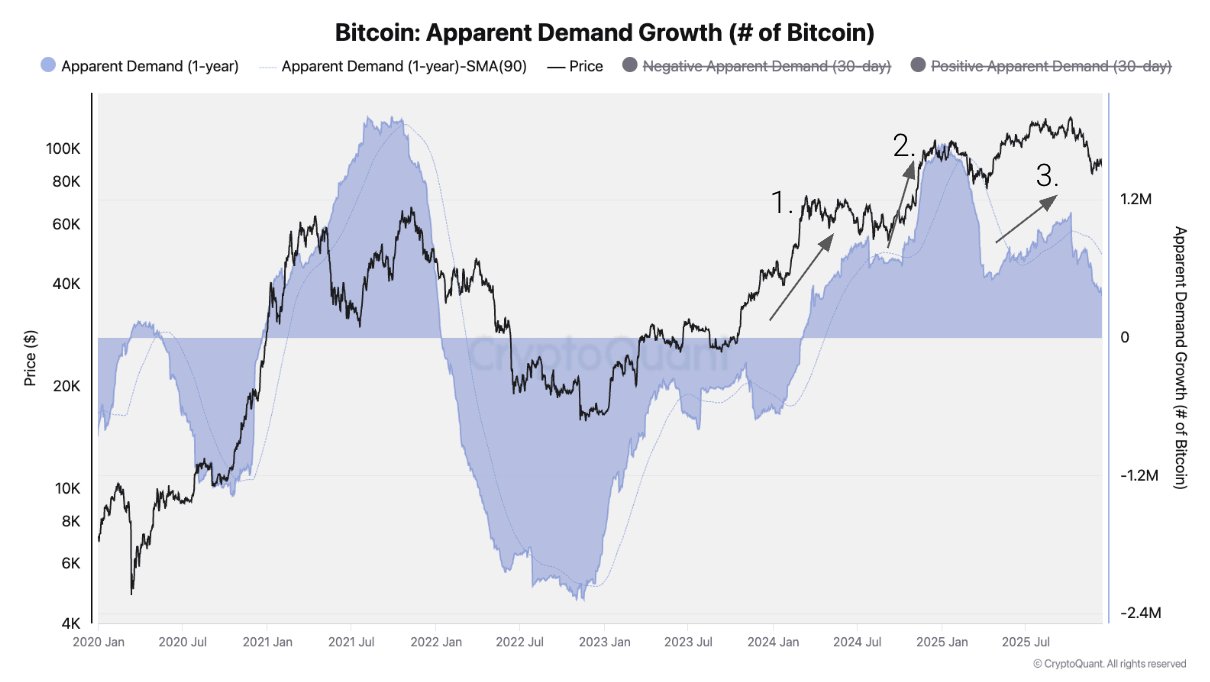
In its latest market report, blockchain analytics firm CryptoQuant has associated the steady decline in Bitcoin price with the fading demand boom. According to data on the on-chain platform, the BTC demand growth has slowed down in the course of 2025, signaling the start of a bear market.

CryptoQuant highlighted that Bitcoin has witnessed three major spot demand waves—triggered by the US spot ETF launch, the US presidential election outcome, and the Bitcoin Treasury Companies bubble—since the bull cycle started in 2023. However, the demand growth has slowed down since early October 2025.

Unsurprisingly, this trend reversal for the demand growth coincides with the October 10 market bloodbath, one of the largest liquidation events in crypto history. The Bitcoin price has since struggled to mount any convincing recovery, falling to as low as $82,000 in late November.

Source: CryptoQuant

CryptoQuant went on to hypothesize that a key pillar of price support has been removed as most of this cycle’s incremental demand has already been realized. For instance, demand from institutional and large investors is in a downturn, with US-based Bitcoin exchange-traded funds (ETFs) turning into net sellers in 2025’s fourth quarter.

According to CryptoQuant’s data, the US spot ETF holdings have declined by 24,000 BTC in Q4 2025, which is a far cry from the steady accumulation seen in Q4 2024. “Similarly, addresses holding 100–1K BTC—representing ETFs and treasury companies—are growing below trend, echoing the demand deterioration seen at the end of 2021 ahead of the 2022 bear market,” the blockchain firm added.

Besides the weakening spot demand, the Bitcoin derivatives market has also seen reduced activity and decreased risk appetite. CryptoQuant revealed that BTC’s funding rates have fallen to their lowest level since December 2023, an on-chain signal that suggests the reduced willingness of traders to maintain long exposure; this trend is often associated with bear markets.

Ultimately, the blockchain firm concluded that the Bitcoin four-year cycle hinges more on demand phases—expansions and contractions in demand growth— rather than on the halving event. In essence, a bear market tends to come after the BTC demand growth peaks and topples over.

What Next For BTC Price?

In its report, CryptoQuant revealed that the Bitcoin price structure has worsened in line with the demand weakness. The flagship cryptocurrency is currently trading below its 365-day moving average, a key long-term support level that has historically separated bull and bear phases.

According to CryptoQuant, the downside reference points suggest that the Bitcoin bear market might not be as deep as feared. As in previous bear seasons, the realized price—currently around $56,000—has been identified as the potential bottom.

This implies a possible 55% correction from the latest all-time high, Bitcoin’s smallest drawdown on record (during a bear market). Meanwhile, the market leader has its intermediate support level around $70,000.

As of this writing, the price of BTC stands at around $88,170, reflecting a 3% jump in the past 24 hours.

The price of BTC on the daily timeframe | Source: BTCUSDT chart on TradingView

Связанные с этим вопросы

QAccording to CryptoQuant, what is the main reason for the recent decline in Bitcoin's price and the start of a bear market?

AThe main reason is the fading demand boom, with Bitcoin demand growth slowing down significantly since early October 2025.

QWhat three major spot demand waves did CryptoQuant identify as driving the bull cycle that started in 2023?

AThe three major demand waves were triggered by the US spot ETF launch, the US presidential election outcome, and the Bitcoin Treasury Companies bubble.

QWhat key on-chain signal from the derivatives market suggests a reduced appetite for risk among traders?

ABitcoin's funding rates have fallen to their lowest level since December 2023, indicating traders' reduced willingness to maintain long positions.

QWhat key long-term support level is Bitcoin currently trading below, according to the report?

ABitcoin is currently trading below its 365-day moving average, a key support level that has historically separated bull and bear phases.

QWhat price level does CryptoQuant identify as the potential bottom for this bear market, based on the realized price?

AThe realized price, currently around $56,000, is identified as the potential bottom for the bear market.

Похожее

From Survival to Accelerated Growth: The Journey of Zcash's Three-Year Rise as Told by the Founder of ZODL

**From Survival to Accelerated Growth: Zcash Founder Details the 3-Year Rise** Three years ago, Zcash (ZEC) was a struggling pioneer in privacy technology, with a price near $30, low shielded supply (11%), and a community mired in governance disputes. Today, ZEC trades around $600, with over 31% of its supply (~$3B) in user-controlled shielded pools. This transformation resulted from breaking key constraints. First, **governance shackles were removed**. The old model guaranteed funding to two entities (ECC and ZF) regardless of performance, creating a monopoly. In 2024, ECC rejected further direct funding, forcing a change. The NU6 upgrade ended direct funding, allocating 8% to community grants and 12% to a protocol-controlled treasury for retroactive rewards, expiring in 2028 unless renewed by overwhelming consensus. The entities also relinquished their trademark-based veto power, freeing community governance. Second, the **product focus shifted** from pure cryptography to user growth. Previously, engineering excelled at privacy tech but failed to attract users. In early 2024, the team (later ZODL) pivoted to building products users wanted, like the Zodl wallet (default privacy, hardware support, cross-asset swaps). This drove shielded supply to grow over 400% in ZEC terms, with 86.5% of recent transactions being shielded, representing real user adoption. Third, the **narrative evolved** from the limiting "privacy coin" label to "unstoppable private money." This clarified Zcash's value proposition: a Bitcoin-like monetary policy with verifiable private payments via advanced cryptography. This structural narrative—protocol (Zcash), asset (ZEC), gateway (Zodl)—enabled broader exchange listings, institutional interest, and ETF filings. Finally, **organizational constraints were broken**. In early 2026, the ECC team left its non-profit structure after disputes over control, forming Zcash Open Development Lab (ZODL). ZODL raised $25M from top VCs (Paradigm, a16z, etc.), gaining the capital and agility of a startup to scale consumer products. Current metrics show strong momentum: social discussion volume for ZEC surged 15,245% in a year, with 81% positive sentiment. The focus is now on enhancing user experience (Zodl wallet), scalability (Tachyon project targeting Visa-level throughput with 25-second blocks), and post-quantum security (quantum-recoverable wallets coming soon). Zcash is positioned to become faster, more usable, scalable, and quantum-resistant.

marsbit3 мин. назад

From Survival to Accelerated Growth: The Journey of Zcash's Three-Year Rise as Told by the Founder of ZODL

marsbit3 мин. назад

Five Counterparty Risk Architectures: A Settlement-Layer Methodology for Classifying TradFi Models in Crypto Exchanges

**Summary:** This companion piece reframes the five TradFi-on-crypto exchange architectures, previously classified by "architectural fingerprint," through the lens of counterparty risk. The core question is: whose balance sheet bears the loss first in a stress scenario, and has it historically done so? Each of the five models corresponds to a distinct risk holder with its own documented failure modes. * **Model 1 (Stablecoin-Settled CEX Perpetuals):** Risk is held by the stablecoin issuer (e.g., reserve composition, bank connectivity) and the CEX's own book. History includes Tether's banking disconnections (2017) and reserve misrepresentations (CFTC 2021 Order). * **Model 2 (CFD Brokers):** Risk resides on the broker's balance sheet (B-book model). Regulatory differences (e.g., ESMA's mandatory negative balance protection vs. Mauritius FSC's lack thereof) define loss allocation rules, as seen in the 2015 SNB event (Alpari UK insolvency). * **Model 3 (Off-Chain Custody & Transfer Agent Chain):** Risk lies with the off-chain custodian/platform. User asset recovery depends on Terms of Use and corporate structure, exemplified by the Celsius bankruptcy ruling (2023) where Earn Account assets were deemed property of the estate. * **Model 4 (DEX Perpetual Protocols):** No single balance sheet bears risk. Loss absorption relies on a protocol's insurance fund and Auto-Deleveraging (ADL) mechanism, as demonstrated in the GMX V1 (2022) and dYdX v3 YFI (2023) incidents. * **Model 5 (Regulated CCP - DCM-DCO-FCM):** The most institutionalized model concentrates risk in the Central Counterparty (CCP). However, history shows CCPs can employ non-standard tools under extreme stress, such as mass trade cancellation (LME Nickel, 2022) or enabling negative price settlements (CME WTI, 2020). The report argues that regulatory choices and counterparty risk structures are co-extensive, not in an upstream-downstream relationship. It concludes with five separate observation checklists (not predictions) for monitoring the structural vulnerabilities of each risk model.

marsbit20 мин. назад

Five Counterparty Risk Architectures: A Settlement-Layer Methodology for Classifying TradFi Models in Crypto Exchanges

marsbit20 мин. назад

Торговля

Спот
Фьючерсы

Популярные статьи

Тест по Bitcoin Биткоина

HTX Learn: Изучите Bitcoin halving и Заработаете Токены USDT

3.0k просмотров всегоОпубликовано 2024.04.16Обновлено 2024.04.16

Тест по Bitcoin  Биткоина

Что такое $BITCOIN

ЦИФРОВОЕ ЗОЛОТО ($BITCOIN): Комплексный анализ Введение в ЦИФРОВОЕ ЗОЛОТО ($BITCOIN) ЦИФРОВОЕ ЗОЛОТО ($BITCOIN) — это проект на основе блокчейна, работающий в сети Solana, который стремится объединить характеристики традиционных драгоценных металлов с инновациями децентрализованных технологий. Хотя он носит имя Биткойн, часто называемого “цифровым золотом” из-за его восприятия как средства хранения ценности, ЦИФРОВОЕ ЗОЛОТО является отдельным токеном, предназначенным для создания уникальной экосистемы в ландшафте Web3. Его цель — позиционировать себя как жизнеспособный альтернативный цифровой актив, хотя детали его применения и функциональности все еще развиваются. Что такое ЦИФРОВОЕ ЗОЛОТО ($BITCOIN)? ЦИФРОВОЕ ЗОЛОТО ($BITCOIN) — это токен криптовалюты, специально разработанный для использования в блокчейне Solana. В отличие от Биткойна, который выполняет широко признанную роль хранения ценности, этот токен, похоже, сосредоточен на более широких приложениях и характеристиках. Примечательные аспекты включают: Инфраструктура блокчейна: Токен построен на блокчейне Solana, известном своей способностью обрабатывать высокоскоростные и недорогие транзакции. Динамика предложения: ЦИФРОВОЕ ЗОЛОТО имеет максимальное предложение, ограниченное 100 квадриллионами токенов (100P $BITCOIN), хотя детали о его обращающемся предложении в настоящее время не раскрыты. Утилита: Хотя точные функциональные возможности не описаны, есть указания на то, что токен может быть использован для различных приложений, потенциально связанных с децентрализованными приложениями (dApps) или стратегиями токенизации активов. Кто создатель ЦИФРОВОГО ЗОЛОТА ($BITCOIN)? На данный момент личность создателей и команды разработчиков, стоящих за ЦИФРОВЫМ ЗОЛОТОМ ($BITCOIN), остается неизвестной. Эта ситуация типична для многих инновационных проектов в области блокчейна, особенно тех, которые связаны с децентрализованными финансами и феноменом мем-криптовалют. Хотя такая анонимность может способствовать культуре, ориентированной на сообщество, она усиливает опасения по поводу управления и ответственности. Кто инвесторы ЦИФРОВОГО ЗОЛОТА ($BITCOIN)? Доступная информация указывает на то, что у ЦИФРОВОГО ЗОЛОТА ($BITCOIN) нет известных институциональных спонсоров или значительных венчурных капиталовложений. Проект, похоже, функционирует по модели пирингового взаимодействия, сосредоточенной на поддержке и принятии сообществом, а не на традиционных путях финансирования. Его активность и ликвидность в основном сосредоточены на децентрализованных биржах (DEX), таких как PumpSwap, а не на устоявшихся централизованных торговых платформах, что еще больше подчеркивает его подход, ориентированный на grassroots. Как работает ЦИФРОВОЕ ЗОЛОТО ($BITCOIN) Операционные механизмы ЦИФРОВОГО ЗОЛОТА ($BITCOIN) можно подробно описать на основе его дизайна блокчейна и характеристик сети: Механизм консенсуса: Используя уникальный механизм доказательства истории (PoH) Solana в сочетании с моделью доказательства доли (PoS), проект обеспечивает эффективную валидацию транзакций, что способствует высокой производительности сети. Токеномика: Хотя конкретные дефляционные механизмы не были подробно описаны, большое максимальное предложение токенов подразумевает, что оно может быть предназначено для микротранзакций или нишевых случаев использования, которые еще предстоит определить. Интероперабельность: Существует потенциал для интеграции с более широкой экосистемой Solana, включая различные платформы децентрализованных финансов (DeFi). Однако детали относительно конкретных интеграций остаются неуточненными. Хронология ключевых событий Вот хронология, которая подчеркивает значимые вехи, касающиеся ЦИФРОВОГО ЗОЛОТА ($BITCOIN): 2023: Первоначальное развертывание токена происходит в блокчейне Solana, отмеченное его адресом контракта. 2024: ЦИФРОВОЕ ЗОЛОТО приобретает видимость, когда оно становится доступным для торговли на децентрализованных биржах, таких как PumpSwap, позволяя пользователям обменивать его на SOL. 2025: Проект наблюдает спорадическую торговую активность и потенциальный интерес к инициативам, возглавляемым сообществом, хотя на данный момент не зафиксировано никаких значительных партнерств или технических достижений. Критический анализ Сильные стороны Масштабируемость: Основная инфраструктура Solana поддерживает высокие объемы транзакций, что может повысить полезность $BITCOIN в различных сценариях транзакций. Доступность: Потенциально низкая цена торговли за токен может привлечь розничных инвесторов, способствуя более широкому участию благодаря возможностям дробного владения. Риски Отсутствие прозрачности: Отсутствие публично известных спонсоров, разработчиков или процесса аудита может вызвать скептицизм относительно устойчивости и надежности проекта. Волатильность рынка: Торговая активность сильно зависит от спекулятивного поведения, что может привести к значительной волатильности цен и неопределенности для инвесторов. Заключение ЦИФРОВОЕ ЗОЛОТО ($BITCOIN) является интригующим, но неоднозначным проектом в быстро развивающейся экосистеме Solana. Хотя он пытается использовать нарратив “цифрового золота”, его отход от установленной роли Биткойна как средства хранения ценности подчеркивает необходимость более четкого различения его предполагаемой утилиты и структуры управления. Будущее принятие и усвоение, вероятно, будут зависеть от решения текущей непрозрачности и более четкого определения его операционных и экономических стратегий. Примечание: Этот отчет охватывает синтезированную информацию, доступную на октябрь 2023 года, и с тех пор могут произойти события.

99 просмотров всегоОпубликовано 2025.05.13Обновлено 2025.05.13

Что такое $BITCOIN

Fractal Bitcoin: масштабирование Биткоина с помощью рекурсивной системы

Fractal Bitcoin — масштабное Layer-1-решнение, созданное на базе кода Биткоина, позволяющего достигать бесконечного масштабирования с помощью рекурсивного подхода.

2.2k просмотров всегоОпубликовано 2025.06.30Обновлено 2025.06.30

Fractal Bitcoin: масштабирование Биткоина с помощью рекурсивной системы

Обсуждения

Добро пожаловать в Сообщество HTX. Здесь вы сможете быть в курсе последних новостей о развитии платформы и получить доступ к профессиональной аналитической информации о рынке. Мнения пользователей о цене на BTC (BTC) представлены ниже.

活动图片