Bitcoin deleverages after $13.45B expiry, but will weak demand stall recovery at $66K?

ambcryptoОпубликовано 2026-03-28Обновлено 2026-03-28

Введение

Following a significant $13.45 billion options expiry, Bitcoin underwent a broad deleveraging event, with Open Interest dropping 42% and reducing gamma constraints. This reset eased liquidation risks and suppressed short-term volatility, allowing the price to stabilize near $66,300. However, the market remains in a state of extreme fear, with weak demand and cautious sentiment hindering a strong recovery. Futures Open Interest declined further, funding rates turned negative, and long/short ratios hovered near parity, reflecting low conviction. The current structure is cleaner but fragile, leaving Bitcoin highly sensitive to macroeconomic triggers and headline-driven moves. For sustained stability, stronger spot demand is essential; otherwise, the market remains vulnerable to renewed volatility.

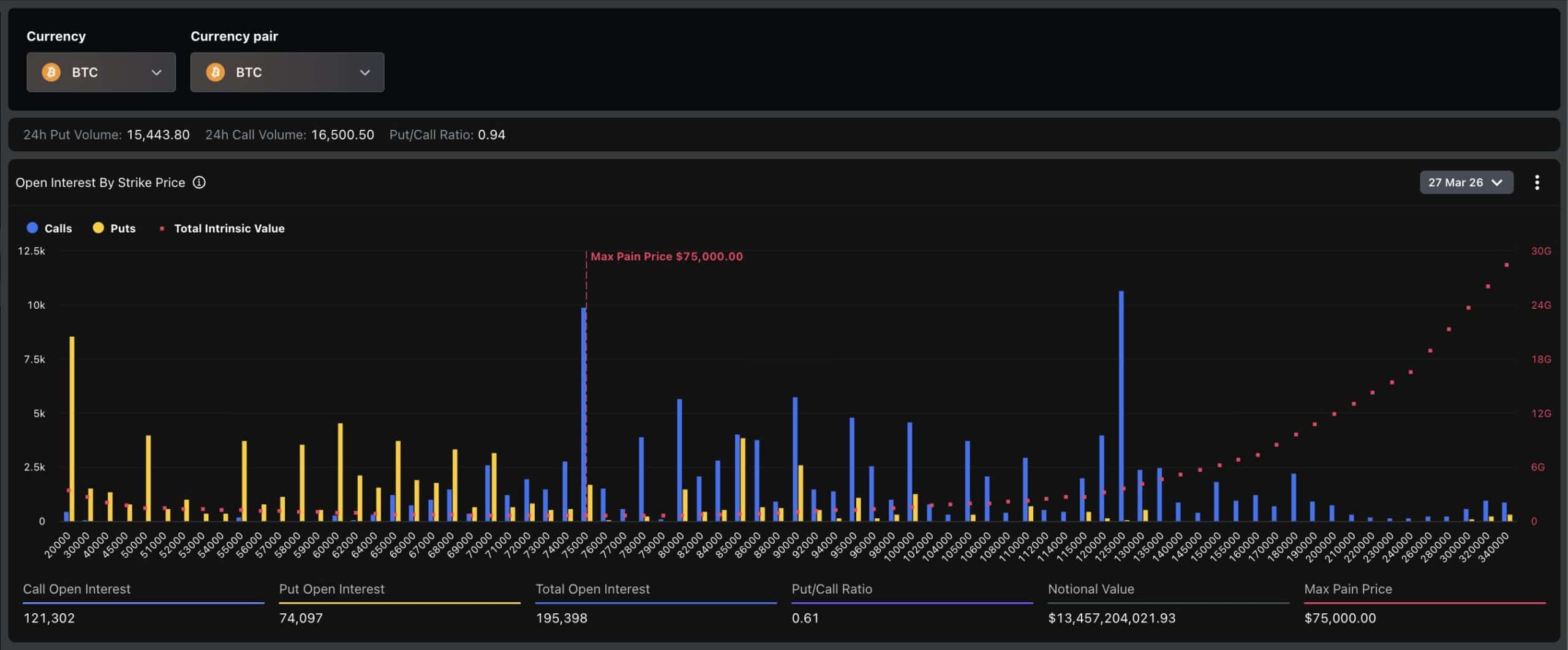
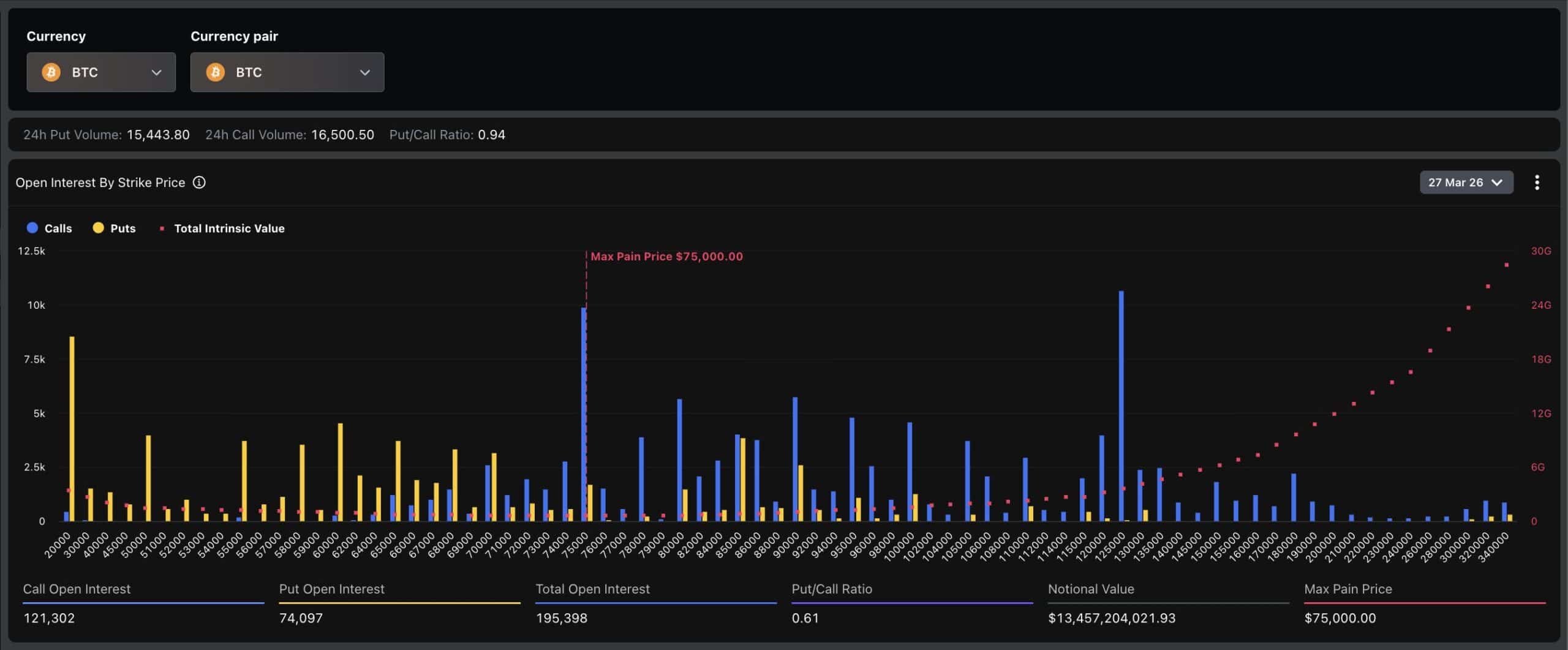
As the markets headed for the weekend, Bitcoin [BTC] cleared $13.45 billion in contracts, removing dense short-term positioning and easing gamma constraints. As this overhang faded, the price slipped towards $65,500, reflecting risk aversion driven by geopolitical tension and extreme fear.

Source: Deribit

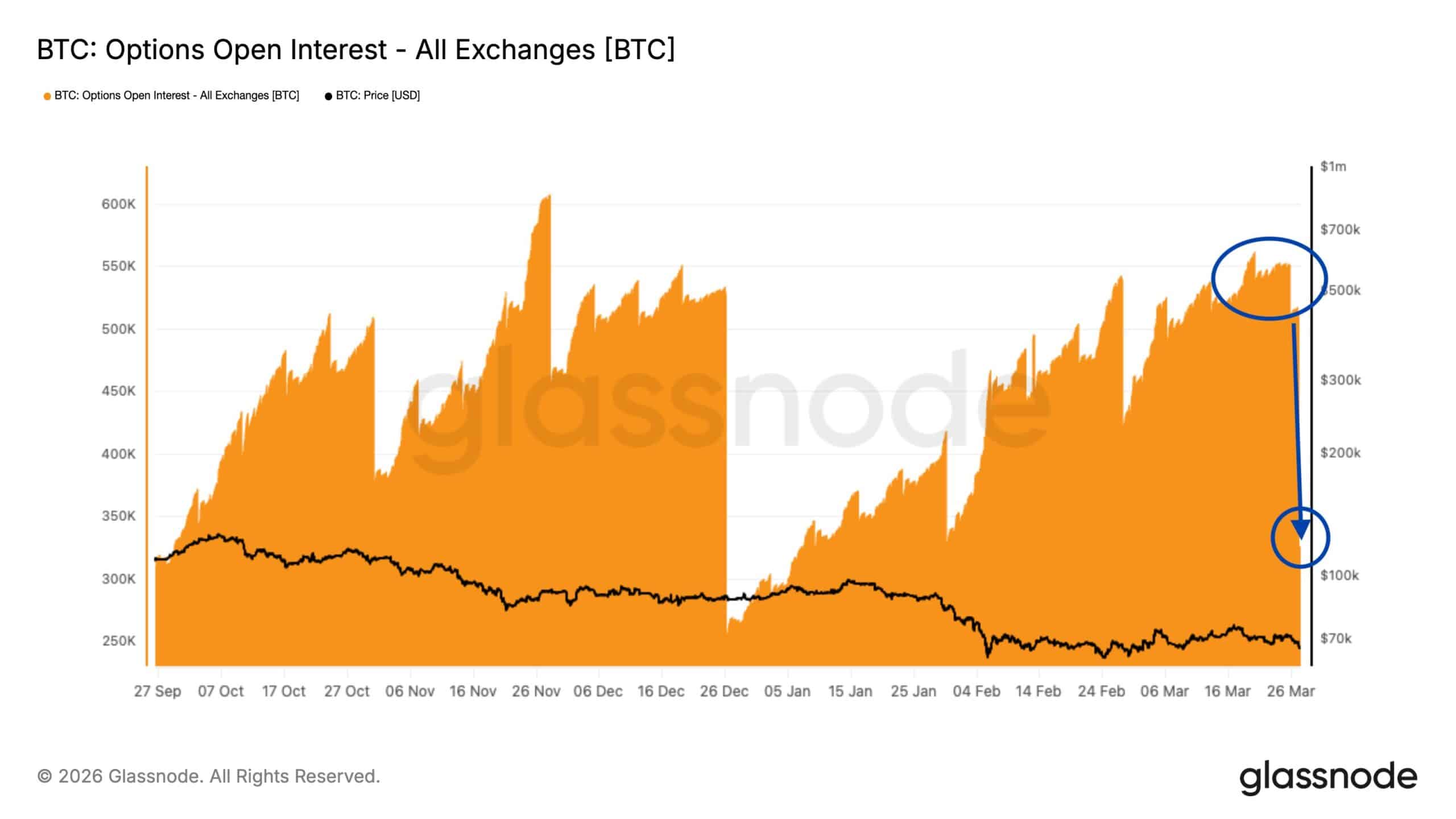
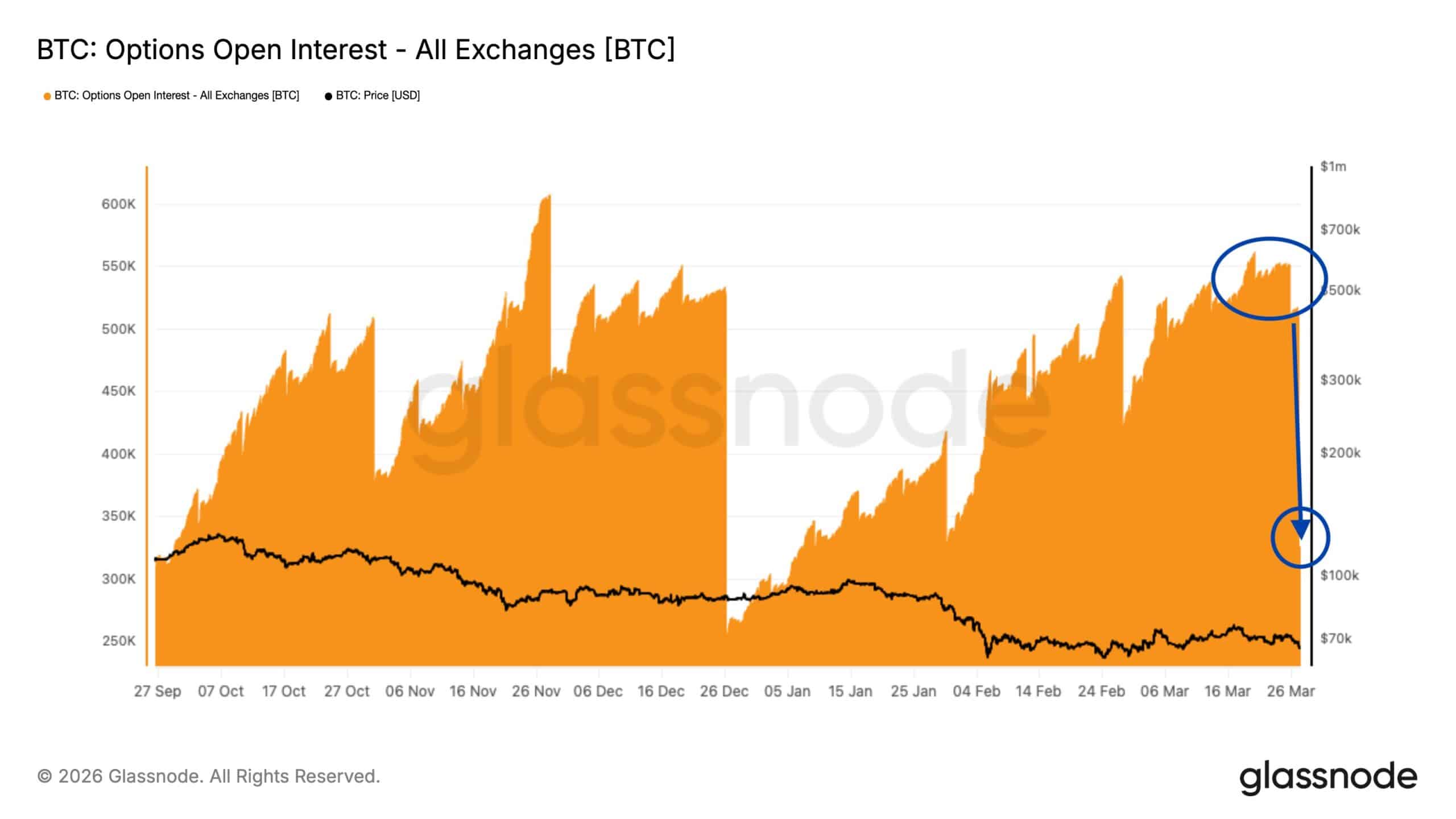
As pressure built, Open Interest fell by 42%, dropping from roughly 550,000 to 320,000 contracts after expiry.

This sharp contraction confirmed broad deleveraging across the board. Especially as traders closed positions, rather than triggering cascading liquidations.

Source: Glassnode

As leverage reset, derivatives pressure declined into lower percentiles, reinforcing that speculative excess has been flushed from the system. The price then stabilized near $66,300, where buyers began absorbing supply within a cleaner, less crowded structure.

This stabilization is evidence of balance, not strength, as demand has so far been cautious under macro stress. With positioning reset, Bitcoin now enters a transitional phase where fresh flows will likely define the next volatility expansion or directional move.

Will low leverage suppress or unleash volatility?

Bitcoin’s derivatives structure reset after the 27 March expiry, leaving Futures Open Interest (OI) near $108.4 billion after a 0.58% decline. As leverage thinned, crowded positioning eased, which removed gamma constraints that had tightly pinned short-term price action.

As the OI declined, liquidation risk dropped. This typically suppresses realized volatility in the immediate post-expiry phase. This happens because fewer leveraged positions remain to trigger forced moves, allowing the price to stabilize within a calmer range.

With strikes clustered around $66,000–$67,000 and leverage rebuild still weak, Bitcoin now sits at a pivot where muted volatility can persist. And yet, any new positioning or macro trigger can quickly drive expansion.

Bitcoin in extreme fear as market awaits demand shift

Bitcoin’s post-expiry reset now shifts into a sentiment phase marked by sustained stress rather than recovery. At the time of writing, the Fear and Greed Index was holding between 11 and 12 for a third session – A sign of downside expectations.

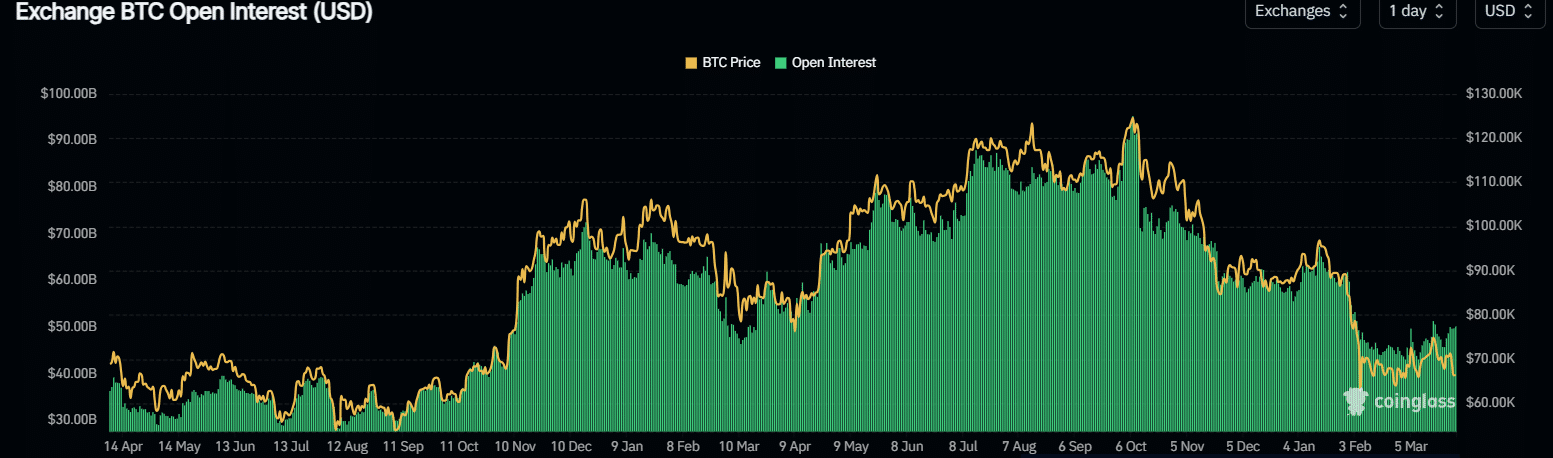
Thanks to this caution, BTC Futures Open Interest dropped by another 3.33% to $50.06 billion – Extending the deleveraging trend. Such a sustained reduction lowers liquidation risk, but it also removes structural buffers that once softened volatility.

CoinGlass

Funding has been slightly negative, while long/short ratios hovered near parity, reinforcing weak conviction across participants. As geopolitical tension builds, this fragile positioning will leave the price increasingly sensitive to headline-driven moves.

Extreme fear alone cannot confirm a bottom without demand. If spot absorption fails to emerge, Bitcoin remains exposed to renewed volatility expansion.

Taken together, it can be argued that Bitcoin has reset its structure. However, conviction remains weak near $66,000. If spot absorption strengthens, recovery can stabilize. On the contrary, if leverage rebuilds first, volatility will likely expand, especially under macro pressure.


Final Summary

  • Bitcoin [BTC] cleared $13.45 billion expiry as Open Interest fell by 42%, reducing liquidation risk but leaving the price near $66,000 with weak demand.
  • Bitcoin now depends on spot absorption for stability, while leverage rebuild risks renewed volatility under macro pressure.

Связанные с этим вопросы

QWhat was the total value of Bitcoin options contracts that expired, and what was the subsequent percentage drop in Open Interest?

A$13.45 billion in contracts expired, and Open Interest fell by 42%.

QTo what level did the price of Bitcoin slip after the expiry, and what was the primary reason for this risk aversion?

AThe price slipped towards $65,500, primarily due to risk aversion driven by geopolitical tension and extreme fear.

QWhat is the current reading on the Fear and Greed Index, and what does this signify for market expectations?

AThe Fear and Greed Index was holding between 11 and 12, which is a sign of extreme fear and downside expectations.

QAccording to the article, what two factors will define Bitcoin's next directional move after its structural reset?

AFresh flows and any new positioning or macro trigger will define the next volatility expansion or directional move.

QWhat is the key condition needed for Bitcoin's price recovery to stabilize at the $66,000 level?

AThe key condition is for spot absorption to strengthen; if leverage rebuilds first, it risks renewed volatility instead.

Похожее

The Battle for the AI Payment Race: Traditional Card Networks Face Off Against Coinbase

With the rise of AI agents conducting transactions, a battle for the underlying payment infrastructure is underway. Two distinct and incompatible approaches have emerged for enabling autonomous AI payments. The first approach is championed by traditional card networks Visa and Mastercard. They leverage their existing tokenized card credential systems, extending them to allow verified AI agents to make purchases within user-defined limits. Services like Mastercard's Agent Pay and Visa's Intelligent Commerce integrate with major AI platforms (e.g., OpenAI, Anthropic) and keep transactions within the established, decades-old card payment model. This system offers advantages for consumer retail, including robust fraud protection, chargeback mechanisms, and extensive merchant networks. The second approach, led by Coinbase, utilizes stablecoins on open internet protocols. Its x402 protocol reactivates the HTTP 402 status code for machine-to-machine micropayments, using USDC for settlement directly on-chain. This method eliminates the need for accounts or card fees, making it highly efficient for high-frequency, low-value, cross-border transactions between AI agents—such as paying for API calls, data streams, or computational resources—where traditional card fees and settlement times are impractical. While card networks excel in consumer-facing scenarios requiring dispute resolution, stablecoin protocols are tailored for machine economies. A key challenge for both is agent identity verification and transaction authorization. Notably, Visa and Mastercard are hedging their bets by also investing in stablecoins. Visa has rapidly grown its stablecoin settlement volume and is collaborating with Coinbase to bridge its network with the x402 protocol. Mastercard plans to acquire stablecoin platform BVNK. Their strategy is to become the fee-collecting gateway for all payment flows, regardless of the channel. Current applications reflect this division: consumer AI shopping tools (e.g., ChatGPT's checkout, Amazon's "Shop for Me") predominantly use card networks, while machine-focused services (e.g., Amazon Bedrock's core payments) adopt stablecoins via the x402 protocol. In the short term, a coexistence model is expected, with cards dominating retail and stablecoins powering machine transactions. The long-term outcome depends on whether AI-driven commerce evolves to resemble traditional retail or becomes a vast network of machine micropayments. By investing in both tracks, the incumbent card networks are positioning themselves to capture transaction fees regardless of which future prevails.

marsbit12 мин. назад

The Battle for the AI Payment Race: Traditional Card Networks Face Off Against Coinbase

marsbit12 мин. назад

Farewell to Traditional Bulls and Bears: The Market Has Entered an Era of Rotating Bubbles

Farewell to traditional bull and bear markets; we have entered an era of rolling bubbles. This article uses a meteorological analogy to explain the modern market's shift from slow-moving, long-term trends to a chain of rapid, successive speculative frenzies. The old market resembled "stratiform" weather—slow, broad cycles lasting years. Today's market is like a "mesoscale convective system," where isolated storms (bubbles in sectors like AI, GLP-1 drugs, or crypto) form in sequence. Each is triggered by the outflow of capital and sentiment from the previous one, creating a self-perpetuating chain of booms and busts. This structural change is driven by eight permanent shifts: the democratization of speculation (zero-commission trading, retail options activity), perpetual buying from defined-contribution retirement plans, the dominance of passive investing (creating price-insensitive flows), the rise of multi-strategy funds and high-frequency trading (weakening price discovery), suppressed volatility that erupts violently, an index composition now dominated by long-duration, narrative-driven tech stocks, the elimination of information delays, and a permissive fiscal/monetary backdrop. These conditions ensure that rolling bubbles are the new normal. To navigate this environment, investors should either become deep-sector experts who understand the underlying technologies and business models or become adept observers of trends and capital flows. While chaotic from within each "storm," a higher-altitude view reveals a predictable pattern of serial booms. The key is to avoid being emotionally swept up in any single narrative and to recognize the market's new, permanent structure.

marsbit47 мин. назад

Farewell to Traditional Bulls and Bears: The Market Has Entered an Era of Rotating Bubbles

marsbit47 мин. назад

Торговля

Спот
Фьючерсы

Популярные статьи

Тест по Bitcoin Биткоина

HTX Learn: Изучите Bitcoin halving и Заработаете Токены USDT

3.1k просмотров всегоОпубликовано 2024.04.16Обновлено 2024.04.16

Тест по Bitcoin  Биткоина

Что такое $BITCOIN

ЦИФРОВОЕ ЗОЛОТО ($BITCOIN): Комплексный анализ Введение в ЦИФРОВОЕ ЗОЛОТО ($BITCOIN) ЦИФРОВОЕ ЗОЛОТО ($BITCOIN) — это проект на основе блокчейна, работающий в сети Solana, который стремится объединить характеристики традиционных драгоценных металлов с инновациями децентрализованных технологий. Хотя он носит имя Биткойн, часто называемого “цифровым золотом” из-за его восприятия как средства хранения ценности, ЦИФРОВОЕ ЗОЛОТО является отдельным токеном, предназначенным для создания уникальной экосистемы в ландшафте Web3. Его цель — позиционировать себя как жизнеспособный альтернативный цифровой актив, хотя детали его применения и функциональности все еще развиваются. Что такое ЦИФРОВОЕ ЗОЛОТО ($BITCOIN)? ЦИФРОВОЕ ЗОЛОТО ($BITCOIN) — это токен криптовалюты, специально разработанный для использования в блокчейне Solana. В отличие от Биткойна, который выполняет широко признанную роль хранения ценности, этот токен, похоже, сосредоточен на более широких приложениях и характеристиках. Примечательные аспекты включают: Инфраструктура блокчейна: Токен построен на блокчейне Solana, известном своей способностью обрабатывать высокоскоростные и недорогие транзакции. Динамика предложения: ЦИФРОВОЕ ЗОЛОТО имеет максимальное предложение, ограниченное 100 квадриллионами токенов (100P $BITCOIN), хотя детали о его обращающемся предложении в настоящее время не раскрыты. Утилита: Хотя точные функциональные возможности не описаны, есть указания на то, что токен может быть использован для различных приложений, потенциально связанных с децентрализованными приложениями (dApps) или стратегиями токенизации активов. Кто создатель ЦИФРОВОГО ЗОЛОТА ($BITCOIN)? На данный момент личность создателей и команды разработчиков, стоящих за ЦИФРОВЫМ ЗОЛОТОМ ($BITCOIN), остается неизвестной. Эта ситуация типична для многих инновационных проектов в области блокчейна, особенно тех, которые связаны с децентрализованными финансами и феноменом мем-криптовалют. Хотя такая анонимность может способствовать культуре, ориентированной на сообщество, она усиливает опасения по поводу управления и ответственности. Кто инвесторы ЦИФРОВОГО ЗОЛОТА ($BITCOIN)? Доступная информация указывает на то, что у ЦИФРОВОГО ЗОЛОТА ($BITCOIN) нет известных институциональных спонсоров или значительных венчурных капиталовложений. Проект, похоже, функционирует по модели пирингового взаимодействия, сосредоточенной на поддержке и принятии сообществом, а не на традиционных путях финансирования. Его активность и ликвидность в основном сосредоточены на децентрализованных биржах (DEX), таких как PumpSwap, а не на устоявшихся централизованных торговых платформах, что еще больше подчеркивает его подход, ориентированный на grassroots. Как работает ЦИФРОВОЕ ЗОЛОТО ($BITCOIN) Операционные механизмы ЦИФРОВОГО ЗОЛОТА ($BITCOIN) можно подробно описать на основе его дизайна блокчейна и характеристик сети: Механизм консенсуса: Используя уникальный механизм доказательства истории (PoH) Solana в сочетании с моделью доказательства доли (PoS), проект обеспечивает эффективную валидацию транзакций, что способствует высокой производительности сети. Токеномика: Хотя конкретные дефляционные механизмы не были подробно описаны, большое максимальное предложение токенов подразумевает, что оно может быть предназначено для микротранзакций или нишевых случаев использования, которые еще предстоит определить. Интероперабельность: Существует потенциал для интеграции с более широкой экосистемой Solana, включая различные платформы децентрализованных финансов (DeFi). Однако детали относительно конкретных интеграций остаются неуточненными. Хронология ключевых событий Вот хронология, которая подчеркивает значимые вехи, касающиеся ЦИФРОВОГО ЗОЛОТА ($BITCOIN): 2023: Первоначальное развертывание токена происходит в блокчейне Solana, отмеченное его адресом контракта. 2024: ЦИФРОВОЕ ЗОЛОТО приобретает видимость, когда оно становится доступным для торговли на децентрализованных биржах, таких как PumpSwap, позволяя пользователям обменивать его на SOL. 2025: Проект наблюдает спорадическую торговую активность и потенциальный интерес к инициативам, возглавляемым сообществом, хотя на данный момент не зафиксировано никаких значительных партнерств или технических достижений. Критический анализ Сильные стороны Масштабируемость: Основная инфраструктура Solana поддерживает высокие объемы транзакций, что может повысить полезность $BITCOIN в различных сценариях транзакций. Доступность: Потенциально низкая цена торговли за токен может привлечь розничных инвесторов, способствуя более широкому участию благодаря возможностям дробного владения. Риски Отсутствие прозрачности: Отсутствие публично известных спонсоров, разработчиков или процесса аудита может вызвать скептицизм относительно устойчивости и надежности проекта. Волатильность рынка: Торговая активность сильно зависит от спекулятивного поведения, что может привести к значительной волатильности цен и неопределенности для инвесторов. Заключение ЦИФРОВОЕ ЗОЛОТО ($BITCOIN) является интригующим, но неоднозначным проектом в быстро развивающейся экосистеме Solana. Хотя он пытается использовать нарратив “цифрового золота”, его отход от установленной роли Биткойна как средства хранения ценности подчеркивает необходимость более четкого различения его предполагаемой утилиты и структуры управления. Будущее принятие и усвоение, вероятно, будут зависеть от решения текущей непрозрачности и более четкого определения его операционных и экономических стратегий. Примечание: Этот отчет охватывает синтезированную информацию, доступную на октябрь 2023 года, и с тех пор могут произойти события.

99 просмотров всегоОпубликовано 2025.05.13Обновлено 2025.05.13

Что такое $BITCOIN

Fractal Bitcoin: масштабирование Биткоина с помощью рекурсивной системы

Fractal Bitcoin — масштабное Layer-1-решнение, созданное на базе кода Биткоина, позволяющего достигать бесконечного масштабирования с помощью рекурсивного подхода.

2.3k просмотров всегоОпубликовано 2025.06.30Обновлено 2025.06.30

Fractal Bitcoin: масштабирование Биткоина с помощью рекурсивной системы

Обсуждения

Добро пожаловать в Сообщество HTX. Здесь вы сможете быть в курсе последних новостей о развитии платформы и получить доступ к профессиональной аналитической информации о рынке. Мнения пользователей о цене на BTC (BTC) представлены ниже.

活动图片