A Person Who Can't Code Single-Handedly Handled All of Anthropic's Growth Marketing for Ten Months

marsbitОпубликовано 2026-03-12Обновлено 2026-03-12

Введение

Anthropic, a company valued at $380 billion, had a single non-technical growth marketer, Austin Lau, managing all performance marketing channels—paid search, paid social, app store optimization, email marketing, and SEO—for nearly ten months. Despite having no coding experience, Lau used Claude Code to automate key workflows. He built a Figma plugin to generate hundreds of creative ad variants in seconds instead of 30 minutes, and created a Google Ads automation tool that drafts compliant ad copy and exports it for upload. He also integrated Claude with Meta’s Ads API to analyze campaign performance in real-time and built a memory system to inform future A/B tests. As a result, ad creation time dropped from 2 hours to 15 minutes, and creative output increased tenfold. Anthropic’s internal case study highlights how AI is erasing the barrier between technical and non-technical roles, enabling individuals to achieve output comparable to full teams. The key to scaling efficiency lies in identifying repetitive tasks, breaking them into sub-tasks handled by specialized AI agents, and designing systematic workflows—not in having advanced technical skills.

To what extent can AI enhance an individual's work efficiency?

Recently, a post about Anthropic sparked widespread sharing on social media. The poster, Ole Lehmann, claimed that Anthropic, a company valued at $380 billion, had an entire growth marketing team consisting of just one person—a non-technical marketer who independently managed paid search, paid social, app store optimization, email marketing, and SEO for nearly ten months.

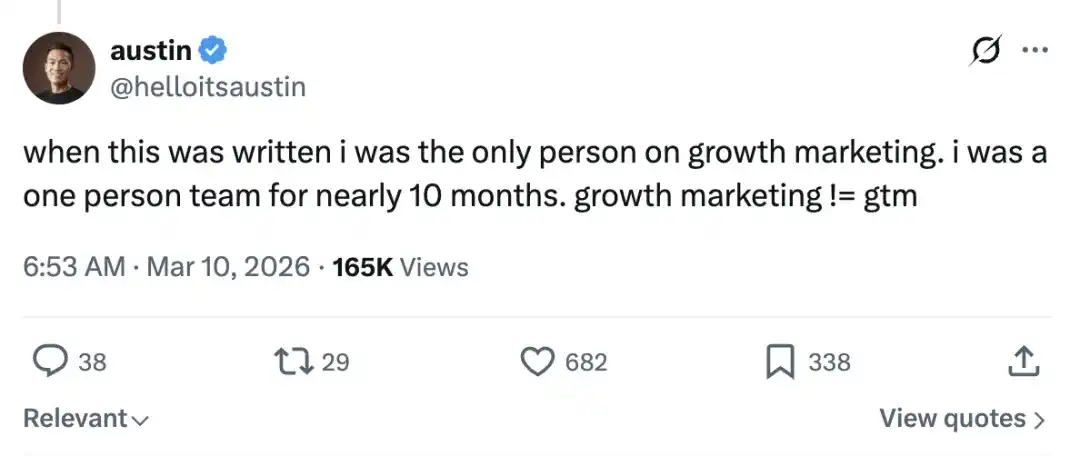
Shortly after the post was published, it was questioned in the comments, but soon, the person involved confirmed it. The growth marketer, named Austin Lau, replied that he was indeed the only one handling growth marketing at the time the article was written, and he had been doing it alone for nearly ten months.

Image丨Related Tweet (Source: X)

In late January, Anthropic published an official case study detailing Austin Lau's working methods. Around the same time, Anthropic also released an internal white paper titled "How the Anthropic Team Uses Claude Code," covering use cases from ten teams, including data infrastructure and legal departments, with growth marketing being one of them.

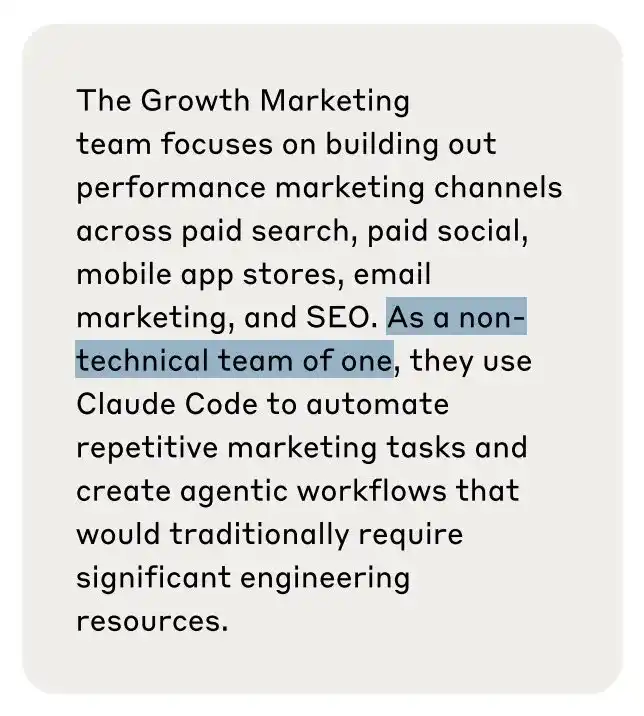
The white paper stated: The growth marketing team focuses on channels such as paid search, paid social, mobile app stores, email marketing, and SEO. It is a "non-technical one-person team" that relies on Claude Code to automate repetitive marketing tasks and build automated workflows that traditionally require significant engineering resources.

(Source: Anthropic)

Austin Lau is not an engineer. In Anthropic's official case study video, he mentioned that he had "never written a single line of code." When he first encountered Claude Code, he even had to Google "how to open Terminal on a Mac." When Claude Code was first released, his initial reaction was that he "had no idea who this product was for." as a marketer, he found its use case unclear.

The turning point came when a colleague shared a Claude Code installation guide for non-technical employees in the company's Slack group. Out of curiosity, Austin installed it, and within a week, he had built two automated workflows that completely transformed his work.

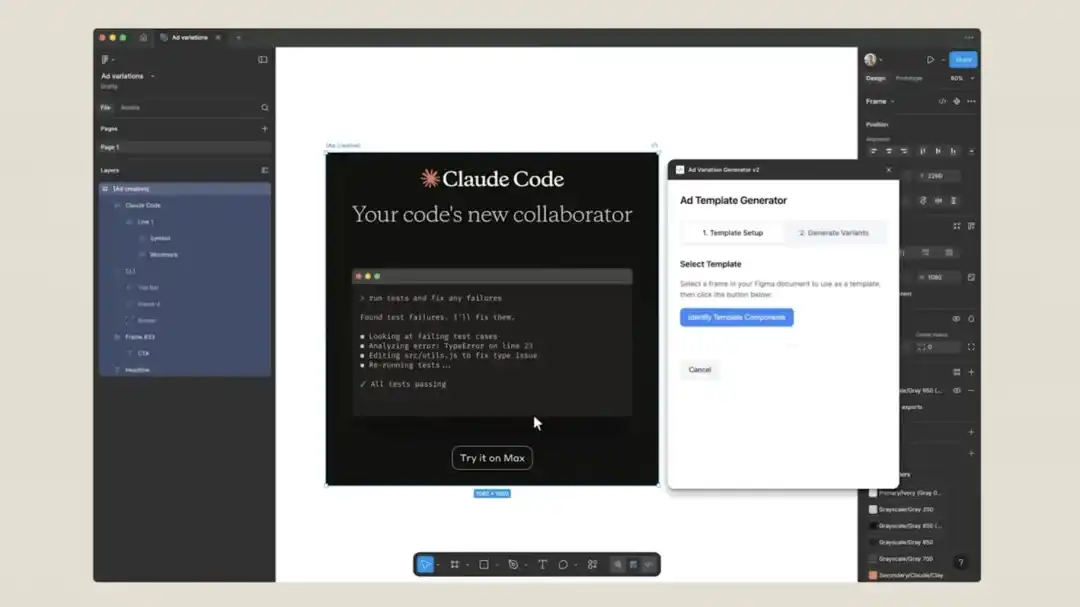
The first was a Figma plugin. For paid social ads and app store marketing, he needed to process a large amount of visual material in Figma. The old workflow was: when creating multiple variations of the same design, he had to manually duplicate frames in Figma, constantly switch between Google Docs and Figma, and copy and paste headlines one by one. If there were 10 variations of copy to adapt to 5 different aspect ratios, this mechanical labor could easily take half an hour.

Image丨 Austin Lau (Source: Anthropic)

He described this pain point to Claude Code in natural language and asked it to help write a Figma plugin. During the process, he had Claude Code refer to Figma's API documentation, prototyping while researching. The first version of the generated prototype wasn't perfect, but it was a starting point. He continuously debugged it and eventually created a functional plugin.

(Source: Anthropic)

The plugin works as follows: select a static image frame, and the plugin automatically identifies components such as headlines, call-to-action buttons, and code blocks. It then batch-generates independent Figma frames from a prepared list of copy, with each variation corresponding to a new set of text. A single batch process can generate up to 100 ad variations, taking about half a second per batch. What used to take 30 minutes of manual work now takes 30 seconds.

The second workflow was for generating Google Ads copy. Google Ads' responsive search ads have strict character limits: 30 characters for headlines and 90 characters for descriptions. Previously, he had to draft in Google Sheets, manually check character counts, and then paste the content into the Google Ads backend one by one.

Austin created a custom slash command "/rsa" in Claude Code. When triggered, Claude Code would ask for input such as campaign data, existing ad copy, and keywords, then cross-reference his pre-defined "Agent Skills," which included Anthropic's brand tone, product accuracy guidelines, and Google Ads RSA best practices.

The system uses two specialized sub-agents: one dedicated to writing headlines and another to writing descriptions, each working within their respective character constraints. This approach yields higher quality output than trying to cram both tasks into a single prompt.

Finally, Claude Code packages 15 headlines and 4 descriptions into a CSV file ready for direct upload to Google Ads. Austin emphasizes that the generated copy is just a starting point; he evaluates each piece: Is the value proposition clear? Is the tone right? Does it stand out from competitors? But at least the tedious work of drafting and formatting is fully automated.

The efficiency gains from these two workflows are already impressive, but Austin's system goes further. He also built an MCP server (Model Context Protocol) connected to the Meta Ads API.

Through this integration, he can directly query ad performance, spending data, and the effectiveness of individual ads within the Claude desktop app, without needing to open the Meta Ads backend dashboard. Questions like "Which ads had the highest conversion rate this week?" or "Where am I waste budget?" can be asked directly to Claude, receiving answers based on real-time data.

More importantly, it's a closed loop. Austin built a memory system that records the hypotheses and experimental results from each round of ad iterations. When he starts a new round of variant generation, Claude automatically retrieves data from all previous tests—which copy performed well and which didn't—ensuring the next generation is built on historical experiments. This system becomes slightly smarter after each cycle. This kind of systematic experiment tracking across hundreds of ads typically requires a dedicated data analyst in a traditional team.

According to Anthropic's white paper, the results of this working method are: ad copy creation time reduced from 2 hours to 15 minutes, creative output increased by 10 times, and the number of ad variants he alone tested covered more channels and quantities than most full-scale marketing teams.

In that white paper, growth marketing is just one of ten cases. The data infrastructure team used Claude Code to debug Kubernetes cluster failures, solving issues that would normally require contacting network experts in minutes; members of the inference team without machine learning backgrounds used it to understand model functions and settings, reducing document lookup time from an hour to 10-20 minutes; the product design team directly used Claude Code to modify front-end code, with engineers noticing designers making "large state management changes you wouldn't typically see designers do"; the legal team had someone build a predictive text assistance app for a family member with language barriers in just one hour, despite having no prior programming experience.

The usage differs between technical and non-technical roles, but the conclusion is consistent: Claude Code is blurring the line between "can do" and "cannot do," a boundary that was almost entirely determined by technical ability in the past.

Austin Lau himself summarized in the case study, roughly: "The distance between 'I wish this existed' and 'I can build it myself' is much shorter than most people think."

Of course, it's important to note that growth marketing is not the same as the entire GTM (go-to-market). Anthropic has full brand, product marketing, and communications teams. Austin Lau is responsible for the performance marketing line—quantifiable channels like paid advertising, app store optimization, and SEO.

In February, Anthropic ran a TV ad during the Super Bowl, which was not something one person could handle. The copy and brand assets his workflows rely on were initially produced collaboratively by the product marketing and copywriting teams. Claude then generates variations and scales testing based on this foundation.

Austin Lau recently added some context on LinkedIn. He pointed out that the widely circulated article described his experience as the sole growth marketer in Q2 2025, which was nearly 8 months ago. The team has since expanded, although its size remains much smaller than outsiders might imagine. In his words, "Our combat effectiveness far exceeds our headcount."

Even so, the signal is strong enough. A company with a post-money valuation of $380 billion and annualized revenue of $14 billion, during its fastest growth phase, let a marketer with no coding experience alone manage core growth channels for ten months, with good results. This should sufficiently demonstrate that the multiplier effect of AI on knowledge workers' capabilities is likely much larger than our current organizational structures and hiring habits assume.

However, it's still unclear how widely replicable this model is. Growth marketing is highly data-driven, process-oriented, and API-friendly, making it naturally suitable for automation. In areas requiring more interpersonal judgment or creative intuition, the situation might be different.

The growth marketing chapter of Anthropic's white paper concludes with three suggestions: Look for repetitive workflows with API interfaces to automate; break down complex processes into multiple specialized sub-agents rather than trying to handle everything with a single prompt; before writing code, fully think through the overall workflow design using Claude. These three suggestions essentially illustrate that the bottleneck to efficiency often lies not in technical ability, but in whether you are willing to spend time deconstructing your workflow clearly and then handing over the parts that can be taken over by machines.

Связанные с этим вопросы

QWhat was the role of Austin Lau at Anthropic and for how long did he work as the sole growth marketer?

AAustin Lau was the sole growth marketer at Anthropic, responsible for paid search, paid social, app store optimization, email marketing, and SEO. He held this role alone for nearly ten months.

QWhat specific tool did Austin Lau use to automate his marketing workflows despite having no coding background?

AAustin Lau used Claude Code, an AI tool from Anthropic, to automate his marketing workflows. He built several automation systems, including a Figma plugin and a Google Ads workflow, without any prior coding experience.

QHow did Claude Code help improve the efficiency of creating advertising variants in Figma?

AClaude Code helped Austin Lau build a Figma plugin that automates the creation of advertising variants. The plugin can generate up to 100 ad variants in about half a second, reducing a task that previously took 30 minutes manually to just 30 seconds.

QWhat were the key results of using Claude Code for growth marketing at Anthropic, according to the internal whitepaper?

AAccording to Anthropic's whitepaper, using Claude Code reduced ad copy creation time from 2 hours to 15 minutes, increased creative output by 10 times, and enabled testing of ad variants at a scale exceeding that of full-sized marketing teams.

QWhat broader implication does this case study suggest about AI and knowledge workers?

AThe case study suggests that AI can significantly amplify the capabilities of knowledge workers, blurring the line between what can and cannot be done without technical skills. It demonstrates that AI tools like Claude Code can enable non-technical employees to automate complex tasks and achieve productivity levels that challenge traditional organizational assumptions.

Похожее

Claude Opus 4.8 Finds a $4.5 Billion Bug: The AI Era is Mass-Producing Hackers

A researcher discovered a critical "infinite mint" vulnerability in the Zcash cryptocurrency's Orchard protocol using Claude Opus 4.8, leading to a swift fix but also a 50% market drop, erasing billions in value. This incident highlights a new era where powerful, accessible AI models are dramatically lowering the barrier to finding software vulnerabilities. Previously, the security community feared specialized models like Claude Mythos Preview, capable of finding decades-old zero-day exploits. The Zcash case, however, involved a publicly available, general-purpose model. This shift makes advanced security auditing—and attack capabilities—accessible to far more people, not just experts. The mass democratization of vulnerability discovery brings a dual challenge: a flood of low-quality, AI-generated false reports that overwhelm maintainers, and the real, rapid uncovering of deep, dangerous bugs. Open-source projects, often understaffed and unfunded, are particularly vulnerable to this "attention DDoS." The article cites examples like curl shutting down its bug bounty program due to the unsustainable workload. Our perceived digital safety has often been luck, relying on the high cost and effort required to find deeply hidden flaws in complex systems, as seen with historical vulnerabilities like Heartbleed or Baron Samedit. AI changes this cost structure, effectively "mass-producing flashlights" to illuminate every corner of our codebase. While large companies operate extensive security chains involving external white-hat hackers and massive defensive operations, the global cybersecurity workforce faces a severe shortage, especially of experienced personnel capable of analyzing complex threats and coordinating fixes. The core dilemma emerges: AI makes *finding* bugs cheap and scalable, but *fixing* them remains a slow, expensive, and human-intensive process. The article concludes that AI won't destroy the internet but acts as a bright light, revealing that our digital existence is not inherently secure but is precariously maintained by ongoing human effort. The true cost in the AI era may not be discovery, but whether there will be enough people left willing and able to do the hard work of repair.

marsbit26 мин. назад

Claude Opus 4.8 Finds a $4.5 Billion Bug: The AI Era is Mass-Producing Hackers

marsbit26 мин. назад

Codex Goal Mode Usage Guide: How to Make AI Continuously Pursue a Specific Objective

"Codex Goal Mode: How to Make AI Work Continuously Toward a Specific Goal" OpenAI's Codex "goal mode" (/goal) transforms the AI from a reactive code assistant into a proactive execution agent capable of working autonomously for hours or even days to achieve a defined objective. To maximize its effectiveness, follow these key principles: 1. **Define Clear, Verifiable Exit Criteria:** The goal prompt should be a concise, measurable success condition, not a lengthy specification. Use quantifiable metrics like "reduce build time by 30%" or "achieve 100% test parity." 2. **Provide Initial Guidance and Tools:** Direct Codex toward likely problem areas and specify available tools (e.g., browsers, testing environments) to prevent it from exploring unproductive paths. 3. **Enable Progress Measurement:** Equip Codex with ways to track advancement, such as creating comparison tools for visual tasks or evaluation sets, ensuring it can gauge its own progress. 4. **Use a Realistic Execution Environment:** For tasks like performance optimization, provide access to environments that closely mimic production (e.g., similar configs, databases) to yield valid results. 5. **Be Cautious with Visual Goals:** Avoid vague "pixel-perfect" instructions. Instead, supplement visual references with functional checklists or design system specifications to prevent Codex from obsessing over minor details. 6. **Implement Progress Tracking:** For long-running tasks, have Codex commit code to draft PRs, update progress documents, or send Slack updates to maintain visibility into its work. 7. **Review and Consolidate Results:** Once the goal is met, instruct Codex to review its work, clean up ineffective experimental code, and reflect on what strategies succeeded or failed. Ultimately, using goal mode shifts the developer's role from writing prompts to managing a persistent engineering agent—defining objectives, establishing metrics, configuring environments, and conducting final reviews.

marsbit1 ч. назад

Codex Goal Mode Usage Guide: How to Make AI Continuously Pursue a Specific Objective

marsbit1 ч. назад

From Ethereum to AI's 'CROPS': What Exactly Is This 'Slow Variable' That Vitalik Has Repeatedly Emphasized?

Recently, Vitalik Buterin has frequently emphasized the concept of "CROPS," first outlined in the Ethereum Foundation's March mandate as core principles guiding its focus: Censorship Resistance, Capture Resistance, Open Source, Privacy, and Security. CROPS represents Ethereum's commitment to providing foundational capabilities for user sovereignty—enabling asset ownership, identity expression, and coordination without reliance on centralized platforms or surrendering ultimate control. This framework is gaining new urgency with the rise of AI, particularly AI agents managing digital assets and automating transactions. While AI offers convenience, it risks centralizing user data, intent, and control if dependent on opaque, centralized services. Vitalik argues for "CROPS AI"—AI that is open, privacy-preserving, secure, and capable of local execution to maintain user agency. He highlights convergence between "CROPS Ethereum access layers" and "CROPS AI," such as using zero-knowledge proofs for private remote LLM calls and Ethereum RPC reads, ensuring users can access services without exposing sensitive information. Ultimately, CROPS is not just an abstract ideal but a practical guide for Ethereum's development and AI integration. It addresses the critical long-term question: as digital systems grow more powerful, how can users retain control over their privacy, assets, and autonomy? In an AI-driven era, these principles may define Ethereum's enduring value—prioritizing verifiable, secure, and user-centric design over short-term optimizations like speed and cost alone.

marsbit1 ч. назад

From Ethereum to AI's 'CROPS': What Exactly Is This 'Slow Variable' That Vitalik Has Repeatedly Emphasized?

marsbit1 ч. назад

Торговля

Спот
Фьючерсы

Популярные статьи

Как купить S

Добро пожаловать на HTX.com! Мы сделали приобретение Sonic (S) простым и удобным. Следуйте нашему пошаговому руководству и отправляйтесь в свое крипто-путешествие.Шаг 1: Создайте аккаунт на HTXИспользуйте свой адрес электронной почты или номер телефона, чтобы зарегистрироваться и бесплатно создать аккаунт на HTX. Пройдите удобную регистрацию и откройте для себя весь функционал.Создать аккаунтШаг 2: Перейдите в Купить криптовалюту и выберите свой способ оплатыКредитная/Дебетовая Карта: Используйте свою карту Visa или Mastercard для мгновенной покупки Sonic (S).Баланс: Используйте средства с баланса вашего аккаунта HTX для простой торговли.Третьи Лица: Мы добавили популярные способы оплаты, такие как Google Pay и Apple Pay, для повышения удобства.P2P: Торгуйте напрямую с другими пользователями на HTX.Внебиржевая Торговля (OTC): Мы предлагаем индивидуальные услуги и конкурентоспособные обменные курсы для трейдеров.Шаг 3: Хранение Sonic (S)После приобретения вами Sonic (S) храните их в своем аккаунте на HTX. В качестве альтернативы вы можете отправить их куда-либо с помощью перевода в блокчейне или использовать для торговли с другими криптовалютами.Шаг 4: Торговля Sonic (S)С легкостью торгуйте Sonic (S) на спотовом рынке HTX. Просто зайдите в свой аккаунт, выберите торговую пару, совершайте сделки и следите за ними в режиме реального времени. Мы предлагаем удобный интерфейс как для начинающих, так и для опытных трейдеров.

1.4k просмотров всегоОпубликовано 2025.01.15Обновлено 2026.06.02

Как купить S

Sonic: Обновления под руководством Андре Кронье – новая звезда Layer-1 на фоне спада рынка

Он решает проблемы масштабируемости, совместимости между блокчейнами и стимулов для разработчиков с помощью технологических инноваций.

2.3k просмотров всегоОпубликовано 2025.04.09Обновлено 2025.04.09

Sonic: Обновления под руководством Андре Кронье – новая звезда Layer-1 на фоне спада рынка

HTX Learn: Пройдите обучение по "Sonic" и разделите 1000 USDT

HTX Learn — ваш проводник в мир перспективных проектов, и мы запускаем специальное мероприятие "Учитесь и Зарабатывайте", посвящённое этим проектам. Наше новое направление .

1.8k просмотров всегоОпубликовано 2025.04.10Обновлено 2025.04.10

HTX Learn: Пройдите обучение по "Sonic" и разделите 1000 USDT

Обсуждения

Добро пожаловать в Сообщество HTX. Здесь вы сможете быть в курсе последних новостей о развитии платформы и получить доступ к профессиональной аналитической информации о рынке. Мнения пользователей о цене на S (S) представлены ниже.

活动图片