A Longer Iran War Could Send Bitcoin Higher, Arthur Hayes Says

bitcoinistОпубликовано 2026-03-02Обновлено 2026-03-02

Введение

Arthur Hayes, co-founder of BitMEX, argues that a prolonged US military conflict with Iran could become a bullish catalyst for Bitcoin. He suggests that such a war would likely pressure the Federal Reserve to implement monetary easing—cutting interest rates and increasing liquidity—to support the economy and stabilize markets amid heightened uncertainty. Hayes cites historical precedents, including the Fed's responses to the Gulf War and the 9/11 attacks, where geopolitical shocks led to easier monetary policy. He advises waiting for clear policy signals, like a Fed rate cut, before aggressively buying Bitcoin and other cryptocurrencies. At the time of writing, Bitcoin was trading at $66,218.

Arthur Hayes argues that a deeper US conflict with Iran could ultimately become a bullish macro setup for Bitcoin, not because war is constructive for markets, but because it may push the Federal Reserve toward cheaper and more abundant money.

Why Bitcoin Could Surge

In his March 2 essay iOS Warfare, the BitMEX co-founder laid out a simple thesis: if President Donald Trump commits the US to a prolonged and expensive campaign tied to Iran, the political and fiscal strain could raise the odds of monetary easing. For Hayes, that matters more than the conflict itself. “The longer Trump engages in the extremely costly activity of Iranian nation-building,” he wrote, “the higher the likelihood the Fed lowers the price and increases the quantity of money to support Pax Americana’s latest bout of Middle Eastern adventurism.”

Hayes’ argument rests on a historical pattern rather than a direct forecast on oil, geopolitics or battlefield outcomes. He points to prior US military engagements in the Middle East and says major conflicts were followed, or accompanied, by easier monetary policy. In his reading, wars do not just damage confidence and strain public finances; they also create conditions in which the Fed has cover to cut rates, support liquidity and help stabilize asset markets.

To support that view, Hayes cites several episodes going back to 1990. After the Gulf War began, he notes, the Fed initially stayed put but signaled that worsening conditions could force a shift. From the August 21, 1990 FOMC discussion, he quotes: “The heightened uncertainties and the prospectively less satisfactory performance of the economy stemming from events in the Middle East had greatly complicated the formulation of an effective monetary policy. In the opinion of several members, events appeared likely to unfold in a direction that would require an easing of policy at some point to counter weakening tendencies in the economy that had been in train before the oil price increase.”

He also highlights the Fed’s response after the September 2001 attacks and the launch of the Global War on Terror. In an emergency meeting, then-Chair Alan Greenspan said: “It’s clear that the events of last week, at a minimum, have created a heightened degree of fear and uncertainty that is placing considerable downward pressure on asset prices, increasing the probability of an asset price deflation, with its obvious impact on the economy. Therefore, I propose a 50-basis point cut in the federal funds rate target.”

For Hayes, those episodes show that geopolitical shocks can become monetary events. His framing is blunt: when war dents confidence, threatens growth or pressures markets, the policy answer tends to be lower rates and more liquidity. That, in turn, is the backdrop he believes tends to favor Bitcoin.

Still, Hayes is not calling for an immediate risk-on trade. He says the market does not yet know how long Trump would stay committed to reshaping Iran, nor how much market or political pain the administration can absorb before changing course. Because of that, he argues the cleaner trade is to wait for confirmation from policy rather than front-run the thesis too early.

“The prudent action is to wait and see,” Hayes wrote. “The time to back up the truck and buy Bitcoin and high-quality shitcoins like HYPE is immediately after the Fed cuts rates and or prints money to support the government’s goals in Iran.”

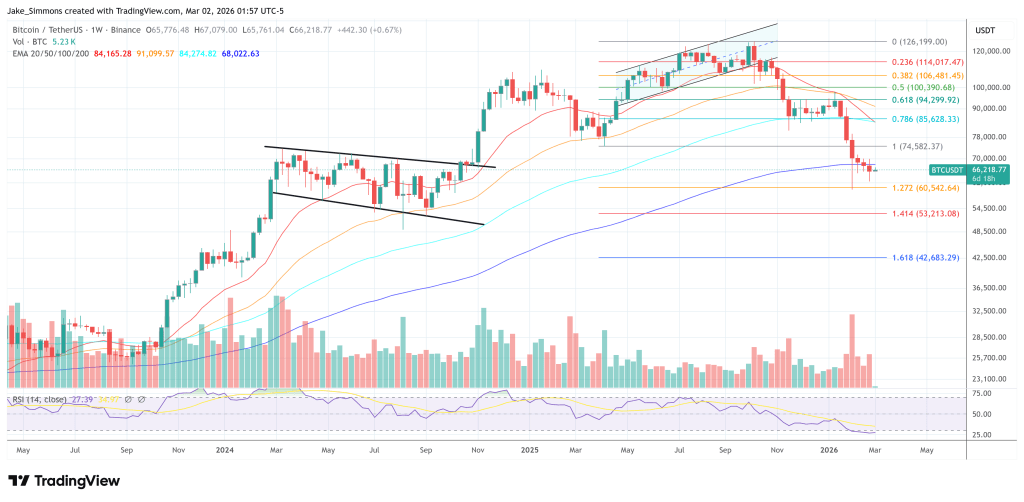
At press time, Bitcoin traded at $66,218.

Bitcoin must reclaim the 200-week EMA, 1-week chart | Source: BTCUSDT on TradingView.com

Связанные с этим вопросы

QAccording to Arthur Hayes, why could a prolonged US conflict with Iran become a bullish setup for Bitcoin?

ABecause it may push the Federal Reserve toward implementing cheaper and more abundant monetary policy (like cutting rates and increasing liquidity) to support the costly military campaign, which historically creates a favorable macro environment for Bitcoin.

QWhat historical pattern does Hayes cite to support his argument about war and monetary policy?

AHe points to prior U.S. military engagements in the Middle East, such as the Gulf War and the post-9/11 Global War on Terror, which were followed or accompanied by easier monetary policy from the Fed to counter economic weakening and stabilize markets.

QWhat specific Fed actions from history does Hayes reference?

AHe quotes from the August 1990 FOMC discussion about the potential need for easing due to the Gulf War and highlights then-Chair Alan Greenspan's emergency 50-basis-point rate cut following the September 2001 attacks.

QWhat is Hayes' recommended trading strategy based on his thesis?

AHe advises a prudent 'wait and see' approach, suggesting that the 'cleaner trade' is to wait for confirmation from Fed policy (like an actual rate cut or money printing) before buying Bitcoin and other cryptocurrencies.

QWhat key technical level for Bitcoin is mentioned in the article's chart caption?

AThe chart caption states that Bitcoin must reclaim the 200-week Exponential Moving Average (EMA).

Похожее

From a $300 Million Valuation to a 'Fire Sale' at Tens of Millions: What Happened to Messari?

On June 12, leading crypto data and capital markets platform Blockworks announced its acquisition of competitor Messari for over $10 million. This price represents a significant discount from Messari's 2022 valuation peak of approximately $300 million, highlighting the survival pressures faced by high-valuation startups during the bear market and a consolidation wave in data infrastructure. Blockworks, founded in 2018, began as a media and events company but has pivoted to focus on institutional-grade data, investor relations, and compliance tools. Its recent Series A extension round, valuing the company at $192 million, aimed to fund this shift and strategic acquisitions like this one. Messari, also founded in 2018, grew as a go-to platform for professional crypto research and data, raising a $35 million Series B at its $300 million valuation in late 2022. However, the prolonged bear market and subsequent internal changes, including founder Ryan Selkis's departure in 2024, increased operational pressures. The acquisition integrates Messari's extensive data platform and API capabilities with Blockworks's strengths in issuer-side disclosure, investor relations, and compliance workflows. The combined entity aims to build a unified "system of record" for the on-chain market. This reflects a broader industry trend where high-quality, structured data is becoming critical for institutional adoption, AI agents, and creating data moats akin to traditional financial platforms like Bloomberg. The deal exemplifies how market consolidation is reshaping the fragmented crypto data landscape.

marsbit7 мин. назад

From a $300 Million Valuation to a 'Fire Sale' at Tens of Millions: What Happened to Messari?

marsbit7 мин. назад

If the AI Bubble Is Already Bursting, Who Will Truly Survive?

If the AI Bubble is Bursting, Who Will Remain? The debate over an AI bubble is intensifying, with figures like Ray Dalio warning of high levels and Jensen Huang seeing immense, early-stage opportunity. Both views hold truth: a speculative bubble in capital markets likely exists, mirroring the dot-com era, but the underlying technological shift is real and transformative. History shows that while bubbles burst—wiping out overvalued companies and speculative capital—they often leave behind critical physical and digital infrastructure. The dot-com bust, for instance, eliminated many firms but left the global fiber optic networks and data centers that enabled the rise of Amazon, Netflix, and cloud computing. Today's massive AI infrastructure investments (projected at trillions by 2030) in data centers, power, cooling, and GPUs may follow a similar path, creating the foundation for future applications. A key divergence from past bubbles is the "Jevons Paradox" effect in AI. As the cost of AI inference has plummeted by over 99.7% since 2023, enterprise spending on AI has skyrocketed. Cheap "tokens" have unlocked vast, previously uneconomical use cases, moving AI from simple chatbots into core business workflows—code generation, legal document review, scientific simulation, and financial analysis. The market is now in a phase of self-correction, weeding out superficial "API-wrapper" startups, but this cleansing process strengthens the ecosystem. The long-term trajectory is clear. The value is gradually shifting from capital expenditure (CapEx) on hardware to operational expenditure (OpEx) on transformative applications. As AI becomes a utility, the winners will be firms that deeply integrate it to solve vertical industry problems in law, healthcare, finance, and manufacturing. The泡沫 will recede, but the foundational shift towards an AI-powered era across all sectors is irreversible. The underlying productive force of AI contains no bubble.

marsbit39 мин. назад

If the AI Bubble Is Already Bursting, Who Will Truly Survive?

marsbit39 мин. назад

If the AI Bubble Is Already Bursting, Who Will Truly Remain?

**Summary: If the AI Bubble is Bursting, What Will Remain?** The debate around an AI bubble is intensifying, with figures like Ray Dalio warning of high valuations while Jensen Huang sees immense opportunity. This echoes the dot-com bubble, which saw massive wealth destruction but ultimately left behind critical infrastructure like undersea cables and broadband, enabling future giants like Amazon and Netflix. Similarly, today's AI boom involves trillions invested in data centers, power, cooling, and GPUs, while application-layer revenue remains comparatively modest. This investment-disparity signals a bubble. However, the core technological progress is real and accelerating. AI inference costs have plummeted by over 99.7% since 2023, making intelligence increasingly cheap and accessible. This cost collapse is unlocking vast new demand. Instead of reducing spending, enterprises are tripling their AI cloud expenditure. Cheap "tokens" enable AI to move beyond simple chatbots into complex workflows—automating code writing, legal document review, financial analysis, and scientific research. This follows "Jevons's paradox": improved efficiency leads to greater total consumption. The market is now undergoing a necessary purification, weeding out "API-wrapper" startups with no real moat. The deeper evolution involves a shift from capital expenditure (CapEx) on infrastructure to operational expenditure (OpEx) on value-creation in applications. While hardware vendors currently profit most, long-term value will migrate to AI-native firms solving vertical industry problems. Ultimately, a market correction will cleanse speculative excess but will not reverse the AI+ trend. The massive physical and algorithmic infrastructure being built will endure, becoming a cheap, utility-like foundation. Just as the internet became indispensable to all industries post-2000, AI is poised to empower and redefine every sector, moving society irreversibly toward an intelligence-augmented era. The bubble may burst, but the underlying productive momentum is solid.

链捕手45 мин. назад

If the AI Bubble Is Already Bursting, Who Will Truly Remain?

链捕手45 мин. назад

Microsoft CEO: In the AI Era, How Do You Define a Company's Moat?

Microsoft CEO Satya Nadella argues that in the AI era, a company's true competitive edge, or "moat," is not determined by choosing the single most powerful model, but by its ability to build a continuous "learning loop." This system integrates and evolves by connecting human workflows, domain expertise, organizational judgment, and employee experience. He posits that future companies will accumulate two types of capital: Human Capital (employee knowledge, judgment, creativity) and "Token Capital" (a firm's own built and owned AI capabilities). Importantly, AI amplifies rather than devalues human capital. Human direction is essential to guide progress, as computational power alone is aimless. The core opportunity lies in creating a closed-loop system where human and token capital reinforce each other in a compound, self-improving cycle. A company must be able to preserve its unique institutional knowledge—its "company veteran" expertise—even if it switches underlying general-purpose AI models. This requires private evaluation benchmarks, reinforcement learning environments based on internal data, and queryable knowledge bases. Nadella warns against a future where economic value is concentrated by a few dominant models that commoditize entire industries' knowledge. Instead, the priority should be building a broad "frontier ecosystem" where every company, industry, and nation can own its learning loop. This allows organizations to retain control of their intellectual property, amplify employee capabilities, and ensure the economic value created by AI is captured within their own businesses and communities. True corporate sovereignty in the AI age comes from turning organizational knowledge into a compounding system that creates enduring, defensible value.

marsbit1 ч. назад

Microsoft CEO: In the AI Era, How Do You Define a Company's Moat?

marsbit1 ч. назад

Торговля

Спот
Фьючерсы

Популярные статьи

Тест по Bitcoin Биткоина

HTX Learn: Изучите Bitcoin halving и Заработаете Токены USDT

3.1k просмотров всегоОпубликовано 2024.04.16Обновлено 2024.04.16

Тест по Bitcoin  Биткоина

Что такое $BITCOIN

ЦИФРОВОЕ ЗОЛОТО ($BITCOIN): Комплексный анализ Введение в ЦИФРОВОЕ ЗОЛОТО ($BITCOIN) ЦИФРОВОЕ ЗОЛОТО ($BITCOIN) — это проект на основе блокчейна, работающий в сети Solana, который стремится объединить характеристики традиционных драгоценных металлов с инновациями децентрализованных технологий. Хотя он носит имя Биткойн, часто называемого “цифровым золотом” из-за его восприятия как средства хранения ценности, ЦИФРОВОЕ ЗОЛОТО является отдельным токеном, предназначенным для создания уникальной экосистемы в ландшафте Web3. Его цель — позиционировать себя как жизнеспособный альтернативный цифровой актив, хотя детали его применения и функциональности все еще развиваются. Что такое ЦИФРОВОЕ ЗОЛОТО ($BITCOIN)? ЦИФРОВОЕ ЗОЛОТО ($BITCOIN) — это токен криптовалюты, специально разработанный для использования в блокчейне Solana. В отличие от Биткойна, который выполняет широко признанную роль хранения ценности, этот токен, похоже, сосредоточен на более широких приложениях и характеристиках. Примечательные аспекты включают: Инфраструктура блокчейна: Токен построен на блокчейне Solana, известном своей способностью обрабатывать высокоскоростные и недорогие транзакции. Динамика предложения: ЦИФРОВОЕ ЗОЛОТО имеет максимальное предложение, ограниченное 100 квадриллионами токенов (100P $BITCOIN), хотя детали о его обращающемся предложении в настоящее время не раскрыты. Утилита: Хотя точные функциональные возможности не описаны, есть указания на то, что токен может быть использован для различных приложений, потенциально связанных с децентрализованными приложениями (dApps) или стратегиями токенизации активов. Кто создатель ЦИФРОВОГО ЗОЛОТА ($BITCOIN)? На данный момент личность создателей и команды разработчиков, стоящих за ЦИФРОВЫМ ЗОЛОТОМ ($BITCOIN), остается неизвестной. Эта ситуация типична для многих инновационных проектов в области блокчейна, особенно тех, которые связаны с децентрализованными финансами и феноменом мем-криптовалют. Хотя такая анонимность может способствовать культуре, ориентированной на сообщество, она усиливает опасения по поводу управления и ответственности. Кто инвесторы ЦИФРОВОГО ЗОЛОТА ($BITCOIN)? Доступная информация указывает на то, что у ЦИФРОВОГО ЗОЛОТА ($BITCOIN) нет известных институциональных спонсоров или значительных венчурных капиталовложений. Проект, похоже, функционирует по модели пирингового взаимодействия, сосредоточенной на поддержке и принятии сообществом, а не на традиционных путях финансирования. Его активность и ликвидность в основном сосредоточены на децентрализованных биржах (DEX), таких как PumpSwap, а не на устоявшихся централизованных торговых платформах, что еще больше подчеркивает его подход, ориентированный на grassroots. Как работает ЦИФРОВОЕ ЗОЛОТО ($BITCOIN) Операционные механизмы ЦИФРОВОГО ЗОЛОТА ($BITCOIN) можно подробно описать на основе его дизайна блокчейна и характеристик сети: Механизм консенсуса: Используя уникальный механизм доказательства истории (PoH) Solana в сочетании с моделью доказательства доли (PoS), проект обеспечивает эффективную валидацию транзакций, что способствует высокой производительности сети. Токеномика: Хотя конкретные дефляционные механизмы не были подробно описаны, большое максимальное предложение токенов подразумевает, что оно может быть предназначено для микротранзакций или нишевых случаев использования, которые еще предстоит определить. Интероперабельность: Существует потенциал для интеграции с более широкой экосистемой Solana, включая различные платформы децентрализованных финансов (DeFi). Однако детали относительно конкретных интеграций остаются неуточненными. Хронология ключевых событий Вот хронология, которая подчеркивает значимые вехи, касающиеся ЦИФРОВОГО ЗОЛОТА ($BITCOIN): 2023: Первоначальное развертывание токена происходит в блокчейне Solana, отмеченное его адресом контракта. 2024: ЦИФРОВОЕ ЗОЛОТО приобретает видимость, когда оно становится доступным для торговли на децентрализованных биржах, таких как PumpSwap, позволяя пользователям обменивать его на SOL. 2025: Проект наблюдает спорадическую торговую активность и потенциальный интерес к инициативам, возглавляемым сообществом, хотя на данный момент не зафиксировано никаких значительных партнерств или технических достижений. Критический анализ Сильные стороны Масштабируемость: Основная инфраструктура Solana поддерживает высокие объемы транзакций, что может повысить полезность $BITCOIN в различных сценариях транзакций. Доступность: Потенциально низкая цена торговли за токен может привлечь розничных инвесторов, способствуя более широкому участию благодаря возможностям дробного владения. Риски Отсутствие прозрачности: Отсутствие публично известных спонсоров, разработчиков или процесса аудита может вызвать скептицизм относительно устойчивости и надежности проекта. Волатильность рынка: Торговая активность сильно зависит от спекулятивного поведения, что может привести к значительной волатильности цен и неопределенности для инвесторов. Заключение ЦИФРОВОЕ ЗОЛОТО ($BITCOIN) является интригующим, но неоднозначным проектом в быстро развивающейся экосистеме Solana. Хотя он пытается использовать нарратив “цифрового золота”, его отход от установленной роли Биткойна как средства хранения ценности подчеркивает необходимость более четкого различения его предполагаемой утилиты и структуры управления. Будущее принятие и усвоение, вероятно, будут зависеть от решения текущей непрозрачности и более четкого определения его операционных и экономических стратегий. Примечание: Этот отчет охватывает синтезированную информацию, доступную на октябрь 2023 года, и с тех пор могут произойти события.

99 просмотров всегоОпубликовано 2025.05.13Обновлено 2025.05.13

Что такое $BITCOIN

Fractal Bitcoin: масштабирование Биткоина с помощью рекурсивной системы

Fractal Bitcoin — масштабное Layer-1-решнение, созданное на базе кода Биткоина, позволяющего достигать бесконечного масштабирования с помощью рекурсивного подхода.

2.3k просмотров всегоОпубликовано 2025.06.30Обновлено 2025.06.30

Fractal Bitcoin: масштабирование Биткоина с помощью рекурсивной системы

Обсуждения

Добро пожаловать в Сообщество HTX. Здесь вы сможете быть в курсе последних новостей о развитии платформы и получить доступ к профессиональной аналитической информации о рынке. Мнения пользователей о цене на BTC (BTC) представлены ниже.

活动图片