Tiger Research: U.S. Strategic Bitcoin Reserve - Should the Market Be Happy or Disappointed?

marsbitОпубликовано 2026-06-16Обновлено 2026-06-16

Введение

Tiger Research analyzes the evolution of U.S. legislative efforts regarding a strategic Bitcoin reserve, concluding the market impact is limited in the short term but potentially positive long-term. The core event was a March 2025 executive order by former President Trump, which designated confiscated Bitcoin as a strategic reserve and promised not to sell existing holdings (approx. 190k BTC). As it contained no mandate to purchase new Bitcoin, the market reacted negatively, with prices dropping 5.7%. Legislative history shows a significant retreat from initial ambitions. The 2024 "BITCOIN Act" proposed mandatory purchases of 1 million BTC over five years. Reintroduced in 2025, it stalled due to high fiscal costs, concerns over dollar hegemony, and opposition from the Treasury Secretary. The current frontrunner, the 2026 "American Retirement and Monetary Advancement (ARMA) Act," is a compromise. It lacks any purchase requirement, instead focusing on consolidating existing government-held Bitcoin and legally prohibiting its sale for at least 20 years. While ARMA has higher passage odds due to bipartisan support and no purchase mandate, its immediate market effect is neutral. It eliminates potential government selling pressure but creates no new demand. The long-term significance is that formally establishing Bitcoin as a national reserve asset in law could later reignite debates on mandatory purchases. Therefore, the path to a government buyer is longer than initially price...

This article is written by Tiger Research. News about a U.S. strategic Bitcoin reserve has circulated for nearly two years. The core of the initial BITCOIN Act (introduced in 2024) was active government purchases of Bitcoin, whereas the ARMA Act contains no such provisions. Whether the market should view this as positive remains an open question.

Key Points

The executive order signed by Trump in March 2025 committed to not selling the Bitcoin already held by the federal government but did not require the purchase of new coins. The market had anticipated more; when the order's content became clear, the Bitcoin price immediately dropped by 5.7%.

Legislative efforts beginning in 2024 have significantly retreated over the past two years: from a bill requiring the purchase of 1 million BTC to a bill containing only custodial obligations and no purchase requirements whatsoever.

The most likely to pass currently, the American Retirement and Monetary Advancement Act (ARMA), is not a purchase bill. It prohibits the government from selling its existing Bitcoin holdings for at least 20 years.

ARMA has limited short-term impact on the Bitcoin market. In the long term, establishing the legal status of Bitcoin as a national reserve asset could reopen the discussion on mandatory purchases, which would be positive for the market.

Background: What the U.S. Has and Has Not Done

During the 2024 presidential campaign, Trump repeatedly promised to establish a strategic Bitcoin reserve, which the market interpreted as the federal government becoming a direct buyer.

After the election, on March 6, 2025, Trump signed an executive order designating Bitcoin obtained through criminal investigations and civil forfeiture as a strategic reserve and directing its permanent holding. The order did not instruct the acquisition of new Bitcoin; it only committed to not selling the Bitcoin the government already owns. When the order's content became clear, the Bitcoin price fell from about $92,000 to below $85,000.

At the time of signing, the federal government held approximately 190,000 BTC, about 0.9% of the total 21 million supply. This Bitcoin came entirely from criminal and civil proceedings; not a single coin was purchased.

The situation remains unchanged. Nothing beyond the executive order has been enacted into law.

Legislative History
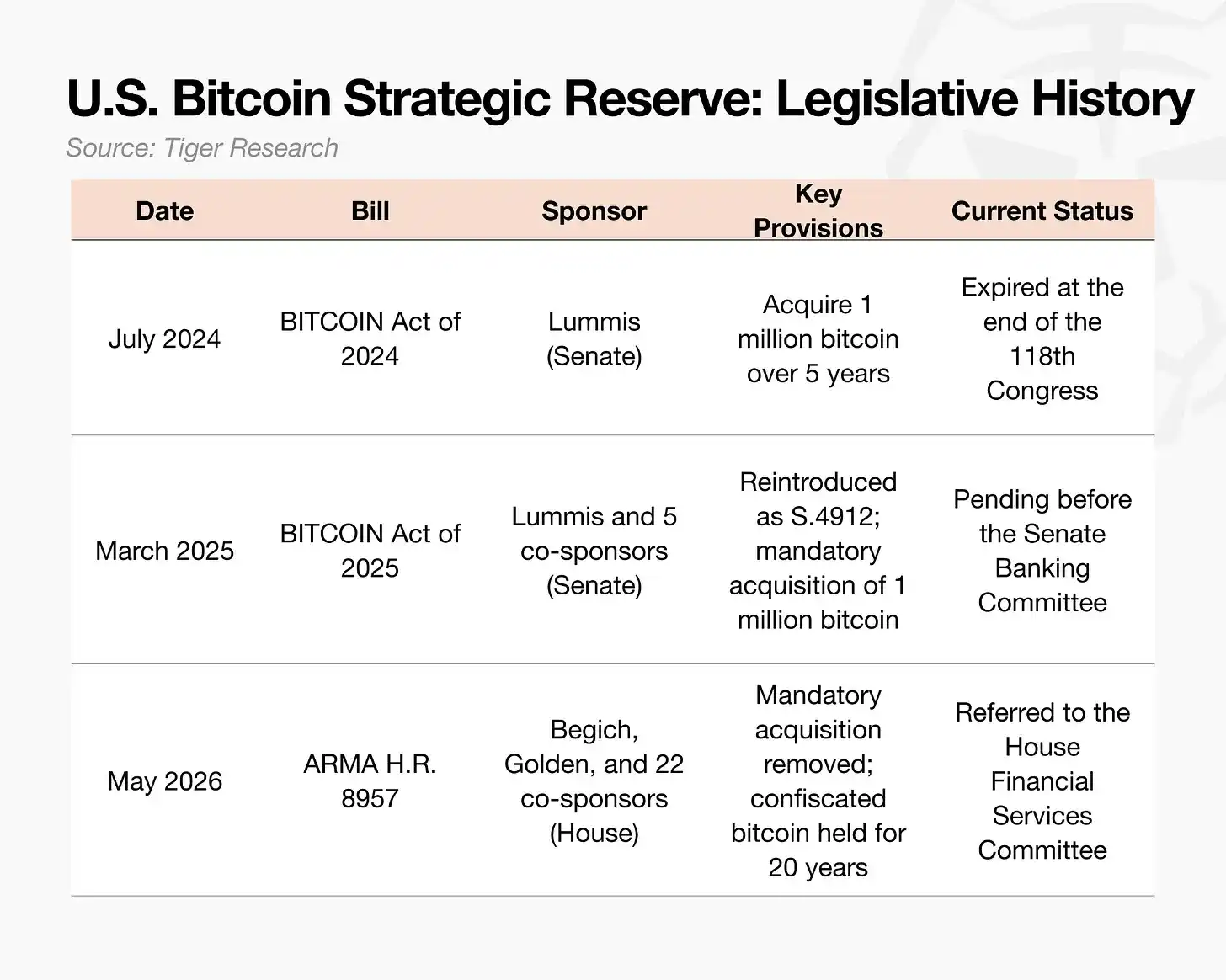
Discussions starting in 2021 produced the first concrete bill in 2024, reintroduced in 2025, and reframed as ARMA in 2026. The main theme of this evolution has been constant compromise with political reality: mandatory purchase quantities went from being present to being absent. Each revision made passage more feasible but simultaneously reduced market impact.

2024: The Original Bill

Since entering the Senate in 2021, Senator Lummis has publicly called for incorporating Bitcoin into the federal reserve. There was no consensus within Congress at the time, and the crypto winter of 2022-2023 coupled with the FTX collapse made the environment even more unfavorable.

The situation shifted in 2024 with Bitcoin surpassing $100,000 and spot ETFs receiving regulatory approval. In July of that year, Lummis introduced the first concrete legislation: requiring the purchase of 1 million Bitcoin over five years, to be held for at least 20 years, funded by the Federal Reserve's surplus account.

1 million BTC represents 4.76% of the total supply, exceeding the approximately 840,000 reportedly held by Strategy. The bill automatically expired at the end of that Congress.

2025: Reintroduction and Stalled Progress

In March 2025, the same month as the executive order, Lummis reintroduced the BITCOIN Act as Senate Bill 954. The core structure remained unchanged: annual purchases of 200,000 BTC, accumulating to 1 million over five years, held for 20 years. The revised version canceled certain exemptions from the disposal ban, tightened holding obligations, and added four cosponsors.

The market reaction was generally positive, but the bill faced substantive resistance on three fronts:

  • Fiscal Cost: Valued at trillions of won at the time, 1 million Bitcoin. Fiscal conservatives within the Republican party viewed gold as a stable store of value and Bitcoin as a speculative asset, opposing any mandatory purchase structure.
  • Dollar Hegemony: Democratic critics, led by Representative Maxine Waters, argued that treating Bitcoin as a reserve asset would weaken the dollar's status as the global reserve currency.
  • Treasury Secretary's Stance: In August 2025, Treasury Secretary Bessent publicly stated the government would not pursue additional Bitcoin purchases. As the official responsible for executing the law, he had clearly voiced opposition.

The bill has remained in the Senate Banking Committee since.

2026: ARMA as Legislative Compromise

In May 2026, Representative Nick Begich introduced the American Retirement and Monetary Advancement Act (ARMA), with Democratic Representative Jared Golden joining as a cosponsor. The name change itself is strategic: aimed at distancing the bill from the associations of previous, difficult-to-advance legislation and broadening its coalition of supporters.

ARMA does two things: consolidates all Bitcoin currently held or forfeited by the federal government into a single reserve managed by the Treasury, and prohibits the sale of this Bitcoin for at least 20 years. The sole exception to the disposal ban is using it to pay down the national debt.

The decisive difference from its predecessor is what ARMA does not contain. The BITCOIN Act mandated annual purchases of 200,000 BTC, whereas ARMA completely removes this obligation. Instead, it directs the Treasury and Commerce Departments to study and report within 180 days on whether additional purchases can be achieved in a budget-neutral manner. A study mandate, not a purchase mandate.

ARMA is essentially a custody and holding bill, not an acquisition bill. Its goal is passage, and it is structured accordingly.

Short-Term Outlook: Limited Market Impact

Currently, two bills are moving through Congress in parallel. The BITCOIN Act (S.954) is in the Senate Banking Committee; ARMA is in the House. Their goals differ: BITCOIN Act is an acquisition bill, ARMA is a custody bill.

ARMA has a higher probability of passage. The BITCOIN Act has been stalled in committee for over a year, weighed down by fiscal cost and purely Republican support. ARMA has Democratic support and imposes no purchase obligations, removing the most common objections.

Even so, the passage of ARMA itself would not constitute a short-term positive for the Bitcoin market. If ARMA were enacted, the approximately 320,000 BTC currently held by the federal government would be legally barred from entering the market for at least 20 years. The pressure of potential government selling would disappear. But the issue is that without any purchase obligation, there is no new demand. The market wants direct government purchases of Bitcoin, and ARMA does not provide that. Its practical effect is closer to elevating the March 2025 executive order to statutory status.
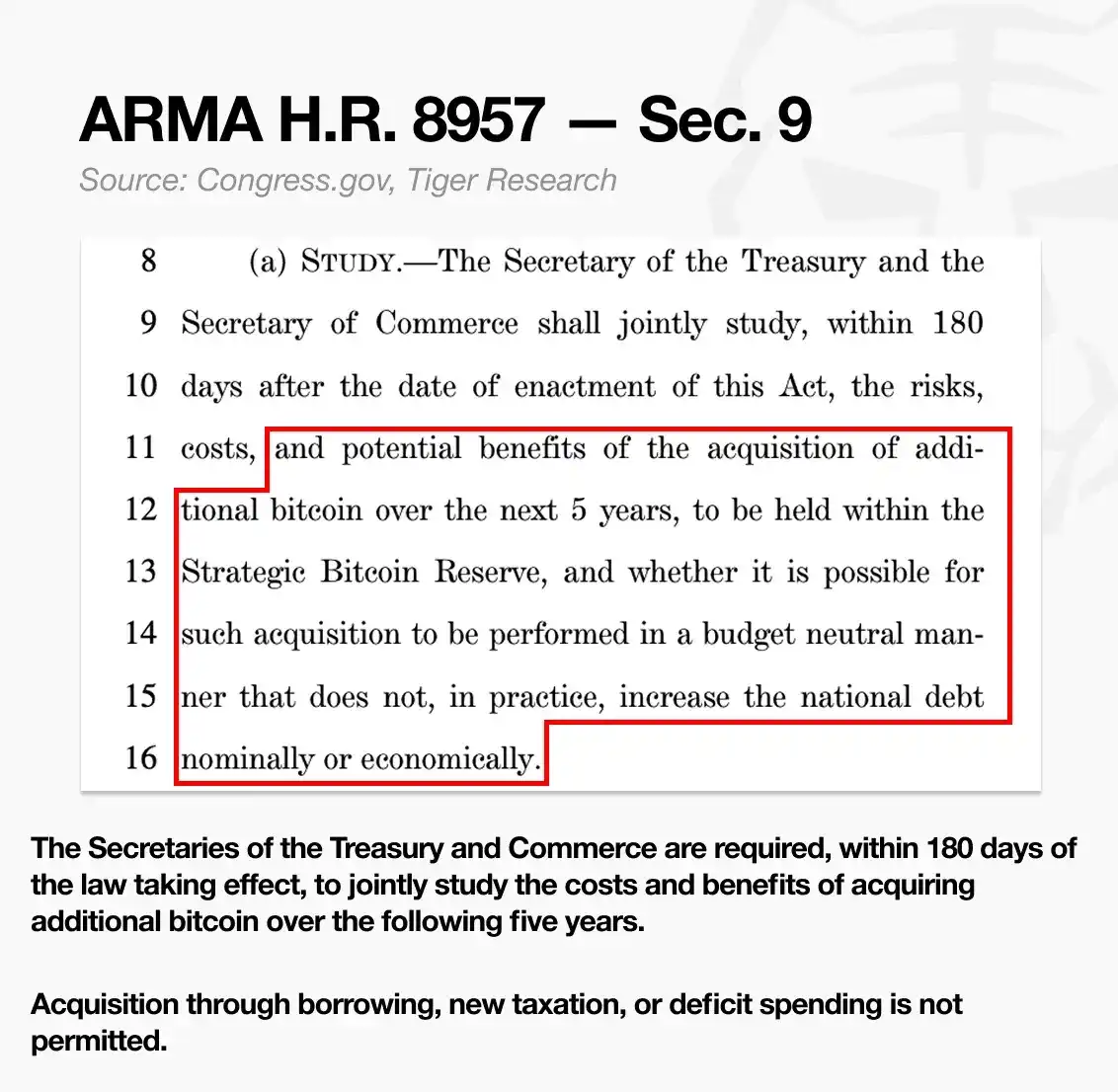
The key lies in what might happen after ARMA. Nick Begich, a Bitcoin holder since 2013, was a House cosponsor of the March 2025 BITCOIN Act. He publicly supports Bitcoin as a strategic asset. The structure of ARMA suggests a phased approach rather than an immediate solution: first, establish the legal framework, then build the acquisition mandate upon it.

If ARMA passes and Bitcoin gains formal legal status as a national reserve asset, then the debate on mandatory purchases is likely to reopen on a firmer foundation. The path to this outcome is longer than the market initially priced in during Trump's campaign promises, but the direction has not changed.

In short, the passage of ARMA would have limited short-term impact on price. In the long term, it remains a constructive factor for the market; if ARMA passes, the probability of eventual purchase legislation becomes more visible.


Связанные с этим вопросы

QWhat is the key difference between the original BITCOIN Act (2024/S.954) and the ARMA bill (2026) regarding government involvement with Bitcoin?

AThe key difference is the absence of a mandatory purchase requirement. The original BITCOIN Act mandated the U.S. government to purchase 1 million Bitcoin over five years. In contrast, the ARMA bill is a custody bill, not an acquisition bill. It only requires the government to consolidate its existing seized Bitcoin holdings into a single reserve and legally prohibits selling them for at least 20 years, with no provisions for buying new Bitcoin.

QAccording to the article, why did the price of Bitcoin drop following President Trump's 2025 executive order on a strategic Bitcoin reserve?

AThe price dropped because the market's expectations were higher than the actual content of the order. The market had interpreted Trump's campaign promises as the federal government becoming a direct buyer. However, the executive order only designated confiscated Bitcoin as a strategic reserve and instructed permanent holding (no selling), with no directive to acquire new Bitcoin. This disappointment led to an immediate price drop from around $92,000 to below $85,000.

QWhat are the three main obstacles that prevented the BITCOIN Act (S.954) from progressing in Congress, as outlined in the article?

AThe three main obstacles are: 1) Fiscal Cost: Republican fiscal conservatives objected to spending trillions on Bitcoin, viewing it as a speculative asset compared to gold. 2) Dollar Hegemony: Democratic critics, led by figures like Maxine Waters, argued that recognizing Bitcoin as a reserve asset would weaken the U.S. dollar's global dominance. 3) Treasury Secretary's Stance: In August 2025, Treasury Secretary Bessent publicly stated the government would not pursue additional Bitcoin purchases, signaling executive branch opposition.

QWhat is the short-term market impact expected if the ARMA bill is passed into law, and why?

AThe short-term market impact is expected to be limited. While ARMA would legally lock up the government's existing ~320,000 Bitcoin, preventing potential future sales pressure, it creates no new, direct demand from the government because it contains no mandatory purchase provisions. The market had priced in the expectation of a major government buyer, which ARMA does not provide. Its effect is closer to codifying the 2025 executive order into law.

QWhat long-term strategic purpose does the ARMA bill serve for Bitcoin proponents, according to the article's analysis?

AThe long-term strategic purpose of ARMA is to establish a foundational legal framework. By giving Bitcoin the formal legal status of a national reserve asset, it creates a more solid basis for future legislative debates about mandatory government purchases. The article describes it as a phased approach: first secure the legal status and custody structure, then potentially build acquisition mandates on top of it. This makes the path to a future 'purchase bill' more visible and plausible, even if it takes longer than initially hoped.

Похожее

Missed Out on SpaceX's IPO? Take a Look at SpaceX's Complete Supply Chain

SpaceX is now public, but its high valuation and losses may deter some investors. However, the real opportunity, as seen with Apple, Tesla, and Nvidia, may lie in its extensive supply chain. SpaceX, funded primarily by its profitable Starlink service, spends hundreds of billions annually on components for its rockets, satellites, and planned orbital AI data centers, creating significant revenue streams for suppliers. Key suppliers are categorized by their indispensability. The first group includes irreplaceable players like **NVIDIA** (GPUs for AI supercomputers), **Eutelsat (SATS)** (spectrum rights), **Filtronic** (millimeter-wave amplifiers), **Materion (MTRN)** (beryllium alloys), and **STMicroelectronics (STM)** (phased array chips). The second category comprises suppliers costly to replace due to long certification cycles or deep integration, such as **Honeywell (HON)** (flight controls), **Carpenter Technology (CRS)** (specialty steel), **Hexcel (HXL)** (carbon fiber), **Broadcom (AVGO)** (data switching), and **Linde** (industrial gases). The third group involves high-volume, cost-critical manufacturers for mass-produced items like Starlink terminals. Major players here include Taiwanese contract manufacturer **Wistron NeWeb (6285)** and several Chinese-listed firms: **Sunway Communication (300136)**, **Parker Advanced Materials (605123)**, **Western Superconducting (002149)**, and **Yingliu Co., Ltd. (603308)**. Other niche providers include **Tianyin Electromechanical**, **Tongyu Communication**, **Trimble (TRMB)**, **Astronics (ATRO)**, and **CTSH**. The timing is now relevant because: 1) SpaceX's procurement is accelerating with plans for 100 launches in 2026, 30 million Starlink terminals, and orbital data centers. 2) Its IPO has brought unprecedented transparency to its supply chain. 3) This phase mirrors early days of the Tesla supply chain boom. The investment thesis shifts from betting on SpaceX's stock to betting on the steady, order-book-driven revenues of its essential suppliers. Risks remain, such as commodity cycles, geopolitical factors, and technological shifts, but the supply chain offers a potentially less speculative path to participate in SpaceX's growth.

marsbit12 мин. назад

Missed Out on SpaceX's IPO? Take a Look at SpaceX's Complete Supply Chain

marsbit12 мин. назад

Jane Street: The Most Powerful Behind-the-Scenes Operator in the Crypto Industry

Jane Street: Crypto's Most Powerful Behind-the-Scenes Operator A recent 13F filing revealed Jane Street, the secretive Wall Street quant giant, drastically reduced its Bitcoin ETF holdings while increasing stakes in Ethereum ETFs. This move highlights its role not as a directional investor, but as a critical infrastructure player extracting "tolls" from crypto's institutionalization. The firm, founded in 2000 and famously lacking a CEO, has systematically embedded itself across crypto markets. It acts as a key Authorized Participant (AP) and market maker for major Bitcoin and Ethereum ETFs, profiting from arbitrage between ETF shares and underlying assets. Its approach combines quantitative prowess with a willingness to hold positions for structural arbitrage, differing from pure high-frequency traders. Jane Street faces allegations related to the 2022 Terra (LUNA) collapse. A lawsuit claims it used non-public information to withdraw $85 million in UST minutes before a critical withdrawal by Terraform Labs, allegedly exacerbating the crash and avoiding over $200 million in losses. The company denies the claims. Further indicating its reach, a wallet suspected to be operated by Jane Street ("JaneStreetIndia") was identified on the prediction market Polymarket. This bot executed over 11,000 high-frequency trades on short-term crypto price movements with a near-perfect win rate, showcasing a套利 strategy divorced from traditional prediction. Beyond trading, Jane Street holds equity in crypto infrastructure like Kraken, 1inch, and Arbitrum, and mining stocks. Its strategy is clear: avoid betting on winners, but secure a position in the market's essential plumbing. By becoming a ubiquitous part of the liquidity infrastructure—from ETFs to OTC trading and potentially链上 markets—Jane Street operates as a market force itself, raising questions about whether crypto's decentralized,散户-friendly alpha is being permanently eroded by traditional finance's most sophisticated players.

Foresight News15 мин. назад

Jane Street: The Most Powerful Behind-the-Scenes Operator in the Crypto Industry

Foresight News15 мин. назад

U.S.-Iran Ceasefire: How Much of a Bitcoin Rally Can a Truce Agreement Support?

Headline: "U.S.-Iran Truce: How Much Can a Ceasefire Agreement Propel Bitcoin's Rebound?" On June 15th, Bitcoin rebounded to around $67,255, marking its first return to the $67,000 level since falling below $60,000 earlier in June. Ethereum and Solana also saw significant gains. The immediate driver for this market-wide recovery in crypto and global risk assets was the signing of a U.S.-Iran ceasefire memorandum, with a formal ceremony scheduled for June 19th. The agreement, which includes reopening the Strait of Hormuz, caused oil prices to plunge roughly 5%, easing inflation expectations and boosting prospects for Federal Reserve rate cuts. This macroeconomic shift fueled a rally in U.S. equities, with the Dow Jones hitting a record high. SpaceX's spectacular post-IPO performance further energized market sentiment. However, on-chain and derivatives data from Glassnode suggest this move is more indicative of a technical rebound from deeply oversold conditions rather than a confirmed trend reversal. The crypto market is undergoing noticeable capital rotation. While Bitcoin ETFs recently saw their worst outflows on record, the bleeding has slowed significantly. Meanwhile, new altcoin ETFs for assets like XRP and Solana are attracting substantial inflows, causing Bitcoin's market dominance to drop to 58%. Despite the rebound, the Crypto Fear & Greed Index remains in "Extreme Fear" territory at 22. The price quickly retreated after touching the $67,000 resistance level, indicating selling pressure persists. Analysis shows short-term speculative supply has been heavily washed out, with holder structure shifting toward a more long-term profile. While panic is subsiding and some on-chain metrics point to accumulation at lower prices, the market currently lacks the strong, sustained institutional buying needed to establish a new bullish trend.

Foresight News32 мин. назад

U.S.-Iran Ceasefire: How Much of a Bitcoin Rally Can a Truce Agreement Support?

Foresight News32 мин. назад

Copper, the Gold of 2026

Copper: The New Gold for 2026? Market focus has shifted from AI chips to underlying infrastructure, with copper emerging as a key narrative. Its role is evolving beyond "Dr. Copper"—a traditional indicator of economic cycles—due to structural demand growth from AI data centers (requiring massive electrical infrastructure), grid expansion, EVs, and re-industrialization. Estimates suggest data centers alone could require 300,000 tons of copper by 2050. The core bullish thesis is not just demand but a severe supply constraint. New copper mines take ~17 years to develop, while ore grades are declining and new discoveries are scarce, potentially leading to a 30% supply deficit by 2035. This supply rigidity, coupled with strategic importance, is giving copper a "gold-like" scarcity narrative. Major macro investors, including Stanley Druckenmiller, are allocating to copper as a hedge against dollar weakness and for its exposure to energy transition and geopolitics. Traders like Pierre Andurand have projected prices could reach $40,000/ton. Capital inflows are visible in surging futures trading volumes. Copper mining stocks act as leveraged plays on copper prices. Companies like Freeport-McMoRan (FCX) and Southern Copper (SCCO), as well as Chinese miners like CMOC, have seen significant volatility, offering high upside but also steep drawdowns, reflecting operational and geopolitical risks. While copper remains cyclical and won't fully replicate gold's monetary role, its long-term fundamentals have shifted. Its new scarcity premium, driven by a tightening supply structure and expanding electrical demand, suggests its "goldification" is just beginning.

marsbit39 мин. назад

Copper, the Gold of 2026

marsbit39 мин. назад

Торговля

Спот
Фьючерсы

Популярные статьи

Тест по Bitcoin Биткоина

HTX Learn: Изучите Bitcoin halving и Заработаете Токены USDT

3.1k просмотров всегоОпубликовано 2024.04.16Обновлено 2024.04.16

Тест по Bitcoin  Биткоина

Что такое $BITCOIN

ЦИФРОВОЕ ЗОЛОТО ($BITCOIN): Комплексный анализ Введение в ЦИФРОВОЕ ЗОЛОТО ($BITCOIN) ЦИФРОВОЕ ЗОЛОТО ($BITCOIN) — это проект на основе блокчейна, работающий в сети Solana, который стремится объединить характеристики традиционных драгоценных металлов с инновациями децентрализованных технологий. Хотя он носит имя Биткойн, часто называемого “цифровым золотом” из-за его восприятия как средства хранения ценности, ЦИФРОВОЕ ЗОЛОТО является отдельным токеном, предназначенным для создания уникальной экосистемы в ландшафте Web3. Его цель — позиционировать себя как жизнеспособный альтернативный цифровой актив, хотя детали его применения и функциональности все еще развиваются. Что такое ЦИФРОВОЕ ЗОЛОТО ($BITCOIN)? ЦИФРОВОЕ ЗОЛОТО ($BITCOIN) — это токен криптовалюты, специально разработанный для использования в блокчейне Solana. В отличие от Биткойна, который выполняет широко признанную роль хранения ценности, этот токен, похоже, сосредоточен на более широких приложениях и характеристиках. Примечательные аспекты включают: Инфраструктура блокчейна: Токен построен на блокчейне Solana, известном своей способностью обрабатывать высокоскоростные и недорогие транзакции. Динамика предложения: ЦИФРОВОЕ ЗОЛОТО имеет максимальное предложение, ограниченное 100 квадриллионами токенов (100P $BITCOIN), хотя детали о его обращающемся предложении в настоящее время не раскрыты. Утилита: Хотя точные функциональные возможности не описаны, есть указания на то, что токен может быть использован для различных приложений, потенциально связанных с децентрализованными приложениями (dApps) или стратегиями токенизации активов. Кто создатель ЦИФРОВОГО ЗОЛОТА ($BITCOIN)? На данный момент личность создателей и команды разработчиков, стоящих за ЦИФРОВЫМ ЗОЛОТОМ ($BITCOIN), остается неизвестной. Эта ситуация типична для многих инновационных проектов в области блокчейна, особенно тех, которые связаны с децентрализованными финансами и феноменом мем-криптовалют. Хотя такая анонимность может способствовать культуре, ориентированной на сообщество, она усиливает опасения по поводу управления и ответственности. Кто инвесторы ЦИФРОВОГО ЗОЛОТА ($BITCOIN)? Доступная информация указывает на то, что у ЦИФРОВОГО ЗОЛОТА ($BITCOIN) нет известных институциональных спонсоров или значительных венчурных капиталовложений. Проект, похоже, функционирует по модели пирингового взаимодействия, сосредоточенной на поддержке и принятии сообществом, а не на традиционных путях финансирования. Его активность и ликвидность в основном сосредоточены на децентрализованных биржах (DEX), таких как PumpSwap, а не на устоявшихся централизованных торговых платформах, что еще больше подчеркивает его подход, ориентированный на grassroots. Как работает ЦИФРОВОЕ ЗОЛОТО ($BITCOIN) Операционные механизмы ЦИФРОВОГО ЗОЛОТА ($BITCOIN) можно подробно описать на основе его дизайна блокчейна и характеристик сети: Механизм консенсуса: Используя уникальный механизм доказательства истории (PoH) Solana в сочетании с моделью доказательства доли (PoS), проект обеспечивает эффективную валидацию транзакций, что способствует высокой производительности сети. Токеномика: Хотя конкретные дефляционные механизмы не были подробно описаны, большое максимальное предложение токенов подразумевает, что оно может быть предназначено для микротранзакций или нишевых случаев использования, которые еще предстоит определить. Интероперабельность: Существует потенциал для интеграции с более широкой экосистемой Solana, включая различные платформы децентрализованных финансов (DeFi). Однако детали относительно конкретных интеграций остаются неуточненными. Хронология ключевых событий Вот хронология, которая подчеркивает значимые вехи, касающиеся ЦИФРОВОГО ЗОЛОТА ($BITCOIN): 2023: Первоначальное развертывание токена происходит в блокчейне Solana, отмеченное его адресом контракта. 2024: ЦИФРОВОЕ ЗОЛОТО приобретает видимость, когда оно становится доступным для торговли на децентрализованных биржах, таких как PumpSwap, позволяя пользователям обменивать его на SOL. 2025: Проект наблюдает спорадическую торговую активность и потенциальный интерес к инициативам, возглавляемым сообществом, хотя на данный момент не зафиксировано никаких значительных партнерств или технических достижений. Критический анализ Сильные стороны Масштабируемость: Основная инфраструктура Solana поддерживает высокие объемы транзакций, что может повысить полезность $BITCOIN в различных сценариях транзакций. Доступность: Потенциально низкая цена торговли за токен может привлечь розничных инвесторов, способствуя более широкому участию благодаря возможностям дробного владения. Риски Отсутствие прозрачности: Отсутствие публично известных спонсоров, разработчиков или процесса аудита может вызвать скептицизм относительно устойчивости и надежности проекта. Волатильность рынка: Торговая активность сильно зависит от спекулятивного поведения, что может привести к значительной волатильности цен и неопределенности для инвесторов. Заключение ЦИФРОВОЕ ЗОЛОТО ($BITCOIN) является интригующим, но неоднозначным проектом в быстро развивающейся экосистеме Solana. Хотя он пытается использовать нарратив “цифрового золота”, его отход от установленной роли Биткойна как средства хранения ценности подчеркивает необходимость более четкого различения его предполагаемой утилиты и структуры управления. Будущее принятие и усвоение, вероятно, будут зависеть от решения текущей непрозрачности и более четкого определения его операционных и экономических стратегий. Примечание: Этот отчет охватывает синтезированную информацию, доступную на октябрь 2023 года, и с тех пор могут произойти события.

102 просмотров всегоОпубликовано 2025.05.13Обновлено 2025.05.13

Что такое $BITCOIN

Fractal Bitcoin: масштабирование Биткоина с помощью рекурсивной системы

Fractal Bitcoin — масштабное Layer-1-решнение, созданное на базе кода Биткоина, позволяющего достигать бесконечного масштабирования с помощью рекурсивного подхода.

2.3k просмотров всегоОпубликовано 2025.06.30Обновлено 2025.06.30

Fractal Bitcoin: масштабирование Биткоина с помощью рекурсивной системы

Обсуждения

Добро пожаловать в Сообщество HTX. Здесь вы сможете быть в курсе последних новостей о развитии платформы и получить доступ к профессиональной аналитической информации о рынке. Мнения пользователей о цене на BTC (BTC) представлены ниже.

活动图片