Analyst Who Predicted The Bitcoin Crash from $82,000 Reveals What’s Next

bitcoinistОпубликовано 2026-06-03Обновлено 2026-06-03

Введение

A crypto analyst known as Tony, who previously predicted Bitcoin's drop from around $82,000, shares his outlook for the leading cryptocurrency. He asserts that Bitcoin is currently in a bear cycle and is likely to decline further, potentially setting new lows this year. Tony points to technical factors like the 200-day moving average and Fibonacci levels as resistance. He outlines a potential scenario where Bitcoin could see a fake breakout above $85,000 to trap retail traders before falling to new lows. His chart analysis suggests possible declines to around $50,000 by July, with a cycle bottom potentially below $40,000. Tony notes that while short-term bounces, possibly from the $67,000 region, could occur, the main trend remains downward. Another analyst, Colin, suggests the $65,000-$66,000 range might offer short-term support for a bounce but reiterates that a retest of $60,000 and lower is still likely, as Bitcoin has not yet seen the typical >70% decline from its peak observed in past bear cycles. Bitcoin is currently trading around $66,300.

Crypto analyst Tony, who predicted the Bitcoin crash from the local top of around $82,000, has revealed what’s next for the leading crypto. He also explained why BTC is likely to set new lows over the coming months before potentially bottoming in this bear cycle.

Analyst Who Predicted The Bitcoin Crash Reveals What’s Next

In an X post, Tony stated that Bitcoin crashed from $82,000 for a reason, as the 200 MA has always been an important resistance level during bear markets. He also pointed to the 0.5 and 0.618 Fibonacci levels, where BTC was trading at. As for what’s next, the analyst indicated that Bitcoin is likely to decline further, noting a high probability it will set a new low during the summer months.

He also pointed to an alternative trap scenario where Bitcoin sees a fake breakout above $85,000 to lure retail traders in, followed by the same dump and a break to new lows. Whatever scenario plays out, Tony noted, it will not change the fact that BTC is in a bear cycle and will make new lows this year.
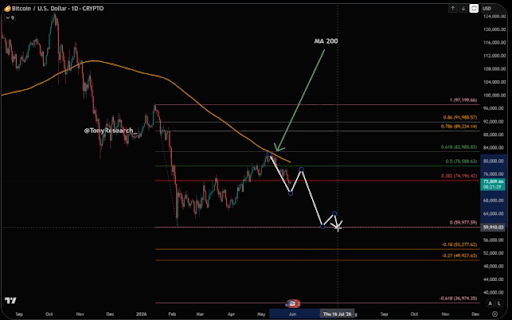
Source: Chart from Tony on X

His accompanying chart showed that Bitcoin could still drop to around $50,000 by July, and also signaled that BTC could decline below $40,000 before it bottoms in this cycle. Meanwhile, in another X post commenting on the current price action, Tony noted that BTC has broken the ascending channel and is trading below the Ichimoku Cloud, a bearish signal.

Tony said that he is expecting a bounce from the $67,000 region into the $74,000 area, followed by a move to make new lows below $60,000. He further remarked that the bear trap is likely over and that the main trend is still down, which is why he expects new lows this year. He added that short-term bounces are possible, but a bull market is unlikely to happen anytime soon.

A Short-Term Bounce Could Occur Around This Region

In an X post, crypto analyst Colin stated that the range between $65,000 and $66,000 appears to be a reasonable support level for a short-term bounce. He noted that the bounce duration could be for weeks or a couple of months. However, the analyst added that BTC retesting $60,000 is still highly likely and that breaking low this year is still a possibility.

Colin stated that the February low of $60,000 is unlikely to be Bitcoin’s bottom in this bear cycle. He explained that BTC has always suffered losses of over 70% in past bear cycles, but the leading crypto has yet to record such a loss in this cycle from its October high of $126,000.

At the time of writing, the Bitcoin price is trading at around $66,300, down over 6% in the last 24 hours, according to data from CoinMarketCap.

BTC trading at $67,211 on the 1D chart | Source: BTCUSDT on Tradingview.com

Связанные с этим вопросы

QAccording to analyst Tony, what is the main reason why Bitcoin crashed from around $82,000?

AAccording to analyst Tony, Bitcoin crashed from around $82,000 because the 200-day Moving Average (200 MA) has always been an important resistance level during bear markets, and it was trading near the 0.5 and 0.618 Fibonacci levels at that time.

QWhat are the two possible scenarios for Bitcoin's price action that Tony describes, and what is the common outcome for both?

AThe two scenarios are: 1) Bitcoin continues to decline further and sets a new low. 2) Bitcoin experiences a fake breakout above $85,000 to lure in retail traders, followed by a dump and a break to new lows. The common outcome for both scenarios is that Bitcoin is in a bear cycle and will make new lows this year.

QBased on Tony's chart analysis, to what price level could Bitcoin potentially drop by July, and what is the possible bottom for this cycle?

ABased on Tony's chart analysis, Bitcoin could drop to around $50,000 by July. The chart also signals that Bitcoin could decline below $40,000 before it bottoms in this cycle.

QWhat key technical levels does analyst Colin identify as a potential support zone for a short-term Bitcoin bounce?

AAnalyst Colin identifies the range between $65,000 and $66,000 as a reasonable support level for a potential short-term bounce.

QWhy does Colin believe the February low of $60,000 is unlikely to be the bottom for Bitcoin in this bear cycle?

AColin believes this because Bitcoin has historically suffered losses of over 70% in past bear cycles. From its October high of $126,000, Bitcoin has not yet recorded such a significant loss in the current cycle, making the $60,000 low unlikely to be the final bottom.

Похожее

Fei-Fei Li's Team Clarifies the Concept of 'World Models', Sora Merely a Renderer

"World Models" has become a widely used yet confusing term in AI. To address this, a team led by Fei-Fei Li and World Labs proposed a functional taxonomy based on the Partially Observable Markov Decision Process framework. This taxonomy categorizes systems called "world models" into three distinct projections: Renderers, Simulators, and Planners. Renderers, like OpenAI's Sora and other video generation models, focus on producing photorealistic visual outputs for human perception. They prioritize visual fidelity over physical accuracy. Simulators, such as NVIDIA Omniverse, aim to compute precise future environmental states for computational tasks like engineering analysis or digital twins. Planners, like Vision-Language-Action models, take in observations and goals to output executable actions for robots or agents. The article clarifies that most current "world models," including Sora, are primarily Renderers. They generate convincing visuals but lack the core ability to simulate state transitions based on actions, a key requirement for a true world model in classic reinforcement learning definitions. This conceptual confusion has practical implications, leading to potential misalignment in technology selection, investment, and public understanding of AI capabilities. Clear categorization is crucial. It helps enterprises avoid costly mistakes (e.g., using a renderer for robot training), allows investors to accurately assess markets, and enables researchers to build comparable benchmarks. While future systems may integrate these functions, recognizing current boundaries is essential for honest assessment and progress.

marsbit25 мин. назад

Fei-Fei Li's Team Clarifies the Concept of 'World Models', Sora Merely a Renderer

marsbit25 мин. назад

Bloomberg Uncovered: How Do China's Wealthy Circumvent the Annual $50,000 Limit to Transfer Assets?

**Summary: How Wealthy Chinese Circumvent $50,000 Annual Foreign Exchange Limits** Despite China's strict capital controls, including an annual $50,000 per person foreign exchange quota, an estimated $150 billion in funds still leaves the country annually via various gray and underground channels. This report outlines the evolution of China's "capital wall" and the methods used to bypass it. **The Evolving Capital Controls:** * **Foundation (1994):** The system of "current account convertibility with strict capital account controls" was established. * **Quota Set (2007):** The $50,000 individual annual forex purchase limit was formalized. * **Crackdown Begins (2015-2017):** Following market volatility, enforcement tightened. Banks were required to scrutinize transactions, and channels like using UnionPay cards for Hong Kong insurance premiums or buying overseas property were blocked. * **Digital & Legal Upgrades (2024-2026):** Enhanced algorithms now flag suspicious patterns (e.g., "smurfing"). The Common Reporting Standard (CRS) provides Chinese tax authorities with data on citizens' offshore accounts. Unlicensed cross-border brokers have been targeted. **Five Primary Methods for Moving Capital:** 1. **Underground Banking / "Hawala" (Duiqiao):** The largest-scale method. No money crosses borders. Clients pay RMB to a domestic account; an overseas associate deposits equivalent foreign currency into the client's offshore account. Risks include high fees, account freezes, and legal penalties. 2. **"Smurfing" or "Ant Moving":** Using multiple individuals' $50,000 quotas to pool funds for one offshore recipient. Increasingly detected by anti-money laundering algorithms. 3. **Trade Invoice Manipulation:** Businesses over-invoice imports or under-invoice exports via offshore shell companies, creating a pretext to transfer excess funds abroad under the guise of trade. 4. **Channel Migration:** After a crackdown on internet brokers, funds flow toward more compliant but costly channels like major banks' cross-border wealth management services or Qualified Domestic Institutional Investor (QDII) quotas. 5. **Structural Arrangements:** High-net-worth individuals use complex, high-cost legal structures involving offshore trusts, insurance, and investment migration programs to transfer asset ownership. **Regulatory Response: Focusing on People, Not Just Money** The current strategy extends oversight from enterprises to **individual residents**. Tools like CRS allow retroactive visibility into offshore assets. Cryptocurrencies, once seen as a potential loophole, are now actively monitored and prosecuted as an illegal channel. The underlying driver remains: with significant wealth concentrated among millions of affluent households seeking diversification amid domestic economic shifts, the incentive to move assets offshore persists despite regulatory barriers.

marsbit45 мин. назад

Bloomberg Uncovered: How Do China's Wealthy Circumvent the Annual $50,000 Limit to Transfer Assets?

marsbit45 мин. назад

Торговля

Спот
Фьючерсы

Популярные статьи

Тест по Bitcoin Биткоина

HTX Learn: Изучите Bitcoin halving и Заработаете Токены USDT

3.1k просмотров всегоОпубликовано 2024.04.16Обновлено 2024.04.16

Тест по Bitcoin  Биткоина

Что такое $BITCOIN

ЦИФРОВОЕ ЗОЛОТО ($BITCOIN): Комплексный анализ Введение в ЦИФРОВОЕ ЗОЛОТО ($BITCOIN) ЦИФРОВОЕ ЗОЛОТО ($BITCOIN) — это проект на основе блокчейна, работающий в сети Solana, который стремится объединить характеристики традиционных драгоценных металлов с инновациями децентрализованных технологий. Хотя он носит имя Биткойн, часто называемого “цифровым золотом” из-за его восприятия как средства хранения ценности, ЦИФРОВОЕ ЗОЛОТО является отдельным токеном, предназначенным для создания уникальной экосистемы в ландшафте Web3. Его цель — позиционировать себя как жизнеспособный альтернативный цифровой актив, хотя детали его применения и функциональности все еще развиваются. Что такое ЦИФРОВОЕ ЗОЛОТО ($BITCOIN)? ЦИФРОВОЕ ЗОЛОТО ($BITCOIN) — это токен криптовалюты, специально разработанный для использования в блокчейне Solana. В отличие от Биткойна, который выполняет широко признанную роль хранения ценности, этот токен, похоже, сосредоточен на более широких приложениях и характеристиках. Примечательные аспекты включают: Инфраструктура блокчейна: Токен построен на блокчейне Solana, известном своей способностью обрабатывать высокоскоростные и недорогие транзакции. Динамика предложения: ЦИФРОВОЕ ЗОЛОТО имеет максимальное предложение, ограниченное 100 квадриллионами токенов (100P $BITCOIN), хотя детали о его обращающемся предложении в настоящее время не раскрыты. Утилита: Хотя точные функциональные возможности не описаны, есть указания на то, что токен может быть использован для различных приложений, потенциально связанных с децентрализованными приложениями (dApps) или стратегиями токенизации активов. Кто создатель ЦИФРОВОГО ЗОЛОТА ($BITCOIN)? На данный момент личность создателей и команды разработчиков, стоящих за ЦИФРОВЫМ ЗОЛОТОМ ($BITCOIN), остается неизвестной. Эта ситуация типична для многих инновационных проектов в области блокчейна, особенно тех, которые связаны с децентрализованными финансами и феноменом мем-криптовалют. Хотя такая анонимность может способствовать культуре, ориентированной на сообщество, она усиливает опасения по поводу управления и ответственности. Кто инвесторы ЦИФРОВОГО ЗОЛОТА ($BITCOIN)? Доступная информация указывает на то, что у ЦИФРОВОГО ЗОЛОТА ($BITCOIN) нет известных институциональных спонсоров или значительных венчурных капиталовложений. Проект, похоже, функционирует по модели пирингового взаимодействия, сосредоточенной на поддержке и принятии сообществом, а не на традиционных путях финансирования. Его активность и ликвидность в основном сосредоточены на децентрализованных биржах (DEX), таких как PumpSwap, а не на устоявшихся централизованных торговых платформах, что еще больше подчеркивает его подход, ориентированный на grassroots. Как работает ЦИФРОВОЕ ЗОЛОТО ($BITCOIN) Операционные механизмы ЦИФРОВОГО ЗОЛОТА ($BITCOIN) можно подробно описать на основе его дизайна блокчейна и характеристик сети: Механизм консенсуса: Используя уникальный механизм доказательства истории (PoH) Solana в сочетании с моделью доказательства доли (PoS), проект обеспечивает эффективную валидацию транзакций, что способствует высокой производительности сети. Токеномика: Хотя конкретные дефляционные механизмы не были подробно описаны, большое максимальное предложение токенов подразумевает, что оно может быть предназначено для микротранзакций или нишевых случаев использования, которые еще предстоит определить. Интероперабельность: Существует потенциал для интеграции с более широкой экосистемой Solana, включая различные платформы децентрализованных финансов (DeFi). Однако детали относительно конкретных интеграций остаются неуточненными. Хронология ключевых событий Вот хронология, которая подчеркивает значимые вехи, касающиеся ЦИФРОВОГО ЗОЛОТА ($BITCOIN): 2023: Первоначальное развертывание токена происходит в блокчейне Solana, отмеченное его адресом контракта. 2024: ЦИФРОВОЕ ЗОЛОТО приобретает видимость, когда оно становится доступным для торговли на децентрализованных биржах, таких как PumpSwap, позволяя пользователям обменивать его на SOL. 2025: Проект наблюдает спорадическую торговую активность и потенциальный интерес к инициативам, возглавляемым сообществом, хотя на данный момент не зафиксировано никаких значительных партнерств или технических достижений. Критический анализ Сильные стороны Масштабируемость: Основная инфраструктура Solana поддерживает высокие объемы транзакций, что может повысить полезность $BITCOIN в различных сценариях транзакций. Доступность: Потенциально низкая цена торговли за токен может привлечь розничных инвесторов, способствуя более широкому участию благодаря возможностям дробного владения. Риски Отсутствие прозрачности: Отсутствие публично известных спонсоров, разработчиков или процесса аудита может вызвать скептицизм относительно устойчивости и надежности проекта. Волатильность рынка: Торговая активность сильно зависит от спекулятивного поведения, что может привести к значительной волатильности цен и неопределенности для инвесторов. Заключение ЦИФРОВОЕ ЗОЛОТО ($BITCOIN) является интригующим, но неоднозначным проектом в быстро развивающейся экосистеме Solana. Хотя он пытается использовать нарратив “цифрового золота”, его отход от установленной роли Биткойна как средства хранения ценности подчеркивает необходимость более четкого различения его предполагаемой утилиты и структуры управления. Будущее принятие и усвоение, вероятно, будут зависеть от решения текущей непрозрачности и более четкого определения его операционных и экономических стратегий. Примечание: Этот отчет охватывает синтезированную информацию, доступную на октябрь 2023 года, и с тех пор могут произойти события.

99 просмотров всегоОпубликовано 2025.05.13Обновлено 2025.05.13

Что такое $BITCOIN

Fractal Bitcoin: масштабирование Биткоина с помощью рекурсивной системы

Fractal Bitcoin — масштабное Layer-1-решнение, созданное на базе кода Биткоина, позволяющего достигать бесконечного масштабирования с помощью рекурсивного подхода.

2.3k просмотров всегоОпубликовано 2025.06.30Обновлено 2025.06.30

Fractal Bitcoin: масштабирование Биткоина с помощью рекурсивной системы

Обсуждения

Добро пожаловать в Сообщество HTX. Здесь вы сможете быть в курсе последних новостей о развитии платформы и получить доступ к профессиональной аналитической информации о рынке. Мнения пользователей о цене на BTC (BTC) представлены ниже.

活动图片