BIT Weekly Market Outlook: Highs Halved, Panic Doubled. The $60,000 Line is the Sole Lifeline

marsbitОпубликовано 2026-06-10Обновлено 2026-06-10

Введение

BIT Market Weekly: Halving from the Peak, Doubling Panic. $60K is the Sole Lifeline. The crypto market faces intense pressure from multiple fronts. MicroStrategy's symbolic sale of 32 BTC, its first since December 2022, shattered its "only accumulate" mantra, triggering panic and significant whale selling (~25,000 BTC). This pushed Bitcoin below MicroStrategy's average cost basis, causing unrealized losses. Bearish momentum intensified as spot Bitcoin ETFs saw a record 13-day net outflow streak, with $4.4 billion exiting, led by BlackRock's IBIT. Concurrently, macro risks mounted: sticky inflation dampened rate cut hopes, Mt.Gox wallet movements stoked sell-off fears, and renewed Middle East tensions added uncertainty. Derivatives data reveals a market at a critical juncture. Short-term options show extreme panic (negative Skew), but forward-term Skew has turned positive, signaling institutional expectations for a recovery in 3-6 months. Most notably, institutional activity shifted from defensive hedging to opportunistic bottom-fishing. They are selling puts and buying calls around the $60,000 level, effectively using options to establish controlled long positions. The $60,000 level is now the core battleground, hosting the largest concentration of put options open interest. It represents a binary outcome for the market. Holding above it could provide a base for stabilization, while a break below risks a swift decline toward the next major support at $55,000. Given the h...

MicroStrategy sold Bitcoin for the first time since December 2022, offloading 32 coins (total value approx. $2.5 million, average price $77,135), with funds used to pay preferred stock dividends; the amount sold constituted only 0.004% of its total holdings of 843,706 coins, and the selling price was above its average cost basis, resulting in a profitable exit.

The actual selling pressure volume was minuscule, but the symbolic impact was immense: Saylor has long upheld the core belief of "Bitcoin is for holding, not selling." The breach of this belief triggered a rapid spread of market panic — even the most steadfast institutional giant started reducing its position. In the following week, whales cumulatively sold approximately 25,000 Bitcoin, and retail panic selling further intensified the decline. When Bitcoin's price fell to $63,083, MicroStrategy's entire holding was underwater, with an average cost basis of $75,699, resulting in a paper loss of over ten thousand dollars per coin.

ETF Outflows Intensify Market Weakness

From May 15 to June 3, spot Bitcoin ETFs experienced net outflows for 13 consecutive trading days, setting the longest outflow streak since the products launched in January 2024, with a cumulative capital flight of approximately $4.4 billion. In three weeks, the total assets under management (AUM) for ETFs shrank from $104.29 billion to $82.83 billion.

BlackRock's IBIT alone accounted for 75% of the total outflows, reaching $3.3 billion; Fidelity's FBTC saw outflows of $456 million, and Grayscale's GBTC saw outflows of $303 million. The outflow trend paused on June 4 with a minor net inflow of $3.05 million, but this was merely a brief pause, not a trend reversal. Bloomberg analyst Eric Balchunas stated that the persistent outflows have turned the year-to-date cumulative flows negative for 2026, though the overall cumulative net inflow since the product launch remains positive at around $55 billion.

Four Other Macro and Geopolitical Risks Amplify the Decline

  1. Large wallet transfers from the Mt.Gox exchange reignited market concerns about selling pressure;
  2. The macro environment remains persistently bearish: sticky inflation exceeding expectations, a significant cooling of market expectations for interest rate cuts (Polymarket platform shows a 66% probability of zero rate cuts in 2026), a strengthening US dollar, and rising US Treasury yields; capital continues flowing into AI and tech sectors, with US stocks hitting new highs this week, severely diverging from cryptocurrency trends;
  3. On June 5, Hezbollah rejected Israel's ceasefire proposal, reigniting Middle East geopolitical uncertainty, coupled with unresolved US-Iran tensions.
  4. A single factor is unlikely to severely depress prices significantly. In an environment devoid of any bullish catalysts, the combined force of multiple negative factors led to a deep correction.

Derivatives Data Signals and Key Interpretations

Implied Volatility (IV) Spikes Again on Second Test of Lows, Suggesting a Top Signal

Implied volatility surged again during the phase of testing lows for the second time; Bitcoin's at-the-money (ATM) near-month option IV rose to 47.47% on June 26 (up 4.14 percentage points), while Ethereum's near-month IV skyrocketed to 64.38% (a 10.68 percentage point increase, with volatility elasticity about 2.6 times that of Bitcoin). On June 9, the near-term IV for near-month contracts briefly touched 65.82% for Bitcoin and 83.50% for Ethereum.

During the session, Bitcoin's DVOL volatility index spiked to 55 before closing at 48.06, down 2.65% for the day; Ethereum's DVOL closed at 66.31, down slightly 1.34% intraday. Both major volatility indices remained high but turned down simultaneously, a typical signal of IV peaking: the market frantically bought short-term downside protection at lows, then partially unwound those positions, releasing pressure.

Implied Skew Curve Shows Crucial Divergence Structure

The clearest data indicator this week is the Skew term structure:

Extreme bearish panic dominates the near end of the curve. On June 9, the short-term effective Skew for Bitcoin near-term contracts was -17.96, and -19.58 for Ethereum. The Skew for 10-Delta deep out-of-the-money (OTM) puts deteriorated more significantly, reaching -33.35 and -40.61 respectively — as prices approached the $60k level, the market was willing to pay a high premium for short-term downside protection.

The forward curve shows significant recovery turning bullish: Bitcoin's forward Skew for September, December, and March of next year turned positive (increasing +0.77 to +1.83 percentage points); Ethereum's forward Skew from August onward also flipped positive. The curve transitioned from being deeply bearish across all tenors last week to a steep shape of "deep panic at the front end, forward pricing recovery."

This is a standard divergence pattern during the mid-stage of a decline: short-term panic dominates the spot market, but forward derivatives are already pricing in market stabilization 3 to 6 months ahead. Impact on structured product practical operations: the cost of long-term downside protection decreases, making yield-enhanced structures like the Collar or Bullish Seagull more cost-effective for building positions with longer protection cycles.

Institutional Block Trades Completely Reverse, Shifting from Defensive Hedging to Bottom-Fishing

Last week, institutions were overall in defensive mode, with buying put options accounting for 33.3%, the highest category. This week, the wind shifted completely:

Block selling of put options surged to 42.0% (up 14.1 percentage points week-over-week), and buying call options rose to 33.0% (up 24 percentage points week-over-week); buying put options halved to 17.3%, and selling call options dropped to 7.6%. Retail operations trended similarly, with retail selling of put options ranking first at 30.1%.

Institutions shifted from actively buying protection/hedging to selling protection and positioning for a bottom-fishing rally — concentrating on selling PUTs and buying CALLs heavily around the $60,000 put wall. Combination trade data corroborates the trend: 44.2% of Bitcoin institutional combination trades were put spread strategies (selling near-month PUTs, buying deeper OTM PUTs to cap maximum downside loss). This is essentially collecting premium at the $60k level while establishing a controlled-risk position at the perceived bottom.

Bitcoin and Ethereum perpetual funding rates remained near neutral throughout (BTC 0.000%, ETH -0.006%), indicating orderly deleveraging without triggering a chain reaction of liquidations and panic selling. Risk layers are clearly differentiated.

Bull/Bear Logics and Neutral Comprehensive Assessment

Bullish Logic

  1. Panic sentiment has reached a structural boundary: The massive put Open Interest (OI) wall at $60,000 (approx. 19,000 contracts, the highest across the entire board) is attracting real institutional capital; institutions selling PUTs and buying CALLs at this level is equivalent to bottom-fishing using options — collecting premium, committing to buy at $60k, while simultaneously buying calls to capture a potential rebound.
  2. The Fear & Greed Index has fallen to cyclical lows; historically, this level often precedes rebounds (not a direct cause for an uptick, but indicates market conditions are primed); long-term holders have not engaged in large-scale panic selling. The selling pressure this round stems from short-term whale de-risking and ETF outflows, not long-term holders capitulating. Exchange reserve balances remain low.
  3. The 13-day consecutive ETF outflow streak has paused; a key positive: MicroStrategy announced reserving $1 billion in cash for future preferred stock dividends, severing the direct link between dividend payments and Bitcoin sales. The 32-coin sale was a one-time confidence slip, unlikely to become a regular selling pressure source.
  4. Forward Skew recovery indicates the derivatives market is pricing in stabilization over the next 3–6 months. If spot prices hold the $60k level and the US CPI data on June 10 delivers no unexpected upside shock, all technical conditions for stabilization are in place.

Bearish Downside Risks

  1. The second test of lows is not yet confirmed complete; the current price of $63,083 is still 4.9% away from the $60k put wall. A break below could trigger accelerated selling due to gamma effects and the "magnet effect" of the put wall; the next major put support levels are at $55,000 (10,800 contracts) and $50,000 (12,500 contracts).
  2. Ethereum selling pressure intensity exceeds Bitcoin's: Ethereum forward futures shifted from a 6.52% premium last week to a deep 9.49% discount, with perpetual funding rates slightly negative; the ETH/BTC volatility ratio for near-month options reached a cyclical high of 1.356, indicating Ethereum has greater downside elasticity and weaker momentum.
  3. MicroStrategy's semi-monthly dividend distribution mechanism is now formalized, implying potential for small, regular Bitcoin selling pressure in the future.
  4. Two major macro catalysts — the June 10 CPI report and the June 16-17 FOMC meeting (the first with Powell's dot plot) — could abruptly shift market sentiment at any time. Before the $60k support is confirmed as holding, aggressive bottom-fishing risks facing deeper retracement.

Neutral Comprehensive Assessment

The panic-driven decline has reached an identifiable structural node. $60,000 is the single, core, critical price level for the current market: not merely a psychological round number, but the convergence point of the largest options OI across the entire board, institutional bottom-fishing capital, and the market's binary bull/bear dividing line. Holding this level provides a foundation for stabilization; a breach would target the next gamma pressure cluster around $55,000.

The shift in institutions from defense to bottom-fishing is the most crucial signal within the entire dataset. However, the proportion of block trade volume dropped from 46.3% to 16.3%, indicating that while directional judgment is correct, overall conviction for full-scale entry is not yet at its peak. The operational approach should be phased accumulation. The market essentially faces two paths from here: holding above $60k, or breaking below $60k. All subsequent price action will be determined by this outcome.

BIT Practical Trading Views

Priority Configuration: Collar Strategy, Primary Hedging Tool This Week

The core objective is not to chase high yields, but asset risk management and protection. The recovery in forward Skew has lowered the cost of long-term downside protection, while elevated short-term IV enhances the premium income from selling the call side, creating an optimal entry window for Collar strategies in recent weeks. The market still retains the possibility of testing or breaking below $60k. Before the two major catalysts — CPI (June 10) and FOMC (June 16-17) — are repriced, deploying a Collar structure (no margin call risk) to lock in maximum downside loss ahead of time is prudent. There's no need to wait for clarity; the core value of the Collar strategy is enabling risk control without requiring precise directional calls.

Phased Bottom-Fishing Accumulation, Scale in Near the $60k Level

The current price (~$63,000) combined with high volatility means premium income from selling PUTs is at cyclical highs, suitable for three types of structured products: Fixed Coupon Notes (FCN), Dual Currency Products (DCP) for discounted accumulation, and Accumulators. The Bullish Seagull structure is also suitable: using USDT as principal, setting the conversion price at $60k or lower. If the price tests the put wall, accumulation can occur at even lower levels; if the market recovers, the structure delivers above-standard annualized yields.

Institutions are already selling PUTs to accumulate at the $60k level. The layered payoff of the Bullish Seagull perfectly aligns with this "smart money" approach: hold the note for yield while waiting, with the product offering even lower entry levels. Strictly control individual position sizes, leaving buffer room for potential further downside. Increase allocation size only after the price stabilizes firmly above $60k.

Volatility Sellers Can Gradually Test the Waters, But Heavy Positioning is Not Yet Advisable

The IV top signal is real and effective: DVOL intraday pullback, historically extreme near-end Skew values tend to mean-revert quickly, and institutions are already selling PUTs en masse; especially, the yield from selling Ethereum volatility is at a peak for this cycle.

However, signs of a top do not equate to a confirmed top. Actual volatility could surge again. Naked short volatility positions, outright gamma risk exposure betting solely on $60k holding, CPI, and FOMC outcomes constitute pure speculative gambling. Following the prudent institutional approach: sell volatility via spread structures (e.g., selling near-month PUTs while buying deep OTM PUTs to cap max loss), start with small pilot positions. Only after spot stabilizes above $60k and DVOL continues its downward trend should you consider scaling up volatility selling positions.

For Holders Planning to Reduce Positions/Take Profits: Current Levels Are Not Suitable for Large-Scale Reduction

After a deep correction, the reasonable execution prices for high-price reduction structures (like Decumulators/Discrete Quanto DQ, bearish FCNs, high-strike DCPs) have significantly lowered. Panic selling at the $63,000 level would only crystallize or amplify paper losses. Consider deploying reduction structures in phases if a rebound reaches the former support-turned-resistance at $72,000, or near the $80,000 call wall. The optimal strategy currently: hold core positions + implement配套的对冲防护 (matching hedging protection).

Summary

Six major negative factors converged to impact the market simultaneously. After digesting the risks, the market has formed a substantive options support wall at $60,000.

Operation priority: First, establish Collar hedging for risk control; second, accumulate positions in phases near the $60k level for bottom-fishing; third, wait for confirmation of a bottom formation before scaling into significant volatility selling for yield capture.


Связанные с этим вопросы

QAccording to the article, what was the symbolic impact of MicroStrategy's Bitcoin sale, despite its small size?

AThe symbolic impact was immense. Michael Saylor's long-held core belief of 'Bitcoin only, never sell' was broken, which caused panic to spread rapidly in the market, as even the most steadfast institutional giant began reducing its position.

QWhat is the key price level identified as the market's 'only core critical line' in the neutral comprehensive judgment?

AThe key price level is $60,000. It is described not just as a psychological integer level, but as a core node where the market's largest open interest, institutional bottom-fishing capital, and the binary boundary between bulls and bears converge.

QWhat is the most significant signal within the derivatives data, as highlighted in the article's interpretation?

AThe most significant signal is the complete reversal in institutional block holdings, switching from defensive hedging to bottom-fishing on dips. Institutions moved from buying puts for protection to selling puts and buying calls near the $60,000 put wall, indicating a shift towards accumulating positions at perceived low prices.

QWhich strategy does BIT recommend as the primary hedging tool for the current week?

ABIT recommends the Collar strategy as the primary hedging tool for the week. The goal is not to seek high yields but for asset risk control, locking in maximum downside loss ahead of key catalysts like CPI and FOMC data.

QWhat is the condition under which the article suggests adding to volatility selling positions?

AThe article suggests that volatility selling positions can be increased only after the spot price steadily holds above the $60,000 support level and the DVOL (volatility) index continues its downward trend, confirming that a bottom has been established.

Похожее

Blockchain has finally begun sailing toward the main channel after 18 years

After 18 years of development, blockchain technology is beginning to move from a specialized niche into mainstream adoption, according to a recent industry analysis. The shift is reflected in the changing strategies of major crypto venture capital firms, which are expanding their focus beyond pure "digital ownership" towards broader themes like "autonomy." The report highlights that leading VC firms like Variant, Paradigm, Haun Ventures, and YZi Labs are broadening their investment mandates to include not only crypto but also artificial intelligence (AI), robotics, biotech, and other frontier technologies. This reflects a recognition that the isolated "crypto investment" narrative is losing appeal to limited partners (LPs) as capital and attention increasingly flow toward AI and other high-growth tech sectors. A key emerging thesis is that blockchain's most significant future application may not be as a consumer-facing product, but as the underlying economic and settlement infrastructure for the AI era. As AI agents and autonomous systems become more prevalent, they will require programmable, global, and low-cost payment networks (like stablecoins), verifiable digital identities, and secure wallets to manage transactions and assets on behalf of users. The investment by stablecoin issuer Tether into robotics company NEURA, with plans to integrate its wallet technology, is cited as a prime example of this convergence. However, the article cautions that simply labeling projects as "AI + Crypto" is insufficient. True value lies in integrations where blockchain technology is essential—such as enabling machine-to-machine micropayments, verifiable data provenance for AI, or transparent governance for autonomous organizations—rather than being a superficial marketing add-on. In conclusion, while AI currently dominates the tech narrative and capital flows, it may ultimately create the real-world, high-frequency demand that the crypto industry has long sought. For crypto VCs and projects, the path forward is to position blockchain not as a competing sector, but as a critical foundational layer powering autonomy and economic activity in an AI-driven future.

链捕手6 мин. назад

Blockchain has finally begun sailing toward the main channel after 18 years

链捕手6 мин. назад

Y Combinator Co-founder: How to Make a Billion Dollars?

The Y Combinator co-founder argues that becoming a billionaire by founding a successful startup is not only possible but demonstrably achievable without unfair or unethical practices. He disputes a politician's claim to the contrary, using the example of a founder whose company grew at 93% monthly solely through creating a product users loved and recommended. The core mechanism is exponential growth. A conservative 15% monthly growth rate compounds to a 4384x increase over five years, which can easily lead to billion-dollar valuations and founder wealth. The process depends on two key variables: the growth rate and the duration it can be sustained. A high growth rate stems from a great product that users naturally promote, while a long duration requires a large enough market. For aspiring founders, especially young ones, the simplest path is to build something they and their friends genuinely need. Young people's current needs often predict future mass-market trends. He advises against actively "searching" for ideas, as this tends to filter out unconventional but promising ones. Instead, inspiration should come from working on interesting projects with friends, as many iconic companies (e.g., Apple, Facebook) started this way. Ultimately, building a massively valuable startup is not about exploitation but empathy: deeply understanding a user group and building a product that significantly improves their lives. This, powered by exponential growth in a large market, is the legitimate path to immense wealth creation.

Foresight News9 мин. назад

Y Combinator Co-founder: How to Make a Billion Dollars?

Foresight News9 мин. назад

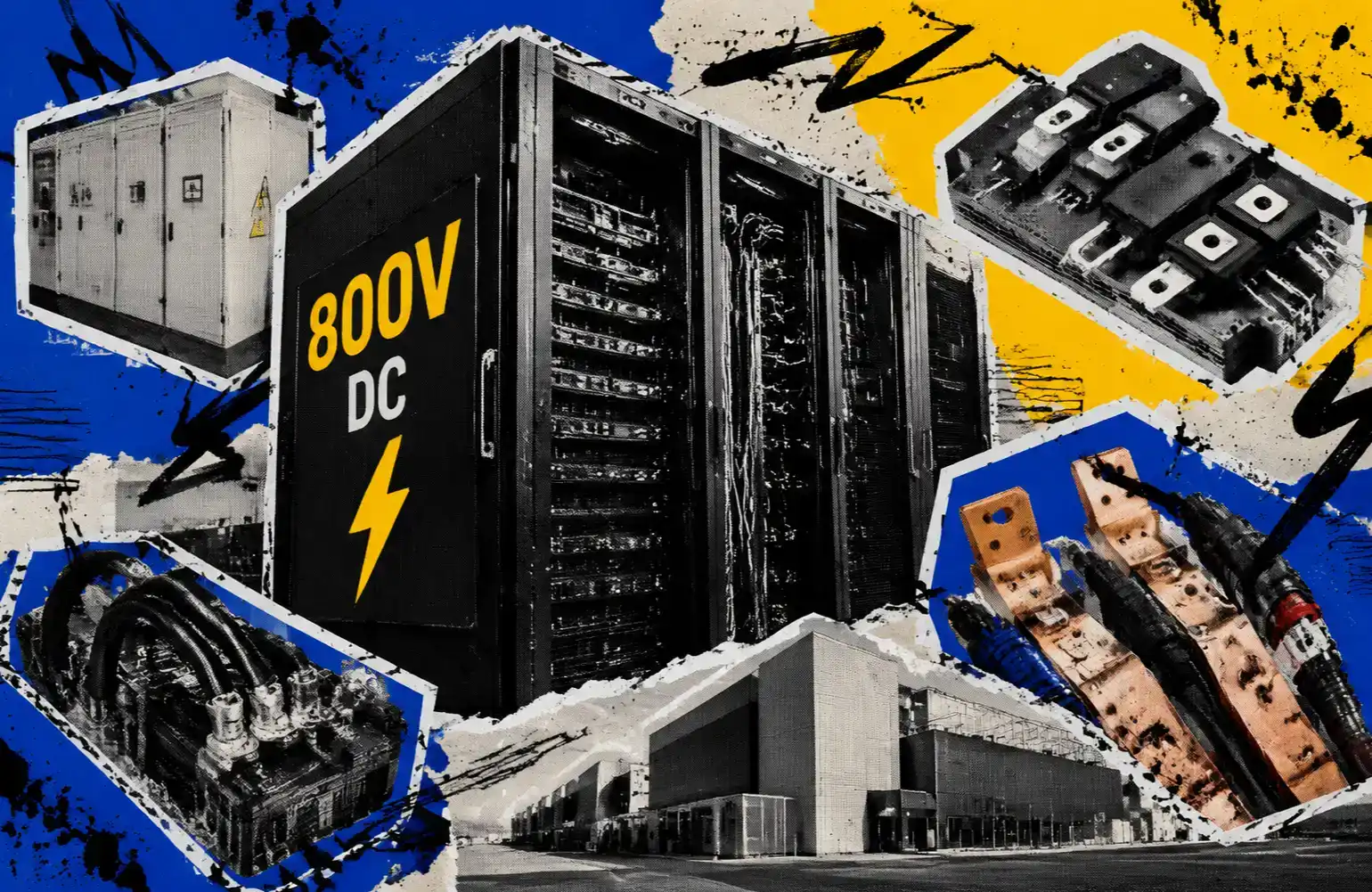
The 800V Voltage Standard Championed by Nvidia: Which Infrastructure Providers Stand to Benefit?

NVIDIA is actively promoting the 800VDC architecture as a key direction for its next-generation AI factories and high-power racks, particularly for the upcoming Rubin and Kyber platforms. The primary driver is the rapidly increasing power density of AI racks, with designs like GB200/GB300 NVL72 reaching 120-140kW and future systems potentially hitting 180-220kW. At such high power levels, traditional low-voltage power delivery becomes inefficient due to massive current, leading to significant copper use, cable bulk, heat, and power loss. The 800VDC standard aims to increase efficiency by transmitting power at higher voltage and lower current to the rack before stepping it down locally for GPUs. NVIDIA claims this can improve efficiency by up to 5%, reduce total cost of ownership (TCO) by up to 30%, and cut copper usage by approximately 45%. This shift redefines infrastructure roles, pushing power engineering to the forefront alongside GPU performance. Key beneficiaries and ecosystem partners highlighted include: 1. **Power Infrastructure Providers:** Companies like Vertiv, Schneider Electric, Delta Electronics (台达电), and Korean firms LS Electric and HD Hyundai Electric are involved in designing next-gen AI factory power distribution, rack power supplies, and backup systems. 2. **Power Semiconductors:** Suppliers of SiC/GaN devices, such as Infineon and STMicroelectronics, are better suited for high-voltage, high-efficiency conversion in this new architecture. 3. **Connectivity & Structure:** The focus shifts to high-reliability components like busbars, high-voltage connectors, and advanced PCBs that meet stricter insulation and safety requirements. 4. **Liquid Cooling & Rack ODM:** As power and heat density rise, liquid cooling becomes critical. Full-rack system integrators (e.g., Dell, Wiwynn, Wistron) must now demonstrate robust pre-delivery testing capabilities, including burn-in testing under full load, requiring significant power and cooling infrastructure in their factories. The transition is not immediate for all data centers but is targeted at high-density AI factories. NVIDIA’s 800VDC ecosystem is in a preparatory phase, with full-scale production expected to align with the 2027 launch of Kyber rack-scale systems. The investment thesis revolves around which companies can demonstrate proven product integration, customer validation, and reliable delivery of complete, high-power AI rack systems, making power, cooling, and testing capabilities new critical variables in the AI infrastructure value chain alongside GPUs.

marsbit29 мин. назад

The 800V Voltage Standard Championed by Nvidia: Which Infrastructure Providers Stand to Benefit?

marsbit29 мин. назад

Did 'Unlimited Minting' Actually Happen? Zcash Founder Responds to Four Major Market Concerns

The Orchard shielding pool in the privacy cryptocurrency Zcash was recently found to have contained a critical counterfeiting vulnerability that existed for four years. This discovery caused significant market panic and a sharp drop in the price of ZEC, though it has since recovered partially. Zcash founder Zooko Wilcox addressed four key questions raised by the vulnerability. First, while it's unknown if the bug was exploited, he believes it likely was not, citing advanced, targeted discovery methods, a rapid response to freeze the pool, and the typical "smash-and-grab" nature of past crypto exploits. Second, he states that if no exploitation occurred, all legitimate user funds in Orchard are recoverable. However, cautious users moving funds should be aware of privacy trade-offs and other risks involved in transferring to transparent or Sapling pools. Third, users currently cannot independently verify that the total ZEC supply hasn't been inflated due to this bug. However, the proposed "Ironwood" network upgrade will restore this ability by permanently sealing the Orchard pool. This will prevent any counterfeit funds from circulating and allow anyone running a node to cryptographically verify that the supply cap has not been breached. Finally, regarding other undiscovered vulnerabilities, Wilcox notes that intensive ongoing audits by multiple teams, including using advanced AI-assisted tools, have so far found no other counterfeiting bugs. This provides increased, though not absolute, confidence. In conclusion, while assessments suggest the bug was likely unused and funds are safe, the core issue was the loss of user-verifiable supply integrity. The Ironwood upgrade is presented as the solution, aiming to restore trust by allowing users to independently verify Zcash's supply security without relying on third-party assurances.

marsbit30 мин. назад

Did 'Unlimited Minting' Actually Happen? Zcash Founder Responds to Four Major Market Concerns

marsbit30 мин. назад

The First Prediction Market Stock Has Emerged!

"Prediction Market Unicorn Emerges!" While the World Cup drives record trading volumes in prediction markets, the industry leader Kalshi faces a new threat from a former key ally. In March 2025, Kalshi partnered with online broker Robinhood to offer prediction market services, allowing users to bet on events. This deal was mutually beneficial: Kalshi gained access to Robinhood's massive retail user base, with an estimated 25-35% of its volume coming through this channel, while Robinhood earned significant fees, reporting a 320% year-over-year increase in "other transaction revenue" to $147 million in Q1 2026, largely fueled by prediction markets. However, Robinhood's ambitions have grown. Recognizing that its user base and distribution power are the scarcest resources, it initiated a plan to bring operations in-house. In late 2025, Robinhood partnered with Susquehanna to acquire CFTC-regulated exchange MIAXdx, renaming it Rothera Exchange. By June 2026, Robinhood launched its own prediction market product on Rothera, strategically using the World Cup as a launchpad. Initial data shows Rothera processing tens of millions of contracts within days, directly siphoning volume away from Kalshi. This shift marks a pivotal moment: control is moving from the market infrastructure provider (Kalshi) to the entity controlling user distribution (Robinhood). The story illustrates a recurring internet era dynamic: "He who controls distribution controls everything." As more platforms with large user bases recognize the value of prediction markets, the industry's future competition may center less on which platform has the best market technology and more on which one owns the user gateway.

marsbit42 мин. назад

The First Prediction Market Stock Has Emerged!

marsbit42 мин. назад

Торговля

Спот
Фьючерсы

Популярные статьи

Тест по Bitcoin Биткоина

HTX Learn: Изучите Bitcoin halving и Заработаете Токены USDT

3.1k просмотров всегоОпубликовано 2024.04.16Обновлено 2024.04.16

Тест по Bitcoin  Биткоина

Что такое $BITCOIN

ЦИФРОВОЕ ЗОЛОТО ($BITCOIN): Комплексный анализ Введение в ЦИФРОВОЕ ЗОЛОТО ($BITCOIN) ЦИФРОВОЕ ЗОЛОТО ($BITCOIN) — это проект на основе блокчейна, работающий в сети Solana, который стремится объединить характеристики традиционных драгоценных металлов с инновациями децентрализованных технологий. Хотя он носит имя Биткойн, часто называемого “цифровым золотом” из-за его восприятия как средства хранения ценности, ЦИФРОВОЕ ЗОЛОТО является отдельным токеном, предназначенным для создания уникальной экосистемы в ландшафте Web3. Его цель — позиционировать себя как жизнеспособный альтернативный цифровой актив, хотя детали его применения и функциональности все еще развиваются. Что такое ЦИФРОВОЕ ЗОЛОТО ($BITCOIN)? ЦИФРОВОЕ ЗОЛОТО ($BITCOIN) — это токен криптовалюты, специально разработанный для использования в блокчейне Solana. В отличие от Биткойна, который выполняет широко признанную роль хранения ценности, этот токен, похоже, сосредоточен на более широких приложениях и характеристиках. Примечательные аспекты включают: Инфраструктура блокчейна: Токен построен на блокчейне Solana, известном своей способностью обрабатывать высокоскоростные и недорогие транзакции. Динамика предложения: ЦИФРОВОЕ ЗОЛОТО имеет максимальное предложение, ограниченное 100 квадриллионами токенов (100P $BITCOIN), хотя детали о его обращающемся предложении в настоящее время не раскрыты. Утилита: Хотя точные функциональные возможности не описаны, есть указания на то, что токен может быть использован для различных приложений, потенциально связанных с децентрализованными приложениями (dApps) или стратегиями токенизации активов. Кто создатель ЦИФРОВОГО ЗОЛОТА ($BITCOIN)? На данный момент личность создателей и команды разработчиков, стоящих за ЦИФРОВЫМ ЗОЛОТОМ ($BITCOIN), остается неизвестной. Эта ситуация типична для многих инновационных проектов в области блокчейна, особенно тех, которые связаны с децентрализованными финансами и феноменом мем-криптовалют. Хотя такая анонимность может способствовать культуре, ориентированной на сообщество, она усиливает опасения по поводу управления и ответственности. Кто инвесторы ЦИФРОВОГО ЗОЛОТА ($BITCOIN)? Доступная информация указывает на то, что у ЦИФРОВОГО ЗОЛОТА ($BITCOIN) нет известных институциональных спонсоров или значительных венчурных капиталовложений. Проект, похоже, функционирует по модели пирингового взаимодействия, сосредоточенной на поддержке и принятии сообществом, а не на традиционных путях финансирования. Его активность и ликвидность в основном сосредоточены на децентрализованных биржах (DEX), таких как PumpSwap, а не на устоявшихся централизованных торговых платформах, что еще больше подчеркивает его подход, ориентированный на grassroots. Как работает ЦИФРОВОЕ ЗОЛОТО ($BITCOIN) Операционные механизмы ЦИФРОВОГО ЗОЛОТА ($BITCOIN) можно подробно описать на основе его дизайна блокчейна и характеристик сети: Механизм консенсуса: Используя уникальный механизм доказательства истории (PoH) Solana в сочетании с моделью доказательства доли (PoS), проект обеспечивает эффективную валидацию транзакций, что способствует высокой производительности сети. Токеномика: Хотя конкретные дефляционные механизмы не были подробно описаны, большое максимальное предложение токенов подразумевает, что оно может быть предназначено для микротранзакций или нишевых случаев использования, которые еще предстоит определить. Интероперабельность: Существует потенциал для интеграции с более широкой экосистемой Solana, включая различные платформы децентрализованных финансов (DeFi). Однако детали относительно конкретных интеграций остаются неуточненными. Хронология ключевых событий Вот хронология, которая подчеркивает значимые вехи, касающиеся ЦИФРОВОГО ЗОЛОТА ($BITCOIN): 2023: Первоначальное развертывание токена происходит в блокчейне Solana, отмеченное его адресом контракта. 2024: ЦИФРОВОЕ ЗОЛОТО приобретает видимость, когда оно становится доступным для торговли на децентрализованных биржах, таких как PumpSwap, позволяя пользователям обменивать его на SOL. 2025: Проект наблюдает спорадическую торговую активность и потенциальный интерес к инициативам, возглавляемым сообществом, хотя на данный момент не зафиксировано никаких значительных партнерств или технических достижений. Критический анализ Сильные стороны Масштабируемость: Основная инфраструктура Solana поддерживает высокие объемы транзакций, что может повысить полезность $BITCOIN в различных сценариях транзакций. Доступность: Потенциально низкая цена торговли за токен может привлечь розничных инвесторов, способствуя более широкому участию благодаря возможностям дробного владения. Риски Отсутствие прозрачности: Отсутствие публично известных спонсоров, разработчиков или процесса аудита может вызвать скептицизм относительно устойчивости и надежности проекта. Волатильность рынка: Торговая активность сильно зависит от спекулятивного поведения, что может привести к значительной волатильности цен и неопределенности для инвесторов. Заключение ЦИФРОВОЕ ЗОЛОТО ($BITCOIN) является интригующим, но неоднозначным проектом в быстро развивающейся экосистеме Solana. Хотя он пытается использовать нарратив “цифрового золота”, его отход от установленной роли Биткойна как средства хранения ценности подчеркивает необходимость более четкого различения его предполагаемой утилиты и структуры управления. Будущее принятие и усвоение, вероятно, будут зависеть от решения текущей непрозрачности и более четкого определения его операционных и экономических стратегий. Примечание: Этот отчет охватывает синтезированную информацию, доступную на октябрь 2023 года, и с тех пор могут произойти события.

99 просмотров всегоОпубликовано 2025.05.13Обновлено 2025.05.13

Что такое $BITCOIN

Fractal Bitcoin: масштабирование Биткоина с помощью рекурсивной системы

Fractal Bitcoin — масштабное Layer-1-решнение, созданное на базе кода Биткоина, позволяющего достигать бесконечного масштабирования с помощью рекурсивного подхода.

2.3k просмотров всегоОпубликовано 2025.06.30Обновлено 2025.06.30

Fractal Bitcoin: масштабирование Биткоина с помощью рекурсивной системы

Обсуждения

Добро пожаловать в Сообщество HTX. Здесь вы сможете быть в курсе последних новостей о развитии платформы и получить доступ к профессиональной аналитической информации о рынке. Мнения пользователей о цене на BTC (BTC) представлены ниже.

活动图片