The 800V Voltage Standard Championed by Nvidia: Which Infrastructure Providers Stand to Benefit?

marsbitОпубликовано 2026-06-15Обновлено 2026-06-15

Введение

NVIDIA is actively promoting the 800VDC architecture as a key direction for its next-generation AI factories and high-power racks, particularly for the upcoming Rubin and Kyber platforms. The primary driver is the rapidly increasing power density of AI racks, with designs like GB200/GB300 NVL72 reaching 120-140kW and future systems potentially hitting 180-220kW. At such high power levels, traditional low-voltage power delivery becomes inefficient due to massive current, leading to significant copper use, cable bulk, heat, and power loss. The 800VDC standard aims to increase efficiency by transmitting power at higher voltage and lower current to the rack before stepping it down locally for GPUs. NVIDIA claims this can improve efficiency by up to 5%, reduce total cost of ownership (TCO) by up to 30%, and cut copper usage by approximately 45%. This shift redefines infrastructure roles, pushing power engineering to the forefront alongside GPU performance. Key beneficiaries and ecosystem partners highlighted include: 1. **Power Infrastructure Providers:** Companies like Vertiv, Schneider Electric, Delta Electronics (台达电), and Korean firms LS Electric and HD Hyundai Electric are involved in designing next-gen AI factory power distribution, rack power supplies, and backup systems. 2. **Power Semiconductors:** Suppliers of SiC/GaN devices, such as Infineon and STMicroelectronics, are better suited for high-voltage, high-efficiency conversion in this new architecture. 3. **Connec...

TL;DR

Over the past few years, the star of AI infrastructure has been the GPU. Those who secured more H100s or B200s had a stronger supply of computing power. But as we move into the Rubin and subsequent platforms, investors need to look one level deeper: Can the GPUs fit into the rack? Can the rack receive stable power? Can the heat be dissipated? Can the systems be fully loaded and tested before leaving the factory?

This is precisely why 800VDC is now being discussed in the market. Since 2025, Nvidia has consistently and publicly advocated for 800VDC architecture, incorporating it into the design direction for next-generation AI factories and high-power racks. On the surface, this is a shift in voltage specification from traditional low voltage to high-voltage DC. Looking deeper, AI servers are no longer just assemblies of boards and chips; they are increasingly resembling power engineering projects.

Ordinary investors can think of it this way: a full rack of AI servers is like a small building with extremely high electricity consumption. Past power delivery methods could still support racks of several dozen or even a hundred kilowatts. But as power continues to increase, the problem is no longer just "how many GPUs to buy," but rather how to deliver the electricity, how to dissipate the heat, and how to run the machines at full load continuously before they leave the factory.

High-Power Racks Are Approaching the Limits of Low-Voltage Power Supply

The starting point for this change is the rapid rise in AI rack power. Traditional server racks might only consume a few to tens of kilowatts. With Nvidia's GB200/GB300 generation, whole-rack power has entered the hundred-kilowatt range. According to Tom’s Hardware, the GB200/GB300 NVL72 consumes approximately 120-140kW.

Power density could climb further post-Rubin. Some supply chain and industry estimates suggest the Rubin NVL72 might reach approximately 180-220kW. This range is not officially confirmed by Nvidia and should still be considered third-party estimates, but the direction is clear: leading-edge AI racks are becoming higher-density power consumption units.

The power issue can be explained by a formula: Power equals Voltage multiplied by Current. To deliver the same 600kW of power, if the voltage is lower, a larger current is required. A larger current necessitates thicker cables and busbars, causes more severe heat generation, and leads to higher power loss in the lines.

Traditional low-voltage power supply is like using a very thick water pipe to slowly move a large volume of water. It works, but the pipe gets thicker, heavier, and takes up more space. Rack space, which should be reserved for GPUs, memory, networking, and cooling structures, gets crowded out by power shelves, cables, and busbars. At power levels of several hundred kilowatts and beyond, continuing to rely on low-voltage, high-current systems becomes increasingly uneconomical.

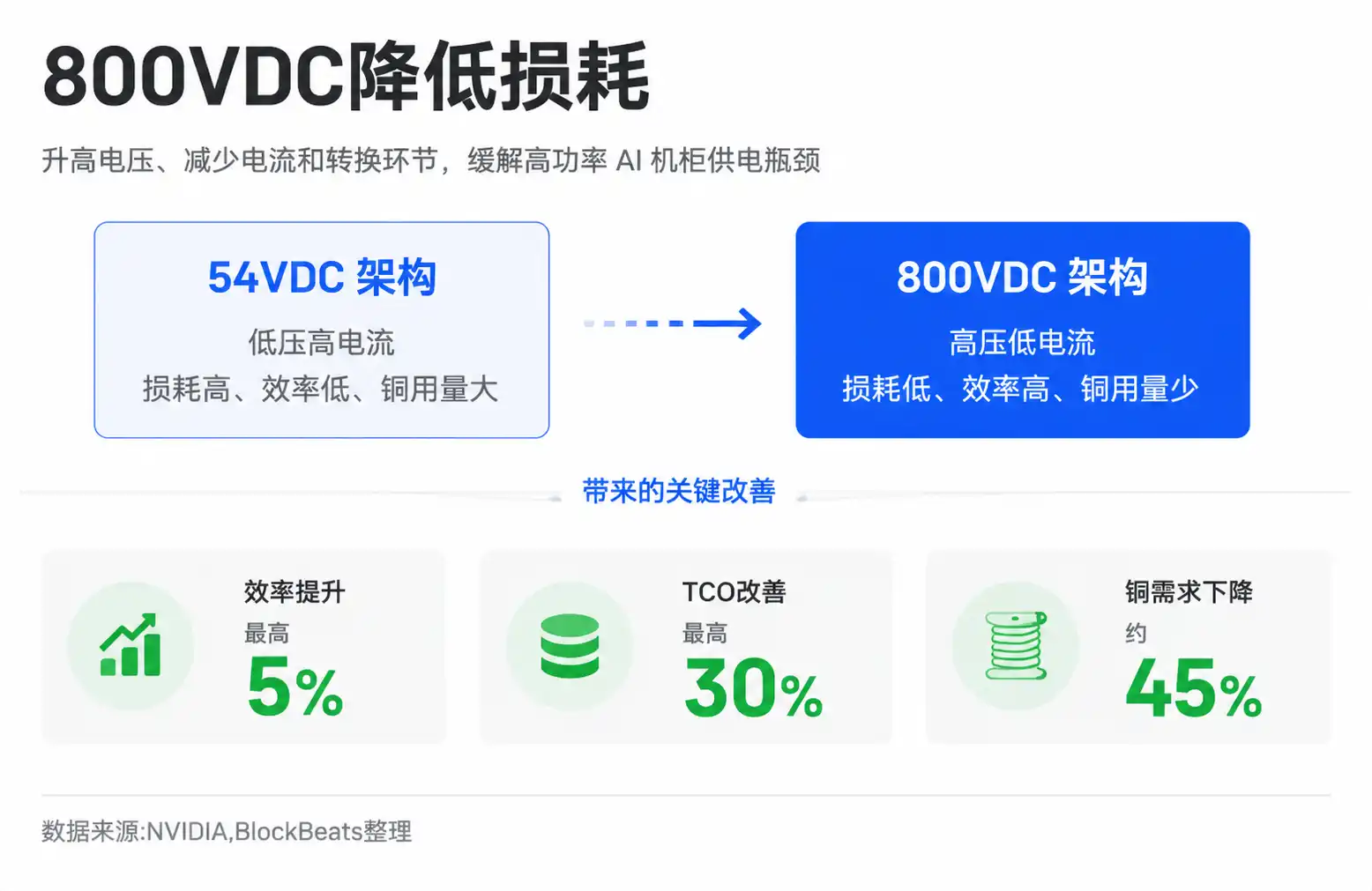
The idea behind 800VDC is to increase the voltage, deliver power more efficiently to the vicinity of the rack, and then step it down locally for use by the GPUs. It's akin to increasing water pressure to use narrower pipes to deliver the same amount of water. Nvidia's official materials state that 800VDC can reduce current, copper usage, cable volume, and conversion stages, potentially increasing efficiency by up to 5% and improving TCO by up to 30%. Some third-party and partner calculations also mention that copper usage could drop by about 45%, with actual benefits depending on the data center and rack integration methods.

This isn't just about saving copper. For Nvidia, the core value of 800VDC is to enable continued increases in compute density for next-generation AI racks. Low-voltage systems aren't unusable, but in the highest-density AI factories, they are beginning to approach engineering limits.

Nvidia Redefines Infrastructure Roles with Reference Architecture

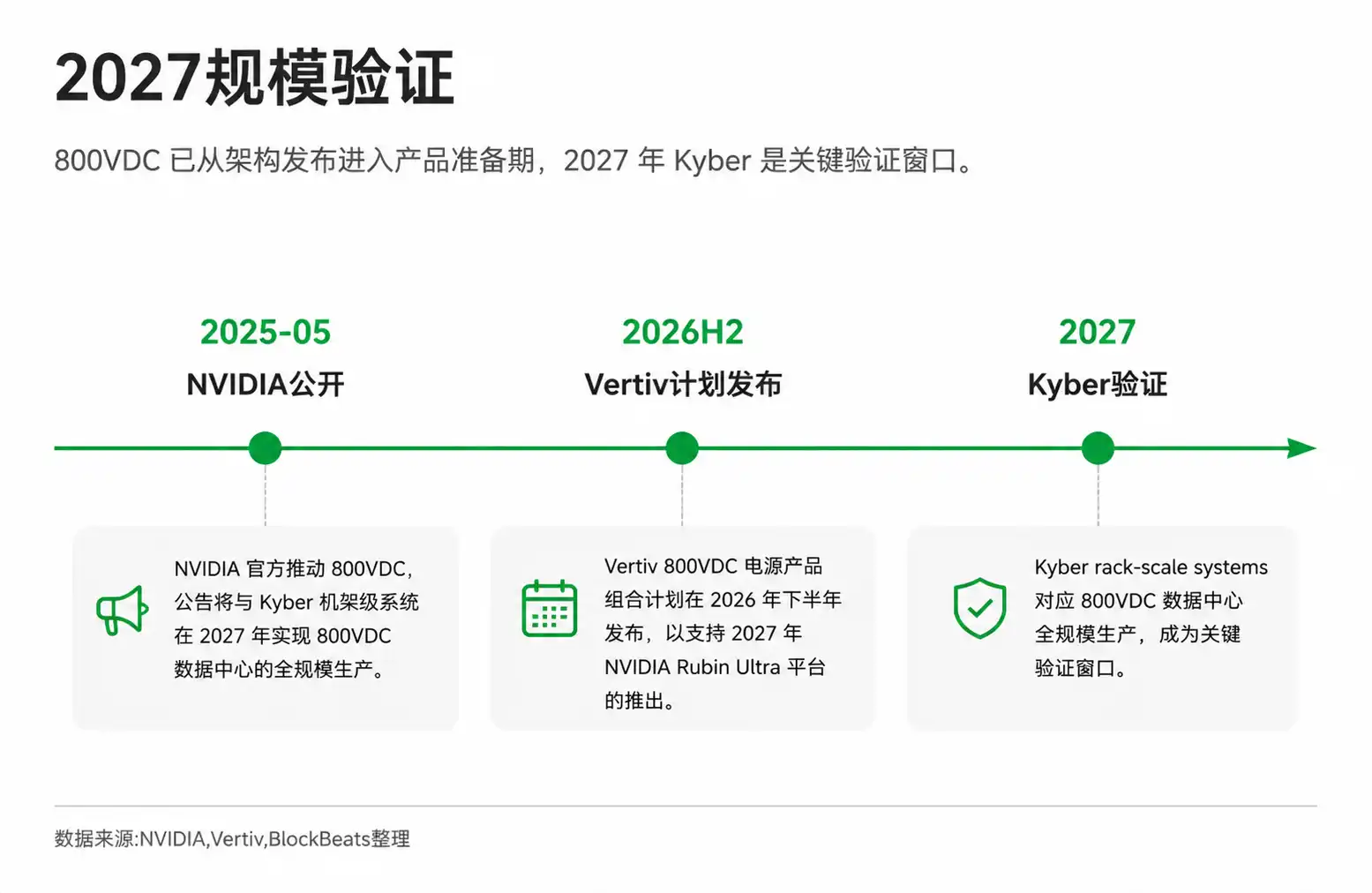
What's significant about Nvidia is not just proposing a voltage solution, but using a reference architecture to redefine the division of labor within the ecosystem. Since 2025, Nvidia has publicly introduced the 800VDC architecture multiple times, showcasing its design direction for high-power systems like Rubin and Kyber racks in technical blogs and at forums like OCP.

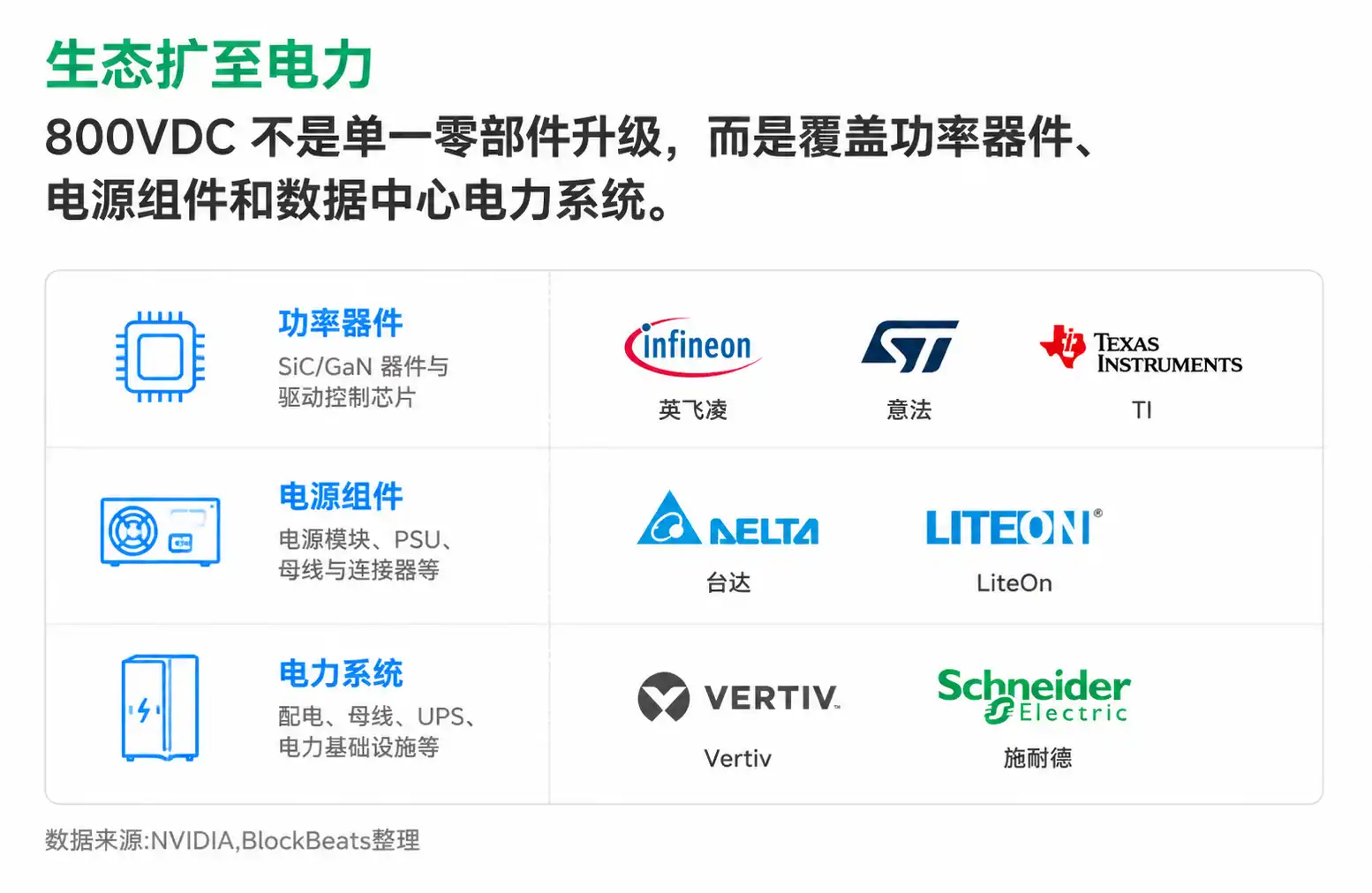
According to Nvidia's official blog, its 800VDC ecosystem partners include Delta Electronics, Schneider Electric, Vertiv, Infineon, STMicroelectronics, as well as companies like ABB, Eaton, GE Vernova, Hitachi Energy, Siemens, Navitas, and Texas Instruments. It's more accurate to describe this as ecosystem collaboration and adaptation, not to be directly interpreted as confirmed orders.

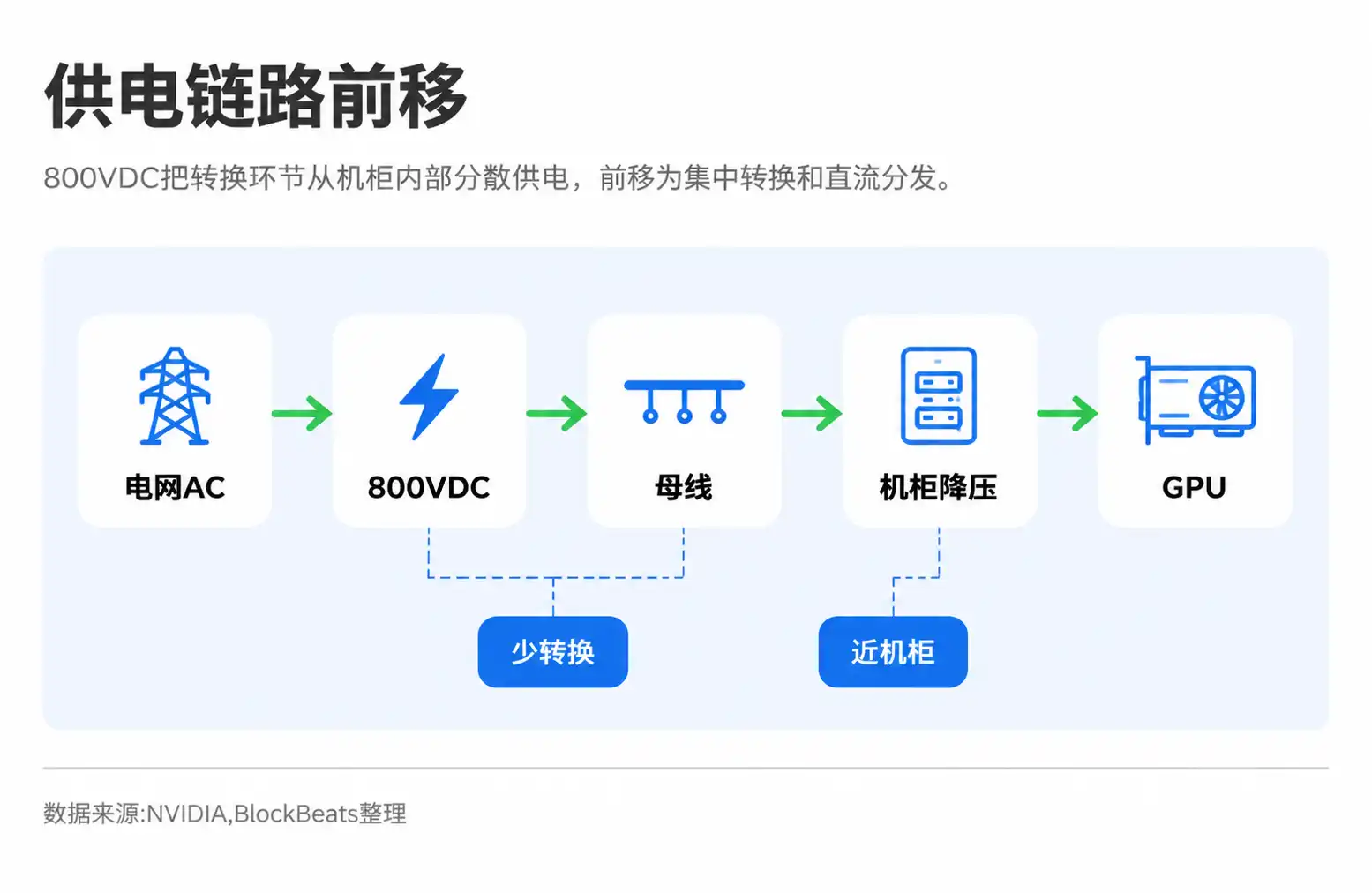
800VDC involves not a single component upgrade, but a change across an entire chain: from data center power distribution and rack power supplies to backup batteries, power devices, connectors, and whole-rack integration. Previously, power conversion might have been distributed across multiple stages like UPS, PDU, server PSUs, and motherboard power delivery. Under a high-voltage DC architecture, power is delivered closer to the rack, then stepped down by modules within or near the GPU.

The weighting within the value chain will also shift accordingly. In the traditional server era, investors focused more on GPUs, CPUs, memory, and system integrators. In the era of high-power AI racks, power shelves, busbars, connectors, power semiconductors, liquid cooling systems, and whole-rack validation capabilities are all becoming part of the delivery capability.

Boundaries must also be clarified. 800VDC is more like an important reference architecture for leading-edge, high-density AI factories, not a standard that all data centers will immediately switch to. Many existing data centers will continue using traditional AC or hybrid architectures. New projects will also adopt it in layers based on power density, cost, owner willingness to retrofit, and safety regulations. What the market is truly trading on is not that everything will switch to 800V this year, but that the infrastructure rules for the highest-density AI racks post-2027 are changing.

Power Supplies, Connectors, Liquid Cooling, and Whole-Rack Testing Move to the Forefront

From an investment perspective, the most direct impact of 800VDC is bringing infrastructure segments that were previously in the background to the forefront.

The first category is power infrastructure companies, such as Vertiv, Schneider Electric, Delta Electronics, and some South Korean and Taiwanese power equipment manufacturers. They are not just selling traditional data center power equipment; they need to participate in the design of power distribution, rack power supply, backup batteries, and high-voltage DC systems for the new generation of AI factories. According to Asia Business Daily, Nvidia has communicated with South Korean power equipment companies like LS Electric, HD Hyundai Electric, and Hyosung regarding 800VDC data center infrastructure. This report is based on industry insider information and should not be equated with confirmed orders, but it illustrates that power equipment providers are being included in the AI factory ecosystem.

The second category is power devices, namely next-generation power switches like SiC/GaN (Silicon Carbide/Gallium Nitride). These are better suited than traditional silicon devices for high-voltage, high-frequency, high-efficiency scenarios. They were often discussed in the context of electric vehicles, charging piles, and industrial power supplies, but are now spilling over into AI data centers. Companies like Infineon and STMicroelectronics are therefore coming into investors' view. However, the benefits for power semiconductors also depend on specific designs, supply share, pricing, and yield, and cannot be simply equated to "800VDC concept stocks."

The third category is connection and mechanical structures, including busbars, power busways, high-voltage connectors, high-end backplanes, and some thick-copper, multi-layer PCBs. When voltage increases and current decreases, copper loss pressure eases, but requirements for insulation, safety, connection reliability, and structural design become higher. Low-end copper materials do not inherently benefit; what's truly valuable are connection and power delivery materials that can adapt to high-power, high-reliability racks.

The fourth category is liquid cooling and whole-rack ODM. As power increases, heat dissipation is no longer a secondary issue. For servers to run stably in customer data centers, they must undergo whole-rack level testing before leaving the factory, including power supply, cooling, networking, and GPU full-load stability. Whole-rack deliverers like Dell, Wiwynn, and Wistron are competing not just on assembly efficiency, but also on whether they have sufficient power, space, liquid cooling testing, and system tuning capabilities.

Design Direction is Clear, but Delivery Capability Requires Real-World Testing

Nvidia has provided a clear technical direction, but supply chain execution won't automatically be smooth. The tension here is precisely what investors need to track.

Independent supply chain analyst Dan Nystedt has recently cited Taiwanese media and industry information multiple times: AI server ODM revenues are strong, Rubin-related production preparations are advancing, but components, power infrastructure, and whole-rack burn-in testing (full-load aging tests) are becoming real constraints. Burn-in can be understood as stress testing of servers before they leave the factory. The power supply, cooling, and system stability of a whole rack of GPUs running at full load for extended periods must all pass together.

If a single rack requires continuous power at the 100-200kW level, the testing facility itself needs power and cooling capacity approaching that of a small data center. Such supply chain signals cannot be written as the industry already commonly having its own power generation, nor can they be directly interpreted as power supply having replaced GPUs as the biggest bottleneck. It's more of a reminder: Delivery in the Rubin era is not just about GPU arrival and motherboard assembly, but about power, liquid cooling, testing, and whole-rack stability all being in place simultaneously.

The logic behind the revaluation of some ODMs, power equipment, and liquid cooling companies is also here. Their value doesn't just come from participating in AI servers, but from their ability to reliably deliver high-power racks to cloud providers. In the future, if everyone gets the same Nvidia reference design, what truly differentiates them might be testing facilities, power capacity, liquid cooling debugging experience, and delivery yield.

For AI cloud providers like CoreWeave and Nebius, 800VDC is not a direct component-benefit logic, but a variable affecting capital expenditure efficiency and deployment speed. Whether high-density racks can be deployed on time impacts computing power delivery, depreciation schedules, and revenue realization. High-speed interconnect or optical module chains, like those involving Marvell or Lumentum, belong more to a parallel logic of AI cluster expansion and should not be confused with direct beneficiaries of 800VDC.

2027 to See Kyber Racks and Order Fulfillment

The direction of 800VDC is much clearer than a year ago: Nvidia is officially promoting it, partners are adapting, physical constraints exist, and leading-edge high-density AI factories need more efficient power delivery. But it is still in the preparation and early deployment window. Nvidia officially states that full-scale production for 800VDC will correspond with the 2027 Kyber rack-scale systems; true validation will depend on whether subsequent products and customer projects materialize.

What's most worth watching next is not whether a company mentions "AI power" in its announcements, but whether it has clearly entered into 800VDC-related products, customer validation, and order fulfillment. Whether ODMs disclose stronger whole-rack testing capabilities, the reliability of liquid cooling systems under prolonged full load, and whether data center owners are willing to retrofit power distribution and safety regulations for high-voltage DC architecture will all influence the rhythm of this trade.

If Rubin-related racks ramp up smoothly and 800VDC component orders move from samples and validation to volume procurement, the market will continue to increase the weighting placed on power supply, liquid cooling, connectors, and whole-rack delivery capabilities. Conversely, if power consumption configurations are lower than expected, customers adopt more conservative hybrid architectures, or testing power and liquid cooling reliability slow down delivery, the 800VDC trade will also shift from directional judgment back to verifying orders and timing. GPUs remain the core, but post-Rubin, the ability to stably deliver a whole rack of high-power systems is beginning to become a variable in asset pricing.

Связанные с этим вопросы

QAccording to the article, why is NVIDIA promoting the 800VDC standard for future AI infrastructure?

ANVIDIA is promoting the 800VDC standard because the power requirements of high-density AI server racks are pushing the limits of traditional low-voltage power delivery. By moving to higher voltage, 800VDC can deliver the same power with lower current, which reduces copper usage, cable size, and power loss, improves efficiency, and allows for continued increases in computing density within a rack.

QWhat are the four main categories of infrastructure companies that the article suggests are brought to the forefront due to the 800VDC push?

AThe four main categories are: 1) Power infrastructure companies (e.g., Vertiv, Schneider Electric, Delta Electronics) involved in design for new AI factories; 2) Power semiconductor companies (e.g., Infineon, STMicroelectronics) producing SiC/GaN devices for efficient high-voltage switching; 3) Connector and structural companies handling busbars, high-voltage connectors, and specialized PCBs; and 4) Liquid cooling and rack-level ODM companies responsible for full rack integration and pre-deployment burn-in testing.

QWhat new challenge for server manufacturers (ODMs) does the article highlight in relation to high-power AI racks like those for Rubin?

AThe article highlights that delivering high-power AI racks requires new capabilities beyond assembly. A key challenge is conducting full rack-level burn-in testing, where an entire rack of GPUs is run at full load for an extended period. This requires the ODM to have access to substantial electrical power and advanced cooling (like liquid cooling) in their testing facilities to ensure system stability before shipment.

QWhat is the key timeline that the article associates with the full-scale production of 800VDC architecture?

AAccording to the article, NVIDIA states that full-scale production for the 800VDC architecture is aligned with the launch of the "Kyber rack-scale systems," which is expected in 2027. True validation will depend on the subsequent product rollouts and customer project implementations.

QHow does the article caution investors about interpreting the list of NVIDIA's 800VDC ecosystem partners?

AThe article cautions that the list of NVIDIA's 800VDC ecosystem partners (including companies like Delta, Schneider, Vertiv, Infineon, etc.) represents collaboration and design adaptation, and should not be directly interpreted as confirmed orders already being placed. The market's focus should shift to tracking which companies secure concrete orders, pass customer validation, and demonstrate actual delivery capabilities.

Похожее

Apple Also Has to Pay Rent Now

Apple Pays Rent Too: The Two-Way Flow of "Traffic Tax" and "AI Capability Rent" Between Tech Giants For over two decades, Google has paid Apple an estimated $20 billion annually to remain the default search engine on Safari, a "traffic tax" for a critical user entry point. However, in 2026, the direction of this cash flow partially reversed. Apple agreed to pay Google roughly $1 billion per year to license its Gemini AI models, as Apple's own models reportedly struggled with complex tasks. This creates a unique dynamic: Apple acts as the "landlord" in the established search ecosystem, collecting rent from Google for access. Simultaneously, in the emerging AI arena, Apple becomes the "tenant," paying Google for access to cutting-edge AI capabilities it cannot currently match internally. While Apple claims its new models are "distilled" from Gemini outputs and contain "not a drop" of Google's original code, core dependencies remain. Its knowledge base is refined using Gemini's outputs, and its most powerful cloud model runs on Google's infrastructure. Apple has structured the deal as non-exclusive, allowing it to theoretically switch AI suppliers—a hedge against over-reliance. The future hinges on whether advanced AI models become a commodity (cheap and abundant) or remain a concentrated, scarce resource (expensive and controlled by few). Apple is betting on the former, leveraging its massive device ecosystem to be a powerful, choosy customer. If the latter proves true, its bargaining power could erode. This power dynamic is extending to developers. Apple, Google, and WeChat are all pushing for apps to expose their core functions as standardized "actions" or "intents" that their respective AI assistants (Siri, Gemini, WeChat AI) can directly call. The new scarce resource is no longer just app store visibility, but "being selected by the AI." The currency of "rent" has changed from a 30% revenue share to ceding control over how users interact with an app's functions.

marsbit32 мин. назад

Apple Also Has to Pay Rent Now

marsbit32 мин. назад

Missed the SpaceX IPO? WEEX's "First Trade Protection" Lets You Experience US Stock Trading Risk-Free.

With the excitement around SpaceX's recent public listing reigniting interest in the US stock market, Chinese investors face significant challenges accessing compliant and convenient trading channels following regulatory actions against major online brokers. This article explores the available options, highlighting their risks and limitations. Traditional paths for US stock investments remain problematic. Qualified Domestic Institutional Investor (QDII) and Listed Open-Ended Fund (LOF) products, while compliant, suffer from high fees, significant purchase premiums, and a very limited selection of assets. Small, unregulated offshore brokers pose substantial risks, including potential insolvency. While secure, VIP accounts at banks in Hong Kong or Singapore require high minimum deposits (often 1-2 million RMB) and in-person visits, placing them out of reach for most retail investors. The article positions cryptocurrency exchanges, specifically their TradFi (traditional finance on-chain) offerings, as a compelling alternative. Platforms like WEEX are noted for providing access to a wide range of US stocks and ETFs, including SpaceX (SPCXON), through tokenized assets. This method offers advantages such as a single account for both crypto and traditional assets, USDT-based settlement avoiding fiat complexities, flexible leverage, and robust risk management. To attract users, WEEX is promoting a "First Trade Guarantee" campaign. Running from June 15 to July 8 (UTC+8), it features a $30,000 prize pool. Users who trade $500 worth of US stock contracts can qualify for a guarantee on their first eligible trade: 100% loss coverage up to $30 or a 20% bonus on profits up to $30. The campaign is presented as a low-risk opportunity for both crypto natives and traditional investors to experience US stock trading.

marsbit34 мин. назад

Missed the SpaceX IPO? WEEX's "First Trade Protection" Lets You Experience US Stock Trading Risk-Free.

marsbit34 мин. назад

How Difficult is Chip Making? A Division Error Costs 475 Million Dollars

How Hard Is It to Make a Chip? A Division Error Cost $475 Million Chip expert Shi Kan, a researcher at the Chinese Academy of Sciences and a popular tech creator, explains the immense challenges of chip development. Chips are foundational to modern technology, but their creation is extraordinarily difficult. The journey from sand to a functional chip involves complex design and manufacturing, but a critical bottleneck is verification—ensuring the design works flawlessly before costly production. A single, undetected bug can have catastrophic consequences, as illustrated by the infamous 1994 Intel Pentium FDIV bug. A flaw in the floating-point division unit forced a recall costing $475 million. Unlike software, chips cannot be easily patched after manufacture, making "first-time success" paramount. However, industry surveys show only 24% of chip projects achieve this; over three-quarters require at least one costly re-spin due to design flaws. Verification has thus become the dominant phase, consuming up to 70% of the design cycle. The core challenge is a "verification impossible triangle" between high performance, good debuggability, and low cost. Exhaustively verifying a modern CPU core could take 15,000 years with software simulation, or 30 years with advanced hardware emulation—timeframes utterly impractical for development. Despite being essential, verification is often seen as unglamorous "dirty work," receiving less academic attention than fields like AI. Shi and his team are tackling this by developing an agile verification research framework called ENCORE, based on FPGA technology, to improve verification efficiency and debug capability. Beyond research, Shi engages in public science communication through long-form video content, aiming to demystify chip technology, AI, and computer science. He argues for the value of pursuing "hard and long-term" endeavors, whether in the meticulous world of chip verification or in creating substantive educational content, believing such sustained effort is likely the right path forward.

marsbit43 мин. назад

How Difficult is Chip Making? A Division Error Costs 475 Million Dollars

marsbit43 мин. назад

Claude to Mandate "Face-Scan ID Verification", No ID No Service Starting July?

Anthropic, the creator of Claude AI, has sent privacy policy update emails to users, signaling a significant shift. The key change, effective July 8, is the potential requirement for consumer-level users (Free, Pro, Max plans) to verify their age or identity. This verification would be conducted through the third-party service Persona, involving uploading a government-issued photo ID and taking a live selfie for comparison. Anthropic states this data is for security purposes only, will not be used for model training, and is processed by Persona, not stored on its own servers. The update also clarifies data handling for Claude's new capabilities: when performing multi-step tasks or connecting to third-party apps, user data may flow between Anthropic and those external services. Additionally, more information may be collected from users who participate in Anthropic research. This move is seen as a major step towards establishing accountability as AI agents become more powerful and autonomous, capable of executing complex, real-world tasks. It follows previous enforcement actions, like the banning of the "Fable 5" account, and indicates a broader industry trend toward stricter user identification and safety measures. The verification is expected to apply in specific scenarios, particularly as users engage Claude in more complex agentic workflows.

链捕手56 мин. назад

Claude to Mandate "Face-Scan ID Verification", No ID No Service Starting July?

链捕手56 мин. назад

Blockchain Has Finally Started to Sail into the Mainstream After 18 Years

Blockchain Finds Its True Path After 18 Years: Becoming the Financial Backbone for AI Agents and Autonomy This analysis explores a pivotal shift in the blockchain and crypto investment landscape, driven by the dominance of AI. Major venture capital firms, including Variant, Paradigm, Haun Ventures, and YZi Labs, are moving beyond pure "crypto" investment theses. They are expanding their focus to AI, robotics, and frontier tech, signaling that blockchain is no longer seen as a standalone sector but as an underlying infrastructure layer. The core argument is that blockchain's killer application may not be user-facing apps, but rather providing the economic rails for the coming wave of AI agents, autonomous robots, and automated systems. Key capabilities like self-custody wallets, programmable stablecoins for micropayments, on-chain identity, and verifiable smart contracts are positioned as essential for a future where machines conduct economic activity. The recent $1.4 billion investment by Tether (via its venture arm) in German robotics company NEURA Robotics exemplifies this, aiming to embed Tether's wallet tools directly into robots for autonomous transactions. While many "AI + Crypto" projects remain superficial, the article concludes that true value lies where crypto is a necessary component—enabling machine-to-machine payments, agent autonomy, verifiable data provenance, and open financial settlement for the AI era. For crypto venture capital, this convergence with AI represents both an adaptation to shifting capital flows and a potential path to unlocking the large-scale, non-speculative utility the industry has long sought.

marsbit1 ч. назад

Blockchain Has Finally Started to Sail into the Mainstream After 18 Years

marsbit1 ч. назад

Торговля

Спот
Фьючерсы

Популярные статьи

Как купить T

Добро пожаловать на HTX.com! Мы сделали приобретение Threshold Network Token (T) простым и удобным. Следуйте нашему пошаговому руководству и отправляйтесь в свое крипто-путешествие.Шаг 1: Создайте аккаунт на HTXИспользуйте свой адрес электронной почты или номер телефона, чтобы зарегистрироваться и бесплатно создать аккаунт на HTX. Пройдите удобную регистрацию и откройте для себя весь функционал.Создать аккаунтШаг 2: Перейдите в Купить криптовалюту и выберите свой способ оплатыКредитная/Дебетовая Карта: Используйте свою карту Visa или Mastercard для мгновенной покупки Threshold Network Token (T).Баланс: Используйте средства с баланса вашего аккаунта HTX для простой торговли.Третьи Лица: Мы добавили популярные способы оплаты, такие как Google Pay и Apple Pay, для повышения удобства.P2P: Торгуйте напрямую с другими пользователями на HTX.Внебиржевая Торговля (OTC): Мы предлагаем индивидуальные услуги и конкурентоспособные обменные курсы для трейдеров.Шаг 3: Хранение Threshold Network Token (T)После приобретения вами Threshold Network Token (T) храните их в своем аккаунте на HTX. В качестве альтернативы вы можете отправить их куда-либо с помощью перевода в блокчейне или использовать для торговли с другими криптовалютами.Шаг 4: Торговля Threshold Network Token (T)С легкостью торгуйте Threshold Network Token (T) на спотовом рынке HTX. Просто зайдите в свой аккаунт, выберите торговую пару, совершайте сделки и следите за ними в режиме реального времени. Мы предлагаем удобный интерфейс как для начинающих, так и для опытных трейдеров.

859 просмотров всегоОпубликовано 2024.03.29Обновлено 2026.06.02

Как купить T

Обсуждения

Добро пожаловать в Сообщество HTX. Здесь вы сможете быть в курсе последних новостей о развитии платформы и получить доступ к профессиональной аналитической информации о рынке. Мнения пользователей о цене на T (T) представлены ниже.

活动图片