Author: 798.eth
Preface:
Yesterday, I posted an article about a PoW protocol fork. Today, the browser mining project on the Ethereum mainnet is also here, using v4 hooks to guard the entrance to liquidity pool creation.
Previously seen projects used hooks for economic engine design. UPEG uses hooks to stitch ERC-20 and NFT together. SATO uses hooks to take over pricing curves. SLOP uses hooks to automatically use swap fees to buy floor NFTs for burning. These all design hooks as economic engines.
Today, I looked at one called HASH. Its logic is completely different. It's essentially a PoW token with a 21M cap, difficulty adjustment, halving—copying the whole BTC set. Mining runs keccak256 in the browser. Hooks are not involved in the mining logic; they only do two things. First, guard the entrance to pool creation: only after the genesis sale is complete is anyone allowed to call seedPool to trigger pool creation, and the parameters must match. Second, each swap charges 1% in both directions to the protocol treasury.
In other words, hooks in this project are infrastructure. Not an economic engine, but a gatekeeper at the moment of launch, plus a layer of protocol fee channel beyond LP fees.
0% team, 0% VC, 0% airdrop—all supply goes through public sale plus PoW. The reason they can achieve such a thorough fair launch is that hooks move the pool creation step from the dev's hands into the contract.
Not financial advice.
Only looking for innovative aspects.
Below is the original article:
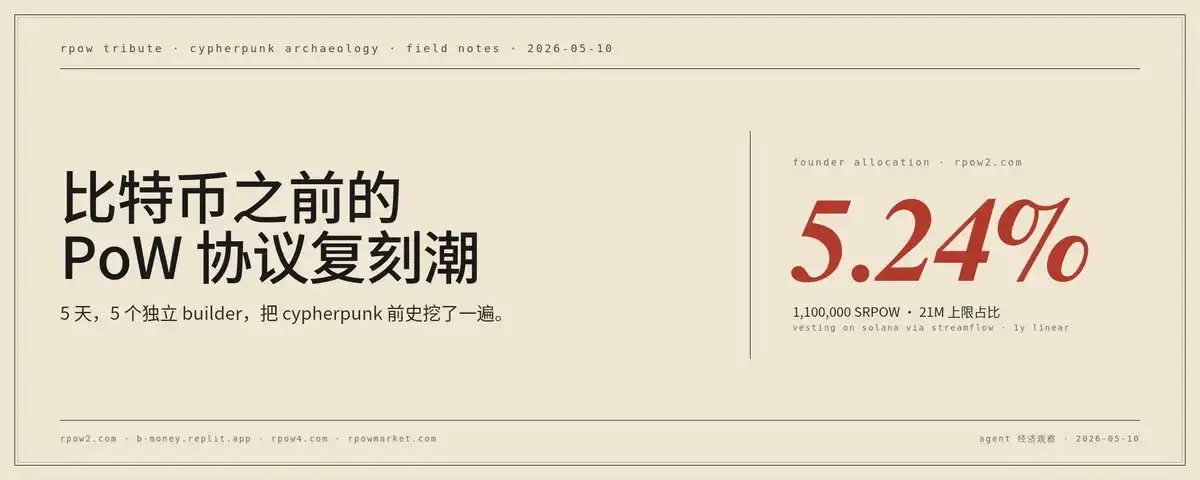
5 days, 5 independent builders dug through cypherpunk prehistory. The first one is RPOW.
Bitcoin did not appear out of thin air.
It has a cypherpunk lineage: Adam Back's Hashcash in 1997, Wei Dai's b-money and Nick Szabo's Bit Gold in 1998, Hal Finney's RPOW in 2004. These proposals each solved part of the problem of "using PoW as electronic cash." Hashcash provided primitives, b-money gave a blueprint for decentralized settlement, Bit Gold gave a blueprint for transferable value, RPOW made PoW tokens reusable. Satoshi strung this lineage together in 2008, writing the Bitcoin whitepaper.
22 years later, in early May 2026, over 5 days, this lineage was collectively reimplemented by a group of people on X and GitHub. The first protocol to be forked was RPOW.
What is RPOW
In 2004, Finney published RPOW on the cypherpunk mailing list—the first electronic currency based on PoW. It was centralized, running on a single server. But this server was connected to an IBM 4758, a FIPS 140-certified hardware cryptographic coprocessor capable of hashing its own internal code and signing a remote attestation. Any user could use this attestation to verify that the server was running Finney's published source code, unaltered—centralized but auditable. This was the real problem RPOW's entire design solved.
In 2009, Bitcoin launched, offering a different answer to the same problem: decentralized consensus. It cut off the trusted hardware path, requiring no trust in any single machine. Finney was the first person to receive a transfer from Satoshi and passed away in 2014 from ALS.
Jump to May 7, 2026
That day, Fred Krueger registered rpow2.com and deployed it.
A brief background on Krueger. He was a Wall Street trader at Salomon Brothers and RBS Greenwich Capital from the 1980s to 1990s. From the 1990s to 2000s, he successively founded TagWorld, iWin, Traffic Marketplace, and Adconion Media Group, with nine exits totaling $500 million according to his own 2018 statement. He entered crypto in 2017 with WorkCoin. In 2022, he initiated Libre Chain, claiming to be Bitcoin's first decentralized lending market. In 2025, he co-authored The Big Bitcoin Book and Bitcoin One Million with Ben Sigman, and in the same year initiated 2718.fund, a Bitcoin fund generating 10% APY cash flow through BTC-collateralized stablecoin loans, with 2718 derived from Euler's number e. He has 244K followers on X, is a Bitcoin maximalist, anti-Ethereum, and has publicly predicted a BTC terminal value of $4.5M to $10M.
I retrieved the webpage from May 7th. It was written like this:
No IBM 4758 — Ed25519 signatures, magic-link auth, Postgres ledger. Still centralized. Still no supply cap. Still no difficulty adjustment. Faithful by design.
No Bitcoin features. At that time, Krueger chose to faithfully replicate Finney, replacing the IBM 4758 with Ed25519 and Postgres, keeping the rest as is.
Within the next 48 hours
On May 8th, developer cryptonaut420 (Nick Rathman) registered rpow4.com, directly copying Bitcoin's full parameters: halving every 210,000 blocks, initial reward of 50 RPOW, transaction fees, treasury—everything included.
On May 9th, GitHub user ImMike launched rpowmarket.com, creating a Polymarket-style BTC price prediction market, integrating rpow2/3/4 as betting tokens.
On May 10th, EmblemVault CSO Adam McBride built rpow2swap.com.
5 days, 3 forks plus a prediction market plus a DEX.
Krueger didn't sit idle
Between May 9th and 10th, he changed the about page of rpow2:
Still centralized — but Bitcoin-flavored where it counts: a fixed 21,000,000 supply cap, and a stepped difficulty adjustment that adds one trailing-zero bit for every 1,000,000 coins minted.
The line "Faithful by design" was gone.
The next paragraph is more telling:
Founder allocation: 1,100,000 SRPOW (5.24% of the 21M cap) was allocated at launch as a "satoshi" tribute, vested linearly over one year via the Streamflow protocol on Solana.
He added a 21M cap, difficulty adjustment, and conveniently reserved 1.1 million tokens as a founder pre-mine. Linear vesting over one year via the Streamflow protocol on Solana, named "satoshi tribute."
Satoshi's most iconic feature was no pre-mine. Anyone who wanted BTC had to mine it themselves. Calling a 5.24% founder pre-mine a "satoshi tribute" is somewhat ironic.
Back to the most crucial line on the webpage.
No IBM 4758 — Ed25519 signatures.
Ed25519 can prove the party holding the private key signed the transaction; it cannot prove what code the party holding the key is running. This misses the entirety of Finney's engineering contribution.
Krueger copied the parts of Bitcoin that look like Bitcoin: 21M cap, halving, scarcity narrative, the word "satoshi." He didn't copy the parts that make Bitcoin Bitcoin: decentralized consensus, the trustless alternative to remote attestation, fair launch.
The story overflows beyond RPOW
On the morning of May 10th, around UTC 06:30, Mike In Space hosted b-money.replit.app on Replit, paying homage to Wei Dai's 1998 electronic cash proposal.
The scale is tiny: 5 accounts, 107.5 total supply, 16 transactions. The code has an `activeContracts` field, corresponding to the `contracts` concept in Wei Dai's original paper.
Mike In Space is not a random person. He is the founder of the Bitcoin Stamps protocol, author of the SRC-20 protocol, and a contributor to Bitcoin Magazine. One of the core figures in the current wave of Bitcoin on-chain inscription.
Wei Dai's b-money predates Hal Finney's RPOW by 6 years. It was never truly implemented because Wei Dai himself stated in his proposal, "I'm not sure if this can work." Mike's version is also clearly a prototype, but it pushes the cypherpunk replication effort to an origin even earlier than RPOW.
The next logical stops would be Bit Gold (Nick Szabo 1998), then DigiCash or Chaum's ecash from the 1980s. This archaeological path is already laid out.
This wave of collective action
5 independent builders: Krueger, cryptonaut420, ImMike, Adam McBride, Mike In Space.
There is overlap at the community level. They all belong to the Bitcoin old-timers / Counterparty / Ordinals / NFT archaeology lineage. Mike In Space's Bitcoin Stamps protocol is exactly the asset type Adam McBride wraps at EmblemVault. This isn't five unrelated people independently forking; it's the same subculture collectively responding to the same meme within 5 days.
Currently, on rpow2swap, rpow FDV is 0.68M. Let's see how it develops later. Essentially, rpow is centralized; if the server is shut down, everything is gone.
But this replication lineage is still quite interesting.
Disclaimer
This article is solely for event documentation and engineering analysis and does not constitute any form of investment advice. All projects mentioned are explicitly labeled by their respective authors as experimental, homage, or for entertainment purposes.
rpow2's webpage clearly states:
this IS a centralized system. The ledger lives in a Postgres database operated by one person on rented infrastructure. If that server is breached, lost, or seized, your tokens may be lost with it. No warranty, no recovery guarantees.
rpowmarket's disclaimer reads: parody · no value · for fun.
b-money.replit.app is a free-hosted prototype.
Not financial advice.