Bitcoin Futures Structure Favors Bulls as Short Liquidations Accelerate

bitcoinistОпубликовано 2025-12-23Обновлено 2025-12-23

Введение

Bitcoin is attempting to reclaim the $90,000 level as market structure signals suggest a tactical upside. According to analyst Axel Adler, Bitcoin’s Regime Score has entered the +15 to +30 range, historically associated with positive returns, indicating an early recovery phase. Simultaneously, derivatives data show a dominance of short liquidations, creating mechanical buying pressure that supports upward movement. The current Regime Score of +16.3 suggests a favorable risk-reward setup, with backtested 30-day returns averaging +3.8% in this zone. While moving into a full bull regime above +30 has often led to local tops, the current neutral-positive transition and prevailing short liquidations indicate improving market structure and potential near-term gains.

Bitcoin is once again attempting to reclaim the $90,000 level, as bulls cautiously rebuild a recovery narrative after weeks of volatility and heavy selling pressure. While sentiment remains fragile and many investors are still positioned defensively, recent price stabilization has opened the door for a short-term upside scenario. Rather than relying on optimism alone, analysts are increasingly pointing to structural indicators that suggest the balance of risk may be shifting.

According to a report by on-chain analyst Axel Adler, Bitcoin’s current setup shows tactical upside potential when viewed through the combined lens of market regime indicators and derivatives liquidation dynamics.

Adler highlights that Bitcoin’s Regime Score has recently transitioned into the +15 to +30 zone, a range that has historically delivered positive average returns. This zone represents an early recovery phase, where downside momentum has faded but euphoria has not yet returned, often creating favorable conditions for asymmetric upside.

At the same time, derivatives data show a clear dominance of short liquidations, meaning that recent price moves have forced bearish positions to close. This creates mechanical buying pressure, which can amplify upward moves even in the absence of strong spot demand. Together, these signals suggest that Bitcoin’s current attempt to reclaim $90,000 is not purely speculative but supported by an improving internal market structure.

Regime Score and Liquidations Point to Tactical Upside

Adler explains that Bitcoin’s composite Regime Score aggregates multiple market dimensions into a single framework, including taker imbalance, open interest pressure, funding rates, ETF flows, exchange flows, and price trend.
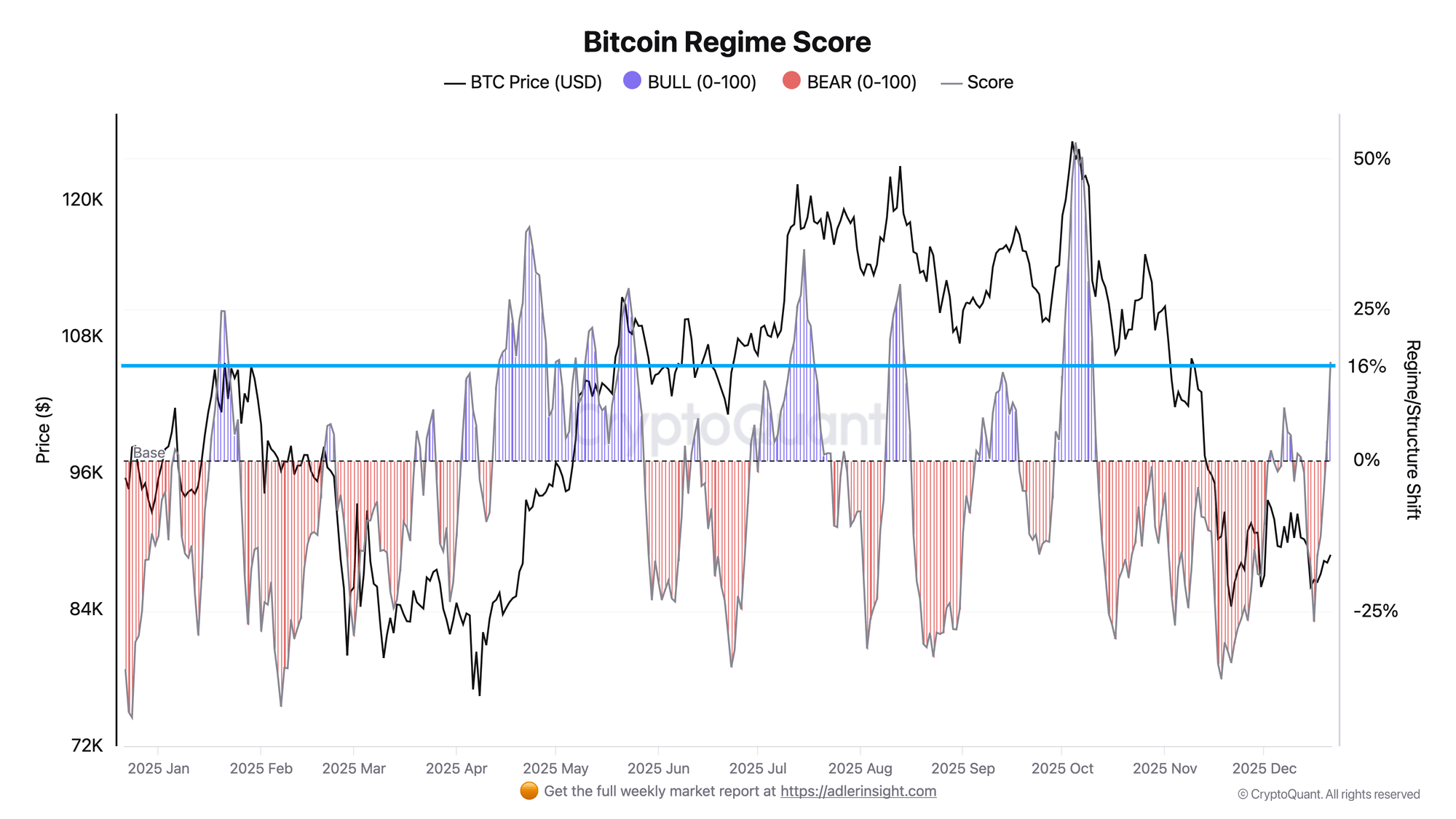
Bitcoin Regime Score | Source: CryptoQuant

The result is a unified indicator ranging from −100 to +100, designed to capture shifts in market structure rather than short-term noise. Currently, the Regime Score stands at +16.3, placing Bitcoin in the upper part of the neutral zone, defined between +15 and +30.

Backtesting data for 2025 shows that this specific subzone has historically delivered average returns of around +3.8% over a 30-day horizon. This contrasts sharply with the −15 to 0 zone, where expected returns were negative, averaging -1.5% over seven days. Importantly, the indicator has recently rebounded from a bearish extreme, after dropping to −27 just a week ago, signaling a structural recovery rather than a random bounce.

Adler highlights a critical nuance: transitions into the formal bull regime above +30 have historically coincided with local tops, often followed by negative short-term returns. This makes the current +15–30 range more attractive for tactical positioning, while aggressive accumulation above +30 may carry elevated risk.

This view is reinforced by derivatives data. The long/short liquidation dominance oscillator has turned negative at −11%, indicating a surge in forced short closures, while its 30-day average remains positive. With long liquidation dominance at just 44%, short liquidations are clearly prevailing, providing additional mechanical fuel for upside.


Связанные с этим вопросы

QWhat is Bitcoin's current Regime Score and what does this value indicate about the market structure?

ABitcoin's current Regime Score is +16.3, which places it in the upper part of the neutral zone (between +15 and +30). This range represents an early recovery phase where downside momentum has faded but euphoria has not yet returned, historically creating favorable conditions for asymmetric upside and positive average returns.

QAccording to the analyst Axel Adler, what historical average return has the +15 to +30 Regime Score zone provided over a 30-day period in 2025?

ABacktesting data for 2025 shows that the +15 to +30 Regime Score zone has historically delivered average returns of around +3.8% over a 30-day horizon.

QHow do short liquidations in the derivatives market currently contribute to Bitcoin's price action?

AShort liquidations are currently dominant, with the long/short liquidation dominance oscillator at -11%. This means recent price moves have forced bearish positions to close, creating mechanical buying pressure that can amplify upward moves even without strong spot demand.

QWhat does the article suggest about the risk of aggressive accumulation when the Regime Score moves above +30?

AThe article states that transitions into the formal bull regime above +30 have historically coincided with local tops and are often followed by negative short-term returns, making aggressive accumulation at those levels carry elevated risk.

QWhat key metrics are aggregated to create Bitcoin's composite Regime Score indicator?

ABitcoin's composite Regime Score aggregates multiple market dimensions, including taker imbalance, open interest pressure, funding rates, ETF flows, exchange flows, and price trend into a single framework.

Похожее

Trump Halts AI Executive Order, Regulatory Efforts Succumb to Competitive Anxiety

In a last-minute reversal, former President Donald Trump halted the signing of a long-anticipated executive order on artificial intelligence. The order had sought to establish a voluntary, pre-release safety testing framework for advanced AI models developed by leading companies like OpenAI, Google, Anthropic, and xAI. Under the proposed plan, companies would have shared their most powerful models with the U.S. government 90 days before public release for national security and cybersecurity risk assessments. Trump refused to approve the order, stating he did not want anything to "slow down our leadership," emphasizing America's lead over China in AI and the technology's role in job creation. This decision highlights the core tension in U.S. AI policy: balancing the management of systemic risks posed by frontier models—such as exposing financial system vulnerabilities—against fears that any regulation could stifle innovation and undermine competitive advantage. The move came despite significant public support for AI safety testing and followed internal administration debates. Some officials, alarmed by the capabilities of models like Anthropic's Mythos in uncovering critical security flaws, had advocated for stronger oversight. However, the industry and many within Trump's circle opposed even this voluntary framework, arguing it would hamper American innovation. The incident underscores how AI policy is increasingly intersecting with national security, economic strategy, and political governance.

marsbit6 мин. назад

Trump Halts AI Executive Order, Regulatory Efforts Succumb to Competitive Anxiety

marsbit6 мин. назад

Machines Pay, Humans Reap: Coinbase, Stripe, Google, Visa's AI Payments Land Grab

One year after being a concept, machine-to-machine payments are now a battleground. Four competing architectures are already deployed by Coinbase (x402 protocol), Stripe/Tempo (MPP standard), Google (AP2 authorization layer), and Visa (tokenized credentials). AI Agents have already settled over $73 million across 176 million transactions, with a median value between $0.01 and $0.10. A key barrier is the ~$0.30 minimum fee of traditional card rails, making them unviable for micro-payments. In contrast, Layer 2 stablecoin settlement costs $0.0001, with USDC dominating 98.6% of all transactions. The dynamic is less about a single winning protocol and more about vertical integration within a new payment stack. Companies like Coinbase and Stripe control multiple layers (settlement, wallet, routing, protocol, governance), driving over $8 billion in recent acquisitions to solidify their positions. The shift from extractive bot activity to productive Agent commerce is underway, with AI Agents accounting for 37% of all Gnosis Chain Safe transactions. The pace of adoption will be set not by available technology but by the development of trust and safety infrastructure for autonomous transactions. While a fully permissionless vision is appealing, supervised access remains crucial until AI reliability improves. Regulatory frameworks like MiCA and the EU AI Act, due in mid-2026, currently lag behind this rapidly evolving reality. The foundational argument is clear: crypto rails have already won micro-payments. The central question is how quickly the trust layer can catch up to the scaling settlement layer.

marsbit55 мин. назад

Machines Pay, Humans Reap: Coinbase, Stripe, Google, Visa's AI Payments Land Grab

marsbit55 мин. назад

ARM's Stock Price Soars 30% Against the Trend, Is ARM, Now Making AI Chips, Winning Big?

ARM's stock surged over 15% on May 21, 2026, reaching a record high of $259, driven by its strategic pivot beyond its traditional IP licensing business. For over three decades, ARM has profited by licensing chip designs to companies like Apple and Qualcomm, earning mere cents per chip. However, with the mobile market maturing, growth stalled. In March 2026, ARM announced a historic shift: it would design and sell its own finished chips for the first time. Its "AGI CPU," built for AI data centers, targets the growing computational needs of AI Agents—tasks like workflow orchestration and data preprocessing where CPUs are crucial. This move positions ARM directly in the high-value server CPU market, competing with some of its own licensees. Analysts believe the rise of Agentic AI will dramatically increase demand for data center CPUs. Bernstein set a $300 price target, forecasting ARM's annual revenue could reach $26 billion by 2030 as the server CPU market expands. Major customers like Meta and OpenAI have already signed on for the AGI CPU, with committed demand reportedly doubling to over $2 billion within six weeks of launch. While this transformation offers massive upside, risks remain. ARM's valuation is extremely high (P/E ~300), pricing in future success. The company must also navigate potential conflicts with existing partners and execute flawless chip manufacturing. Nevertheless, Wall Street is betting that ARM's move from a "tax collector" to an AI infrastructure provider could redefine its growth trajectory for the AI era.

marsbit1 ч. назад

ARM's Stock Price Soars 30% Against the Trend, Is ARM, Now Making AI Chips, Winning Big?

marsbit1 ч. назад

Торговля

Спот
Фьючерсы

Популярные статьи

Тест по Bitcoin Биткоина

HTX Learn: Изучите Bitcoin halving и Заработаете Токены USDT

3.0k просмотров всегоОпубликовано 2024.04.16Обновлено 2024.04.16

Тест по Bitcoin  Биткоина

Что такое $BITCOIN

ЦИФРОВОЕ ЗОЛОТО ($BITCOIN): Комплексный анализ Введение в ЦИФРОВОЕ ЗОЛОТО ($BITCOIN) ЦИФРОВОЕ ЗОЛОТО ($BITCOIN) — это проект на основе блокчейна, работающий в сети Solana, который стремится объединить характеристики традиционных драгоценных металлов с инновациями децентрализованных технологий. Хотя он носит имя Биткойн, часто называемого “цифровым золотом” из-за его восприятия как средства хранения ценности, ЦИФРОВОЕ ЗОЛОТО является отдельным токеном, предназначенным для создания уникальной экосистемы в ландшафте Web3. Его цель — позиционировать себя как жизнеспособный альтернативный цифровой актив, хотя детали его применения и функциональности все еще развиваются. Что такое ЦИФРОВОЕ ЗОЛОТО ($BITCOIN)? ЦИФРОВОЕ ЗОЛОТО ($BITCOIN) — это токен криптовалюты, специально разработанный для использования в блокчейне Solana. В отличие от Биткойна, который выполняет широко признанную роль хранения ценности, этот токен, похоже, сосредоточен на более широких приложениях и характеристиках. Примечательные аспекты включают: Инфраструктура блокчейна: Токен построен на блокчейне Solana, известном своей способностью обрабатывать высокоскоростные и недорогие транзакции. Динамика предложения: ЦИФРОВОЕ ЗОЛОТО имеет максимальное предложение, ограниченное 100 квадриллионами токенов (100P $BITCOIN), хотя детали о его обращающемся предложении в настоящее время не раскрыты. Утилита: Хотя точные функциональные возможности не описаны, есть указания на то, что токен может быть использован для различных приложений, потенциально связанных с децентрализованными приложениями (dApps) или стратегиями токенизации активов. Кто создатель ЦИФРОВОГО ЗОЛОТА ($BITCOIN)? На данный момент личность создателей и команды разработчиков, стоящих за ЦИФРОВЫМ ЗОЛОТОМ ($BITCOIN), остается неизвестной. Эта ситуация типична для многих инновационных проектов в области блокчейна, особенно тех, которые связаны с децентрализованными финансами и феноменом мем-криптовалют. Хотя такая анонимность может способствовать культуре, ориентированной на сообщество, она усиливает опасения по поводу управления и ответственности. Кто инвесторы ЦИФРОВОГО ЗОЛОТА ($BITCOIN)? Доступная информация указывает на то, что у ЦИФРОВОГО ЗОЛОТА ($BITCOIN) нет известных институциональных спонсоров или значительных венчурных капиталовложений. Проект, похоже, функционирует по модели пирингового взаимодействия, сосредоточенной на поддержке и принятии сообществом, а не на традиционных путях финансирования. Его активность и ликвидность в основном сосредоточены на децентрализованных биржах (DEX), таких как PumpSwap, а не на устоявшихся централизованных торговых платформах, что еще больше подчеркивает его подход, ориентированный на grassroots. Как работает ЦИФРОВОЕ ЗОЛОТО ($BITCOIN) Операционные механизмы ЦИФРОВОГО ЗОЛОТА ($BITCOIN) можно подробно описать на основе его дизайна блокчейна и характеристик сети: Механизм консенсуса: Используя уникальный механизм доказательства истории (PoH) Solana в сочетании с моделью доказательства доли (PoS), проект обеспечивает эффективную валидацию транзакций, что способствует высокой производительности сети. Токеномика: Хотя конкретные дефляционные механизмы не были подробно описаны, большое максимальное предложение токенов подразумевает, что оно может быть предназначено для микротранзакций или нишевых случаев использования, которые еще предстоит определить. Интероперабельность: Существует потенциал для интеграции с более широкой экосистемой Solana, включая различные платформы децентрализованных финансов (DeFi). Однако детали относительно конкретных интеграций остаются неуточненными. Хронология ключевых событий Вот хронология, которая подчеркивает значимые вехи, касающиеся ЦИФРОВОГО ЗОЛОТА ($BITCOIN): 2023: Первоначальное развертывание токена происходит в блокчейне Solana, отмеченное его адресом контракта. 2024: ЦИФРОВОЕ ЗОЛОТО приобретает видимость, когда оно становится доступным для торговли на децентрализованных биржах, таких как PumpSwap, позволяя пользователям обменивать его на SOL. 2025: Проект наблюдает спорадическую торговую активность и потенциальный интерес к инициативам, возглавляемым сообществом, хотя на данный момент не зафиксировано никаких значительных партнерств или технических достижений. Критический анализ Сильные стороны Масштабируемость: Основная инфраструктура Solana поддерживает высокие объемы транзакций, что может повысить полезность $BITCOIN в различных сценариях транзакций. Доступность: Потенциально низкая цена торговли за токен может привлечь розничных инвесторов, способствуя более широкому участию благодаря возможностям дробного владения. Риски Отсутствие прозрачности: Отсутствие публично известных спонсоров, разработчиков или процесса аудита может вызвать скептицизм относительно устойчивости и надежности проекта. Волатильность рынка: Торговая активность сильно зависит от спекулятивного поведения, что может привести к значительной волатильности цен и неопределенности для инвесторов. Заключение ЦИФРОВОЕ ЗОЛОТО ($BITCOIN) является интригующим, но неоднозначным проектом в быстро развивающейся экосистеме Solana. Хотя он пытается использовать нарратив “цифрового золота”, его отход от установленной роли Биткойна как средства хранения ценности подчеркивает необходимость более четкого различения его предполагаемой утилиты и структуры управления. Будущее принятие и усвоение, вероятно, будут зависеть от решения текущей непрозрачности и более четкого определения его операционных и экономических стратегий. Примечание: Этот отчет охватывает синтезированную информацию, доступную на октябрь 2023 года, и с тех пор могут произойти события.

99 просмотров всегоОпубликовано 2025.05.13Обновлено 2025.05.13

Что такое $BITCOIN

Fractal Bitcoin: масштабирование Биткоина с помощью рекурсивной системы

Fractal Bitcoin — масштабное Layer-1-решнение, созданное на базе кода Биткоина, позволяющего достигать бесконечного масштабирования с помощью рекурсивного подхода.

2.3k просмотров всегоОпубликовано 2025.06.30Обновлено 2025.06.30

Fractal Bitcoin: масштабирование Биткоина с помощью рекурсивной системы

Обсуждения

Добро пожаловать в Сообщество HTX. Здесь вы сможете быть в курсе последних новостей о развитии платформы и получить доступ к профессиональной аналитической информации о рынке. Мнения пользователей о цене на BTC (BTC) представлены ниже.

活动图片