GBTC为何会有近50%的负溢价率?Genesi破产文件终于披露真相

PanewsОпубликовано 2023-01-25Обновлено 2023-01-25

Введение

GBTC为何会出现近50%的负溢价率?最近流出的加密借贷公司Genesis破产文件终于披露了一些真相。对于Gemini及其Earn客户而言,他们不得不面临一个事实:自己已经成为Genesis的最大债权人,但却不是级别最高的债权人。

GBTC为何会出现近50%的负溢价率?最近流出的加密借贷公司Genesis破产文件终于披露了一些真相,主要情况概述如下:

1、Genesis承诺向加密货币交易所Gemini的Earn用户提供GBTC产品

2、Genesis暂停提款

3、Gemini撤销GBTC抵押品赎回权

4、Gemini将GBTC出售给私人买家,导致价差不断扩大

Gemini“不仁”在先,Genesis “不义”在后?

如果按照破产文件披露的信息,似乎是加密货币交易所Gemini“不仁”在先,最终导致Genesis“不义”。下面,就让我们按照时间线的方式详细分析整个事件的来龙去脉。

2022年8月15日,也就是三箭资本(3AC)破产之后的两个月,加密货币交易所Gemini签署了一份抵押品协议(Security Agreement),其中包括价值4.65亿美元的GBTC购买承诺,以15.06美元购买3100万个GBTC股份单位。

对于Gemini来说,这笔交易存在风险,他们的Gemini Earn收益产品风险经理曾要求Genesis尽快提供抵押品:“嘿,Genesis,我们(Gemini)有很多无担保风险资产,所以快点把抵押品发给我们吧。”

Gemini风险经理的担心不无道理,主要有三个原因:

1、交易对手的中心化风险增加

2、Genesis未偿付贷款开始建设

3、来自Gemini的潜在风险蔓延

没有人想让自己变成下一个三箭资本。

(注:三箭资本曾从Genesis获得了高达23.6亿美元的贷款,几乎占到Genesis总贷款额的50%,数据显示Genesis向三箭资本提供的贷款总共获得了约1700万股GBTC的支持。)

2022年11月7日,Gemini交易所和Genesis修改了抵押品协议,双方同意先延长偿还期限,这么做的原因是为了能让Genesis有更多时间偿还Gemini Earn债权人。

2022年11月8日,加密货币交易所FTX宣布停止提款,尽管Genesis与FTX协商了很长时间,但FTX最终内爆让Genesis彻底失去拿回资金的希望。

2022年11月10日,Gemini交易所和Genesis对抵押品协议进行了第二次修正。这一次,数字货币集团(DCG)加入,并成为了抵押品协议中的一份子。DCG之所以介入,主要是为了希望通过抵押另外3100万股GBTC来帮助Genesis。

2022年11月16日,Genesis宣布暂停提款。同一天,加密货币交易所Gemini开始在私人销售交易中抛售GBTC抵押品(这意味着Gemini没有遵守11月7日双方重新修订的抵押品协议要求),每GBTC股票价格为9.20美元,总计抛售了3090万股,并且用2.843 亿美元的收益减去取消抵押品赎回权的成本和费用来偿还债务。——而在2022年11月7日,也就是9天前,GBTC的每股股价是12.15美元,这意味着Gemini以25%的折扣价抛售GBTC,而且抛售的规模占到GBTC总流通量的5%。

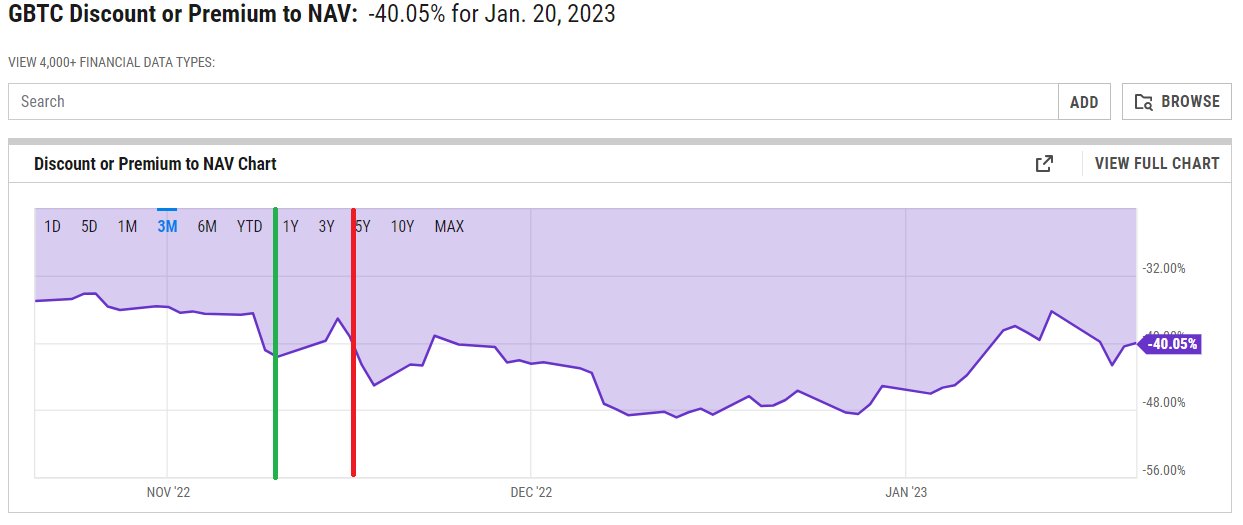
从下图可以看出2022年11月10日和2022年11月16日发生的情况,2022年11月10日是GBTC抵押品返还日期,而2022年11月16日则是Genesis宣布暂停提款以及加密货币交易Gemini开始清算抛售GBTC的日期。Gemini折价抛售GBTC之后,一些私人买家开始在公开市场上做空或出售 GBTC 来对冲风险,结果导致负溢价率进一步扩大。

这次折价出售GBTC给Gemini带来了2.84亿美元的收益,随后Gemini将止赎和出售情况告知了Genesis,但Genesis认为,Gemini止赎和出售GBTC在商业规则上似乎不合理(尽管相关交易是在通知了Genesis的情况下完成的)并且提出了异议(注:实际上,这时候DCG和Genesis已经非常不满了,重组咨询服务公司Alvarez & Marsal North America董事总经理迈克尔·莱托曾透露,Genesis曾指出Gemini对抵押品的止赎操作根本不适用法律规则)。

需要注意的是,此时Genesis依然没有交付承诺返还给Gemini的“第二批”GBTC抵押品,要知道,这些抵押品应该在2022年11月10日就交付给Gemini。

此外,GBTC的控股股东Genesis和Digital Currency Group不能简单地“抛售”其持股以筹集更多资金,因为根据1933年美国证券法第144A条规定,场外交易或场外交易实体的发行方提前通知拟议的销售,而且已发行股票销售上限或每周交易量只能占到股票总量的 1%。根据法规,GBTC持股将被视为“受限证券”。

所以,从Genesis破产文件中披露出的细节信息可以看出,加密货币交易所Gemini未按照双方修订协议选择折价抛售GBTC,或是导致该基金负溢价率不断走高并触及“-50%”历史低点的导火索。

Gemini提前套现,最后反而得不偿失?

后面的故事,想必很多人都已经知道——Gemini交易所联合创始人Cameron Winklevoss和DCG首席执行官Barry Silbert在社交媒体上开撕,紧接着Genesis申请破产……

“有趣”的是,在Genesis破产重组计划中,他们将Gemini及其Earn客户设定为“IV级无担保债权人”,排在Genesis机构债权人、有担保债权人和持有优先债权的债权人这三类债权人之后,这或许是Genesis在表达对Gemini此前所作所为的强烈不满。需要注意的是,债权人等级对于确定每一类债权人可以通过破产程序最终收回多少资金至关重要,而Gemini及其Earn客户作为“四级无担保债权人”,可能意味着即使法院支持Gemini并且判决该交易所有资格获得索赔,他们也不一定能够得到索赔资金,因为这是破产,没人可以确保有足够的钱可以补偿给债权人,更别说是低级别的债权人。

现在,相信大家可以理解为什么“Genesis正式申请破产”消息出来后,Cameron Winklevoss第一时间就在社交媒体发文称会对DCG及其首席执行官Barry Silbert等人采取直接法律行动——“除非DCG能给出一个公平的解决方案,否则Gemini将立即对DCG及其CEO提起诉讼,Gemini也将使用破产法庭可用的所有工具以最大限度地为Earn用户追回损失。”

整体来看,目前很难断定Gemini和Genesis两家公司彼此之间的是非,毕竟从情理来说,Gemini为了保护自身及Earn客户权益折价抛售GBTC也有道理(尽管存在法律异议)。但Genesis申请破产可能让Gemini始料未及,因为对于Gemini及其Earn客户而言,他们不得不面临一个事实:自己已经成为Genesis的最大债权人,但却不是级别最高的债权人。也就是说,Gemini很可能永远无法获得索赔资金,即便可以获得,或许也不得不要等待相当长一段时间。


Похожее

Earning 1000 Trillion in Half a Year, 'Pocketing' 20 Million per Capita: This Round of Wealth Creation in the Korean Stock Market is Unprecedented in Scale

The South Korean stock market is experiencing an unprecedented wealth surge in 2026, with household equity and fund asset values soaring by over 1,000 trillion KRW (~$730bn) year-to-date. This translates to an average per capita wealth increase of roughly 20 million KRW, fueled by a historic 109% rally in the KOSPI index. The boom is driven by three converging forces: an AI-driven semiconductor supercycle boosting giants like Samsung and SK Hynix; the government's "Value-Up" market reforms addressing long-standing corporate governance issues; and aggressive real estate regulations that have locked capital within financial markets, preventing profits from flowing back into property. This has triggered a wealth effect, boosting high-end consumption significantly. However, the gains are highly concentrated. The two semiconductor behemoths account for over half the index's value, but retail investors own relatively low stakes in them, systematically missing the biggest rallies. Wealth and consumption benefits are skewed towards luxury goods and imported cars, bypassing mainstream retail. Further risks stem from excessive leverage, with high trading volume in leveraged ETFs, and a market sentiment heavily reliant on the AI sector's fortunes and speculative rumors. While this cycle marks a potential shift from real estate to equities as a primary wealth generator for Koreans, its sustainability, amid structural imbalances and leverage, remains a critical test.

marsbit3 мин. назад

Earning 1000 Trillion in Half a Year, 'Pocketing' 20 Million per Capita: This Round of Wealth Creation in the Korean Stock Market is Unprecedented in Scale

marsbit3 мин. назад

Behind ZEC's Over 30% Plunge: An 'Unlimited Minting' Vulnerability with No Way to Prove if It Was Ever Exploited

A critical vulnerability was discovered in Zcash's Orchard privacy pool, allowing for the theoretical creation of undetectable counterfeit ZEC. Researcher Taylor Hornby found the flaw on May 29th, 2024, within the Orchard circuit's cryptographic constraints, which could let an attacker bypass asset conservation rules. Although a rapid emergency fix was deployed within days via a coordinated soft and hard fork, a core uncertainty remains: due to Orchard's privacy features, it is impossible to cryptographically prove whether this "unlimited mint" flaw was exploited in the nearly four years since the pool's 2022 launch. This uncertainty, rather than the patched flaw itself, triggered a market panic, causing ZEC's price to drop over 30%. While the Zcash Foundation stated no evidence of exploitation was found, independent entity Shielded Labs emphasized the impossibility of definitively proving no counterfeit ZEC was ever created. The incident highlights the unique trust challenge in privacy systems. To address this, developers are proposing a new network upgrade with enhanced auditing to allow verifiable proof of supply integrity. Notably, the researcher utilized the newly released AI model Claude Opus 4.8 as a tool during the security review, signaling the growing role of advanced AI in uncovering complex cryptographic vulnerabilities.

marsbit5 мин. назад

Behind ZEC's Over 30% Plunge: An 'Unlimited Minting' Vulnerability with No Way to Prove if It Was Ever Exploited

marsbit5 мин. назад

imToken's 10th Anniversary Unveils Strategic Direction for the Next Decade: Evolving from a Trusted Main Wallet to a Personal Digital Hub

On its tenth anniversary, decentralized wallet imToken announced its strategic vision for the next decade: evolving from a "trusted main wallet" into a "personal control interface." This new direction aims to help users manage not only digital assets but also identity, permissions, and AI agent actions in an increasingly open and intelligent internet. imToken outlined that while the past decade focused on Store, Send, and Stake—securing assets, enabling transfers, and facilitating network participation—the future introduces a fourth core proposition: Sign. This expanded concept goes beyond transaction signing to encompass expressing intent, granting permissions, setting rules, delegating actions, and revoking authorizations. As AI agents gain autonomy, imToken emphasizes the need for clear, verifiable, and revocable user control over their actions. CEO Ben He stated that imToken's mission is shifting from enabling ownership of digital assets to ensuring user sovereignty over their entire digital world in the AI era. The company's core principle has been upgraded from "Digital Assets, Under Your Control" to "Your Digital World, Under Your Control." Future development will focus on three areas: upholding self-custody principles, extending security from transactions to authorizations and automated actions, and building product capabilities for managing permissions, delegations, policies, and revocations. imToken views the wallet's role as expanding into a trusted control interface for human-AI collaboration, where managing keys, signatures, and permissions forms the infrastructure for personal digital sovereignty. Founded in 2016, imToken serves millions of users across 150+ countries, providing non-custodial wallet services supporting over 50 blockchain networks.

marsbit6 мин. назад

imToken's 10th Anniversary Unveils Strategic Direction for the Next Decade: Evolving from a Trusted Main Wallet to a Personal Digital Hub

marsbit6 мин. назад

With 300 Million Financing to Accumulate ETH, the Hidden Concerns Behind BitMine's High-Yield Preferred Shares

BitMine, led by Thomas Lee, plans to raise up to $300 million through an initial public offering of 3 million shares of perpetual Series A preferred stock on the NYSE (ticker: BMNP). The stock offers a fixed 9.5% annual dividend. The funds are intended to further the company's accumulation of Ethereum, expand its staking node operations, and for general corporate purposes. This move comes as BitMine faces significant challenges. Its massive Ethereum holdings, over 5.3 million ETH (roughly 4.5% of circulating supply), are currently at an unrealized loss exceeding $8.5 billion due to the crypto market downturn. The company's core business model relies on staking these ETH holdings to generate yield, which it presents as the primary means to cover the new, substantial annual dividend obligation of approximately $28.5 million if the offering is fully subscribed. While the model is similar to MicroStrategy's bitcoin-focused strategy of using capital markets to fund crypto acquisitions, BitMine's product differs with its fixed, non-adjustable dividend rate. The company acknowledges risks, stating dividend payments could also come from cash reserves, asset sales, or future financing, and warns that staking yields may underperform or be illiquid during market stress. The 9.5% fixed rate reflects the higher risk premium demanded from investors for a company heavily exposed to Ethereum's volatility.

Foresight News9 мин. назад

With 300 Million Financing to Accumulate ETH, the Hidden Concerns Behind BitMine's High-Yield Preferred Shares

Foresight News9 мин. назад

A Year of Observing Agent Payments: The Cold Reality Behind the Hot Narrative

A Year in Agent Payments: The Cold Reality Behind a Hot Narrative This article examines the current state of "Agent payments," a year after it became a major trend at the intersection of AI, payments, and crypto. Despite significant investments from major players like Stripe, Visa, and Google, the author—having built products and spoken with merchants and developers—finds genuine, large-scale demand still lacking. Key findings across several hyped scenarios reveal structural challenges: * **Agent-to-Merchant Commerce:** For most product categories (e.g., clothing, electronics), AI shopping via chat is inferior to traditional visual e-commerce. Merchant interest is largely defensive, focused on future-proofing rather than current consumer demand. True potential exists only in specific, high-frequency/low-decision scenarios (like food orders) or for simplifying broken checkout experiences, but these require massive consumer distribution, favoring incumbents. * **Agent-to-API/Machine Commerce:** While stablecoin micropayments are touted for API calls, developers already solve small-value payments via prepaid credits and subscriptions. Large SaaS providers prefer enterprise contracts over fragmented micro-pricing. The market exists for long-tail services outside the top providers but is inherently smaller than the hype suggests. * **Agent-to-Agent Payments:** This remains a theoretical long-term vision with negligible real transaction volume. The core challenges—discovery, trust, negotiation, dispute resolution—are unsolved. While the potential for a new, high-speed settlement layer is real, it is not the current market. * **Agent Finance:** This is the sole area with existing, paying customers (fund managers, DeFi users). AI enhances real-time monitoring and autonomous rebalancing, offering real capability gains. However, competition favors established, regulated institutions with existing licenses and client relationships. The author concludes that the core deficiency in the Agent economy is not merely a payment layer, but a more complex **coordination** capability—figuring out how Agents and humans work together, verify task completion, and settle outcomes. Payment is just one component of settlement, which is itself part of coordination. For large companies, investing now is a defensive, long-term bet with minimal cost. For startups, however, the imperative is to find markets that exist today, not wait for a future wave that remains on the horizon.

marsbit11 мин. назад

A Year of Observing Agent Payments: The Cold Reality Behind the Hot Narrative

marsbit11 мин. назад

Торговля

Спот
Фьючерсы

Популярные статьи

Manyu: восходящая мем-звезда на Ethereum, готовая открыть новую эру культуры Shiba

Manyu - это мемтокен на Ethereum, который приносит децентрализованную культурную и развлекательную ценность через вирусное влияние в соцсетях и вовлечённость сообщества.

1.9k просмотров всегоОпубликовано 2025.11.27Обновлено 2025.11.27

Manyu: восходящая мем-звезда на Ethereum, готовая открыть новую эру культуры Shiba

Неделя обучения по популярным токенам 14: Glamsterdam — самое ожидаемое обновление Ethereum в 2026 году

Ordinals/Runes по-прежнему стимулируют доходы от комиссий за блоки и активность разработчиков, рассматриваются как отправная точка «нативной эмиссии активов» в сети.

1.5k просмотров всегоОпубликовано 2026.04.29Обновлено 2026.04.29

Неделя обучения по популярным токенам 14: Glamsterdam — самое ожидаемое обновление Ethereum в 2026 году

Обсуждения

Добро пожаловать в Сообщество HTX. Здесь вы сможете быть в курсе последних новостей о развитии платформы и получить доступ к профессиональной аналитической информации о рынке. Мнения пользователей о цене на ETH (ETH) представлены ниже.

活动图片