50% Of All Bitcoin In Circulation Are Now Sitting On Major Losses, Is This A Bottom Signal?

bitcoinistОпубликовано 2026-06-09Обновлено 2026-06-09

Введение

Bitcoin is potentially flashing a key contrarian signal as over 10.46 million BTC, roughly half of its circulating supply, is now held at a loss. This metric, highlighted by analyst Ali Martinez using Glassnode data, has historically coincided with major market turning points. The significant increase in underwater supply, alongside Bitcoin's price decline of over 40% from its highs to around $63,242, suggests heightened investor stress. Martinez notes that such elevated loss holdings can reduce selling pressure as holders are less incentivized to realize losses. Supporting this, the Net Unrealized Profit/Loss (NUPL) indicator has entered the "Hope-Fear" zone, reflecting shaken confidence. While a definitive bottom is unconfirmed, the scale of unrealized losses places Bitcoin in a historical accumulation zone, raising debate on whether the current decline is nearing its end.

Bitcoin may be flashing one of its most closely watched contrarian signals. With more than 10 million BTC now held below their acquisition cost, a growing portion of the market is underwater. According to recent on-chain observations highlighted by analyst Ali Martinez, this development places Bitcoin in a zone that has historically coincided with major market turning points, raising fresh debate over whether the latest decline is nearing a bottom.

Bitcoin’s Underwater Supply Reaches A Historic Threshold

The latest data points to a remarkable shift in market positioning. According to Glassnode, BTC’s Total Supply in Loss metric shows that approximately 10.46 million BTC are currently being held at a loss. Given Bitcoin’s circulating supply of just under 21 million coins, that figure represents roughly half of all coins in existence.
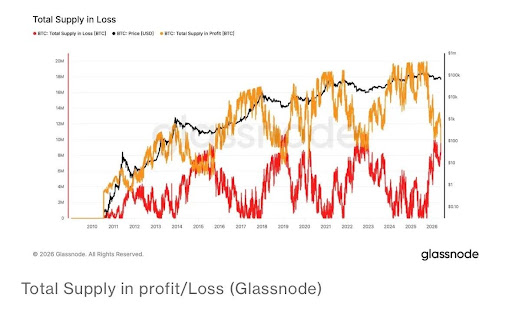
Source: Glassnode

The significance of this threshold becomes clearer when viewed against Bitcoin’s historical market cycles. Previous major bottoms have frequently developed when the amount of BTC held at a loss climbed beyond 10 million coins. Similar conditions emerged during some of the market’s deepest corrections, many of which later gave way to prolonged recoveries.

The latest on-chain data also highlights the shifting balance between profitable and unprofitable holdings. As Bitcoin’s price retreated from its highs, the number of coins held in profit contracted while the amount of supply sitting at a loss expanded considerably. By June 2026, the latter had risen to roughly 10.46 million BTC, pushing the market into a zone that has historically been associated with severe downturns and heightened investor stress.

At the same time, Bitcoin’s price has fallen substantially from its cycle highs. Recent market data shows BTC trading around $63,242, with losses extending across multiple timeframes, including a decline of more than 40% over the previous year. Those figures help explain why such a large share of the network has slipped into unrealized losses.

Bottom Signal Or Just Another Stage Of A Correction?

This is where the discussion becomes particularly interesting. Martinez argues that elevated loss holdings can reduce the intensity of selling activity. When large numbers of investors are already deeply underwater, the incentive to liquidate positions often diminishes. Rather than locking in losses, many holders choose to wait, causing selling pressure to gradually weaken.

Recent Glassnode data appears to support the idea that sentiment has deteriorated significantly. Bitcoin’s Net Unrealized Profit/Loss (NUPL) indicator has fallen into the “Hope–Fear” zone after spending much of the previous year in more optimistic territory. Historically, these lower NUPL ranges have reflected periods when confidence has been shaken, but widespread capitulation has not necessarily intensified further.
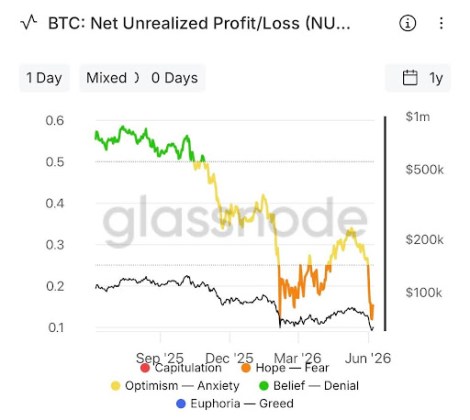
The combination of more than 10 million BTC in loss, weak sentiment, and a steep decline from previous highs has historically appeared near major market bottoms. While a definitive bottom remains unconfirmed, the scale of unrealized losses across the network indicates that Bitcoin is once again trading in a zone often associated with accumulation and recovery.

BTC bears push price down | Source: BTCUSD on Tradingview.com

Связанные с этим вопросы

QWhat is the key metric indicating that 50% of all Bitcoin in circulation are currently held at a loss?

AThe key metric is the 'Total Supply in Loss' from Glassnode, which shows approximately 10.46 million BTC are currently being held at a loss.

QAccording to the article, what has historically happened when the amount of BTC held at a loss surpasses 10 million coins?

AHistorically, when the amount of BTC held at a loss surpasses 10 million coins, it has frequently coincided with major market bottoms and deep corrections that later gave way to prolonged recoveries.

QWhat is the current price of Bitcoin mentioned in the article, and what is its approximate decline over the previous year?

AThe current price of Bitcoin mentioned is around $63,242, with a decline of more than 40% over the previous year.

QAccording to analyst Ali Martinez, why can elevated loss holdings potentially lead to a reduction in selling pressure?

AAli Martinez argues that when many investors are already deeply underwater, the incentive to liquidate positions often diminishes. Many holders choose to wait instead of locking in losses, which causes selling pressure to gradually weaken.

QWhat does the article suggest about Bitcoin's Net Unrealized Profit/Loss (NUPL) indicator's current position?

AThe article states that Bitcoin's Net Unrealized Profit/Loss (NUPL) indicator has fallen into the 'Hope–Fear' zone, reflecting a period where confidence has been shaken.

Похожее

The World Cup is Here: The Battle for Entry into Prediction Markets Has Begun

The 2026 FIFA World Cup has begun, and alongside the on-field competition, a new off-field battleground is emerging: prediction markets. These blockchain-based platforms, which convert crowd wisdom into tradable probabilities, are gaining significant traction. However, their complexity—involving wallets, gas fees, and smart contracts—has historically limited participation to crypto-native users. Centralized exchanges (CEXs), like Gate, are tackling this adoption barrier. By integrating with leading prediction market protocol Polymarket, Gate simplifies the user experience. Users can participate directly with their exchange account and USDT, bypassing complex Web3 steps. Gate offers a streamlined "Prediction Mode" for casual users and a professional "Trading Mode" with advanced tools. Key features include two-way trading (allowing users to buy or sell positions before event resolution), support for diverse markets (sports, crypto, macroeconomics), and a suite of information tools like a "Smart Money" leaderboard, wallet tracking, and AI-powered insights. For the World Cup, Gate launched a dedicated hub aggregating schedules, standings, and relevant markets. This allows fans to seamlessly follow games and trade on outcomes, transforming passive viewing into active participation where they can monetize their predictions and trade on shifting consensus throughout a match. The article argues that prediction markets have proven their value in event forecasting. The next challenge is mass adoption. The competition is shifting from building effective protocols to creating accessible user entry points. By lowering technical barriers and building a complete ecosystem for information and trading, platforms like Gate aim to transition prediction markets from a niche crypto tool to a mainstream platform for expressing and trading on collective intelligence.

Odaily星球日报7 мин. назад

The World Cup is Here: The Battle for Entry into Prediction Markets Has Begun

Odaily星球日报7 мин. назад

Spain Held to a Draw by Cape Verde, Jucom Prediction Market Witnesses Historic Upset

In a major upset at the 2026 FIFA World Cup, tournament favorites Spain were held to a surprising 0-0 draw by debutants Cape Verde in their Group H opener on June 16, Beijing time. Despite dominating possession (74%) and recording 27 shots with an expected goals figure of 2.16, Spain failed to break down a resilient Cape Verde defense, with their 40-year-old goalkeeper Vozinha making 7 saves to earn Man of the Match. Pre-match predictions on the Jucom prediction market had heavily favored Spain, assigning them a 92% win probability. The actual result, a goalless draw, triggered significant volatility across related prediction markets. This outcome forces a market-wide reassessment of several key probabilities, including Spain's likelihood of winning the group and the tournament itself, while Cape Verde's previously near-zero chance of advancing is now being re-evaluated. The event highlights both the efficiency and the inherent limitations of prediction markets. While prices aggregate known information, football's low-scoring, high-variance nature means unquantifiable in-game factors can lead to unlikely results. The core value of such markets lies not in perfect foresight but in their ability to dynamically reflect how new information is incorporated into collective expectations. Platforms like Jucom, which track outcomes from single matches to the final champion, provide a real-time lens into how global consensus evolves with each game.

链捕手11 мин. назад

Spain Held to a Draw by Cape Verde, Jucom Prediction Market Witnesses Historic Upset

链捕手11 мин. назад

Standard Chartered Bank Places a 40x 'Bet', Calls for UNI to Rise to $100

Standard Chartered Bank’s digital asset research head, Geoff Kendrick, initiated coverage on Uniswap with a highly bullish long-term price target of $100 for its UNI token by 2030—a roughly 40-fold increase from its ~$2.60 trading price at the time of the report. The bank’s thesis hinges on the exponential growth of tokenized real-world assets (RWA), projected to surge from ~$340 billion to $4 trillion by 2028. It expects the share of these assets deployed in DeFi to rise from 3.5% to 30%, driving total DeFi TVL to around $2.7 trillion. As the leading decentralized exchange (DEX), Uniswap is positioned to capture a significant portion of this liquidity influx. A key catalyst is Uniswap’s “fee switch,” activated in late 2024, which directs a portion of protocol fees to UNI token buybacks and burns. This transforms UNI from a pure governance token into a yield-generating, deflationary asset, narrowing its valuation gap with centralized exchanges like Coinbase. The report draws an analogy: Coinbase operates like Netflix (centralized, high-cost), while Uniswap functions like YouTube (open, user-generated, network-effect driven). Despite its dominant market share and recent institutional adoption—such as BlackRock’s BUIDL fund and Fidelity’s stablecoin using Uniswap for liquidity—the path faces challenges. Competition from Solana-based DEXs and aggregators threatens user mindshare, while regulatory delays or setbacks in RWA adoption could slow the projected growth. Furthermore, UNI remains down over 92% from its 2021 peak, reflecting persistent market skepticism. Ultimately, Standard Chartered’s report signals a shift in traditional finance’s perception of DeFi, valuing network effects and cash flow potential. However, realizing the $100 target depends on Uniswap successfully navigating intense competition, regulatory hurdles, and the multi-year timeline for massive tokenized asset adoption.

marsbit35 мин. назад

Standard Chartered Bank Places a 40x 'Bet', Calls for UNI to Rise to $100

marsbit35 мин. назад

Торговля

Спот
Фьючерсы

Популярные статьи

Тест по Bitcoin Биткоина

HTX Learn: Изучите Bitcoin halving и Заработаете Токены USDT

3.1k просмотров всегоОпубликовано 2024.04.16Обновлено 2024.04.16

Тест по Bitcoin  Биткоина

Что такое $BITCOIN

ЦИФРОВОЕ ЗОЛОТО ($BITCOIN): Комплексный анализ Введение в ЦИФРОВОЕ ЗОЛОТО ($BITCOIN) ЦИФРОВОЕ ЗОЛОТО ($BITCOIN) — это проект на основе блокчейна, работающий в сети Solana, который стремится объединить характеристики традиционных драгоценных металлов с инновациями децентрализованных технологий. Хотя он носит имя Биткойн, часто называемого “цифровым золотом” из-за его восприятия как средства хранения ценности, ЦИФРОВОЕ ЗОЛОТО является отдельным токеном, предназначенным для создания уникальной экосистемы в ландшафте Web3. Его цель — позиционировать себя как жизнеспособный альтернативный цифровой актив, хотя детали его применения и функциональности все еще развиваются. Что такое ЦИФРОВОЕ ЗОЛОТО ($BITCOIN)? ЦИФРОВОЕ ЗОЛОТО ($BITCOIN) — это токен криптовалюты, специально разработанный для использования в блокчейне Solana. В отличие от Биткойна, который выполняет широко признанную роль хранения ценности, этот токен, похоже, сосредоточен на более широких приложениях и характеристиках. Примечательные аспекты включают: Инфраструктура блокчейна: Токен построен на блокчейне Solana, известном своей способностью обрабатывать высокоскоростные и недорогие транзакции. Динамика предложения: ЦИФРОВОЕ ЗОЛОТО имеет максимальное предложение, ограниченное 100 квадриллионами токенов (100P $BITCOIN), хотя детали о его обращающемся предложении в настоящее время не раскрыты. Утилита: Хотя точные функциональные возможности не описаны, есть указания на то, что токен может быть использован для различных приложений, потенциально связанных с децентрализованными приложениями (dApps) или стратегиями токенизации активов. Кто создатель ЦИФРОВОГО ЗОЛОТА ($BITCOIN)? На данный момент личность создателей и команды разработчиков, стоящих за ЦИФРОВЫМ ЗОЛОТОМ ($BITCOIN), остается неизвестной. Эта ситуация типична для многих инновационных проектов в области блокчейна, особенно тех, которые связаны с децентрализованными финансами и феноменом мем-криптовалют. Хотя такая анонимность может способствовать культуре, ориентированной на сообщество, она усиливает опасения по поводу управления и ответственности. Кто инвесторы ЦИФРОВОГО ЗОЛОТА ($BITCOIN)? Доступная информация указывает на то, что у ЦИФРОВОГО ЗОЛОТА ($BITCOIN) нет известных институциональных спонсоров или значительных венчурных капиталовложений. Проект, похоже, функционирует по модели пирингового взаимодействия, сосредоточенной на поддержке и принятии сообществом, а не на традиционных путях финансирования. Его активность и ликвидность в основном сосредоточены на децентрализованных биржах (DEX), таких как PumpSwap, а не на устоявшихся централизованных торговых платформах, что еще больше подчеркивает его подход, ориентированный на grassroots. Как работает ЦИФРОВОЕ ЗОЛОТО ($BITCOIN) Операционные механизмы ЦИФРОВОГО ЗОЛОТА ($BITCOIN) можно подробно описать на основе его дизайна блокчейна и характеристик сети: Механизм консенсуса: Используя уникальный механизм доказательства истории (PoH) Solana в сочетании с моделью доказательства доли (PoS), проект обеспечивает эффективную валидацию транзакций, что способствует высокой производительности сети. Токеномика: Хотя конкретные дефляционные механизмы не были подробно описаны, большое максимальное предложение токенов подразумевает, что оно может быть предназначено для микротранзакций или нишевых случаев использования, которые еще предстоит определить. Интероперабельность: Существует потенциал для интеграции с более широкой экосистемой Solana, включая различные платформы децентрализованных финансов (DeFi). Однако детали относительно конкретных интеграций остаются неуточненными. Хронология ключевых событий Вот хронология, которая подчеркивает значимые вехи, касающиеся ЦИФРОВОГО ЗОЛОТА ($BITCOIN): 2023: Первоначальное развертывание токена происходит в блокчейне Solana, отмеченное его адресом контракта. 2024: ЦИФРОВОЕ ЗОЛОТО приобретает видимость, когда оно становится доступным для торговли на децентрализованных биржах, таких как PumpSwap, позволяя пользователям обменивать его на SOL. 2025: Проект наблюдает спорадическую торговую активность и потенциальный интерес к инициативам, возглавляемым сообществом, хотя на данный момент не зафиксировано никаких значительных партнерств или технических достижений. Критический анализ Сильные стороны Масштабируемость: Основная инфраструктура Solana поддерживает высокие объемы транзакций, что может повысить полезность $BITCOIN в различных сценариях транзакций. Доступность: Потенциально низкая цена торговли за токен может привлечь розничных инвесторов, способствуя более широкому участию благодаря возможностям дробного владения. Риски Отсутствие прозрачности: Отсутствие публично известных спонсоров, разработчиков или процесса аудита может вызвать скептицизм относительно устойчивости и надежности проекта. Волатильность рынка: Торговая активность сильно зависит от спекулятивного поведения, что может привести к значительной волатильности цен и неопределенности для инвесторов. Заключение ЦИФРОВОЕ ЗОЛОТО ($BITCOIN) является интригующим, но неоднозначным проектом в быстро развивающейся экосистеме Solana. Хотя он пытается использовать нарратив “цифрового золота”, его отход от установленной роли Биткойна как средства хранения ценности подчеркивает необходимость более четкого различения его предполагаемой утилиты и структуры управления. Будущее принятие и усвоение, вероятно, будут зависеть от решения текущей непрозрачности и более четкого определения его операционных и экономических стратегий. Примечание: Этот отчет охватывает синтезированную информацию, доступную на октябрь 2023 года, и с тех пор могут произойти события.

102 просмотров всегоОпубликовано 2025.05.13Обновлено 2025.05.13

Что такое $BITCOIN

Fractal Bitcoin: масштабирование Биткоина с помощью рекурсивной системы

Fractal Bitcoin — масштабное Layer-1-решнение, созданное на базе кода Биткоина, позволяющего достигать бесконечного масштабирования с помощью рекурсивного подхода.

2.3k просмотров всегоОпубликовано 2025.06.30Обновлено 2025.06.30

Fractal Bitcoin: масштабирование Биткоина с помощью рекурсивной системы

Обсуждения

Добро пожаловать в Сообщество HTX. Здесь вы сможете быть в курсе последних новостей о развитии платформы и получить доступ к профессиональной аналитической информации о рынке. Мнения пользователей о цене на BTC (BTC) представлены ниже.

活动图片