After the Lending Markets Disappear, What's Left for These Public Chains?

marsbitОпубликовано 2026-08-06Обновлено 2026-08-06

Введение

"The Lending Market Vanishes: What Remains for These Blockchains?" Last week, Aave announced the closure of its lending markets on six blockchains where each generated less than $5,000 in quarterly revenue. This move highlights a critical trend: while the DeFi lending sector is growing overall, it is becoming highly concentrated on a few leading chains like Ethereum, Base, and Arbitrum. The article analyzes the cascading effects when a major lending protocol like Aave exits a chain. Past examples, such as Harmony Protocol and Fantom (later rebranded as Sonic), demonstrate that losing core lending infrastructure leads to a complete collapse of the credit ecosystem. This is because a functional lending market relies on a costly, interconnected stack of services—including reliable price oracles (often maintained by the largest protocol), deep DEX liquidity for liquidations, and stablecoin issuers willing to support native minting and redemption. Once the primary lending demand disappears, maintaining this infrastructure becomes commercially unviable, triggering an exodus of other service providers. The six chains Aave is leaving (including Soneium, Aptos, zkSync, and Scroll) are in an even weaker position than Harmony or Fantom were. They never developed substantial native lending demand despite significant initial funding. Aave's departure will likely accelerate the withdrawal of oracle providers, market makers, and stablecoin issuers, as their business cases depend on a fun...

Original Author: Vaidik Mandloi

Original Compilation: Chopper, Foresight News

Last week, Aave announced it would shut down lending markets on six blockchains. Each of these six chains individually generated less than $5,000 in quarterly revenue. Based on Aave's typical fee of 13 cents per dollar of interest, the revenue from its deployments on Mentis and Aptos would barely cover a meal. In contrast, Aave's deployment on Ethereum generated $142 million in revenue last year; meanwhile, it expanded to new chains like Linea, and the V4 version surpassed $300 million in deposits within months.

This article will delve into what will happen to these public chains after Aave's departure, and whether any projects will take its place. If no one steps in, these chains may permanently lose their credit function.

The Domino Effect of Collapse

What exactly happens when a leading lending protocol leaves a public chain? Let's review past cases.

The first case is Harmony Protocol. In June 2022, its core cross-chain bridge, Horizon, was hacked, resulting in a loss of approximately $100 million. As the largest lending protocol on the chain, Aave froze all reserve assets on the chain. Later that year, the community proposed a rescue plan, but it was rejected by 99% of Aave token holders. Today, this public chain is dead, primarily due to the complete loss of lending liquidity.

You might wonder: Why not just fork Aave and redeploy it on Harmony? After all, the code is open source, and deploying a lending protocol takes less than a day. That's true, but what's easily overlooked is: a lending market also requires continuous operation, capital-backed oracles to price collateral assets; it requires sufficient DEX liquidity to ensure that when a borrower is liquidated, the collateral can be automatically sold without causing more than 40% price slippage.

It also needs stablecoin issuers to recognize the chain and support native on-chain redemption. That means issuers like Circle and Tether can natively issue tokens on the chain, allowing users to directly redeem USDC for fiat without cross-chain transfers. After Harmony's cross-chain bridge became paralyzed, all stablecoins on the chain depegged, oracle feeds failed, and the liquidation mechanism completely ceased to function. The entire suite of components supporting the lending market collectively failed. After that, no party had the commercial incentive to rebuild this system. On a public chain with no lending demand, who would be willing to pay to maintain oracle price feeds?

Another typical case is Fantom, which also suffered a cross-chain bridge hack in 2023. Prior to that, 78% of the chain's market cap depended on that bridge. After the attack, the price of bridged USDC on Fantom plummeted to about $0.22, causing the value of a large amount of collateral to shrink and become insolvent.

The most thought-provoking point is: Fantom was once the third-largest DeFi public chain in the crypto industry, with real users and lending demand. Even with this foundation, it still failed to rebuild its credit market. For a chain losing users, the cost of rebuilding the entire underlying infrastructure—including oracles and stablecoins—always exceeds the potential revenue, as the core user base has already left.

Later, Fantom attempted a rebranded restart as Sonic, trying to rely solely on capital to turn the situation around. The project conducted a $190 million token airdrop. On the first day of launch, Aave, Silo, and Euler were all deployed, with Wintermute providing market-making support. However, the results backfired, as the project suffered a sybil attack. Depositors and borrowers were largely the same group of users: depositing assets to farm airdrop points, then using the same assets as collateral to borrow, maximizing point gains. The TVL was inflated, with the same capital being double-counted repeatedly through leverage loops.

Lending demand came entirely from airdrop incentives, not from genuine on-chain economic activity requiring working capital or leverage. For example, Ethereum users might borrow to leverage stake stETH or to fund trading strategies; such demand exists regardless of whether the protocol offers rewards. But on Sonic, once the incentives were removed, no real lending demand existed. This directly led to, after Wintermute's partnership expired, the on-chain TVL plummeting by 98%, the token price dropping to less than 1 cent, and both founders resigning from the board. Subsidies and market-making partnerships can create the appearance of a credit market, but cannot sustain its long-term operation.
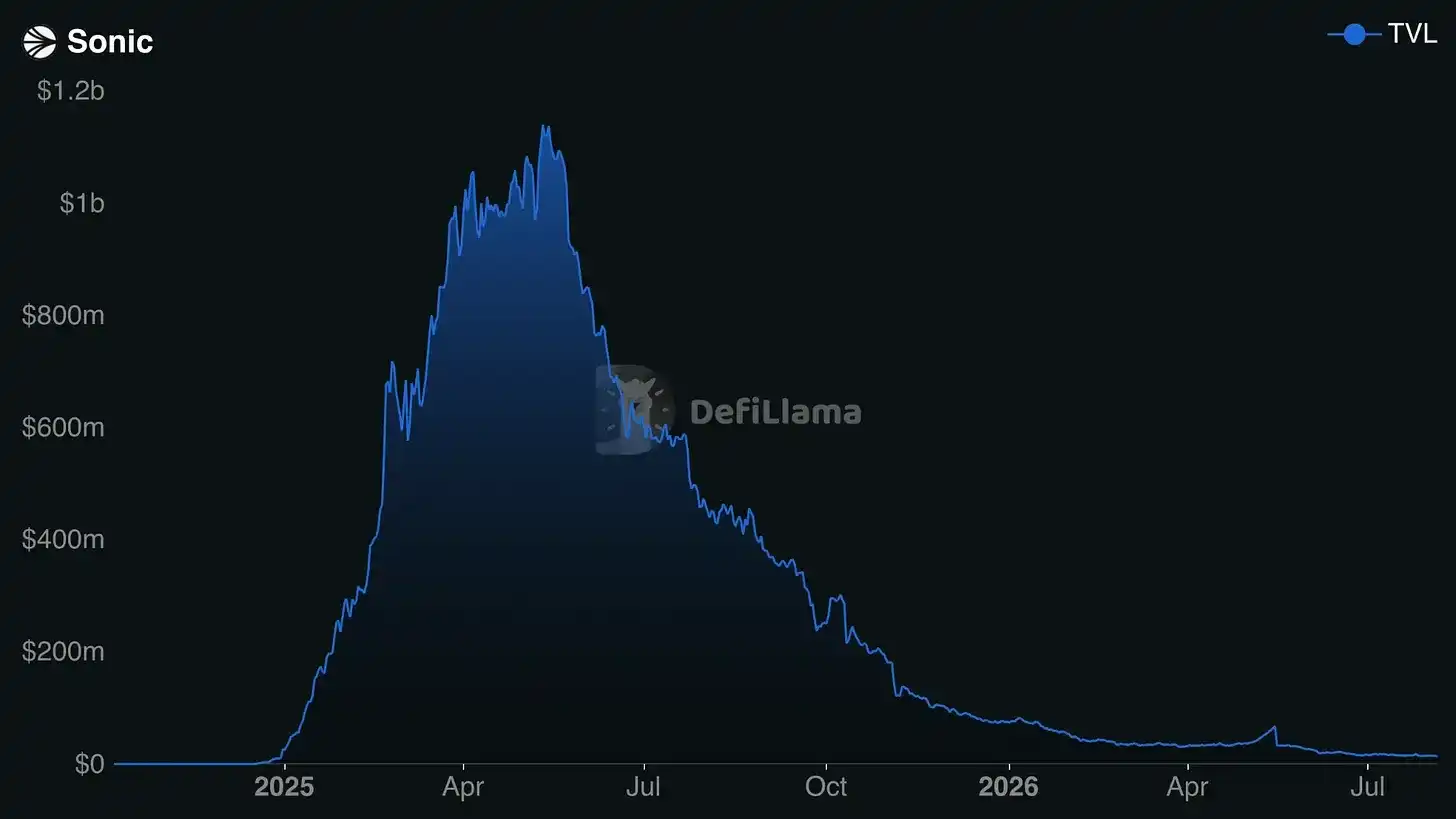
Data Source: DeFiLlama

Now, looking at the public chains from which Aave is about to withdraw—Soneium, Aptos, Zksync, Scroll, etc.—their situation is even worse than Harmony and Fantom. On-chain deposits have already plunged by 95%, and lending business quarterly revenue is less than $5,000.

At least before the hacks, Harmony and Fantom had genuine native lending demand generated by real users. But these six public chains never developed native business demand from the start. These chains raised an average of $250 million each and deployed one of the most cost-efficient lending protocols in DeFi, yet still failed to catalyze real demand.
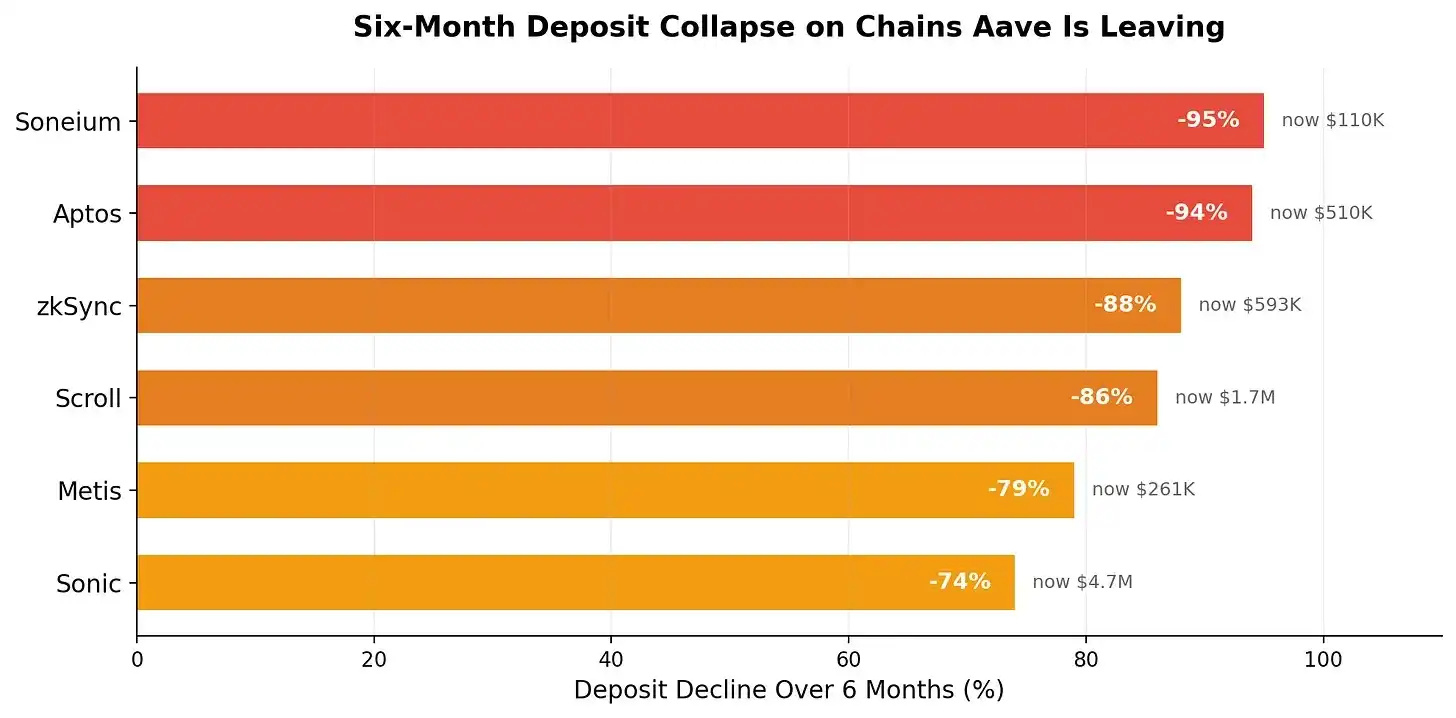
Data Source: Aave Governance Page

Aave's exit will also trigger a chain reaction. Many people don't realize that Aave is the core pillar of the financial infrastructure on these public chains. Almost all Chainlink oracle price feeds on these chains are maintained at Aave's cost, as Aave is the largest caller. After Aave leaves, all oracle service providers will reassess whether it's worth maintaining feeds for a public chain without an active lending market. Market makers will also stop allocating capital to DEXs on these chains for the same reason. Even stablecoin issuers won't provide native issuance support for chains with monthly revenue under a thousand dollars. The departure of one service provider accelerates the next provider's exit. The commercial viability of all these service providers is built on the premise that other supporting services are functioning normally.

Resources will increasingly concentrate towards public chains that are operating well, have ample liquidity, and where lending markets function normally. Every infrastructure withdrawal from a niche public chain further strengthens the aggregation effect of leading chains, making the business case for remaining niche chains to maintain their own lending infrastructure even weaker.

This centralization is self-reinforcing. Lending is the foundation of a public chain's entire financial system. Without lending, most yield strategies cannot operate, as many strategies require borrowing one type of asset by collateralizing another; efficient liquidity market-making also becomes impossible, as concentrated liquidity positions often rely on borrowed funds. Once lending disappears, all financial applications built on top of it lose their foundation. Subsequently, developers gradually leave, on-chain activity further declines, and even fewer infrastructure service providers are willing to stay.

This is precisely why Aave has set thresholds for future deployments on new chains: a minimum annual revenue of $2 million. This amount essentially covers the cost of maintaining the entire lending infrastructure—oracle feeds, risk monitoring, and liquidation—for a single public chain. This also fully illustrates that the past model of public chains raising hundreds of millions and quickly onboarding liquidity through subsidies is no longer viable or sustainable.

A Dilemma Not Unique to the Crypto Industry

The loss of credit infrastructure on public chains is not a phenomenon unique to the crypto space. Any industry with high fixed costs but a small market size faces similar issues.

After 2008, global banks began cutting correspondent banking relationships with some smaller countries. The logic is highly similar to Aave's: anti-money laundering monitoring, regulatory reporting—each relationship established incurs fixed costs, and the revenue from some small-scale cross-border businesses cannot cover these costs. Between 2011 and 2022, the number of active global correspondent banking relationships decreased by 30%. Dollar clearing channels for Pacific island nations shrunk by over 60%, with some countries left with only one correspondent bank. The situation became so severe that the World Bank had to allocate $69 million in subsidies to keep the last clearing service providers operating in eight Pacific nations.
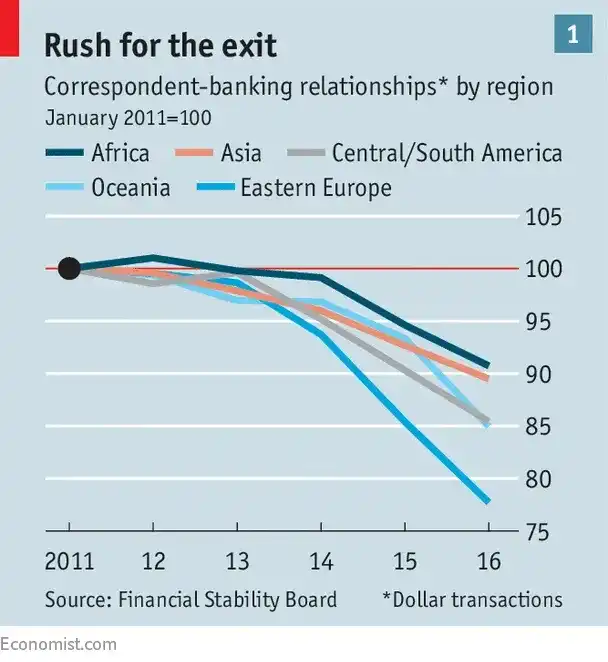
There is a crucial difference between the crypto industry and traditional cases. In the traditional correspondent banking system, entities like the World Bank step in as a backstop, with central banks and development agencies providing subsidies to sustain operations. But the crypto industry almost entirely lacks such a backstop mechanism, which is precisely the reality these public chains are experiencing. A medium-sized bank spends $15–40 million annually on compliance costs alone; the World Bank's $68 million investment merely preserved the last dollar clearing channel for 8 countries. Meanwhile, the total cost for Aave's risk monitoring contracts across all public chains is only $5–8 million, and these six chains can't even afford their share of that cost.

Of course, this doesn't mean DeFi lending as a whole is shrinking; quite the opposite: the industry is growing rapidly, but also highly concentrated. Morpho's TVL grew from $105 million to over $8 billion within a year; Euler expanded from $6 million to $300 million in just a few months. Aave's V4 surpassed $300 million in deposits within months of launch, and Société Générale became the first traditional bank to integrate with a DeFi lending protocol. The credit market is vibrant, but resources are concentrated on Ethereum and two or three layer-2 networks like Base and Arbitrum, rather than being dispersed across dozens of public chains.

The proliferation of many public chains was based on the assumption that deploying infrastructure costs very little, and each chain could build its own financial system. This assumption is only half right. Launching a public chain is indeed cheap, but operating a credit infrastructure on it is extremely costly. Looking at the current layer-2 landscape, Ethereum and the top three public chains command 90% of the TVL. The remaining chains can only compete for meager shares, and this revenue might not even cover the cost of a single set of Chainlink price feeds. In the future, these chains might see a forked version of Aave with flawed oracles, or perhaps nothing at all will remain.


Трендовые криптовалюты

Связанные с этим вопросы

QWhy did Aave decide to close its lending markets on six blockchains?

AAave decided to close its lending markets on six blockchains because each of these chains individually generated less than $5,000 in quarterly revenue. For instance, their revenue from Mentis and Aptos was minimal, roughly equivalent to the cost of a meal. In contrast, the deployment on Ethereum generated $142 million in revenue last year.

QWhat are the key components required for a functioning lending market on a blockchain, according to the article?

AAccording to the article, a functioning lending market requires: 1) Continuous operation and well-funded oracles to price collateral assets. 2) Sufficient DEX liquidity to ensure liquidations can occur without causing high price slippage (e.g., over 40%). 3) Recognition from stablecoin issuers (like Circle, Tether) for native issuance and redemption on the chain, allowing users to cash out without cross-chain bridges.

QWhat happened to Fantom (later Sonic) after its cross-chain bridge was hacked, and what did its attempted revival reveal?

AAfter Fantom's cross-chain bridge hack, its bridged USDC depegged to around $0.22, causing collateral values to plummet and loans to become undercollateralized. Its later attempt to revive as Sonic with a $190M airdrop attracted 'sybil attacks,' where users deposited and borrowed the same assets to farm points. The TVL was inflated, and once the airdrop incentives and market-making partnerships (e.g., with Wintermute) ended, the TVL crashed by 98%, showing that the lending demand was artificial and not based on real economic activity.

QWhat 'cascade effect' might occur after Aave's withdrawal from these blockchains?

AAave's withdrawal could trigger a cascade effect where other infrastructure providers also leave. As the primary user, Aave bore the costs for most Chainlink oracle price feeds on these chains. Without an active lending market, oracles, market makers (for DEX liquidity), and stablecoin issuers have little commercial incentive to maintain their services. The exit of one provider accelerates the exit of others, leading to a complete collapse of the financial ecosystem on those chains, as all these services depend on each other to be viable.

QHow does the article compare the situation in crypto to a similar problem in the traditional financial world?

AThe article compares it to the decline of correspondent banking relationships after 2008. Major banks cut ties with smaller nations because the fixed costs of compliance (anti-money laundering monitoring, regulatory reporting) exceeded the revenue from low-volume cross-border transactions. From 2011 to 2022, such relationships fell by 30%. A key difference is that in traditional finance, institutions like the World Bank can provide subsidies (e.g., $69M to maintain services for 8 Pacific nations), whereas such a backstop mechanism is almost non-existent in the crypto industry.

Похожее

Аналитический отчет Citigroup: предлагаемый запрет США на китайские оптические модули не имеет существенного прогресса, краткосрочное исполнение сталкивается с узкими местами в поставках

Аналитики Citigroup изучили слухи о возможном запрете США на китайские оптические модули и пришли к выводу, что в краткосрочной перспективе такие меры маловероятны. Как следует из их отчета от 9 августа, несмотря на сообщения Reuters от 4 августа, оптические модули не включены ни в один из действующих запретительных списков FCC (Комиссии по связи США). В постановлении FCC 26-50 установлены два механизма ограничений: по производителю (например, Huawei, ZTE) и по стране происхождения (для определенных категорий товаров). Оптические модули в этих списках отсутствуют. Единственное упоминание о них содержится в разделе о требованиях к раскрытию информации, а не в запретительной части. По оценкам Citigroup, китайские поставщики обеспечивают 60-70% высокоскоростных оптических модулей для американских гиперскейлеров. Запрет немедленно нанесет удар по инфраструктуре ИИ в США, что противоречит заявленным целям правительства. Американские компании наращивают местное производство, но для выхода на полную мощность потребуется время. Аналитики рассматривают три возможных сценария регулирования, отмечая, что ограничения по стране происхождения более вероятны, чем по производителю, но их реализация в ближайшее время маловероятна. Вопрос может быть включен в повестку американо-китайских переговоров как инструмент торга. Среди китайских компаний наибольшему потенциальному риску подвержены XinYiSheng и Dongshan Precision из-за их значительной экспозиции на рынке США. Tianfu Communication, как поставщик пассивных компонентов, находится в более защищенном положении. Вывод Citigroup: обсуждения запрета будут продолжаться, но быстрое введение мер маловероятно из-за отсутствия у США достаточных мощностей для замещения китайских поставок. Ключевыми факторами для наблюдения являются темпы наращивания производства в США и место вопроса об оптических модулях в дипломатической повестке.

marsbit18 мин. назад

Аналитический отчет Citigroup: предлагаемый запрет США на китайские оптические модули не имеет существенного прогресса, краткосрочное исполнение сталкивается с узкими местами в поставках

marsbit18 мин. назад

Материнская компания Truth Social понесла квартальный убыток в 238 млн долларов: 190 млн убытка пришлись на криптоактивы, компания объявила об ужесточении стратегии управления казной

Корпорация Trump Media & Technology Group (DJT), владелец Truth Social, сообщила о чистом убытке в размере 238,1 млн долларов во втором квартале 2026 года. Основная часть убытка (190,4 млн долларов) связана с нереализованными потерями от цифровых активов, в основном биткойнов. При этом выручка компании составила лишь 1,7 млн долларов. Несмотря на убытки, в июле компания увеличила свои запасы биткойнов, доведя их до примерно 14 139 BTC (на сумму около 890,5 млн долларов на конец июля), продав связанные с биткойном ценные бумаги. Биткойн теперь составляет почти половину её финансовых активов. Компания объявила о введении «более дисциплинированной системы управления» своим крипто-казначейством, чтобы снизить волатильность. Она также заявляет о намерении уделять больше внимания основному медиа-бизнесу, включая новый продукт Truth API, который уже приносит доход. Ожидается, что в четвертом квартале 2026 года Trump Media завершит слияние с компанией в области термоядерного синтеза TAE Technologies. Ключевыми моментами для наблюдения остаются конкретные изменения в управлении крипто-активами, рост выручки от основной деятельности и влияние биткойн-портфеля на оценку акций компании.

marsbit26 мин. назад

Материнская компания Truth Social понесла квартальный убыток в 238 млн долларов: 190 млн убытка пришлись на криптоактивы, компания объявила об ужесточении стратегии управления казной

marsbit26 мин. назад

Ведущий аналитик утверждает, что биткоин находится на критически важном этапе: «Мы на дне медвежьего рынка, что будет дальше…»

Ведущий аналитик Бенджамин Коуэн заявил, что биткоин, торгующийся в районе $64 000-$65 000, находится на критическом переломном этапе, напоминающем окончание прошлых медвежьих рынков (2018 и 2022 гг.). Он отмечает резкий спад общественного интереса, низкую волатильность и недоверие инвесторов. Исторически дно формируется летом, за которым следует затишье, а основное движение ожидается в последнем квартале года. Однако, по мнению Коуэна, индикаторы, такие как Z-Score MVRV, ещё не сигнализируют об окончательном дне. Аналитик прогнозирует, что в ближайшие недели возможен событийный шок, который спровоцирует финальную волну продаж, очистит рынок и откроет путь новому бычьему циклу. Наиболее вероятным месяцем для достижения дна он называет октябрь, хотя не исключает сентябрь или ноябрь, и призывает инвесторов к осторожности.

cryptonews.ru27 мин. назад

Ведущий аналитик утверждает, что биткоин находится на критически важном этапе: «Мы на дне медвежьего рынка, что будет дальше…»

cryptonews.ru27 мин. назад

Южная Корея снижает порог применения Travel Rule для криптотранзакций

Южная Корея отменяет порог в 1 миллион вон (около $700) для действия «Правила поездок» при криптовалютных переводах. Теперь оно будет применяться ко *всем* переводам между зарегистрированными поставщиками услуг виртуальных активов (VASP) для предотвращения обхода правил через разбивку сумм. Поправки также ужесточают меры по борьбе с отмыванием денег (AML) для переводов на зарубежные биржи и личные кошельки. Локальные VASP должны оценивать риски контрагента и запрещать транзакции с высокорисковыми сторонами. Для переводов от 10 миллионов вон необходимо внедрить системы мониторинга подозрительных операций. Кроме того, усилены требования к регистрации криптопровайдеров, включая финансовую устойчивость, контроль и стандарты инфраструктуры. Положения о регистрации VASP вступят в силу 20 августа, а расширенное «Правило поездок» и другие AML-требования — через шесть месяцев после официального опубликования указа.

cointelegraph38 мин. назад

Южная Корея снижает порог применения Travel Rule для криптотранзакций

cointelegraph38 мин. назад

Землетрясение иены: открывается тёмный канал для возврата гособлигаций США на 1,37 трлн долларов, расширение баланса ФРС взорвёт Биткойн и золото

Автор Артур Хейз (сооснователь BitMEX) предупреждает о надвигающемся "сейсмическом" событии для иены, которую он называет самой недооценённой валютой в мире. Американские и японские власти выбрали "официальный" план для её укрепления: Министерство финансов Японии будет использовать свои $1.373 трлн казначейских облигаций США в качестве залога в программе репо ФРС (FIMA), чтобы получить доллары, а затем выкупить иену на рынке. Этот механизм, по сути, представляет собой скрытое печатание денег (расширение баланса ФРС), которое не требует продажи активов. Его реализация приведёт к новому всплеску глобальной долларовой ликвидности. Исторически расширение баланса ФРС совпадало с резким ростом цен на биткоин и золото. Хейз уже увеличил позиции в биткоине, золоте и акциях золотодобытчиков, ожидая этого сценария. Он также рассматривает альтернативные пути укрепления иены — повышение ставок Банком Японии или репатриацию капитала японскими институтами, — но отмечает, что власти предпочитают вариант с FIMA по политическим и экономическим причинам. Хейз считает, что изменение правил FIMA — лишь вопрос времени, и это станет сигналом для рынков. В криптосекторе, помимо биткоина, он видит потенциал в недооцененном эфире (ETH) и токене ENA от протокола Ethena, который может получить краткосрочный импульс.

marsbit46 мин. назад

Землетрясение иены: открывается тёмный канал для возврата гособлигаций США на 1,37 трлн долларов, расширение баланса ФРС взорвёт Биткойн и золото

marsbit46 мин. назад

Торговля

Спот

Популярные статьи

Как купить LA

Добро пожаловать на HTX.com! Мы сделали приобретение Lagrange (LA) простым и удобным. Следуйте нашему пошаговому руководству и отправляйтесь в свое крипто-путешествие.Шаг 1: Создайте аккаунт на HTXИспользуйте свой адрес электронной почты или номер телефона, чтобы зарегистрироваться и бесплатно создать аккаунт на HTX. Пройдите удобную регистрацию и откройте для себя весь функционал.Создать аккаунтШаг 2: Перейдите в Купить криптовалюту и выберите свой способ оплатыКредитная/Дебетовая Карта: Используйте свою карту Visa или Mastercard для мгновенной покупки Lagrange (LA).Баланс: Используйте средства с баланса вашего аккаунта HTX для простой торговли.Третьи Лица: Мы добавили популярные способы оплаты, такие как Google Pay и Apple Pay, для повышения удобства.P2P: Торгуйте напрямую с другими пользователями на HTX.Внебиржевая Торговля (OTC): Мы предлагаем индивидуальные услуги и конкурентоспособные обменные курсы для трейдеров.Шаг 3: Хранение Lagrange (LA)После приобретения вами Lagrange (LA) храните их в своем аккаунте на HTX. В качестве альтернативы вы можете отправить их куда-либо с помощью перевода в блокчейне или использовать для торговли с другими криптовалютами.Шаг 4: Торговля Lagrange (LA)С легкостью торгуйте Lagrange (LA) на спотовом рынке HTX. Просто зайдите в свой аккаунт, выберите торговую пару, совершайте сделки и следите за ними в режиме реального времени. Мы предлагаем удобный интерфейс как для начинающих, так и для опытных трейдеров.

828 просмотров всегоОпубликовано 2025.06.04Обновлено 2026.06.02

Как купить LA

Обсуждения

Добро пожаловать в Сообщество HTX. Здесь вы сможете быть в курсе последних новостей о развитии платформы и получить доступ к профессиональной аналитической информации о рынке. Мнения пользователей о цене на LA (LA) представлены ниже.

活动图片