With Less Than 1% Support, Will BIP-110 Still Force a Bitcoin Soft Fork?

Odaily星球日报Опубликовано 2026-07-17Обновлено 2026-07-17

Введение

**English Summary:** Despite garnering minimal support (less than 1% from miners and around 14.6% of nodes), the controversial BIP-110 proposal is poised to enter its "forced activation" window in early August. Proposed in December 2025 by Dathon Ohm and backed by Bitcoin Core developer Luke Dashjr, BIP-110 aims to temporarily restrict non-monetary data (like Ordinals and Bitcoin NFTs) in transactions for one year to reduce network "spam" and refocus Bitcoin on its monetary function. The proposal's contentious mechanism means that supporting nodes will enforce the new rules starting at block height 965,664 (late August/early September), even without reaching the 55% activation threshold. This will likely cause a chain split between nodes enforcing BIP-110 and the main chain. **Supporters**, led by Luke Dashjr and his Ocean mining pool, view BIP-110 as a necessary correction to stop what they consider an "attack" on Bitcoin—the use of block space for data storage, which they argue drives up transaction fees and burdens nodes. They believe the stricter BIP-110 chain could eventually become the longest chain. **Opponents**, including figures like Adam Back, Jameson Lopp, and Michael Saylor, argue that BIP-110 fails to solve core issues while creating new risks. Their concerns include stifling future innovation (e.g., hindering BitVM), compromising Bitcoin's censorship-resistant and decentralized ethos, introducing potential chain-split uncertainties like double-spend risks, ...

Original | Odaily Planet Daily (@OdailyChina)

Author | Golem (@web3_golem)
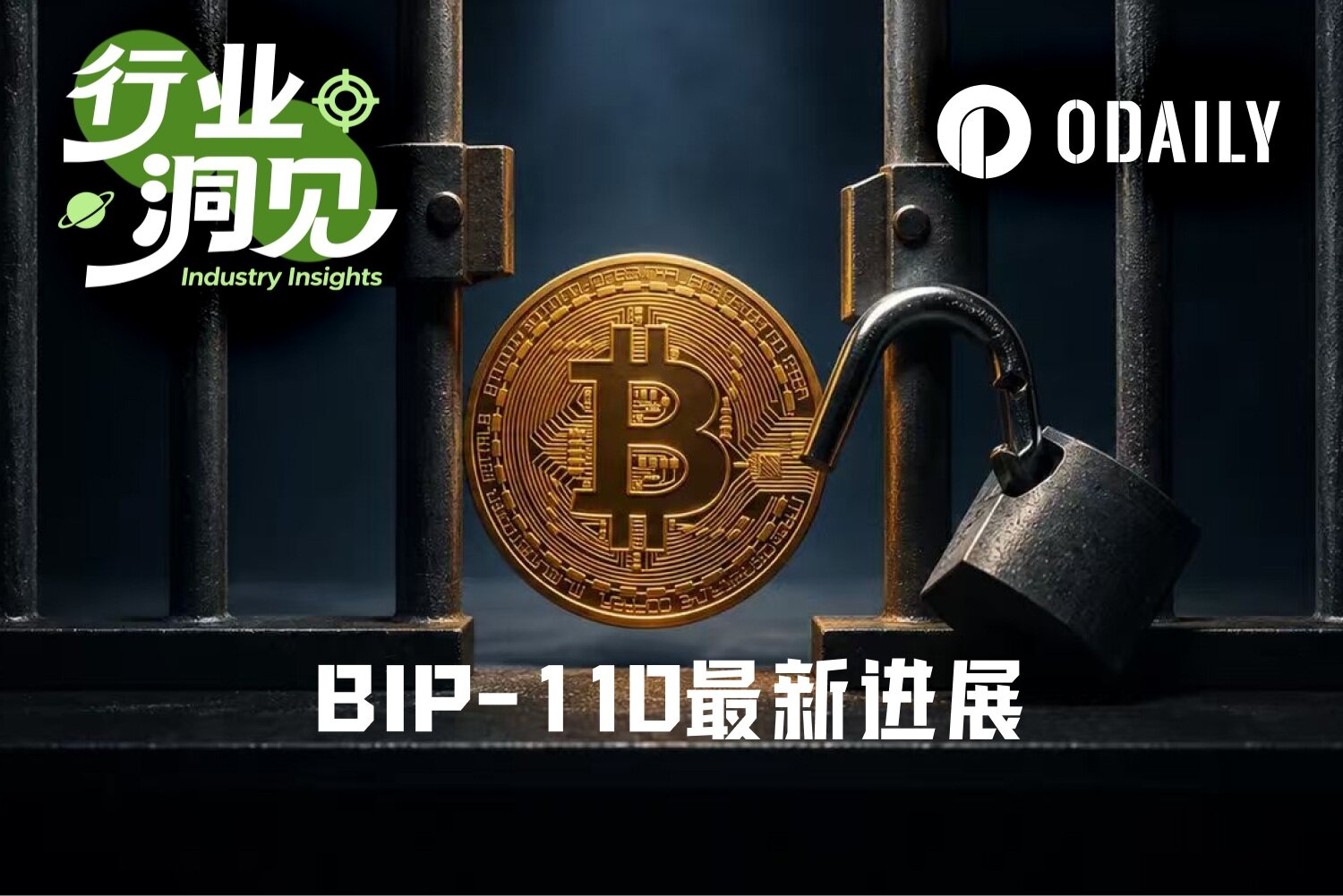
As the mandatory activation window in August approaches, discussions around the BIP-110 proposal have recently heated up again.

BIP-110 was proposed by Dathon Ohm in December 2025 and is supported by Bitcoin Core developer Luke Dashjr. This proposal aims to limit arbitrary/non-monetary data in Bitcoin transactions over the next year, primarily targeting large data storage like Ordinals and Bitcoin NFTs, in hopes of reducing "spam transactions" in the network and keeping Bitcoin focused on its monetary function.

This proposal has been controversial since its introduction, but data shows that BIP-110 currently lacks mainstream support from miners and nodes. The activation threshold for BIP-110 is 55%. According to statistics, current miner support is less than 1%. Out of a total of 102,674 nodes in the network, only 15,035 nodes are willing to enforce BIP-110, a ratio of 14.64%.
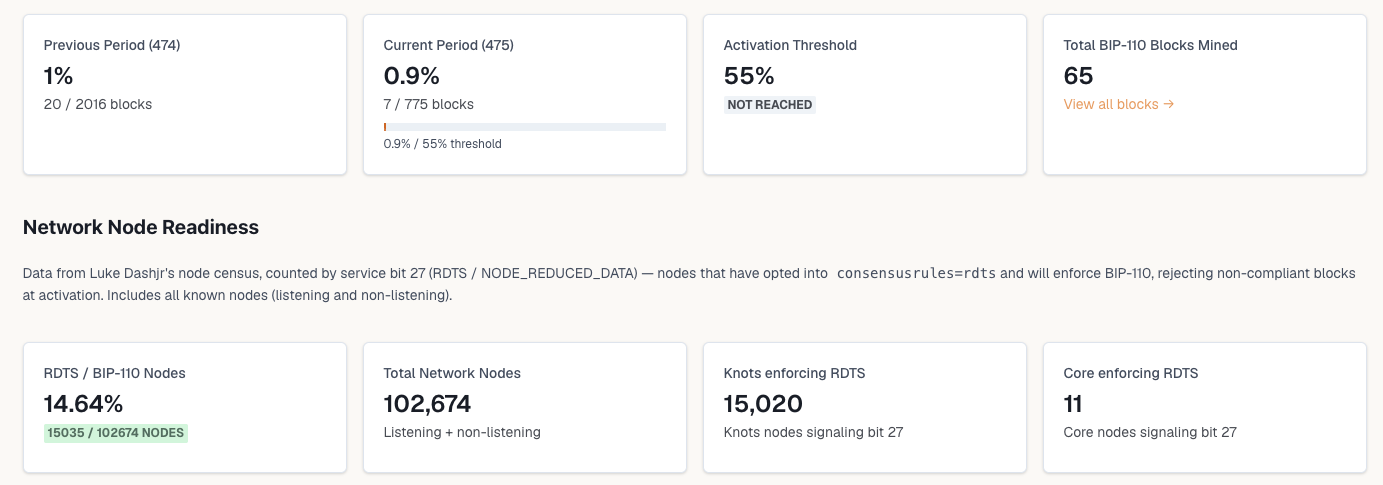
BIP-110 Miner and Node Support Rate

Typically, a proposal with such low support cannot pass on the Bitcoin network. However, the audacious aspect of BIP-110 is that even without achieving consensus, nodes supporting BIP-110 will enforce it. If BIP-110 does not reach the 55% activation threshold before block height 961,632, it will enter a mandatory activation window (block heights 961,632-963,647). During this period, nodes running BIP-110 will reject non-compliant blocks, forcibly pushing the acceptance rate to 100%, enabling BIP-110 to be ultimately activated and enforced at block height 965,664.

At the current Bitcoin network block production rate, BIP-110 will enter its mandatory activation window in early August. This means that although BIP-110 is a soft fork proposal, the Bitcoin network will still experience a chain split (a minority chain supporting BIP-110 and the main chain not supporting it) at that time.

BIP-110 Continuous Controversy

According to Bitcoin's "longest chain rule," a soft fork only succeeds—meaning the entire network unifies under the new rules—when miners supporting BIP-110 (or, more accurately, the proposed changes) actually possess a majority (>50%) of the hash rate, allowing their chain to become the longest chain. Therefore, although the forced activation of BIP-110 seems inevitable, its ultimate persistence still depends on consensus. Otherwise, BIP-110 will likely meet the same fate as the vast majority of Bitcoin soft forks in history: dying out naturally.

Supporters: BIP-110 is not a change, but a negation of a change

The main representatives of the BIP-110 supporters are Luke Dashjr and his mining pool, Ocean. Luke Dashjr has long been a vocal opponent of BRC-20 and inscriptions within the Bitcoin developer community and provided initial suggestions for the BIP-110 proposal.

Luke Dashjr is considered a representative figure of Bitcoin maximalism or fundamentalism. They are unwilling to see Bitcoin block space used for any purpose other than Bitcoin transfers. In the BIP-110 proposal, inscriptions that emerged in 2022 are viewed as a type of "Bitcoin attack." The rationale is that allowing arbitrary data to be embedded in Bitcoin transactions creates a massive and unnecessary burden for nodes. Furthermore, this "junk data" occupies a significant amount of block space, forcing monetary transactions to raise their fee bids to be included in a block, thereby crowding out Bitcoin's monetary use.

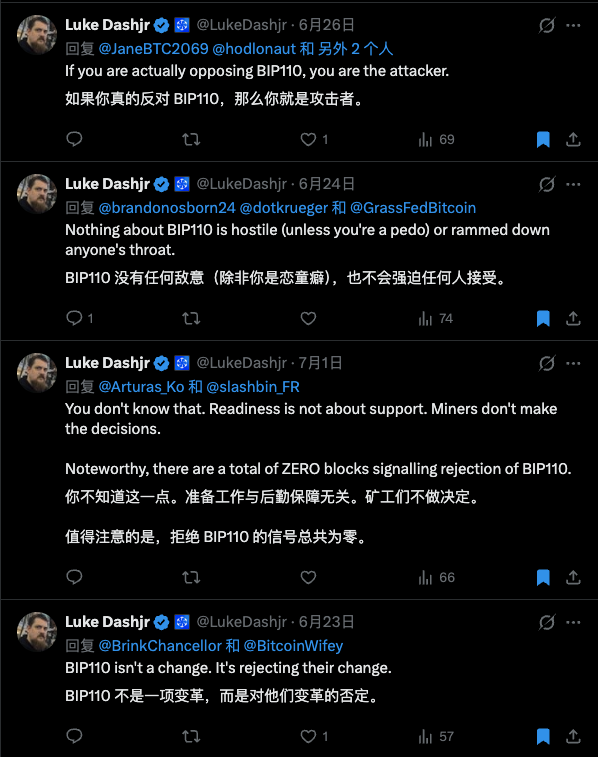
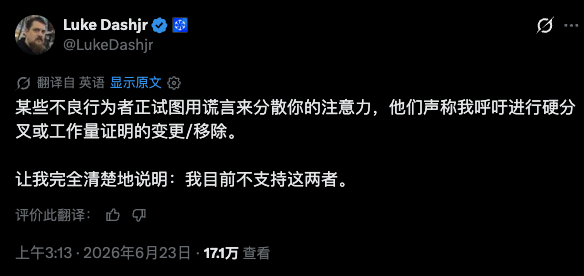
Therefore, Luke Dashjr posted on platform X, stating that BIP-110 is not a change, but a negation of a change. When facing opposition to BIP-110, he also employs sophistry, claiming on one hand that BIP-110 has no hostility and does not force anyone to accept it, and on the other hand, asserting that those who oppose BIP-110 are the true attackers of Bitcoin.

Moreover, although the current voting rate of miners approving BIP-110 is very low (<1%), Luke Dashjr remains optimistic, pointing out that the direct opposition voting rate among miners is also nearly 0%. The implication is that miners are not making a decision; once BIP-110 activates, they will naturally follow.
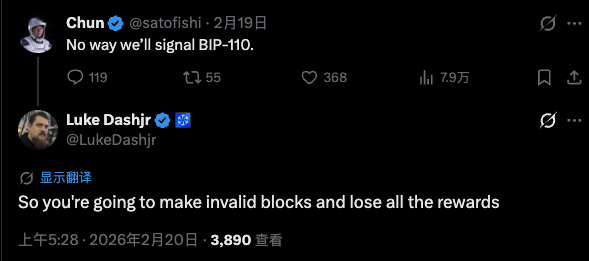
Looking at reality, as of now, the only mining pool publicly supporting BIP-110 is Luke Dashjr's own Ocean. F2Pool co-founder Wang Chun publicly stated back in February that they would absolutely not support BIP-110. Luke Dashjr confidently replied under that post, "Then you will mine invalid blocks and lose all your rewards."
According to miningradar data, F2Pool is the third-largest Bitcoin mining pool globally, with a hash rate share of 13.6%. Meanwhile, Ocean's current hash rate is only 24.6 EH/s, accounting for 2.6% of the network's total hash rate.
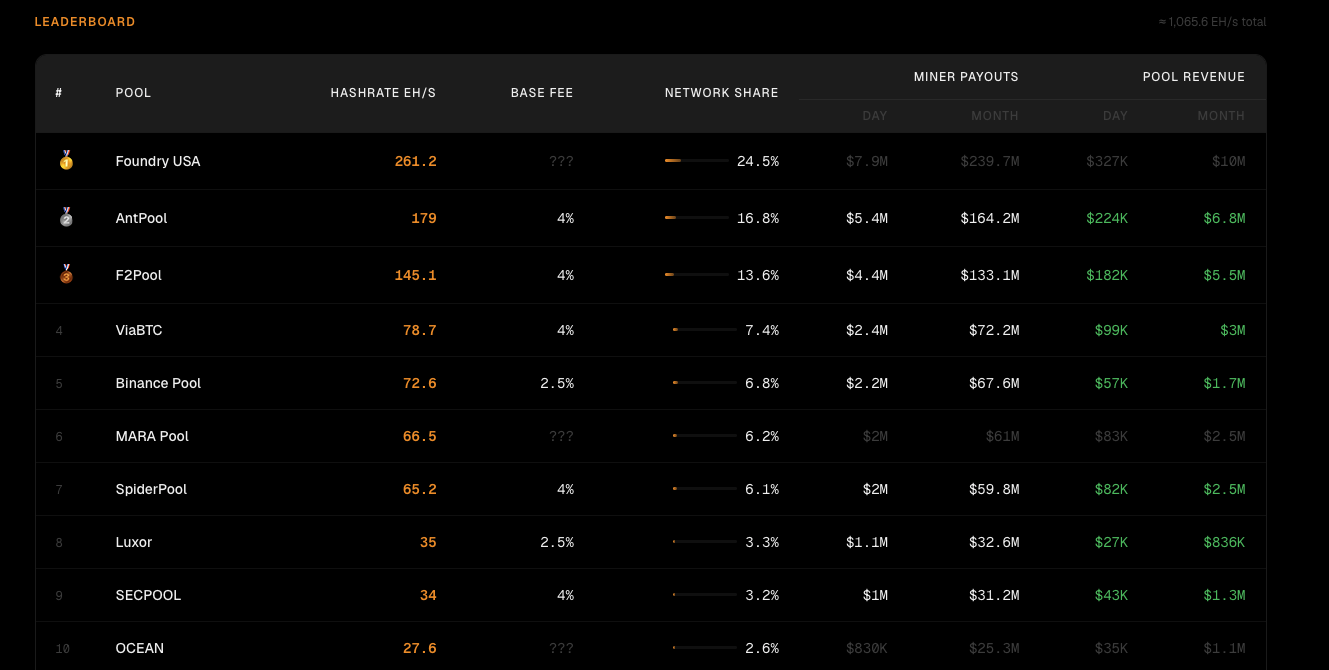
Bitcoin Mining Pool Rankings

If Ocean ultimately becomes the only pool supporting the fork, they would only produce 3-5 blocks per day. Such efficiency and block production speed would be insufficient to become the "longest chain" on the Bitcoin network.

Opponents: BIP-110 Doesn't Solve the Problem and Creates More New Issues

Opponents of the BIP-110 proposal not only focus on whether BIP-110 will be successful after activation but also criticize it for failing to solve the "spam transaction" problem on the Bitcoin network while simultaneously creating many potential new issues. In short, BIP-110 opponents are strongly opposing it out of concern for various unintended consequences, not out of any attachment to Ordinals or inscriptions. Key figures among the opponents include cypherpunk pioneer Adam Back, Bitcoin Core developer Jameson Lopp, and MicroStrategy founder Michael Saylor.

Firstly, opponents argue that BIP-110 cannot completely solve the "spam transaction" issue facing the Bitcoin network; the author of the BIP-110 proposal also admits it can only provide temporary relief. Jameson Lopp believes that Bitcoin's block size limit and the fee market for block space have already mitigated the spam transaction problem to some extent. However, Bitcoin remains a target for various spam transaction attacks primarily because very few people actually use the Bitcoin network regularly, keeping transaction fees consistently low. This prevents the formation of sufficient fee pressure to deter most spam transactions.

Furthermore, BIP-110 could stifle future innovation on Bitcoin. The BIP-110 proposal itself acknowledges that restrictions on Taproot would hinder the implementation of advanced functionalities or complex contracts like BitVM on the Bitcoin network. Although BIP-110 is described as a one-year temporary restriction, Jameson Lopp believes this is merely a delaying tactic by Luke Dashjr. If these restrictions severely constrain future Bitcoin upgrades, it could ultimately lead to a Bitcoin hard fork rather than a soft fork.

Adam Back focuses more on Bitcoin's censorship resistance and decentralized spirit. He argues that BIP-110 would subjectively censor transactions within blocks, fundamentally aiming to regulate others. This goes against the neutrality and censorship-resistant spirit Bitcoin has upheld since its inception, representing a dangerous step towards centralization and control. Adam Back uses Bitcoin's original principles to negate the changes proposed by Bitcoin extremists, essentially "using magic to defeat magic."

Michael Saylor summarizes BIP-110 as a "Bitcoin Iatrogenic Proposal," implying that the "treatment" (BIP-110) itself would harm Bitcoin rather than solve existing problems.
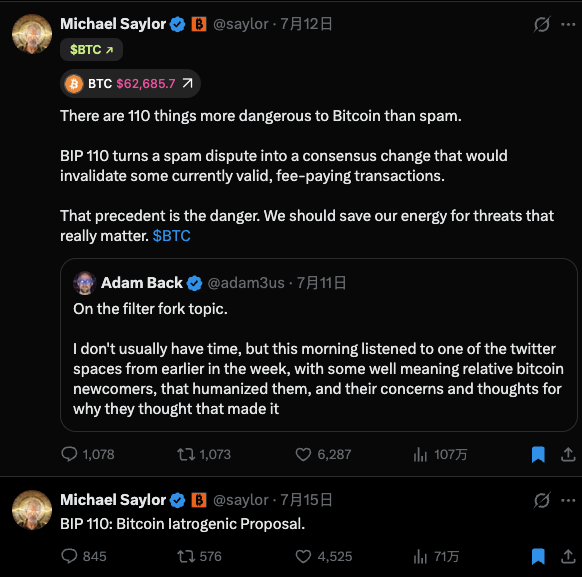
Michael Saylor also believes that if BIP-110 were to become consensus, some valid paid transactions would become invalid, and setting this precedent for censorship is the true danger.

Opponents have another major concern: the serious consequence that activating BIP-110 could split the Bitcoin chain ecosystem. Two competing chains would emerge, vying for the status of the "real Bitcoin." In such a scenario, uncertainty about the fork's outcome could create a risk of Bitcoin double-spending. Even without causing double-spending, if BIP-110 ultimately evolves into a new chain, it would split Bitcoin's developer resources, hash rate resources, and monetary consensus.

Opponents believe BIP-110 is attempting to use a technical solution to address a cultural problem, potentially generating more unpredictable issues in the process.

Despite these concerns, opponents are confident about BIP-110's failure. Jameson Lopp made a bet against BIP-110 back in February, with a minimum wager of 1 BTC. So far, no BIP-110 supporter has publicly accepted the bet.
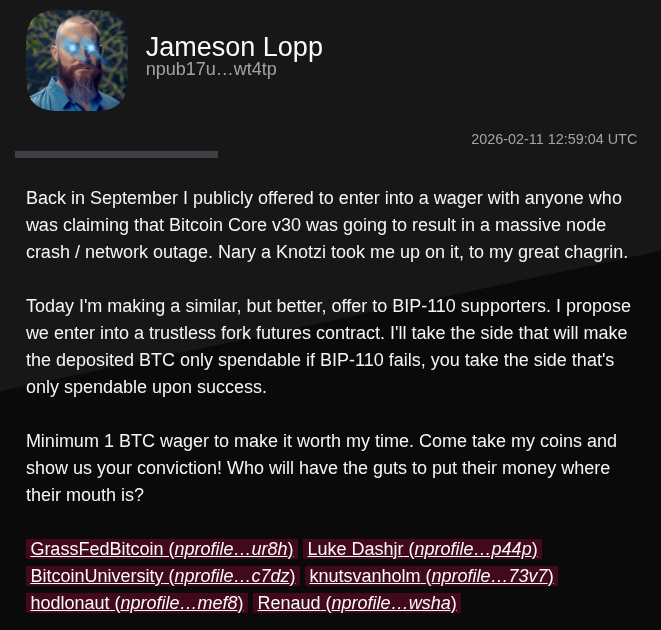
Jameson Lopp's Wager Invitation to BIP-110 Supporters

On the prediction market Predyx, the probability for "BIP-110 will activate and be enforced on Bitcoin between September 1-7, 2026" is 10%. The settlement condition for "Yes" is that the BIP-110 chain must become the "Bitcoin longest chain" and be accepted by most nodes.
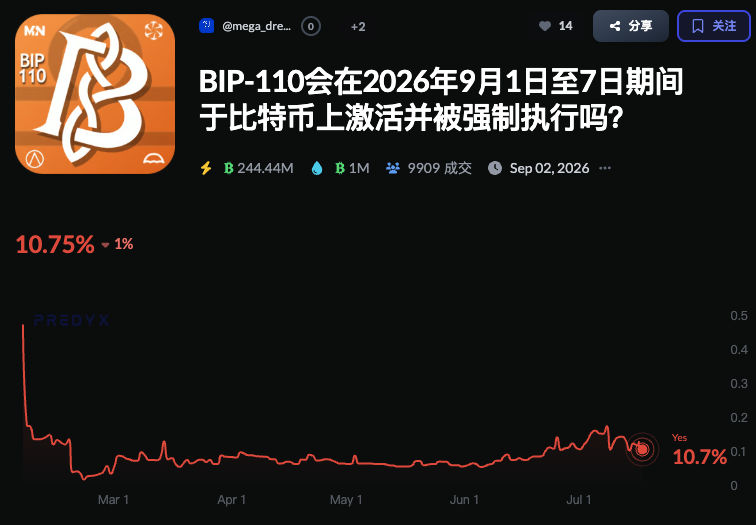
What Happens After BIP-110 Activates?

We can now consider several hypothetical scenarios for what might happen when BIP-110 is ultimately forcibly activated at block height 965,664 (late August to early September).

The first scenario is as described above. After reaching the activation height, BIP-110 nodes reject main chain blocks, but there aren't enough miners producing new blocks that comply with BIP-110 rules. The BIP-110 chain's block production speed would be extremely slow, eventually stopping altogether and ceasing to "grow."

The second scenario assumes a certain proportion of miners support BIP-110. BIP-110 supporters believe they possess an "asymmetric advantage" because BIP-110 rules are stricter. Therefore, while BIP-110 nodes will reject blocks containing违规数据 (inscriptions, etc.), non-BIP-110 nodes (mainstream Core nodes) will consider blocks produced by BIP-110 nodes as valid.

Moreover, currently, inscription transactions only account for about 5% of Bitcoin block space usage, with over 95% being traditional Bitcoin transfer transactions. BIP-110 nodes would still receive a large number of mainstream blocks. This is why Luke Dashjr believes BIP-110 will ultimately become the "longest chain" and unify the network.
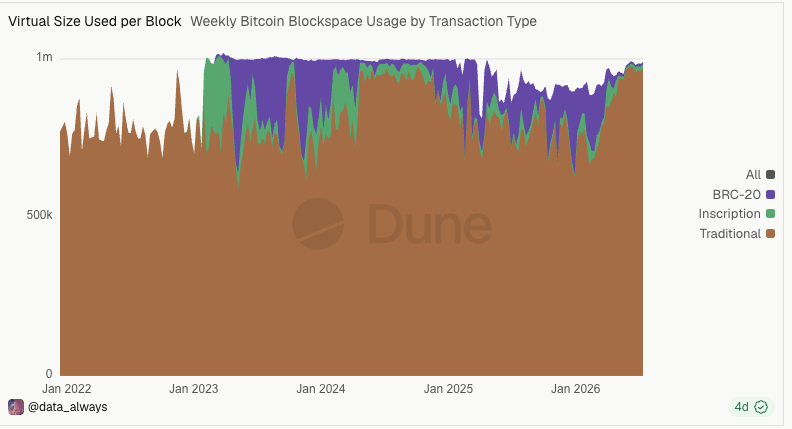
Bitcoin Block Space Usage by Transaction Type

The third scenario involves a certain proportion of miners supporting BIP-110, but their hash rate never surpasses that of the existing majority chain. Typically, miners are highly rational because their machines incur electricity costs as soon as they are turned on. In a competition between two chains, miners weigh the pros and cons. Miners on the BIP-110 chain might find it easier to abandon sunk costs (mining rewards on the minority chain) and join the majority chain, as the minority chain not only lags in length but also accumulates fewer Bitcoin rewards than the majority chain. This would ultimately lead to the first scenario.

Now, assuming Luke Dashjr has immense influence and miners act irrationally, persisting in mining on the BIP-110 chain, what would happen? This chain would continue to operate independently, but block times could be very slow. Miners would essentially be mining for the sake of ideology, consuming energy meaninglessly. The most plausible outcome in this situation is that the BIP-110 chain, driven by its supporters, permanently forks into an independent chain, "manually" adjusts its difficulty, and launches a new network token.

However, Luke Dashjr has repeatedly emphasized his refusal to hard fork for BIP-110, believing it's not yet time to use that method. Public sentiment can be a double-edged sword. At that point, even Luke Dashjr might be carried away by the will of the crowd, finding the arrow already on the bowstring and having to release it.
Therefore, the minority chain run by BIP-110 supporters can technically continue to operate, but it will likely struggle to thrive, as that depends on economic and ecosystem factors, including support from wallets, exchanges, users, etc. There are many such examples on the Bitcoin network; most ultimately fail. Even those that succeed rarely reach heights beyond independent coins like BCH or BSV.


Трендовые криптовалюты

Связанные с этим вопросы

QWhat is BIP-110 and what is its main objective?

ABIP-110 is a proposal introduced by Dathon Ohm in December 2025, supported by Bitcoin Core developer Luke Dashjr. Its main objective is to limit arbitrary/non-monetary data in Bitcoin transactions, particularly targeting large data storage like Ordinals and Bitcoin NFTs, over the next year. The aim is to reduce 'spam transactions' on the network and refocus Bitcoin on its monetary function.

QAccording to the article, what are the current support levels for BIP-110 among miners and nodes?

AThe current support levels for BIP-110 are very low. The activation threshold is 55%, but miner support is reportedly under 1%. Out of 102,674 total nodes, only 15,035 nodes (approximately 14.64%) are willing to enforce BIP-110.

QWhat is the 'forced activation period' for BIP-110, and what is the primary concern about this period?

AThe 'forced activation period' for BIP-110 is between block heights 961,632 and 963,647, which is expected around early August. The primary concern is that during this period, nodes running BIP-110 will reject non-compliant blocks, attempting to force the adoption rate to 100% and activate BIP-110 by block height 965,664. This could lead to a chain split between the minority chain supporting BIP-110 and the main chain that does not.

QWho are some prominent opponents of BIP-110, and what are their main arguments against it?

AProminent opponents include cypherpunk pioneer Adam Back, Bitcoin Core developer Jameson Lopp, and MicroStrategy founder Michael Saylor. Their main arguments are: 1) BIP-110 doesn't fully solve the spam transaction problem and could create new issues. 2) It could stifle future innovation on Bitcoin (e.g., hindering BitVM). 3) It introduces subjective transaction censorship, contradicting Bitcoin's neutral and censorship-resistant principles. 4) It risks splitting the Bitcoin ecosystem and consensus, potentially creating two competing chains.

QWhat are the possible scenarios described in the article for what could happen after BIP-110 is forcibly activated?

AThe article outlines three possible scenarios: 1) BIP-110 nodes reject main chain blocks, but without enough miner support to produce compliant blocks, the BIP-110 chain stops growing and 'dies naturally.' 2) A significant portion of miners supports BIP-110. Due to its stricter rules, its blocks are valid on the main chain, potentially allowing it to become the longest chain. 3) Some miners support BIP-110, but their hash power never surpasses the majority chain. Rational miners would eventually switch to the more profitable main chain, leading again to scenario 1. A fourth implied scenario is a permanent hard fork creating a separate chain, though Luke Dashjr has stated opposition to this.

Похожее

Стимулируют ли новые предложения по комиссиям протокола Uniswap ‘существенное сжигание UNI’?

Uniswap представил три предложения по активации протокольных комиссий в различных версиях (V2, V3, V4) на блокчейнах Ethereum, Base, Arbitrum, Robinhood, BNB Chain, Polygon и Optimism. Все новые сборы будут направляться в механизм сжигания токенов UNI. Генеральный директор Хейден Адамс ожидает «существенного» увеличения объема сжигания, особенно учитывая высокий торговый оборот на новой сети Robinhood L2. Однако предложения встретили сопротивление со стороны некоторых поставщиков ликвидности (LP), например Gamma Strategies. Они утверждают, что комиссии снизят их доходы и сделают Uniswap V4 менее конкурентоспособным на фоне других DEX. В настоящее время львиная доля сборов (более $5 млрд с 2018 года) идет LP, в то время как сам протокол заработал лишь $25 млн. Если предложения будут приняты и грамотно сбалансированы, это может значительно ускорить сжигание UNI. На прошлой неделе темпы сжигания уже выросли втрое. Цена UNI в июле выросла на 41%, но сейчас столкнулась с сопротивлением. Дальнейший рост может зависеть от сохранения импульса на Robinhood и эффекта от новых комиссионных предложений.

ambcrypto38 мин. назад

Стимулируют ли новые предложения по комиссиям протокола Uniswap ‘существенное сжигание UNI’?

ambcrypto38 мин. назад

Прогноз цены SHIB на 2026 год — вот что говорят эти модели ИИ!

Согласно прогнозам трех моделей искусственного интеллекта (Shiba Inu, Claude и Grok), цена мемкоина Shiba Inu (SHIB) к концу 2026 года может продемонстрировать умеренный рост. Модели ожидают не взрывного ралли, а скорее скромные или средние прибыли. Ключевыми факторами роста называют большое и растущее сообщество SHIB, а также возможный рост цен под влиянием Bitcoin и притока капитала в мемкоины. Однако, по мнению Claude и Grok, слабое внедрение в экосистеме Shibarium и общие настроения на крипторынке могут ограничить потенциал роста. Технический анализ показывает, что в краткосрочной перспективе цена SHIB консолидируется выше уровня поддержки $0.00000412, при этом объем торгов и RSI снижаются, что указывает на активность продаж. Для достижения уровня $0.00000510 необходимо преодолеть сопротивление на отметке $0.0000045. На дневном графике наблюдается накопление монет покупателями, а индикатор MACD подтверждает контроль быков, хотя их импульс остается минимальным. Эти данные согласуются с прогнозами ИИ о вероятных, но не взрывных, ростах.

ambcrypto2 ч. назад

Прогноз цены SHIB на 2026 год — вот что говорят эти модели ИИ!

ambcrypto2 ч. назад

Вспыхнул конфликт между США и Ираном, хедж-фонды агрессивно наращивают позиции в нефти с самой высокой скоростью за десятилетие

Возобновление боевых действий между США и Ираном кардинально меняет ситуацию на глобальном рынке нефти. Хедж-фонды агрессивно наращивают ставки на рост цен на Brent, а перебои с проходом через Ормузский пролив и сокращение поставок топлива подстегивают рост как цен на нефть, так и прибыли нефтепереработчиков. По данным Bloomberg, на неделе, завершившейся 14 июля, институциональные инвесторы увеличили чистые длинные позиции по Brent на 75 996 лотов до 357 154 — это максимальный недельный прирост с декабря 2016 года. Цены на нефть за 10 дней выросли примерно до месячного максимума после падения примерно на 30% во втором квартале. Непосредственной причиной стало возобновление американских ударов по Ирану, который, в свою очередь, атаковал суда в Ормузском проливе, сократив его пропускную способность. Атаки в Ормузском проливе также привели к сокращению глобальных поставок дизельного топлива и бензина, подняв маржу нефтеперерабатывающих заводов до рекордного уровня. Инвесторы одновременно нарастили чистые длинные позиции по мазуту на NYMEX. Ситуацию усугубляет резкое падение экспорта нефтепродуктов из России из-за украинских атак на НПЗ и последующего запрета Москвой на экспорт дизеля, что создало дополнительное давление на глобальный рынок топлива.

marsbit4 ч. назад

Вспыхнул конфликт между США и Ираном, хедж-фонды агрессивно наращивают позиции в нефти с самой высокой скоростью за десятилетие

marsbit4 ч. назад

Столкновение США и Ирана возобновляется, хедж-фонды агрессивно увеличивают позиции по нефти со скоростью, которая стала самой быстрой за последние десять лет

Конфликт между США и Ираном глубоко перестраивает мировую нефтяную картину. Хедж-фонды агрессивно наращивают ставки на рост Brent с самой высокой скоростью за последнее десятилетие. Согласно данным Bloomberg, по состоянию на неделю 14 июля управляющие активами увеличили чистые длинные позиции по Brent на 75 996 лотов до 357 154 лотов — это самый большой еженедельный прирост с декабря 2016 года. Непосредственным катализатором стал возобновленный военный удар США по Ирану, что привело к ответным действиям Тегерана и атакам на суда в Ормузском проливе, серьёзно сократившим трафик через этот ключевой маршрут. Резко сменившись с опасений по поводу переизбытка предложения, инвесторы начали активный закрытие коротких позиций. Одновременно атаки в проливе и сокращение экспорта нефтепродуктов из России из-за атак Украины на НПЗ привели к резкому ужесточению глобальных поставок топлива. Это взвинтило прибыль нефтеперерабатывающих заводов до рекордных уровней, что также привлекло значительный приток средств в длинные позиции по дизельному топливу и мазуту на биржах.

链捕手4 ч. назад

Столкновение США и Ирана возобновляется, хедж-фонды агрессивно увеличивают позиции по нефти со скоростью, которая стала самой быстрой за последние десять лет

链捕手4 ч. назад

Торговля

Спот

Популярные статьи

Тест по Bitcoin Биткоина

HTX Learn: Изучите Bitcoin halving и Заработаете Токены USDT

3.2k просмотров всегоОпубликовано 2024.04.16Обновлено 2024.04.16

Тест по Bitcoin  Биткоина

Что такое $BITCOIN

ЦИФРОВОЕ ЗОЛОТО ($BITCOIN): Комплексный анализ Введение в ЦИФРОВОЕ ЗОЛОТО ($BITCOIN) ЦИФРОВОЕ ЗОЛОТО ($BITCOIN) — это проект на основе блокчейна, работающий в сети Solana, который стремится объединить характеристики традиционных драгоценных металлов с инновациями децентрализованных технологий. Хотя он носит имя Биткойн, часто называемого “цифровым золотом” из-за его восприятия как средства хранения ценности, ЦИФРОВОЕ ЗОЛОТО является отдельным токеном, предназначенным для создания уникальной экосистемы в ландшафте Web3. Его цель — позиционировать себя как жизнеспособный альтернативный цифровой актив, хотя детали его применения и функциональности все еще развиваются. Что такое ЦИФРОВОЕ ЗОЛОТО ($BITCOIN)? ЦИФРОВОЕ ЗОЛОТО ($BITCOIN) — это токен криптовалюты, специально разработанный для использования в блокчейне Solana. В отличие от Биткойна, который выполняет широко признанную роль хранения ценности, этот токен, похоже, сосредоточен на более широких приложениях и характеристиках. Примечательные аспекты включают: Инфраструктура блокчейна: Токен построен на блокчейне Solana, известном своей способностью обрабатывать высокоскоростные и недорогие транзакции. Динамика предложения: ЦИФРОВОЕ ЗОЛОТО имеет максимальное предложение, ограниченное 100 квадриллионами токенов (100P $BITCOIN), хотя детали о его обращающемся предложении в настоящее время не раскрыты. Утилита: Хотя точные функциональные возможности не описаны, есть указания на то, что токен может быть использован для различных приложений, потенциально связанных с децентрализованными приложениями (dApps) или стратегиями токенизации активов. Кто создатель ЦИФРОВОГО ЗОЛОТА ($BITCOIN)? На данный момент личность создателей и команды разработчиков, стоящих за ЦИФРОВЫМ ЗОЛОТОМ ($BITCOIN), остается неизвестной. Эта ситуация типична для многих инновационных проектов в области блокчейна, особенно тех, которые связаны с децентрализованными финансами и феноменом мем-криптовалют. Хотя такая анонимность может способствовать культуре, ориентированной на сообщество, она усиливает опасения по поводу управления и ответственности. Кто инвесторы ЦИФРОВОГО ЗОЛОТА ($BITCOIN)? Доступная информация указывает на то, что у ЦИФРОВОГО ЗОЛОТА ($BITCOIN) нет известных институциональных спонсоров или значительных венчурных капиталовложений. Проект, похоже, функционирует по модели пирингового взаимодействия, сосредоточенной на поддержке и принятии сообществом, а не на традиционных путях финансирования. Его активность и ликвидность в основном сосредоточены на децентрализованных биржах (DEX), таких как PumpSwap, а не на устоявшихся централизованных торговых платформах, что еще больше подчеркивает его подход, ориентированный на grassroots. Как работает ЦИФРОВОЕ ЗОЛОТО ($BITCOIN) Операционные механизмы ЦИФРОВОГО ЗОЛОТА ($BITCOIN) можно подробно описать на основе его дизайна блокчейна и характеристик сети: Механизм консенсуса: Используя уникальный механизм доказательства истории (PoH) Solana в сочетании с моделью доказательства доли (PoS), проект обеспечивает эффективную валидацию транзакций, что способствует высокой производительности сети. Токеномика: Хотя конкретные дефляционные механизмы не были подробно описаны, большое максимальное предложение токенов подразумевает, что оно может быть предназначено для микротранзакций или нишевых случаев использования, которые еще предстоит определить. Интероперабельность: Существует потенциал для интеграции с более широкой экосистемой Solana, включая различные платформы децентрализованных финансов (DeFi). Однако детали относительно конкретных интеграций остаются неуточненными. Хронология ключевых событий Вот хронология, которая подчеркивает значимые вехи, касающиеся ЦИФРОВОГО ЗОЛОТА ($BITCOIN): 2023: Первоначальное развертывание токена происходит в блокчейне Solana, отмеченное его адресом контракта. 2024: ЦИФРОВОЕ ЗОЛОТО приобретает видимость, когда оно становится доступным для торговли на децентрализованных биржах, таких как PumpSwap, позволяя пользователям обменивать его на SOL. 2025: Проект наблюдает спорадическую торговую активность и потенциальный интерес к инициативам, возглавляемым сообществом, хотя на данный момент не зафиксировано никаких значительных партнерств или технических достижений. Критический анализ Сильные стороны Масштабируемость: Основная инфраструктура Solana поддерживает высокие объемы транзакций, что может повысить полезность $BITCOIN в различных сценариях транзакций. Доступность: Потенциально низкая цена торговли за токен может привлечь розничных инвесторов, способствуя более широкому участию благодаря возможностям дробного владения. Риски Отсутствие прозрачности: Отсутствие публично известных спонсоров, разработчиков или процесса аудита может вызвать скептицизм относительно устойчивости и надежности проекта. Волатильность рынка: Торговая активность сильно зависит от спекулятивного поведения, что может привести к значительной волатильности цен и неопределенности для инвесторов. Заключение ЦИФРОВОЕ ЗОЛОТО ($BITCOIN) является интригующим, но неоднозначным проектом в быстро развивающейся экосистеме Solana. Хотя он пытается использовать нарратив “цифрового золота”, его отход от установленной роли Биткойна как средства хранения ценности подчеркивает необходимость более четкого различения его предполагаемой утилиты и структуры управления. Будущее принятие и усвоение, вероятно, будут зависеть от решения текущей непрозрачности и более четкого определения его операционных и экономических стратегий. Примечание: Этот отчет охватывает синтезированную информацию, доступную на октябрь 2023 года, и с тех пор могут произойти события.

195 просмотров всегоОпубликовано 2025.05.13Обновлено 2025.05.13

Что такое $BITCOIN

Fractal Bitcoin: масштабирование Биткоина с помощью рекурсивной системы

Fractal Bitcoin — масштабное Layer-1-решнение, созданное на базе кода Биткоина, позволяющего достигать бесконечного масштабирования с помощью рекурсивного подхода.

2.4k просмотров всегоОпубликовано 2025.06.30Обновлено 2025.06.30

Fractal Bitcoin: масштабирование Биткоина с помощью рекурсивной системы

Обсуждения

Добро пожаловать в Сообщество HTX. Здесь вы сможете быть в курсе последних новостей о развитии платформы и получить доступ к профессиональной аналитической информации о рынке. Мнения пользователей о цене на BTC (BTC) представлены ниже.

活动图片