Google Shaken, Market Cap Evaporates Hundreds of Billions. Can Gemini Spark Save the Day?

marsbitОпубликовано 2026-07-01Обновлено 2026-07-01

Введение

Google is facing a turbulent period marked by a significant brain drain of top AI talent. Key figures like Noam Shazeer, John Jumper, Jonas Adler, and Alexander Pritzel have recently left for competitors OpenAI and Anthropic, causing investor concern and a sharp stock decline wiping hundreds of billions from Alphabet's market cap. Amidst this talent exodus and the delayed launch of the anticipated Gemini 3.5 Pro model, Google has unveiled its major new offering: Gemini Spark. This is not a standard chatbot but a persistent, cloud-based AI agent designed to automate multi-step workflows across Google's ecosystem (Gmail, Calendar, Docs, Drive, etc.) and some third-party apps. Powered by the Antigravity framework with Tasks, Skills, and Schedules, it aims to function as a continuous digital assistant. However, its high price point—exclusive to the $100/month AI Ultra tier—has drawn criticism. The article positions Spark as Google's critical, albeit late, move into the AI agent arena, where AI transitions from a tool to an autonomous workforce. While competitors and startups are already advancing in this space, Google's vast integration with Workspace gives it a potential edge, though its historical caution due to scale and risk may have cost it the lead. Ultimately, Spark represents a necessary shift for Google, but the question remains whether this "digital employee" can compensate for the loss of foundational talent and restore investor confidence in the company's future.

Recently, morale is low at Google, with the company seemingly on shaky ground.

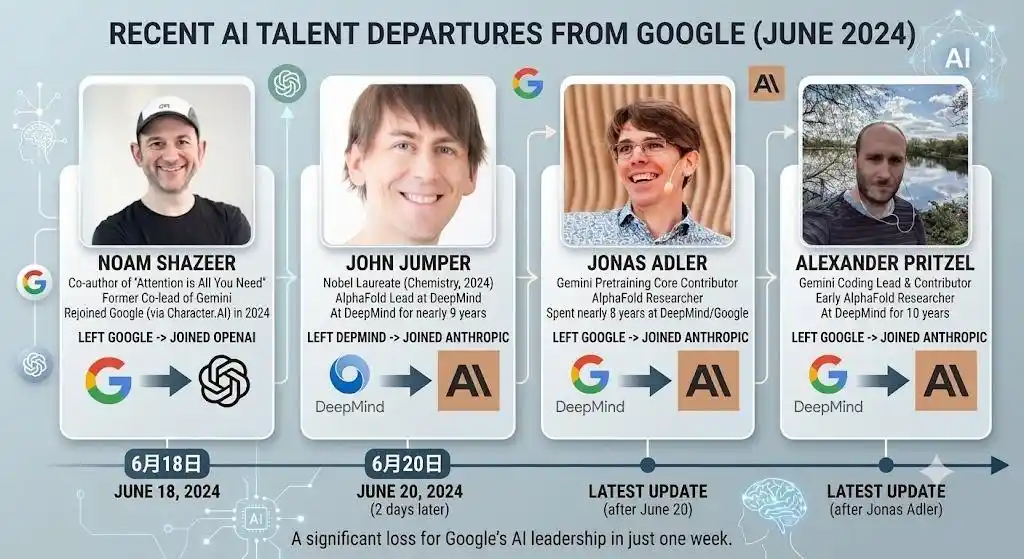
On June 18th, Noam Shazeer, one of the original eight authors of the 'Attention Is All You Need' paper, announced his departure from Google for OpenAI. In 2024, Google spent approximately $2.7 billion to bring him back, placing him in the role of co-lead for Gemini. In less than two years, he's gone again.

Two days later, John Jumper also left, heading to Anthropic. He is a 2024 Nobel Laureate in Chemistry, the lead developer of AlphaFold, and had been at DeepMind for nearly nine years.

Then came Jonas Adler and Alexander Pritzel, core contributors to Gemini's pre-training and programming directions, who also worked on AlphaFold. The latest news: these two are also preparing to join Anthropic.
If these were just ordinary resignations, Google could certainly withstand them.

The problem is, these four individuals each represent crucial nerve centers in the field of large models: architecture, science, programming, and pre-training.

The capital market's reaction was swift and direct, voting with its feet. On June 22nd, Alphabet's stock price fell 5% to 6% over two days, wiping hundreds of billions of dollars from its market capitalization.
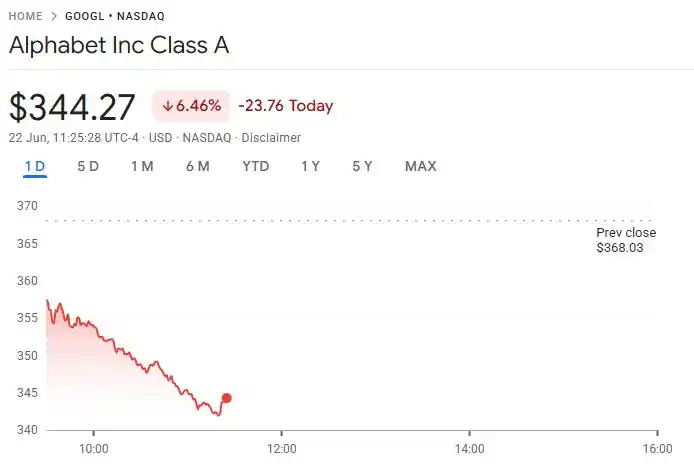
What investors fear isn't a specific product; it's something more fundamental: can Google still retain the people who built its most important creations?

Making things more awkward, during the very same month this brain drain occurred, Google served up its long-brewed new card: Gemini Spark.
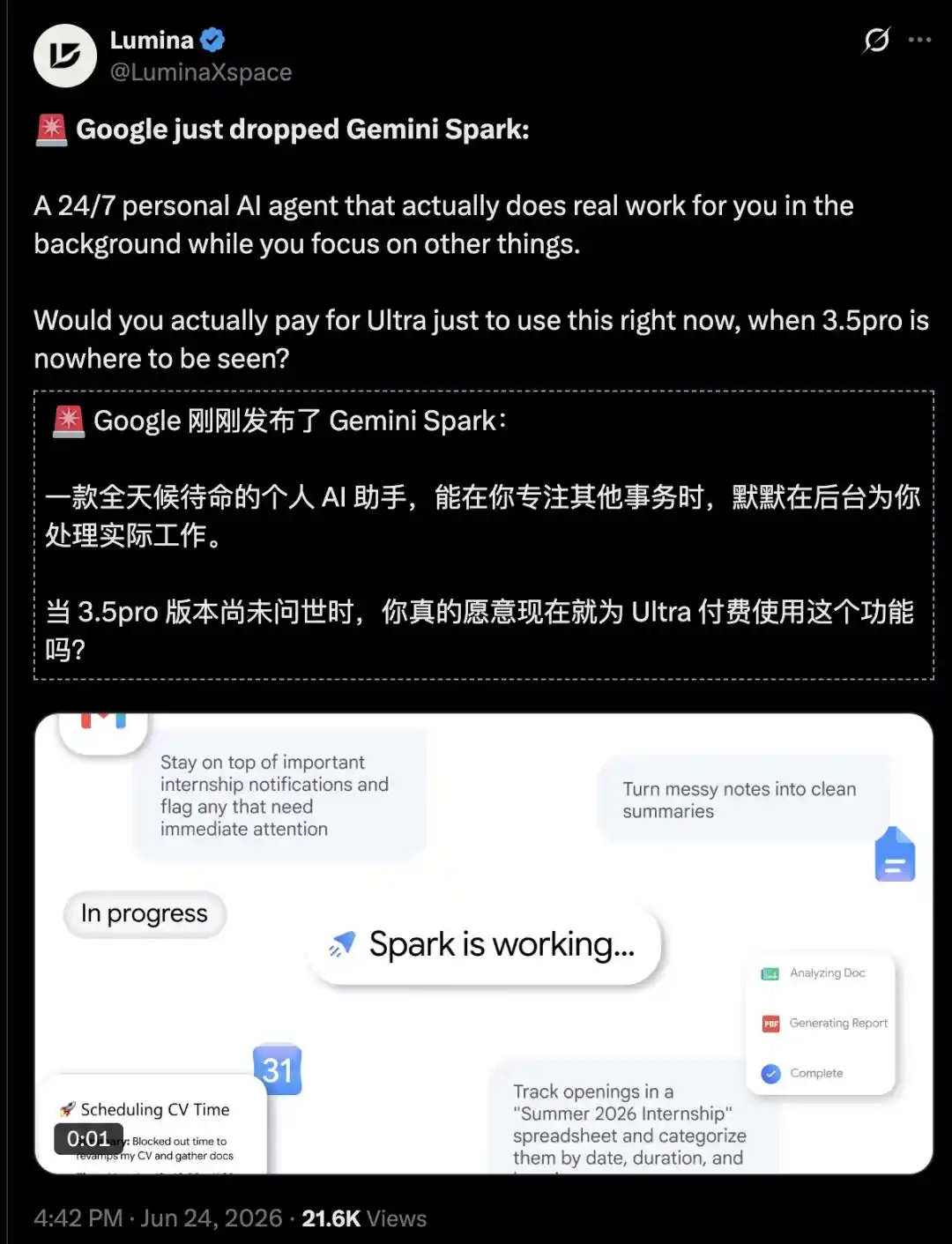
On one side, a brain drain; on the other, a massive push for breakthroughs.

The most authentic portrait of Google in 2026 is hidden within this schism.

Gemini 3.5 Pro Possibly Delayed. Is Google's Breakthrough Tied to Spark?

The talent exodus isn't the only issue; Google's product cadence looks even worse.

At I/O 2026, everyone was waiting for Gemini 3.5 Pro.

Google's CEO stood on stage and said, "Give us another month," reportedly eliciting a collective sigh from the audience.
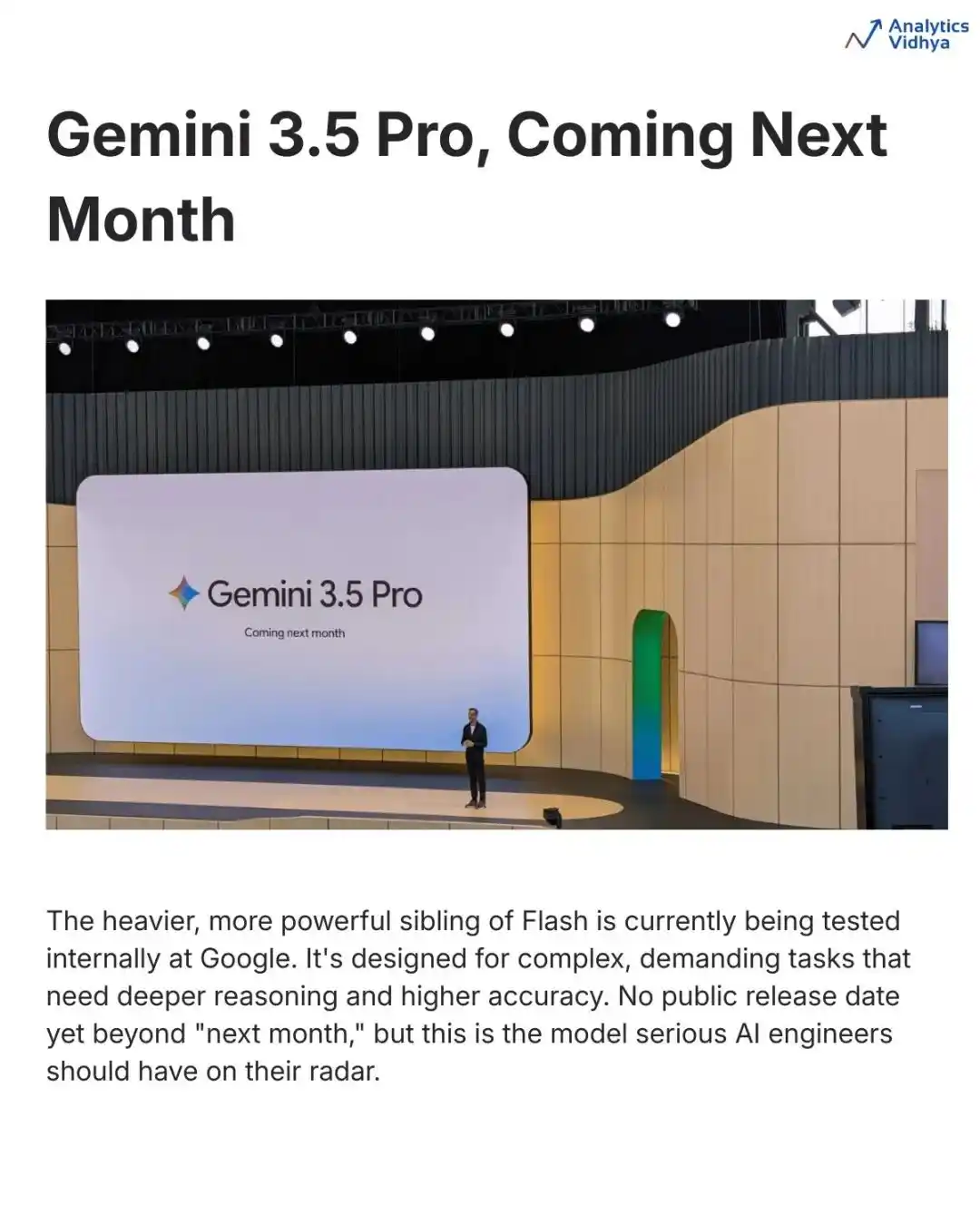
A month passed, and the latest news: Gemini 3.5 Pro has been pushed back from June to July.
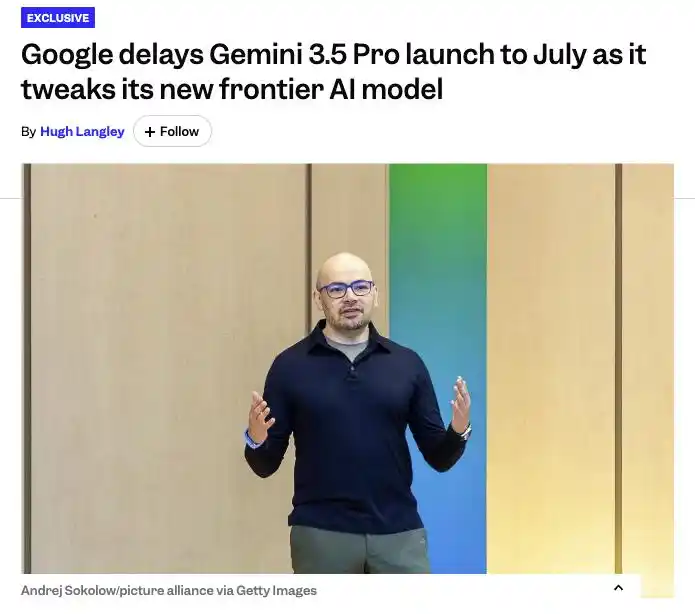
Two million token context, Deep Think reasoning—on paper, it's powerful. It just can't seem to reach your hands.

It was into this twilight that Google played its heaviest card of the year: Gemini Spark.

First, let's clarify how it differs from the Gemini app on your phone.
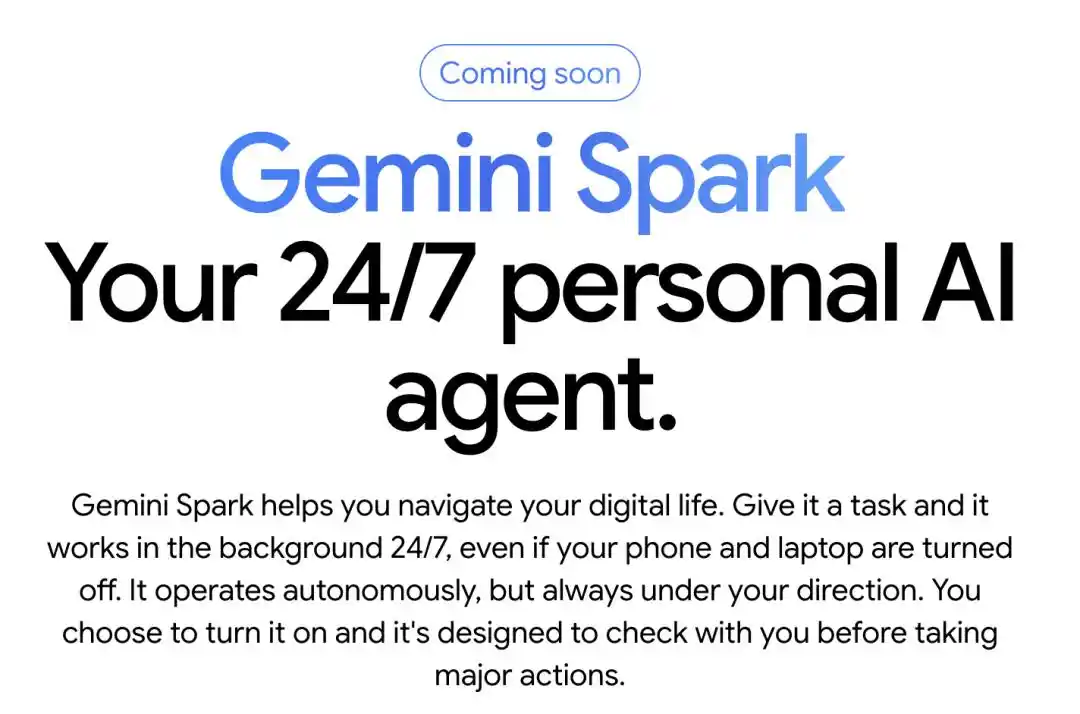
A regular chatbot: you ask, it answers. You close the app, it ceases to exist.

Spark is not like that. It runs on dedicated virtual machines in Google Cloud. You close your laptop, lock your phone, fall asleep—it remains awake in the cloud, continuing to work for you.

You don't need to keep your computer on for it to operate.

It connects most deeply to the Google tools you use every day: Gmail, Calendar, Docs, Sheets, Slides, Drive, plus Maps and YouTube.
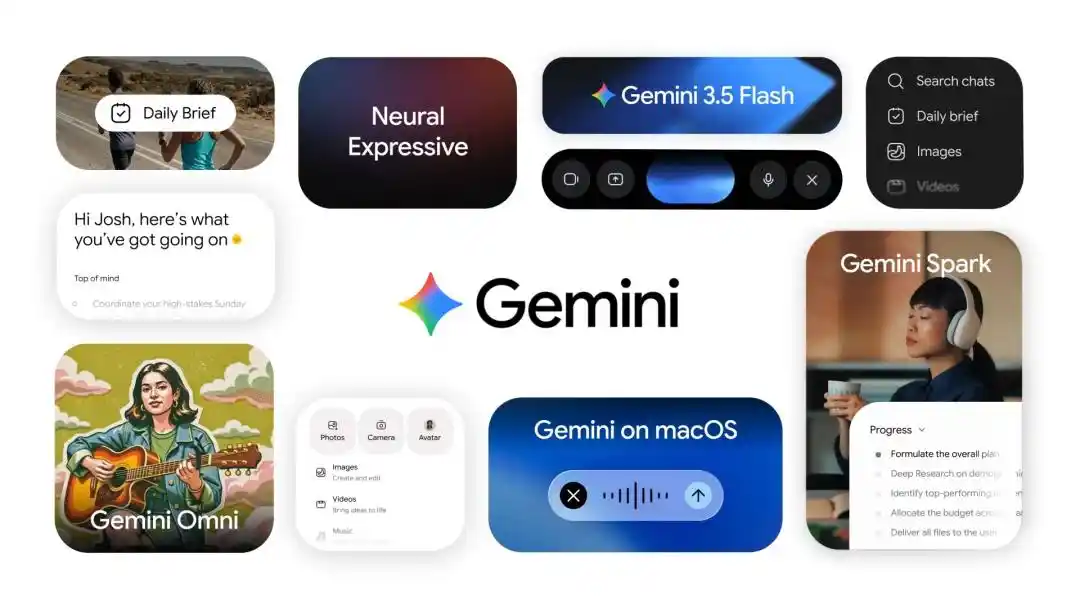
Words aren't enough; let's see what it can actually do.

You're a photographer. An inquiry email comes in. Spark automatically extracts the client's name and requested date, logs it into your "Client Tracker" spreadsheet, and creates a new Drive folder named after that client.

You have kids. Have it monitor your inbox for notifications from the school, extract key deadlines, and send you and your partner a daily summary.

Do you see the pattern?

These aren't one-off "help me write an email" prompts. You give it a goal, and it breaks it down into several steps, running across multiple apps to complete it.

Google equipped it with a framework called Antigravity, divided into Tasks, Skills, and Schedules. It can run on a schedule or wait for a specific trigger condition.

Tasks: You can set AI agents to work, connecting them to your Google Workspace ecosystem, including Gmail, Calendar, Docs, Sheets, and Slides.

Skills: By building skills, you can precisely define how Spark handles your frequently recurring tasks, customizing your experience and freeing you from repetitive prompting.

Schedules: By setting time-based or condition-based trigger rules, you can execute tasks exactly when you need them, automating your workload on your own terms.

It can also reach outward.

Through the MCP protocol, it connects to Canva, OpenTable, Instacart. Theoretically, you could have it book a restaurant or order groceries. For high-risk actions involving spending money or sending emails, it will pause and ask for your confirmation first.

Imagine an unpaid intern who doesn't drink coffee and is permanently online in the cloud. That's roughly the illusion Spark aims to create.

The cost? It's currently only available to Google AI Ultra users, the $100 per month tier.

Pro users get access to something else called Daily Brief, a morning briefing, not the Spark core.

Netizens are calling the pricing a joke.
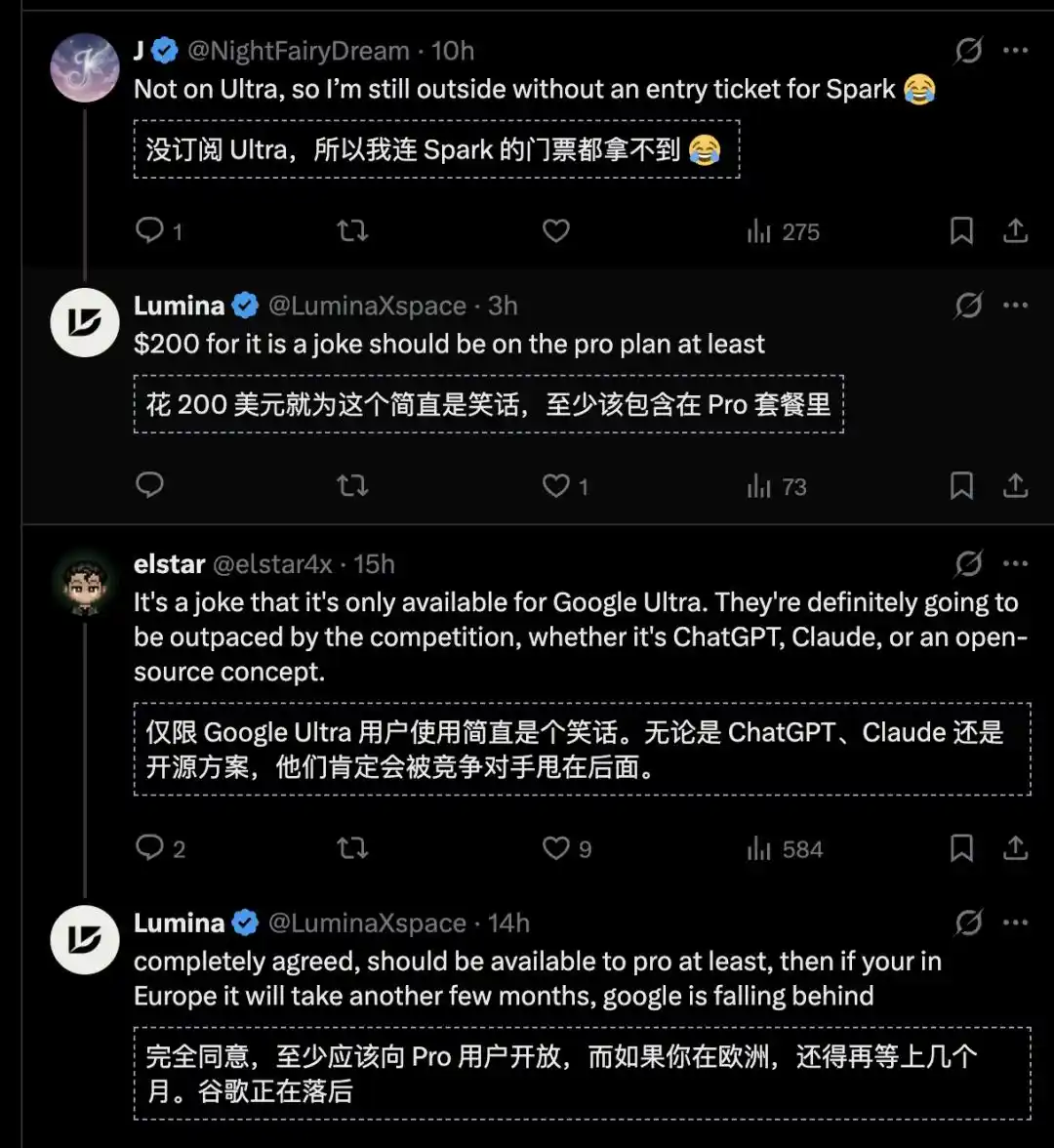
An invisible gate keeps the "digital employee" confined to the most expensive tier.

Google Started Early but Arrived Late to the Party

Placing Spark back into the broader Agent landscape makes its significance even more complex.

OpenAI has its own Agent product roadmap.

Anthropic, from Computer Use to Claude Code, is also delving deeper into "having AI do things for you."

Then there's a plethora of vertical Agent startups cutting into niches like legal, sales, recruitment, customer service, data analysis, and programming.
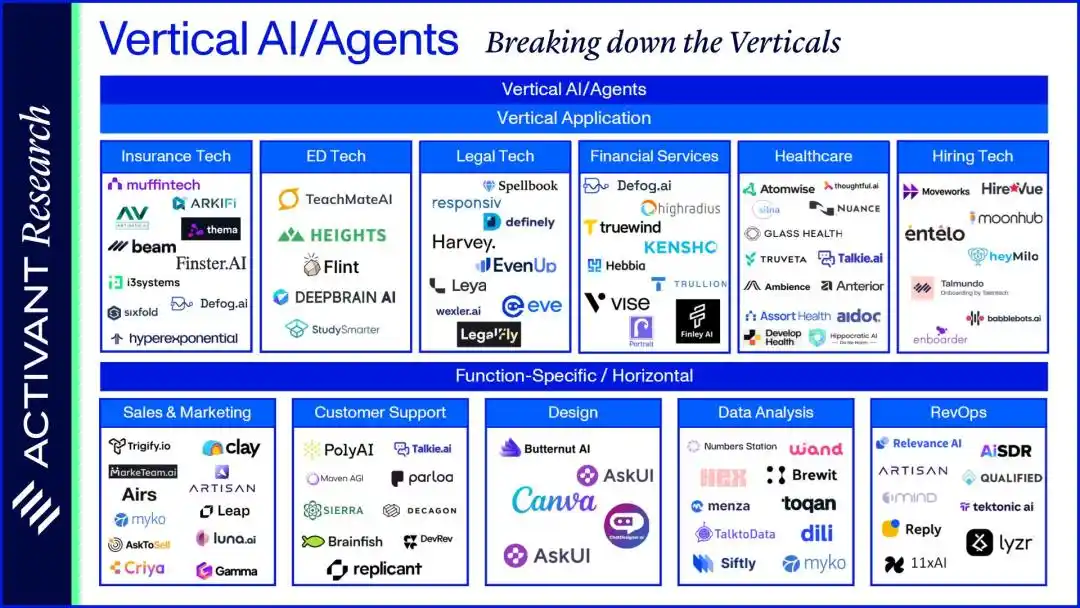
The industry has reached a high degree of consensus: AI is transitioning from being a tool to becoming labor.

Past AI was a co-pilot. You drive, it reminds you. Present AI is the driver. You state the destination, it plans the route.

And here lies Google's most awkward position: it should have won this race.

No company is better suited than Google to build a productivity Agent.

Gmail, Calendar, Docs, Sheets, Drive—these aren't isolated apps; they are the capillaries of modern work life.

A true digital employee, if it could natively access these systems, would possess a terrifying efficiency advantage.

The problem is, Google held the best cards but didn't play them first.

The reason isn't hard to understand. The bigger Google is, the more it fears mishaps.

What if the AI misreads an email? Deletes a file by mistake? Sends out content it shouldn't? Accesses user privacy, triggering a PR disaster?

These are risks for startups, but minefields for Google.

Thus, it was cautious, hesitant, scrutinizing, waiting.

And while Google hesitated, open-source projects like OpenClaw have been redefining "browser agents."

They operate like parasites, directly taking over web browser actions with impressive efficiency.

Google's setback is, at its core, a story of "giant's arrogance and fear."

The emergence of Spark marks the turning point where Google finally decided to loosen the reins, allowing AI to truly enter the background and "do the work."

This is Google's most painful paradox: it started early but arrived late to the party.

Can Google stem the bleeding with Spark? Unlikely.

But Spark at least points the way: AI must step out of the "dialog box" and enter the capillaries of productivity.

And for those investors who watched the market cap evaporate by $200 billion, the question they most want answered is: The creators have left. Can this remaining "work machine" truly support Google's next decade?

References:

https://x.com/LuminaXspace/status/2069702715999998139

https://www.datacamp.com/blog/gemini-spark

This article is from the WeChat public account "New Zhiyuan," author: ASI Apocalypse

Трендовые криптовалюты

Связанные с этим вопросы

QAccording to the article, what is the primary reason for the recent sharp decline in Alphabet's stock price?

AThe primary reason for Alphabet's recent sharp stock decline is a loss of investor confidence triggered by the departure of key AI talent. The article cites the high-profile exits of core contributors from projects like Gemini and AlphaFold to competitors like OpenAI and Anthropic, making investors question Google's ability to retain the people who build its most important technologies.

QHow does the functionality of Gemini Spark differ fundamentally from a standard chatbot like the Gemini app?

AGemini Spark differs fundamentally from a standard chatbot by being a persistent, autonomous agent. Instead of a simple question-and-answer interface, Spark runs on a dedicated cloud virtual machine, continues working even when the user's device is off, and can execute multi-step tasks across multiple Google Workspace apps (Gmail, Calendar, Docs, etc.) and external services based on user-defined goals, schedules, or triggers.

QWhat are the three core components of the Antigravity agent framework that powers Gemini Spark, as described in the article?

AThe three core components of the Antigravity agent framework powering Gemini Spark are Tasks, Skills, and Schedules. Tasks connect the agent to the Google Workspace ecosystem. Skills allow users to customize how Spark handles repetitive actions. Schedules enable task execution based on time or conditional triggers.

QWhat is the main paradox or contradiction highlighted in the article regarding Google's position in the AI agent race?

AThe main paradox is that Google, which possesses the most suitable ecosystem for productivity agents (its deeply integrated Google Workspace apps), has been slow to launch a full-fledged agent product like Gemini Spark. The article attributes this delay to a combination of 'giant's arrogance and fear'—caution over potential risks and PR disasters—which allowed smaller, more agile players to move first, meaning Google 'woke up early but arrived late to the game.'

QWhat critical question does the article pose to investors at the end, regarding Google's future?

AThe article concludes by posing a critical question to investors: With the key innovators and 'god-makers' leaving the company, can the remaining 'work machine' (referring to products like the task-automating Gemini Spark) truly support Google's next decade?

Похожее

Обзор 8 «кэш-коров» бычьего рынка: крупнейший проект выкупил токенов на $283 млн за год

В условиях продолжающегося криптомедвежьего рынка некоторые проекты демонстрируют устойчивую способность генерировать денежные потоки и активно выкупают свои токены. По данным Tokenomist, с января 2026 года восемь проектов значительно превзошли рост предложения своих токенов объемами выкупа. Лидером стал Hyperliquid (HYPE), выкупивший токены на сумму 2,83 млрд долларов, что составляет 3% от его предложения при одновременном сокращении предложения на 11%. Другие заметные проекты включают Meteora (MET), где выкуп составил 71% от предложения на начало года, Pump.fun, GMX, Lighter, Aave, Rollbit (RLB) и Metaplex (MPLX). Эти проекты, представляющие различные сегменты (Perp DEX, DeFi, Launchpad для мемкоинов), используют выручку от комиссий для обратного выкупа и сжигания токенов, что теоретически увеличивает их дефицит. Однако авторы отмечают, что такая деятельность не гарантирует роста цены, на которую также влияют общая рыночная конъюнктура, новости и развитие продукта. Тем не менее, в текущей рыночной среде эти проекты выделяются как стабильные генераторы денежных потоков.

marsbit18 мин. назад

Обзор 8 «кэш-коров» бычьего рынка: крупнейший проект выкупил токенов на $283 млн за год

marsbit18 мин. назад

Эфириум налегке? Как E-гвардейцы смотрят на обновление Lean Ethereum и перспективы на рынке

Автор: Biteye Эфириум (ETH) демонстрирует рост на фоне ожиданий снижения процентных ставок. В этот момент Виталик Бутерин представил дорожную карту «Lean Ethereum» (Облегченный Эфириум), назвав это третьим крупным обновлением сети. Цель — перепроектировать уровни консенсуса, данных и выполнения, чтобы сделать Ethereum проще, безопаснее (с квантовой устойчивостью), более проверяемым и масштабируемым. Это происходит на фоне реструктуризации: Фонд Эфириума сократил штат на 20%, а новые организации, такие как EthLabs, активизируются. **Оптимисты** видят в этом ключевой сигнал. Они считают, что Lean Ethereum вернет фокус на фундаментальные основы: безопасность, приватность и децентрализацию. Это укрепит долгосрочную ценность Ethereum как «минимального надежного фундамента» для мировой экономики. Обновление может резко снизить требования к узлам, повысив доступность. **Осторожные голоса** согласны с целями, но сомневаются в сроках. Дорожная карта рассчитана на 3-4 года, что в быстро меняющемся рынке кажется медленным. Конкуренты, такие как Tempo и Canton, наступают на пятки в сегментах RWA и институционального внедрения. Критики указывают, что Ethereum необходимо не только планировать, но и быстро выполнять, демонстрируя реальный прогресс. **Итог:** Lean Ethereum — это попытка Ethereum перезагрузить свою базовую повестку дня, сосредоточившись на долгосрочной устойчивости и простоте. Хотя техническое видение сильное, его влияние на цену ETH в краткосрочной перспективе будет зависеть от фактической скорости реализации и способности сети доказывать свою актуальность на фоне растущей конкуренции.

marsbit1 ч. назад

Эфириум налегке? Как E-гвардейцы смотрят на обновление Lean Ethereum и перспективы на рынке

marsbit1 ч. назад

Стресс у майнеров биткоина возвращается к историческим минимумам – Близко ли восстановление BTC?

Напряжение в майнинговом секторе биткойна достигло исторически низких значений, соответствующих сигналам капитуляции, наблюдаемым в прошлых циклах (2015, 2018, 2020, 2022 и 2024 годах). Это подтверждается данными индикатора Miner Cycle Stress Composite и продолжительным давлением на майнеров согласно Hash Ribbons, сохраняющимся после халвинга. Низкая прибыльность вынуждает слабых игроков продавать резервы для покрытия расходов, в то время как сильные участники укрепляют сеть. Настроения инвесторов также достигли крайне пессимистичного уровня, о чём свидетельствует коэффициент Шарпа BTC, опускавшийся до -20, что отражает один из худших периодов с поправкой на риск в текущем цикле. Однако подобные экстремумы в прошлом (в 2015, 2018 и 2022 годах) знаменовали начало фаз накопления, когда давление продавцов иссякало. Таким образом, текущее выравнивание данных о капитуляции майнеров и пессимизме инвесторов создаёт предпосылки для ослабления нисходящего давления. Если волатильность снизится, а долгосрочные держатели продолжат поглощать предложение, это может заложить основу для более масштабного восстановления рынка биткойна.

ambcrypto1 ч. назад

Стресс у майнеров биткоина возвращается к историческим минимумам – Близко ли восстановление BTC?

ambcrypto1 ч. назад

ИИ-складывание, Fable 5 и GPT-5.6 становятся привилегией избранных

Мы живем в мире «искусственного интеллекта для избранных». Пока большинство населения либо вообще не использует ИИ, либо довольствуется бесплатными «игрушками» вроде базового ChatGPT, технологическая элита уже работает с мощнейшими системами, такими как Fable 5 и ожидаемый GPT-5.6. Разрыв в возможностях колоссален: бесплатные модели часто ошибаются даже в медицинских вопросах, в то время как платные инструменты в руках специалистов превращаются в целые рабочие экосистемы, способные за 30 минут выполнять задачи недельной сложности. Эта «складывающаяся» реальность создает новое неравенство: доступ к передовому ИИ, меняющему правила игры, становится привилегией немногих, оставляя основную массу людей за пределами подлинной технологической революции.

marsbit1 ч. назад

ИИ-складывание, Fable 5 и GPT-5.6 становятся привилегией избранных

marsbit1 ч. назад

Кэти Вуд в июне приобрела акции криптокомпаний на 77 миллионов долларов: действительно ли криптоакции — это «альтернатива» биткоину?

Арк инвестиции Кэти Вуд в июне приобрели акции криптокомпаний на 77 миллионов долларов, включая Coinbase, Circle и Bullish. Идея таких инвестиций — получить доступ к крипторынку через регулируемые акции без прямого владения биткоином. Однако анализ показывает, что акции криптокомпаний несут более высокие риски, чем сам биткоин. Волатильность акций девяти криптокомпаний США за 30 дней составляет 68–90%, что почти вдвое выше волатильности биткоина (37,6%). При этом корреляция с биткоином у многих из них низкая (0,55–0,58), а значит, большая часть колебаний их цен обусловлена специфическими бизнес-рисками: финансовыми отчетами, конкуренцией, эмиссией акций и др. Исключением является MicroStrategy (MSTR), чьи акции тесно связаны с биткоином (бета 1,59, корреляция 0,85), работая как инструмент с левериджем. Coinbase также показывает относительно сильную связь с биткоином, но его волатильность все еще высока. Такие компании, как Circle (эмитент стейблкоина USDC), сильно зависят от отраслевой конкуренции, а Robinhood — от общего брокерского бизнеса. Майнинговые компании, такие как Riot и Marathon, в этом году показали рост благодаря контрактам в сфере ИИ, а не движениям цены биткоина. Кейс MicroStrategy демонстрирует дополнительные риски, присущие акциям: необходимость поддержания премии к чистой стоимости активов (mNAV) и возможные продажи биткоинов для покрытия расходов, что нехарактерно для прямых держателей криптовалюты. Таким образом, инвестиции в акции криптокомпаний часто означают не «замену» биткоину с меньшим риском, а либо повышенную волатильность, либо принятие на себя совершенно иных бизнес-рисков, слабо связанных с динамикой крипторынка.

marsbit1 ч. назад

Кэти Вуд в июне приобрела акции криптокомпаний на 77 миллионов долларов: действительно ли криптоакции — это «альтернатива» биткоину?

marsbit1 ч. назад

Торговля

Спот

Популярные статьи

Как купить CAP

Добро пожаловать на HTX.com! Мы сделали приобретение Cap (CAP) простым и удобным. Следуйте нашему пошаговому руководству и отправляйтесь в свое крипто-путешествие.Шаг 1: Создайте аккаунт на HTXИспользуйте свой адрес электронной почты или номер телефона, чтобы зарегистрироваться и бесплатно создать аккаунт на HTX. Пройдите удобную регистрацию и откройте для себя весь функционал.Создать аккаунтШаг 2: Перейдите в Купить криптовалюту и выберите свой способ оплатыКредитная/Дебетовая Карта: Используйте свою карту Visa или Mastercard для мгновенной покупки Cap (CAP).Баланс: Используйте средства с баланса вашего аккаунта HTX для простой торговли.Третьи Лица: Мы добавили популярные способы оплаты, такие как Google Pay и Apple Pay, для повышения удобства.P2P: Торгуйте напрямую с другими пользователями на HTX.Внебиржевая Торговля (OTC): Мы предлагаем индивидуальные услуги и конкурентоспособные обменные курсы для трейдеров.Шаг 3: Хранение Cap (CAP)После приобретения вами Cap (CAP) храните их в своем аккаунте на HTX. В качестве альтернативы вы можете отправить их куда-либо с помощью перевода в блокчейне или использовать для торговли с другими криптовалютами.Шаг 4: Торговля Cap (CAP)С легкостью торгуйте Cap (CAP) на спотовом рынке HTX. Просто зайдите в свой аккаунт, выберите торговую пару, совершайте сделки и следите за ними в режиме реального времени. Мы предлагаем удобный интерфейс как для начинающих, так и для опытных трейдеров.

49 просмотров всегоОпубликовано 2026.06.26Обновлено 2026.06.26

Как купить CAP

Обсуждения

Добро пожаловать в Сообщество HTX. Здесь вы сможете быть в курсе последних новостей о развитии платформы и получить доступ к профессиональной аналитической информации о рынке. Мнения пользователей о цене на CAP (CAP) представлены ниже.

活动图片