Fastest Bitcoin Layer-2 in History Raises $25.7M: Bitcoin Hyper to Soar Next?

bitcoinistОпубликовано 2025-11-05Обновлено 2025-11-05

Введение

Quick Facts: ➡️Bitcoin’s base layer limits DeFi. Low TPS, minutes-long finality, fee spikes and minimal programmability push liquidity to EVM...

Trusted Editorial content, reviewed by leading industry experts and seasoned editors. Ad Disclosure

Quick Facts:

  • ➡️Bitcoin’s base layer limits DeFi. Low TPS, minutes-long finality, fee spikes and minimal programmability push liquidity to EVM and Solana, fragmenting $BTC-native activity.
  • ➡️Reliance on liquidity silos deters builders and users, making seamless $BTC collateral use across dApps difficult.
  • ➡️Bitcoin Hyper’s SVM Layer 2 batches to Bitcoin, delivering near-instant, low-fee dApps while anchoring security to $BTC, using a canonical bridge for movement.
  • ➡️Transparent presale with no private rounds, in-app staking and a developer SDK position $HYPER as a credible and promising $BTC DeFi project.

There’s no doubt that Bitcoin is unmatched as a store of value, yet its original design struggles to handle modern on chain activity.

Throughput sits in the single digits per second (around 7) and confirmation time sits at ~36 minutes as of two days ago, so market makers and retail users face slow settlement and slippage during volatility.

And this is far below what consumer applications or global financial rails expect.

When activity spikes, fees climb and push out smaller transfers, which makes on chain swaps and micropayments impractical.

This bottleneck reduces the appeal of building interactive services directly on $BTC.
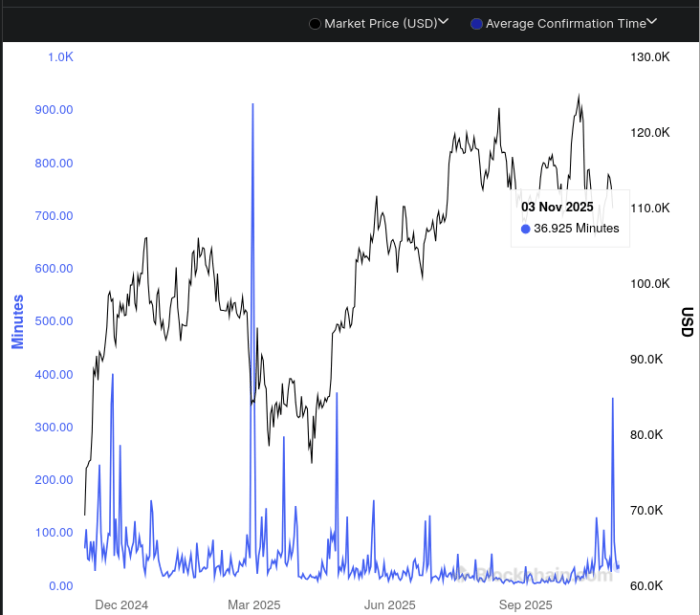
Bitcoin transaction confirmation time
Source: Blockchain.com

Moreover, limited programmability further constrains builders, as Bitcoin lacks the flexible smart contract logic that powers lending markets, DEXs and gaming on other chains.

This also means developers either accept narrow functionality or move liquidity away from $BTC to access modern tooling.

As a result, $BTC liquidity often leaves the network via wrapped assets and custodial bridges, fragmenting collateral and adding counterparty risk. This is the core DeFi gap on Bitcoin today.

The net effect is a split where Bitcoin captures savings like a digital gold while the activity layer lives elsewhere.

Projects that bridge this gap must increase speed and lower costs without weakening Bitcoin’s final settlement or adding custodial risks that negate decentralization benefits.

Bitcoin Hyper ($HYPER) proposes a Layer 2 that keeps Bitcoin for settlement while moving execution to a high throughput environment. Transactions run on a fast virtual machine and are batched, then committed back to Bitcoin for finality.

Unlike external custodial bridges, Hyper uses a canonical, programmatic bridge verified by an SVM relay and commits state to Bitcoin L1, aiming to keep BTC activity consolidated above Bitcoin rather than scattered across external chains.

Specifically, the project integrates the Solana Virtual Machine so developers can deploy Rust smart contracts and run dApps at low latency. A canonical bridge locks $BTC on Layer 1 and mints equivalent assets on Layer 2, letting users move value in and out while retaining Bitcoin settlement.

If delivered, this real time Layer 2 could make payments, DeFi, NFTs and gaming on Bitcoin feel fast and inexpensive without sacrificing the assurances that make $BTC valuable.

📚 Read more about Bitcoin Hyper in our comprehensive guide.

How Bitcoin Hyper Works And Why It Matters for Bitcoin’s Future

Bitcoin Hyper’s design centers on a performant execution layer plus a Canonical Bridge. Users deposit $BTC to a monitored address, proofs of the deposit are verified by an SVM program, and equivalent wrapped $BTC is minted on the Layer 2.

Activity happens with near instant finality, while batches are periodically committed back to Bitcoin. This keeps the Layer 2 state synchronized with Layer 1 security.

This flow aims to deliver speed and low fees without divorcing from Bitcoin-native settlement.
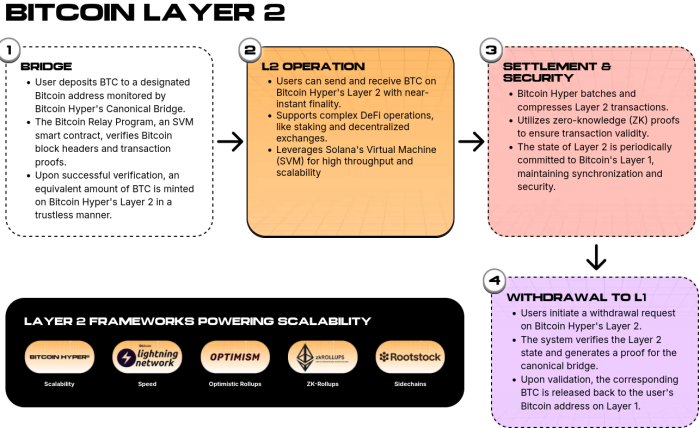
Bitcoin Hyper utility overview on the official presale site.

The whitepaper highlights an SVM environment optimized for low latency and supporting decentralized exchanges, lending, payments, NFTs and games.

Developers will get Rust tooling and a planned SDK and API to accelerate integrations, while users pay gas in $HYPER inside the ecosystem.

But utility extends beyond raw throughput, as $HYPER powers transaction fees, staking access and ecosystem permissions. And best of all, $HYPER is positioned to fund developer grants so teams can ship early dApps on the network.

The Layer 2 validator network uses proof of stake to process transactions while anchoring to Bitcoin for settlement, which keeps energy use low relative to Bitcoin itself because only batched commitments touch Layer 1.

For users who value sustainability, this is a practical side benefit.

Holding $HYPER puts you at the forefront of this new Layer-2 development, as it’s the main currency to be used in the ecosystem.

The presale has now raised almost $26M, with one whale $130K just an hour ago. In fact, the project has seen massive attention from crypto whales over the months:

In recent months, Bitcoin Hyper has been hailed as one of 2025’s most promising presales, especially since it follows in Bitcoin’s footsteps. It might just become one of the next crypto to explode at this rate.

Our guide on buying $HYPER will help you join the presale in 4 simple steps.

One token is now priced at $0.013225, with the next price increase in one day. Joining now will give you an early-bird edge over others, and coupled with the dynamic 45% staking APY, the potential profits are clear.

Get your $HYPER now before the next price increase!

Authored by Ben Wallis, Bitcoinist – https://bitcoinist.com/bitcoin-hyper-to-soar-fastest-bitcoin-layer2-presale

Disclaimer: This is informational content, not financial advice. Always do your own research on audits, tokenomics, staking terms and bridge risks before purchasing.

Editorial Process for bitcoinist is centered on delivering thoroughly researched, accurate, and unbiased content. We uphold strict sourcing standards, and each page undergoes diligent review by our team of top technology experts and seasoned editors. This process ensures the integrity, relevance, and value of our content for our readers.

Ben is a freelance writer specializing in crypto developments (mainly altcoins) and the intricate ways global economics shape the digital asset space. His B.Ed. in Education provides a unique foundation for his writing, enabling him to distill complex crypto concepts and market shifts into clear, digestible insights. This skill is key to helping readers adapt and apply their understanding to the ever-evolving world of crypto investment. Passionate about making crypto accessible, Ben crafts content designed to educate a broad audience, from current market events to the essential foundational knowledge that underpins them. His goal is to empower readers through understanding. When he’s not immersed in crypto analysis and breaking down complex topics, Ben is an avid Pokémon fan and enjoys all things Disney.

Похожее

The Paradox of Automation: The Stronger the AI, the Busier Humans Become

The Paradox of Automation: The more powerful AI becomes, the more work humans have to do. This article, based on observations from AI-heavy company Every, argues that while AI agents automate tasks like coding, writing, and customer service, they don't eliminate human jobs. Instead, they transform work and create *more* demand for human expertise. AI commoditizes "yesterday's human capabilities" by cheaply generating code, text, and images from past data. This leads to an abundance of similar, generic outputs. Consequently, what becomes scarce and valuable is human judgment in the present moment: knowing *what* is worth doing, *why*, and *how* to do it well. The article identifies two collaboration models: "Agent employees" for delegated tasks and "human-AI collaboration" within tools like Claude Code for complex work. In both cases, humans are essential to set direction, judge quality, and maintain systems. As AI makes execution cheap, human roles shift from executors to designers, reviewers, and meaning-makers. The author addresses "benchmark anxiety" by explaining that AI excels within specific, human-defined problem "frames." As AI masters one frame (e.g., code rewriting), new, more complex frames emerge (e.g., deciding *when* to rewrite). This creates an ongoing cycle where AI chases the frames, but humans remain the "framers." Even with advanced AGI, this dynamic may persist as long as AI lacks true human-like agency and self-directed purpose. The core paradox holds: automation amplifies the need for the very human judgment it seems to replace.

marsbit17 мин. назад

The Paradox of Automation: The Stronger the AI, the Busier Humans Become

marsbit17 мин. назад

a16z: 7 Charts to Understand How Tokenization is Changing the Nature of Assets

"a16z: 7 Charts on How Tokenization is Changing the Nature of Assets" Tokenized Assets (or Real-World Assets - RWA) are transforming asset forms, liquidity, and financial system construction. The market recently surpassed $30 billion, stabilizing around $34 billion (excluding stablecoins), representing a tenfold increase in less than two years, driven by clearer regulations, mature institutional infrastructure, and increased financial institution adoption. The primary driver of recent growth is tokenized U.S. Treasury bonds. These offer investors efficient, flexible digital access to yield-bearing assets and improve institutional operations like settlement and collateral management. Other asset classes show varied growth: asset-backed credit leads, followed by niche financial assets (e.g., reinsurance, mining notes), while venture capital took longer to scale. Market segmentation shows high concentration. In commodities, tokenized gold dominates (~$5 billion), as its standardized, storable nature fits tokenization well. Bonds are the largest category ($15.2B), but only ~5% are used in DeFi protocols. Conversely, smaller niches like reinsurance tokens see high (~84%) on-chain utilization, highlighting a core industry divide: most current tokenized assets are merely digitized records for easier holding/transfer, lacking the "composability" (free combination/interaction) that is key to blockchain-native finance. The ecosystem is distributed across multiple blockchains, with Ethereum hosting over half the value ($15.7B), followed by BNB Chain, Solana, and others. Future market size predictions vary widely (e.g., $2-$30 trillion by 2030+), but all indicate massive potential from the current small base. Tokenized assets currently represent minuscule fractions of their global counterparts (e.g., 0.01% of global bonds). The current phase focuses on digitizing straightforward assets. The next challenge is to bring more complex financial components on-chain and deeply integrate tokenized assets into composable, internet-native financial infrastructure.

链捕手58 мин. назад

a16z: 7 Charts to Understand How Tokenization is Changing the Nature of Assets

链捕手58 мин. назад

a16z: How Tokenization is Transforming the Nature of Assets in 7 Charts

"Tokenized Assets: How Tokenization Changes the Nature of Assets" by a16z Crypto The market for tokenized assets, excluding stablecoins, has grown from under $3 billion two years ago to over $340 billion today. US Treasury bonds are the primary growth driver, allowing investors to hold yield-bearing assets digitally and enabling more efficient settlement. Other key sectors include private credit (growing fastest), commodities (dominated by gold), and niche financial assets. However, the market remains concentrated in tokenized US Treasuries and gold. A critical insight is that most tokenized assets currently lack "composability." While the total market is large, only a small fraction is actively used within DeFi protocols. For instance, only about 5% of tokenized bonds and a low percentage of tokenized gold are utilized on-chain. In contrast, assets like reinsurance and private credit tokens show much higher on-chain usage rates (84% and 33%, respectively). This highlights a divide: many tokenized assets are merely digital records on a blockchain without enabling new, programmable financial applications. The Pantera Capital Token Native Index indicates over 70% of tokenized assets have minimal on-chain native functionality. Ethereum remains the dominant blockchain for tokenized assets (over $150B), but the ecosystem is diversifying across chains like BNB Chain, Solana, and Stellar, based on factors like cost and compliance. Major institutions forecast massive future growth, with predictions for the tokenized asset market ranging from $2 trillion to over $30 trillion by the early 2030s. However, compared to the global financial system (e.g., ~$140T bonds, multi-trillion dollar gold market), tokenized assets currently represent a tiny fraction (0.01% or less). The conclusion is that while tokenization has begun by digitizing and streamlining settlement for simpler assets, the next phase involves bringing more complex financial instruments on-chain and deeply integrating them into composable, internet-native financial infrastructure.

Odaily星球日报1 ч. назад

a16z: How Tokenization is Transforming the Nature of Assets in 7 Charts

Odaily星球日报1 ч. назад

The Revived Codex, Carrying OpenAI's Hopes for IPO

This article analyzes the intense recent development of OpenAI's Codex, positioning it as a crucial component for OpenAI's impending IPO. Over the past two months, Codex has seen a rapid series of major updates focused on integrating into real enterprise workflows. Key new features include enhanced context capture (Appshots, file previews, built-in browser), long-running task execution ("Goal Mode"), remote operation (phone control, lock-screen access), and enterprise management tools (plugin sharing, access tokens, automated risk review). These updates aim to make Codex a comprehensive AI workbench that can "see the scene, push tasks, and manage risks." The author argues that while ChatGPT proves OpenAI's massive user base and API provides foundational revenue, Codex represents OpenAI's clearest path to demonstrating tangible, high-value commercial viability. It targets developers and engineering teams—a segment already accustomed to paying for efficiency gains in costly software development cycles. This is critical because, despite higher overall revenue, OpenAI's adjusted operating margins remain deeply negative, highlighting the challenge of outrunning immense compute costs. The pressure is amplified by competitor Anthropic's success with Claude Code, which has shown that a focused approach on high-value enterprise and developer workflows can lead to a path toward profitability. Codex's aggressive evolution is thus seen as OpenAI's strategic move to capture a similar enterprise-ready, revenue-generating narrative essential for its market debut. In essence, "ChatGPT proved OpenAI has users. Codex needs to prove OpenAI is a business that can make money."

marsbit2 ч. назад

The Revived Codex, Carrying OpenAI's Hopes for IPO

marsbit2 ч. назад

a16z: 7 Charts to Understand How Tokenization Is Changing the Nature of Assets

a16z: 7 Charts on How Tokenization is Transforming the Nature of Assets Tokenized Assets, often referred to as "real-world assets" (RWA), are altering the form, flow, and structure of the financial system. The market recently surpassed $30 billion (excluding stablecoins), driven largely by tokenized U.S. Treasuries. These offer investors digital, yield-bearing assets with efficient settlement. Growth varies significantly by asset class. Asset-backed credit leads in speed, followed by niche financial assets, while venture capital and active strategies took longer to scale. U.S. Treasuries and commodities dominate, holding about two-thirds of the current market share. Within commodities, gold tokenization dominates entirely due to its standardization and historical appeal in crypto. The ecosystem is spread across multiple blockchains. Ethereum holds over half the market, with others like BNB Chain, Solana, and Stellar holding significant shares. However, a key insight is that most tokenized assets currently lack "composability." While the total market is large, only a small fraction (e.g., 5% of tokenized bonds) is used within DeFi protocols. Many tokens are simply digital records of off-chain assets, not natively programmable financial building blocks. In contrast, smaller categories like reinsurance tokens see very high on-chain usage. Looking ahead, forecasts for the tokenized asset market by 2030 range from $2 trillion to over $30 trillion, representing immense potential growth from today's ~$340 billion base. Yet, relative to global markets (e.g., $140T+ in bonds), tokenization's penetration remains minuscule (<0.02%). The current phase focuses on digitizing straightforward assets for efficiency. The next major challenge is bringing more complex financial instruments on-chain and integrating tokenized assets into truly composable, internet-native financial infrastructure.

marsbit2 ч. назад

a16z: 7 Charts to Understand How Tokenization Is Changing the Nature of Assets

marsbit2 ч. назад

Торговля

Спот
Фьючерсы

Популярные статьи

Что такое DOGE M

Doge Matrix ($doge m): Новая порода криптовалюты, управляемой сообществом Введение В постоянно развивающемся мире криптовалют новые проекты постоянно появляются, каждый из которых стремится привлечь интерес инвесторов и энтузиастов. Одним из последних участников этой области является Doge Matrix, представленный тикером $doge m. Этот проект привлек внимание благодаря своим корням в популярной мем-культуре, окружающей Dogecoin, и занял свое место в пространстве web3. Эта статья направлена на предоставление всестороннего анализа Doge Matrix, охватывающего его обзор, создателя, инвесторов, функциональность, временную шкалу и примечательные аспекты. Что такое Doge Matrix ($doge m)? Doge Matrix — это проект криптовалюты, управляемый сообществом, который, по-видимому, основывается на широкой привлекательности Dogecoin, цифровой валюты, известной своим маскотом Шиба Ину и мем-истоками. Хотя общие цели Doge Matrix не определены в широком смысле, он характеризуется стремлением к вовлечению и поддержке сообщества. В отличие от традиционных криптовалют, которые часто подчеркивают полезность или внутреннюю ценность через базовые технологии, Doge Matrix позиционирует себя в пространстве, которое охватывает культурный феномен криптовалют, особенно привлекая тех, кто резонирует с этосом активов на основе мемов. Опираясь на сильные стороны сообщества Dogecoin, Doge Matrix функционирует как часть более широкой экосистемы, приглашая участие и вовлеченность пользователей, которые разделяют интерес к криптовалюте и цифровому пространству. Кто является создателем Doge Matrix ($doge m)? Личность создателя Doge Matrix остается неизвестной. Эта нехватка прозрачности не является редкостью в пространстве криптовалют, где некоторые проекты запускаются без раскрытия личностей своих основателей. Отсутствие информации о команде основателей может вызывать вопросы у потенциальных инвесторов о подотчетности и направлении проекта. Кто являются инвесторами Doge Matrix ($doge m)? На данный момент нет общедоступной информации, подробно описывающей инвесторов или инвестиционные фонды, поддерживающие Doge Matrix. Проект, похоже, в основном полагается на поддержку сообщества, а не на институциональные инвестиции. Эта модель соответствует управляемой сообществом природе инициативы, способствуя созданию среды, в которой направление проекта формируется его участниками, а не диктуется избранными финансовыми спонсорами. Как работает Doge Matrix ($doge m)? Специфика операционных механизмов Doge Matrix несколько расплывчата, отражая более широкую тенденцию проектов в пространстве мем-коинов, где инновационные функции не всегда четко сформулированы. Тем не менее, Doge Matrix, похоже, разработан для того, чтобы использовать существующую экосистему криптовалют, поощряя участие пользователей и опираясь на знакомые культурные ссылки, связанные с Dogecoin. Его потенциально уникальные характеристики происходят от взаимодействий сообщества, а не от технологических достижений, подчеркивая общие переживания и сотрудничество среди держателей токенов. Хотя точные инновации не были явно изложены, проект, похоже, создает пространство, где члены сообщества могут взаимодействовать, делиться идеями и продвигать потенциал проекта вперед. Временная шкала Doge Matrix ($doge m) Обзор временной шкалы проекта выявляет значимые события, которые определили его путь до сих пор: 25 ноября 2024 года: Doge Matrix достиг своего исторического максимума, что стало значительной вехой в его ранней истории. 1 января 2025 года: Напротив, Doge Matrix достиг своего исторического минимума, иллюстрируя волатильность, часто ассоциируемую с криптовалютами, особенно на ранних стадиях жизненного цикла проекта. В процессе: Проект продолжает активно торговаться и поддерживаться своим сообществом, хотя конкретные будущие вехи или цели еще не были раскрыты. Ключевые моменты о Doge Matrix ($doge m) Ориентированность на сообщество В центре Doge Matrix лежит стремление к вовлечению сообщества. Проект процветает на основе сотрудничества и общих целей среди своих участников, подчеркивая важность коллективных усилий. В отличие от централизованных проектов, которые часто имеют четкую структуру руководства, Doge Matrix в настоящее время демонстрирует более гибкий подход к управлению, где голос каждого члена сообщества имеет значение. Волатильность Криптовалютный рынок известен своей волатильностью, и Doge Matrix не является исключением. Его история цен отражает значительные колебания между высокими и низкими значениями, что типично для многих новых криптовалют, но подчеркивает риски, связанные с инвестициями в новые токены. Нехватка детальной информации Одной из самых поразительных особенностей Doge Matrix является нехватка детальной информации о его технологических основах и операционных механизмах. Эта неопределенность требует от потенциальных инвесторов проведения тщательной проверки перед взаимодействием с проектом. Заключение В заключение, Doge Matrix ($doge m) иллюстрирует новую волну проектов криптовалют, которые сильно полагаются на вовлечение сообщества и культурную значимость. Хотя проект и не хватает некоторых конкретных деталей — таких как четкое руководство, определенные цели и детальная функциональность — он сумел вызвать интерес в крипто-сообществе, используя установленную привлекательность мем-культуры. Как и в случае с любыми инвестициями в пространстве криптовалют, понимание присущих рисков и проведение комплексного исследования являются необходимыми для потенциальных участников. Doge Matrix служит напоминанием о динамичной, иногда непредсказуемой природе криптоиндустрии, отмеченной постоянной эволюцией и энтузиазмом в отношении инициатив, управляемых сообществом.

639 просмотров всегоОпубликовано 2025.02.03Обновлено 2025.02.03

Что такое DOGE M

Что такое $M

Понимание Mantis ($M): Новая эра в кросс-цепной интероперабельности В постоянно развивающемся ландшафте Web3 и криптовалют новые проекты стремятся предложить инновационные решения, направленные на улучшение пользовательского опыта и расширение функциональных возможностей в рамках децентрализованной финансовой экосистемы. Один из таких проектов, привлекающих внимание, — Mantis ($M), пионерский протокол, основанный на принципах кросс-цепной интероперабельности и расчетов на основе намерений. Эта статья углубляется в основные аспекты Mantis, включая его основную функциональность, создателей, инвестиционную поддержку, инновационные функции и ключевые вехи. Что такое Mantis ($M)? Mantis описывается как протокол расчетов по намерениям в нескольких доменах, который упрощает кросс-цепные взаимодействия, позволяя пользователям без труда выполнять сложные финансовые транзакции на различных блокчейн-платформах. Протокол работает через три основных уровня: Выражение намерений: Пользователи могут формулировать свои цели транзакций на естественном языке с помощью DISE LLM, продвинутой модели AI. Например, пользователь может выразить желание обменять Ethereum (ETH) на Solana (SOL) с определенной допустимой проскальзыванием в 1%. Исполнение: Этот уровень использует сеть решателей, которые конкурируют за выполнение намерений пользователей. Транзакции выполняются с использованием таких механизмов, как совпадение желаний (CoWs) и аукционы потока заказов (OFAs), которые обеспечивают оптимальное удовлетворение потребностей пользователей. Расчет: Используя протокол межблокчейн-коммуникации (IBC), Mantis позволяет атомарные кросс-цепные транзакции, позволяя пользователям работать на различных поддерживаемых цепях, включая Ethereum, Solana и Cosmos. Mantis разработан для введения родного генерации дохода для неактивных активов, используя криптографические доказательства для поддержания целостности транзакций на протяжении всего процесса. Создатели и команда разработки Mantis был задуман Composable Foundation, исследовательской организацией, известной своим акцентом на решениях для блокчейн-интероперабельности. Этот фонд сотрудничает с уважаемыми академическими учреждениями, включая Гарвардский университет и Университет Лиссабона, внося вклад в обширные исследования и разработки, которые информируют архитектуру и функциональность Mantis. Обязательство Composable Foundation по содействию инновациям в области блокчейна позиционирует Mantis как надежное решение для растущего спроса на интероперабельность среди множества блокчейн-сетей. Инвесторы и поддержка Хотя конкретные детали о частных инвесторах не были публично раскрыты, Mantis пользуется значительной поддержкой от различных организаций, включая: Гранты экосистемы от цепей с поддержкой IBC, которые поддерживают рост протокола и его интеграцию в экосистемы децентрализованных финансов. Стратегические партнерства с поставщиками инфраструктуры, которые усиливают сетевые возможности Mantis и стратегии развертывания. Финансирование через казну Composable Foundation, обеспечивая устойчивую финансовую поддержку для продолжающейся разработки и операционных расходов. Эти совместные усилия отражают консенсус среди заинтересованных сторон о важности улучшения кросс-цепной функциональности и потенциальной полезности инфраструктурных инноваций Mantis. Ключевые инновации Mantis выделяется благодаря нескольким пионерским инновациям, которые улучшают его функциональность и полезность: Независимые от цепи намерения: Пользователи могут инициировать транзакции с любой поддерживаемой цепи, при этом расчет происходит на другой. Эта гибкость дает пользователям больше возможностей, способствуя увеличению взаимодействия между различными платформами. Интерфейс на базе AI: Интеграция DISE LLM позволяет пользователям проводить сложные операции DeFi на естественном языке, тем самым упрощая взаимодействия и делая технологии блокчейн доступными для более широкой аудитории. Кросс-доменное захватывание MEV: Mantis создает внутренний рынок для максимальной извлекаемой ценности (MEV) через конкуренцию между решателями. Этот инновационный подход позволяет достичь большей эффективности и извлечения ценности в сложных транзакциях. Модульный уровень расчетов: Протокол поддерживает различные методы верификации, включая нулевые доказательства и оптимистичные роллапы, предоставляя универсальную структуру, которая может адаптироваться к новым технологиям блокчейна. Историческая хронология Разработка Mantis отмечена несколькими критическими вехами, которые определяют его траекторию и рост: | Год | Веха | |————|———————————————————————–| | 2022 | Начальная разработка концепции в исследовательском подразделении Composable Foundation. | | Q3 2024 | Запуск тестовой сети с возможностями мостов между Solana и Ethereum. | | Q1 2025 | Ожидаемое событие генерации токенов (TGE) наряду с запуском основной сети. | | Q2 2025 | Ожидаемая интеграция DISE LLM и расширение кросс-цепных возможностей. | | 2025 H2 | Запланированная поддержка более 15 цепей через дальнейшие обновления IBC. | Эта хронология описывает эволюцию Mantis, от концептуальных обсуждений до активной реализации и будущих этапов роста. Стратегия роста экосистемы Стратегия Mantis по росту экосистемы включает несколько инициатив, направленных на поощрение участия пользователей и вовлечения разработчиков: Система кредитов: Пользователи могут зарабатывать кредиты протокола, предоставляя ликвидность и участвуя в реферальных программах. Эти кредиты можно будет обменять на стимулы в будущем, способствуя формированию активного сообщества пользователей. Модульный комплект для разработки программного обеспечения (SDK): Этот инструмент позволяет разработчикам создавать приложения на основе моделей, управляемых намерениями, используя инфраструктуру Mantis, тем самым способствуя инновациям в его экосистеме. Модель управления: По мере взросления протокола держатели токенов $M получат возможность участвовать в управлении протоколом, позволяя им голосовать за предлагаемые обновления и изменения, тем самым усиливая вовлеченность сообщества и децентрализацию. Mantis представляет собой значительный шаг вперед в области кросс-цепной архитектуры. Путем бесшовной интеграции продвинутых алгоритмов AI с надежной расчетной структурой Mantis стремится решить проблемы фрагментации в многоцепных экосистемах. Его инновационный подход приоритизирует улучшение пользовательского опыта, соблюдая при этом основные принципы децентрализации и безопасности, устанавливая новый стандарт для будущей интероперабельности технологий блокчейн. По мере того как Mantis продолжает свой путь роста и реализации, он обещает стать проектом, за которым стоит внимательно следить в конкурентной среде Web3 и децентрализованных финансов. С акцентом на преодоление границ и повышение вовлеченности пользователей Mantis готов стать неотъемлемой частью будущих разработок в области криптовалют.

54 просмотров всегоОпубликовано 2025.03.18Обновлено 2025.03.18

Что такое $M

Как купить M

Добро пожаловать на HTX.com! Мы сделали приобретение MemeCore (M) простым и удобным. Следуйте нашему пошаговому руководству и отправляйтесь в свое крипто-путешествие.Шаг 1: Создайте аккаунт на HTXИспользуйте свой адрес электронной почты или номер телефона, чтобы зарегистрироваться и бесплатно создать аккаунт на HTX. Пройдите удобную регистрацию и откройте для себя весь функционал.Создать аккаунтШаг 2: Перейдите в Купить криптовалюту и выберите свой способ оплатыКредитная/Дебетовая Карта: Используйте свою карту Visa или Mastercard для мгновенной покупки MemeCore (M).Баланс: Используйте средства с баланса вашего аккаунта HTX для простой торговли.Третьи Лица: Мы добавили популярные способы оплаты, такие как Google Pay и Apple Pay, для повышения удобства.P2P: Торгуйте напрямую с другими пользователями на HTX.Внебиржевая Торговля (OTC): Мы предлагаем индивидуальные услуги и конкурентоспособные обменные курсы для трейдеров.Шаг 3: Хранение MemeCore (M)После приобретения вами MemeCore (M) храните их в своем аккаунте на HTX. В качестве альтернативы вы можете отправить их куда-либо с помощью перевода в блокчейне или использовать для торговли с другими криптовалютами.Шаг 4: Торговля MemeCore (M)С легкостью торгуйте MemeCore (M) на спотовом рынке HTX. Просто зайдите в свой аккаунт, выберите торговую пару, совершайте сделки и следите за ними в режиме реального времени. Мы предлагаем удобный интерфейс как для начинающих, так и для опытных трейдеров.

1.1k просмотров всегоОпубликовано 2025.07.02Обновлено 2025.07.02

Как купить M

Обсуждения

Добро пожаловать в Сообщество HTX. Здесь вы сможете быть в курсе последних новостей о развитии платформы и получить доступ к профессиональной аналитической информации о рынке. Мнения пользователей о цене на M (M) представлены ниже.

活动图片