Ethereum Developer Consensys Inches Closer To IPO: Report

bitcoinistОпубликовано 2025-10-30Обновлено 2025-10-30

Введение

Consensys, the Ethereum infrastructure firm best known for building the MetaMask wallet and the Infura developer toolkit, has quietly taken...

Trusted Editorial content, reviewed by leading industry experts and seasoned editors. Ad Disclosure

Consensys, the Ethereum infrastructure firm best known for building the MetaMask wallet and the Infura developer toolkit, has quietly taken the next formal step toward going public, selecting JPMorgan and Goldman Sachs to lead work on a planned initial public offering, according to Axios. The move places one of the most systemically important companies in the Ethereum ecosystem on a path toward public market scrutiny and capital access after nearly a decade of operating as a privately held, founder-controlled Web3 software company.

Ethereum’s Consensys Gears Up For IPO

The reported bank mandate is the clearest signal so far that Consensys is positioning itself to test US equity markets in the post-2024 regulatory environment, and comes as crypto companies have re-opened the IPO window in 2025 after two years of near-total freeze. Axios reported that JPMorgan and Goldman Sachs have been tapped to run the offering, a role traditionally reserved for deals that are expected to command institutional interest at scale. While neither timeline nor targeted valuation has been formally disclosed, Axios indicated that Consensys is working toward a listing as early as 2026.

Consensys did not confirm an imminent S-1 filing but acknowledged that it is actively evaluating capital markets options. “Consensys is constantly exploring opportunities to expand its impact,” the company told Decrypt when asked about the IPO report. “While we continuously evaluate strategic options for growth, we have nothing to announce at this time.”

A Consensys IPO would be structurally different from the wave of crypto listings that defined the last cycle. Rather than a centralized exchange, a miner, or a pure-play trading proxy, Consensys is an infrastructure and tooling company embedded in Ethereum’s execution layer. The firm develops MetaMask, the self-custody wallet that has, for years, functioned as a default retail access point to Ethereum and EVM-compatible networks, and Infura, the backend service used by hundreds of thousands of developers to route blockchain queries and broadcast transactions without running their own nodes.

MetaMask has been repeatedly described by Consensys as having tens of millions of monthly active users, and Infura processes billions of requests per day for applications that rely on reliable RPC infrastructure. That combination gives Consensys direct exposure to core on-chain activity rather than speculative token price action, which is likely to be a central part of the pitch to public market funds that want revenue tied to Ethereum’s usage rather than just its volatility.

Regulatory posture is a critical part of that story. In February 2025, the US Securities and Exchange Commission informed Consensys that it would move to dismiss its lawsuit over MetaMask’s staking features, walking back allegations that the company had acted as an unregistered broker. The agency’s reversal effectively removed a material overhang on one of Consensys’ most commercially sensitive products, and it did so against the backdrop of a broader softening in crypto enforcement tone under the Trump administration.

Consensys last raised external capital in March 2022, when it closed a $450 million Series D led by ParaFi Capital with participation from Temasek, SoftBank’s Vision Fund 2, Microsoft, and others, valuing the company at roughly $7 billion post-money.

The timing of Consensys’ reported IPO push also lines up with a broader re-entry of crypto names into US public markets in 2025. Stablecoin issuer Circle listed in June at a valuation in the high single-digit billions, while exchange operator Bullish won a New York Stock Exchange listing in August.

At press time, ETH traded at $3,907.
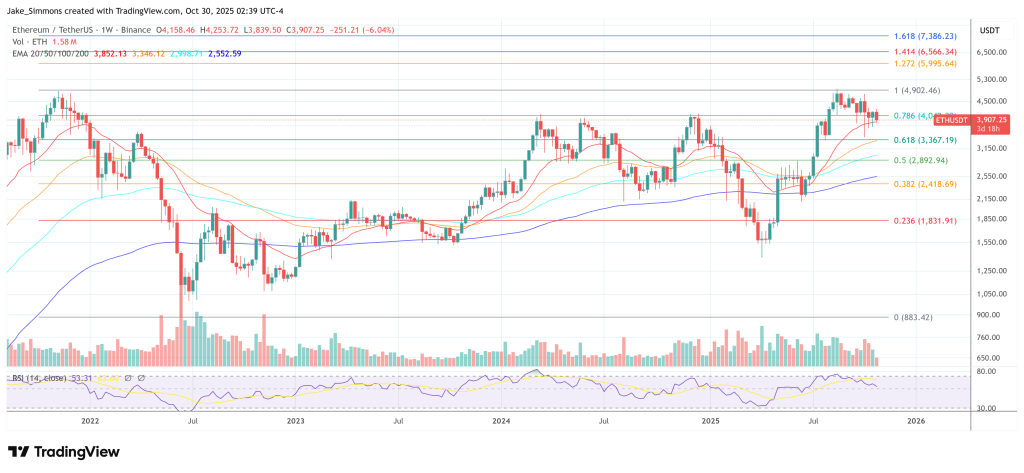
Ethereum price
ETH slips below the 0.786 Fib again, 1-week chart | Source: ETHUSDT on TradingView.com
Featured image created with DALL.E, chart from TradingView.com
Editorial Process for bitcoinist is centered on delivering thoroughly researched, accurate, and unbiased content. We uphold strict sourcing standards, and each page undergoes diligent review by our team of top technology experts and seasoned editors. This process ensures the integrity, relevance, and value of our content for our readers.

Jake Simmons has been a Bitcoin enthusiast since 2016. Ever since he heard about Bitcoin, he has been studying the topic every day and trying to share his knowledge with others. His goal is to contribute to Bitcoin's financial revolution, which will replace the fiat money system. Besides BTC and crypto, Jake studied Business Informatics at a university. After graduation in 2017, he has been working in the blockchain and crypto sector. You can follow Jake on Twitter at @realJakeSimmons.

Похожее

DeFi Has Reached Its Most Dangerous Moment: The Real Vulnerabilities Are Not in the Code

DeFi in Peril: The Real Vulnerability Isn't in the Code April 2026 marked a paradigm shift in DeFi security, with over $625 million lost across 30 incidents—the worst month in crypto history by event count. Crucially, none of the major exploits (Drift Protocol: $285M, KelpDAO: $292M, Wasabi Protocol: $4.5M) resulted from smart contract vulnerabilities. Instead, failures occurred in the operational "plumbing": social engineering to compromise multi-signature councils, a single-point-of-failure 1-of-1 bridge validator, and stolen admin private keys. These events expose a fundamental misalignment: the industry's security model has long focused on code audits, while the actual attack surface has shifted to privileged access points and off-chain infrastructure. The article introduces the term "OpenFi" to describe this reality: permissionless, on-chain, yet operationally dependent on trusted third parties (admins, validators, oracles) at key junctures. The KelpDAO exploit vividly demonstrated asymmetric "contagion risk." A configuration error in a smaller protocol triggered a panic, causing approximately $13.2 billion in outflows from larger, unaffected protocols like Aave within 48 hours, as users fled uncertain collateral. The core dilemma is the double-edged sword of centralization. Operational levers like emergency councils (e.g., Arbitrum freezing stolen funds post-KelpDAO) enable crisis response but also create catastrophic attack surfaces if compromised (e.g., Drift). The path forward demands radical honesty: protocols must clearly disclose their trust assumptions, operational levers, and failure modes. The industry must treat operational security (key management, configurations, incident response) with the same rigor as code security. Survival depends on building systems whose risks can be understood, priced, and insured, moving beyond the outdated "code is law" mantra to a mature model of disclosed and managed trust.

链捕手20 мин. назад

DeFi Has Reached Its Most Dangerous Moment: The Real Vulnerabilities Are Not in the Code

链捕手20 мин. назад

Vitalik's Article Emphasizes Ethereum Must Be 'Amazing', But Foundation Is Not the Center

Vitalik Buterin has published a lengthy response to recent community criticism directed at the Ethereum Foundation (EF). Acknowledging a sense of "unease," he addresses concerns about the EF's strategic direction, its perceived disconnect from ETH's price performance, and calls for its reduced central role. Vitalik rejects the notion that the EF should be the central governing body of Ethereum, framing it instead as one "node with a clear mandate" among many within the ecosystem. He highlights the EF's limited ETH holdings (≈0.16% of supply) compared to other blockchain foundations and states it will no longer sell significant amounts of ETH. Its future focus will be on long-term, critical projects that align with Ethereum's core values of censorship-resistance and decentralization, which might not otherwise happen. A core argument is that Ethereum must be "amazing," but not by merely chasing higher transaction speeds at the cost of decentralization. He proposes focusing on the "CROPS" dimensions: creating a Cryptographically provable, Reliable, Open, Private, and Secure network. This includes pursuing goals like a formally verifiable, bug-free Ethereum client and minimizing protocol-level reliance on intermediaries. The article concludes by noting that while Vitalik clarifies the EF's refocused role, he does not directly address community suggestions for creating a new organization explicitly aligned with ETH's economic interests. This "alignment gap" is presented as a key challenge for Ethereum's future.

链捕手31 мин. назад

Vitalik's Article Emphasizes Ethereum Must Be 'Amazing', But Foundation Is Not the Center

链捕手31 мин. назад

Galxe: How a Quest Platform Evolved into Web3's Growth Infrastructure

Galxe, once perceived as a simple Web3 quest platform, has evolved into a core growth infrastructure within the Web3 ecosystem. It addresses a fundamental Web3 growth dilemma: the lack of a mature, systematic user acquisition and retention system akin to Web2's advertising and analytics platforms. While users complete quests (social tasks, on-chain interactions) for rewards, Galxe's true innovation lies in transforming these fragmented, one-off actions into lasting, verifiable identity credentials. This process of *behavioral assetization* creates a persistent record of a user's activities across projects and chains. For users, their wallet accumulates a valuable history that can unlock future access and rewards, fostering a "profile-building" mentality. For projects, Galxe provides a pre-screened user pool with rich behavioral data, enabling targeted outreach to users based on their specific on-chain history and community engagement. Galxe employs a gamefied growth path, guiding users from low-friction social tasks into deeper, valuable on-chain interactions through a structured progression of quests. This solves the incentive-behavior mismatch common in Web3, filtering users by their willingness to engage. Beyond quests, products like Passport (identity verification) and Starboard (community analytics) position Galxe as a comprehensive growth operating system. The platform's defensible advantage is its self-reinforcing data and network flywheel: more projects attract more users, enriching behavioral data; richer data enables better user targeting, attracting more projects. Ultimately, Galxe is shifting Web3's growth logic from short-term "reward-driven" traffic towards a long-term "identity-driven" relationship model, where a user's accumulated on-chain履历 becomes a core asset.

marsbit38 мин. назад

Galxe: How a Quest Platform Evolved into Web3's Growth Infrastructure

marsbit38 мин. назад

Торговля

Спот
Фьючерсы

Популярные статьи

Manyu: восходящая мем-звезда на Ethereum, готовая открыть новую эру культуры Shiba

Manyu - это мемтокен на Ethereum, который приносит децентрализованную культурную и развлекательную ценность через вирусное влияние в соцсетях и вовлечённость сообщества.

1.9k просмотров всегоОпубликовано 2025.11.27Обновлено 2025.11.27

Manyu: восходящая мем-звезда на Ethereum, готовая открыть новую эру культуры Shiba

Неделя обучения по популярным токенам 14: Glamsterdam — самое ожидаемое обновление Ethereum в 2026 году

Ordinals/Runes по-прежнему стимулируют доходы от комиссий за блоки и активность разработчиков, рассматриваются как отправная точка «нативной эмиссии активов» в сети.

1.4k просмотров всегоОпубликовано 2026.04.29Обновлено 2026.04.29

Неделя обучения по популярным токенам 14: Glamsterdam — самое ожидаемое обновление Ethereum в 2026 году

Обсуждения

Добро пожаловать в Сообщество HTX. Здесь вы сможете быть в курсе последних новостей о развитии платформы и получить доступ к профессиональной аналитической информации о рынке. Мнения пользователей о цене на ETH (ETH) представлены ниже.

活动图片