Key Takeaways
- Solana’s Alpenglow (SIMD-0326) enters community voting.
- The proposal would cut transaction finality from 12.8 seconds to ~150 milliseconds.
- If passed, Solana could rival Visa and Mastercard in speed, opening doors for real-time DeFi, gaming, and institutional use cases.
Solana (SOL) has taken a major step toward reshaping its core infrastructure.
The network’s latest consensus overhaul, known as Alpenglow (SIMD-0326), has entered the community voting phase—a test of whether Solana is ready to trade its current framework for near-instant block finality.
If approved, the proposal could compress transaction settlement from today’s 12.8 seconds to just 150 milliseconds, putting Solana in the same league as Visa and Mastercard for processing speed.
The Mechanics of Alpenglow
Developed by Anza, a Solana research group, the Alpenglow update proposes a departure from the blockchain’s existing Proof-of-History and TowerBFT systems.
At its core is Votor, a direct-vote protocol that allows validators to notarize or skip blocks off-chain, with compact proofs submitted on-chain.
Blocks would finalize in a single round with 80% validator approval, or in a second round with 60% approval.
The system is designed to achieve sub-second confirmation while keeping validator costs predictable.
Alpenglow introduces a 1.6 SOL per-epoch fee, roughly 80% of today’s vote costs, with funds burned to offset SOL inflation.
Validators risk losing rewards—or even removal from the active set—if they abstain or submit contradictory votes.
Some in the community have suggested tiered fees based on stake size to ensure fairness across participants.
Where the Vote Stands
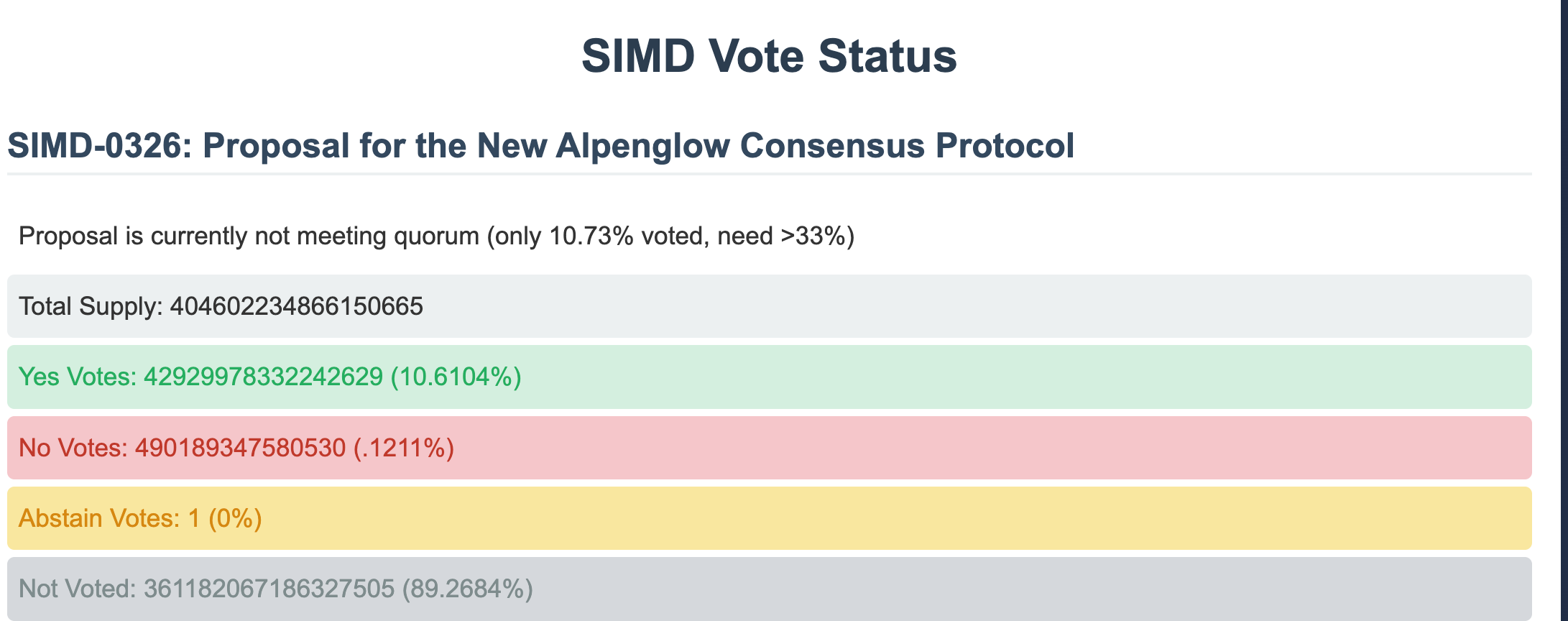
Community voting, which runs from Epoch 840 through 842 (roughly four days total), requires a two-thirds majority to pass.
As of Epoch 840, voter turnout hovered near 11%, with overwhelming support: 10.6% in favor versus just 0.12% opposed.
While turnout is still early, the direction suggests strong backing from developers and validators, many of whom see Alpenglow as the breakthrough needed to make Solana competitive for real-time finance, gaming, and high-frequency applications.
Why It Matters For Solana
The blockchain industry has long wrestled with a trade-off: decentralization slows networks down, while centralization sacrifices trust for speed.
Alpenglow is Solana’s answer to that dilemma.
By compressing block finality to fractions of a second, it promises not only to rival traditional financial rails but to expand what decentralized applications can realistically achieve.
If passed, Solana would cement its reputation as the blockchain most willing to push consensus boundaries, offering a glimpse of how next-generation networks could finally meet institutional and consumer expectations for scale.