Falling Tides

insights.glassnodeОпубликовано 2025-02-18Обновлено 2025-02-26

Executive Summary

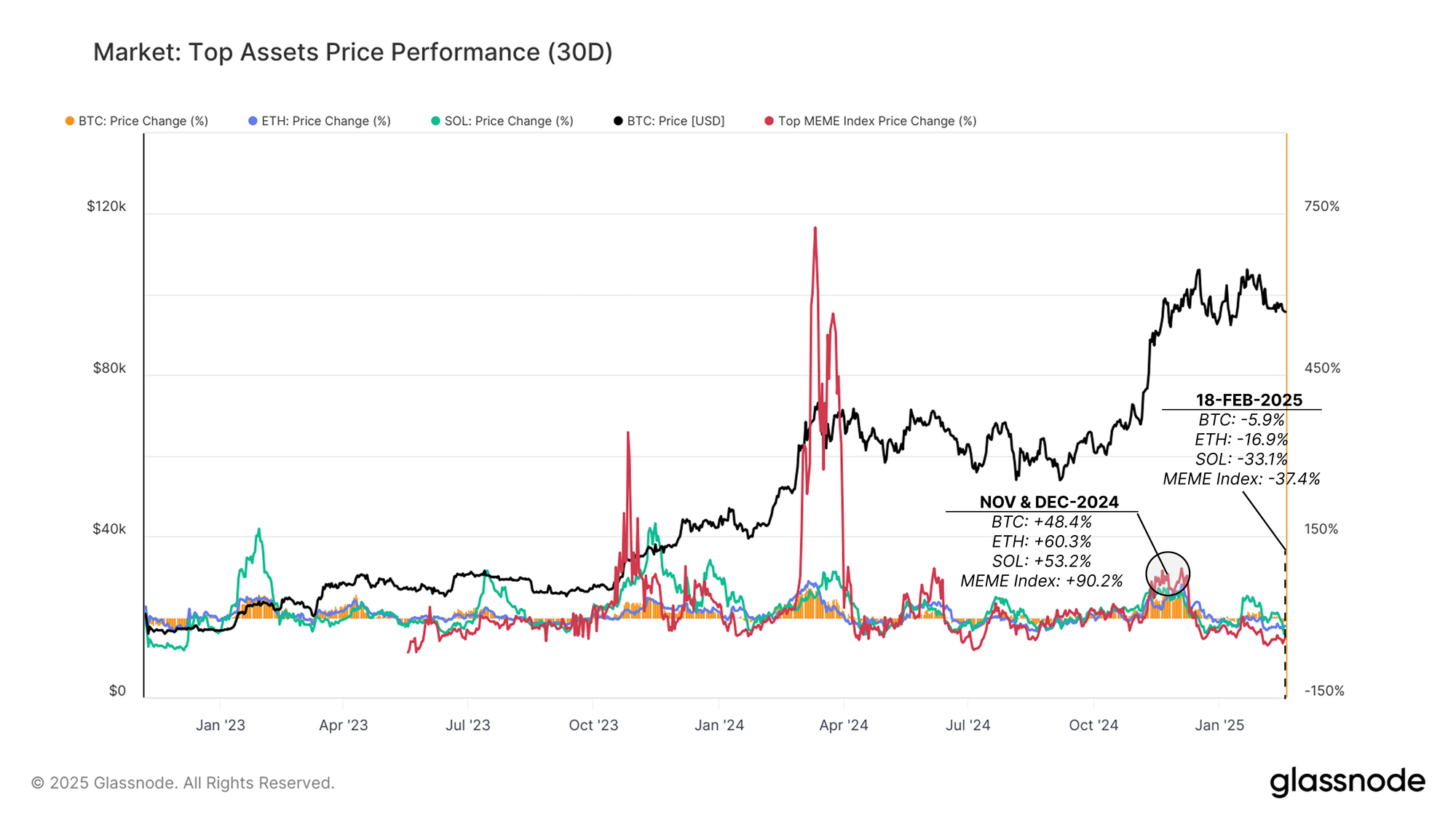
  • After Bitcoin’s second attempt to break above $105k in late January, the market has entered a contraction phase, with monthly price momentum sharply declining across major assets.
  • Bitcoin has held relatively steady, while Ethereum, Solana, and Memecoins have faced much deeper corrections, reflecting a shifting appetite for risk.
  • Solana has emerged as a market leader in capital inflows over the past two years, in contrast to Ethereum, which has comparatively struggled to attract sustained demand.
  • However, this week, all digital assets aside from Bitcoin have seen a dramatic decline in capital flows, with Solana, and its associated memecoin ecosystem taking a relatively large hit.
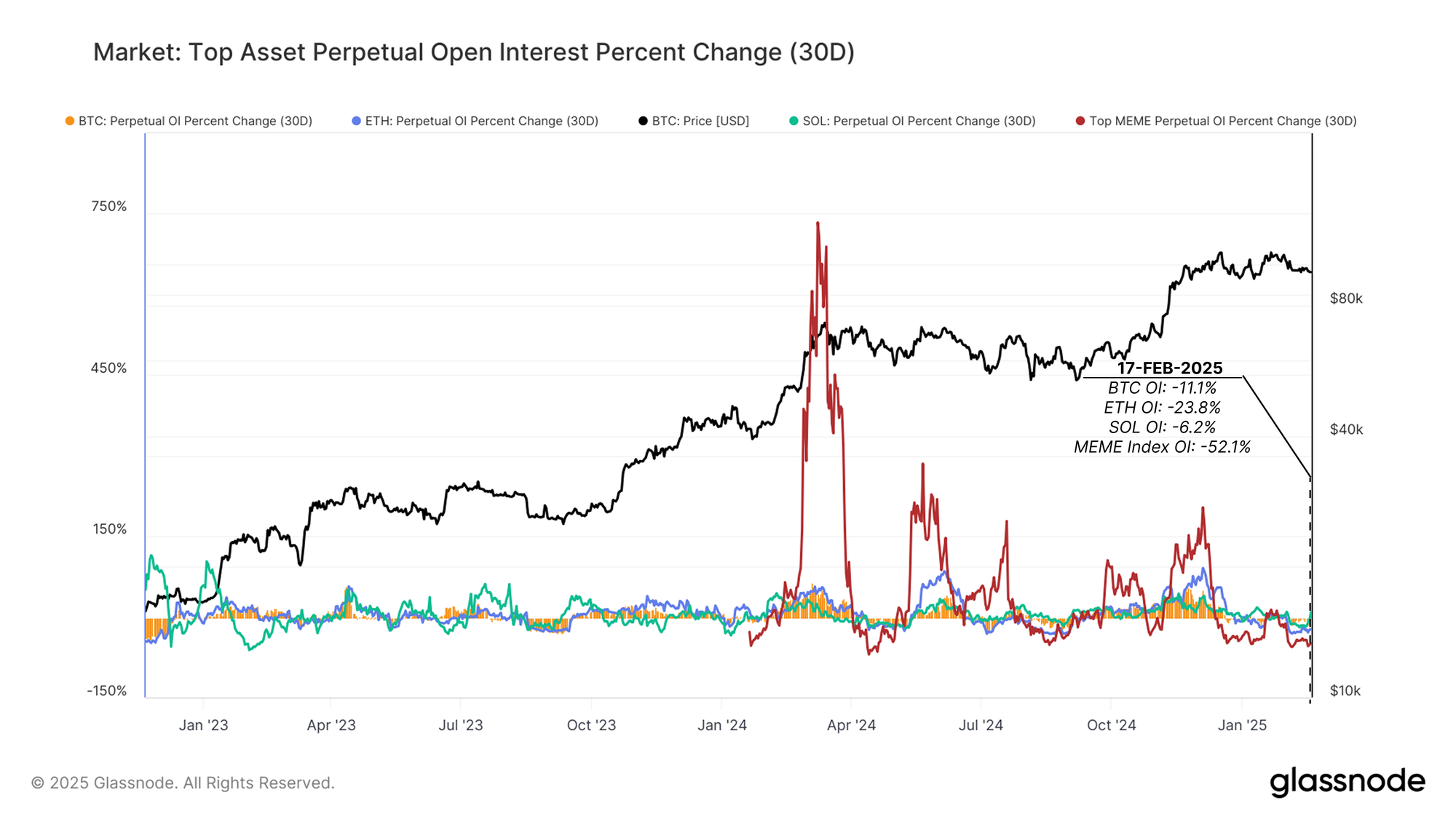
  • Perpetual futures open interest has declined across Bitcoin (-11.1%), Ethereum (-23.8%), Solana (-6.2%), and Memecoins Index (-52.1%), reflecting a diminished appetite for leveraged speculation.
💡
View all charts in this edition in The Week On-chain Dashboard.

Market Momentum Takes a Breather

The Bitcoin market attempted to rally above the ATH, and back into price discovery in late January 2025. This rally, however, could not achieve the necessary momentum, and the market has entered into a period of contraction and consolidation since then, with price momentum sharply declining across major assets.

  • Bitcoin: +48.4% (Nov 2024) → -5.9% (Feb 2025)
  • Ethereum: +60.3% (Dec 2024) → -16.9% (Feb 2025)
  • Solana: +53.2% (Nov 2024) → -33.1% (Feb 2025)
  • Meme Coins Index: +90.2% (Dec 2024) → -37.4% (Feb 2025)

Notably, Memecoins and Solana have thrived during strongly trending market conditions but also tend to correct sharply during downturns. Ethereum has remained one of the weakest performers throughout this cycle, and whilst it has outperformed Solana this week, a robust trend of out-performance has not yet been established.
Live Chart

Assessing Performance So Far

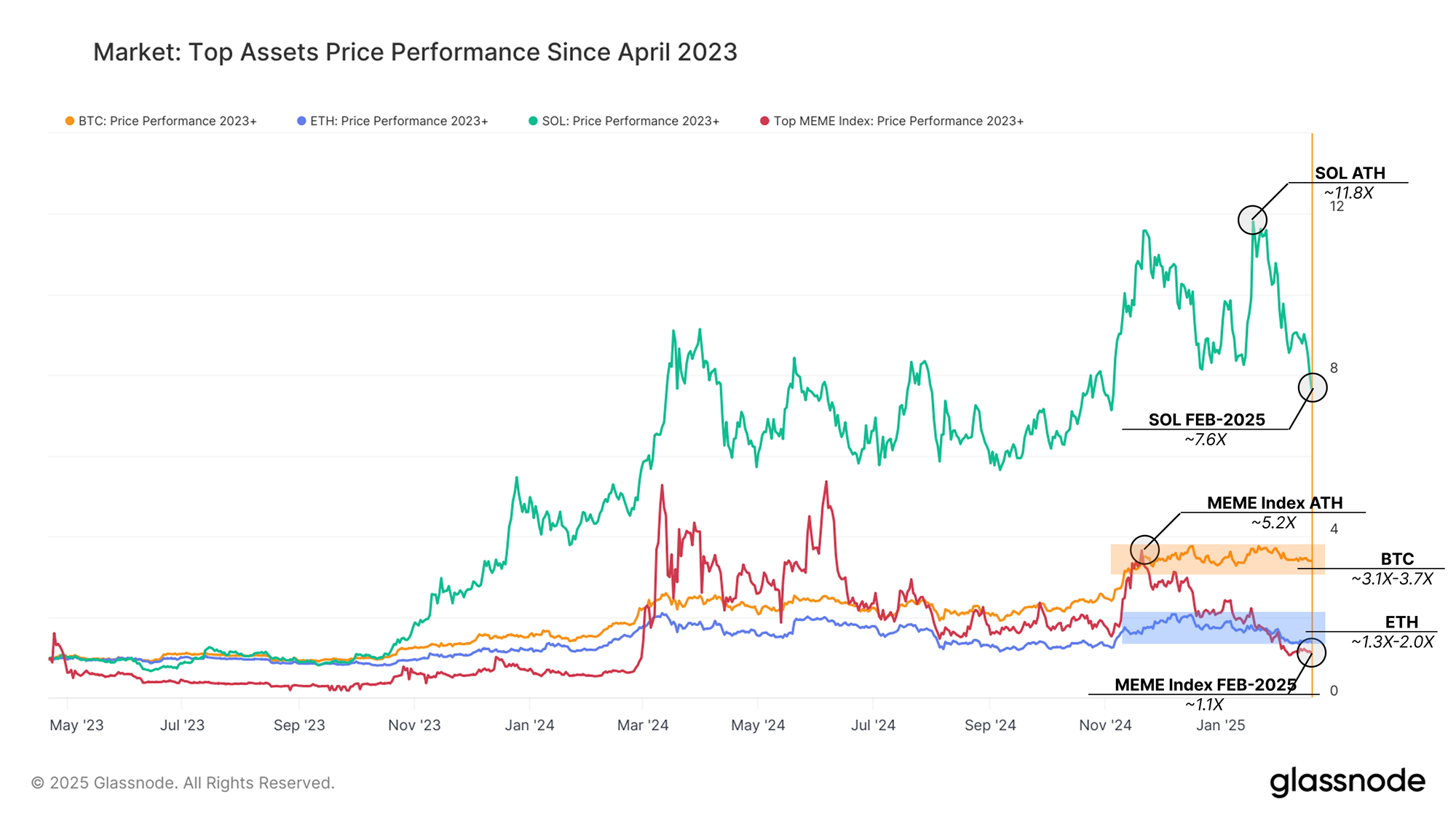
The recent slowdown comes after an extended period of strong gains across the major digital assets. Looking at the performance since early 2023, we can see clear differentiation in how each asset has navigated the cycle so far:

  • Bitcoin is trading within a range approximately 3.4x higher than April 2023, providing a benchmark return profile.
  • Ethereum has struggled compared to its peers, ranging between 1.3X and 2.0X relative to April 2023.
  • Solana's returns since 2023 peaked at 11.8x in early January 2025, but have since dropped sharply to around 7.6x as the current correction took hold.
  • Memecoins Index: Saw an explosive uptick in prices in mid-2024, largely aligned with Solana’s out-performance, and peaking 5.2X since 2023. However, recent weeks have seen this sector get hit quite severely, with total performance now being the worst out of the four assets.

This provides a view of Solana’s high-beta nature, where it has experienced both the strongest upside and also the sharpest corrections. Bitcoin’s steadier trajectory highlights its resilience as a benchmark return profile for the digital asset space. Memecoins, in particular, have seen a marked decline in investor demand of late, suggesting there has been a change in risk appetite.
Live Chart

Capital Flows Drive Markets

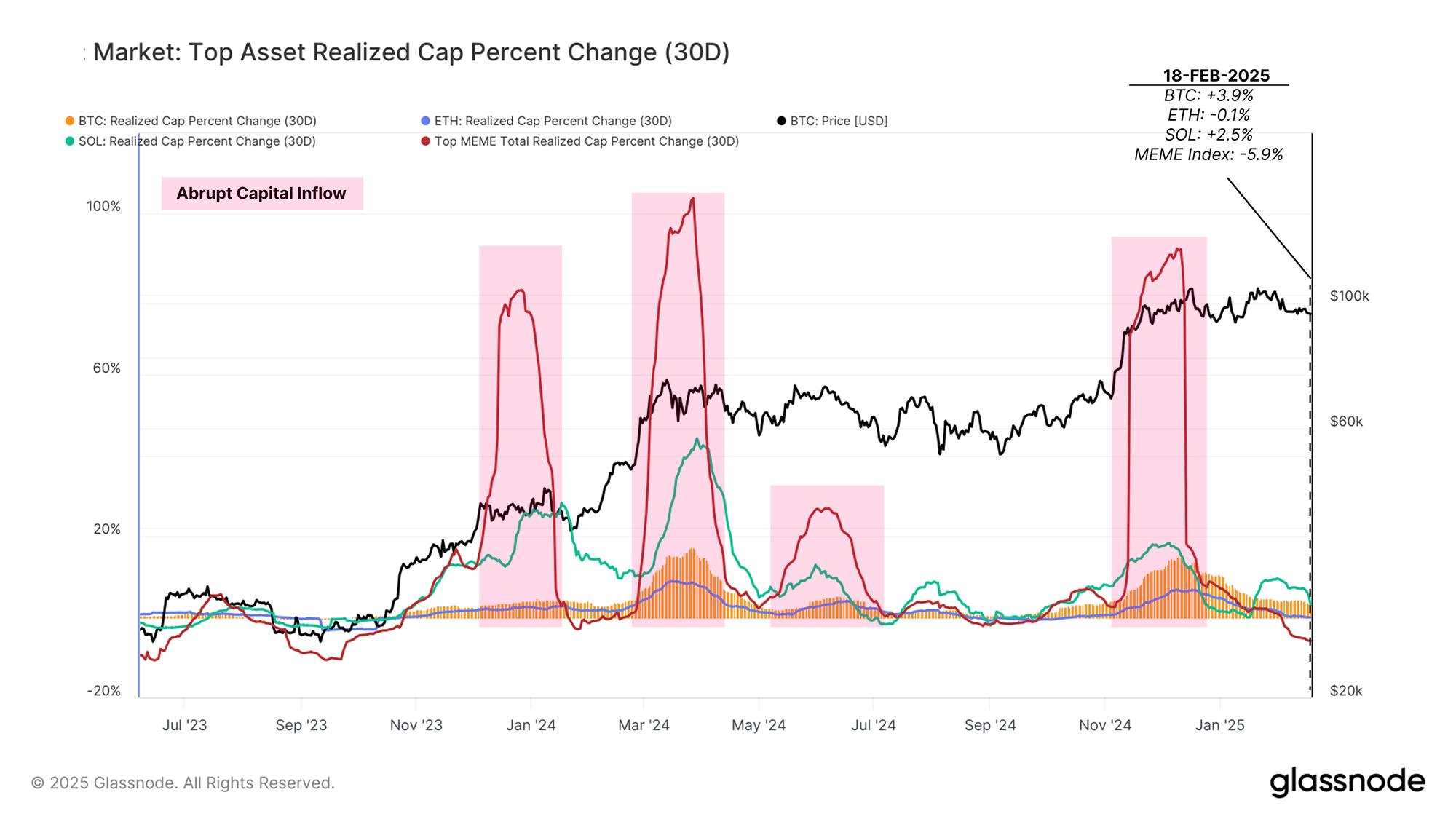
The strong out-performance of Solana over the last two years aligns with a persistent capital inflow from investor demand. Looking at the monthly change in the realized cap, we can see clear patterns in capital movement across various digital assets:

  • Solana: Has consistently attracted higher relative capital inflows, supporting its strong price appreciation.
  • Ethereum: Has seen the weakest capital net inflow out of the majors, explaining its relative underperformance.
  • Memecoins: Experienced several abrupt but unsustainable surges in capital inflow, reflecting speculative bursts, but without sustained momentum.

However, in recent weeks, the momentum of capital inflows has declined for all digital assets. Notably, Ethereum and Top Memecoins have now flipped negative (capital outflows), with Ethereum facing a -0.1% net outflow from the Realized Cap and Memecoins Index seeing an even sharper -5.9% outflow.

This signals a meaningful cooling down in speculative appetite and alludes to a potential for capital rotation out of riskier assets on the road ahead.
Live Chart

Weakness In Futures Markets

As momentum starts to fade in spot markets, we can also see a decline in capital inflows within the perpetual futures market. The cooling of demand on the spot side has led to a sharp drop in perpetual open interest (OI) across all major assets, signalling a reduction in speculative activity and lower cash and carry yields.

Over the last 30 days, the rate of change in open interest highlights a widespread retreat of capital:

  • Bitcoin OI: -11.1%
  • Ethereum OI: -23.8%
  • Solana OI: -6.2%
  • Memecoins OI: -52.1%

This trend of declining open interest across the board suggests that speculators are reducing their leveraged exposure, likely in response to weaker market momentum and increasing market uncertainty. The most extreme decline is seen in Memecoins, which tend to attract more short-term leveraged bets but lose traction quickly whenever sentiment weakens.
Live Chart

Funding Rates Signal Bearish Sentiment

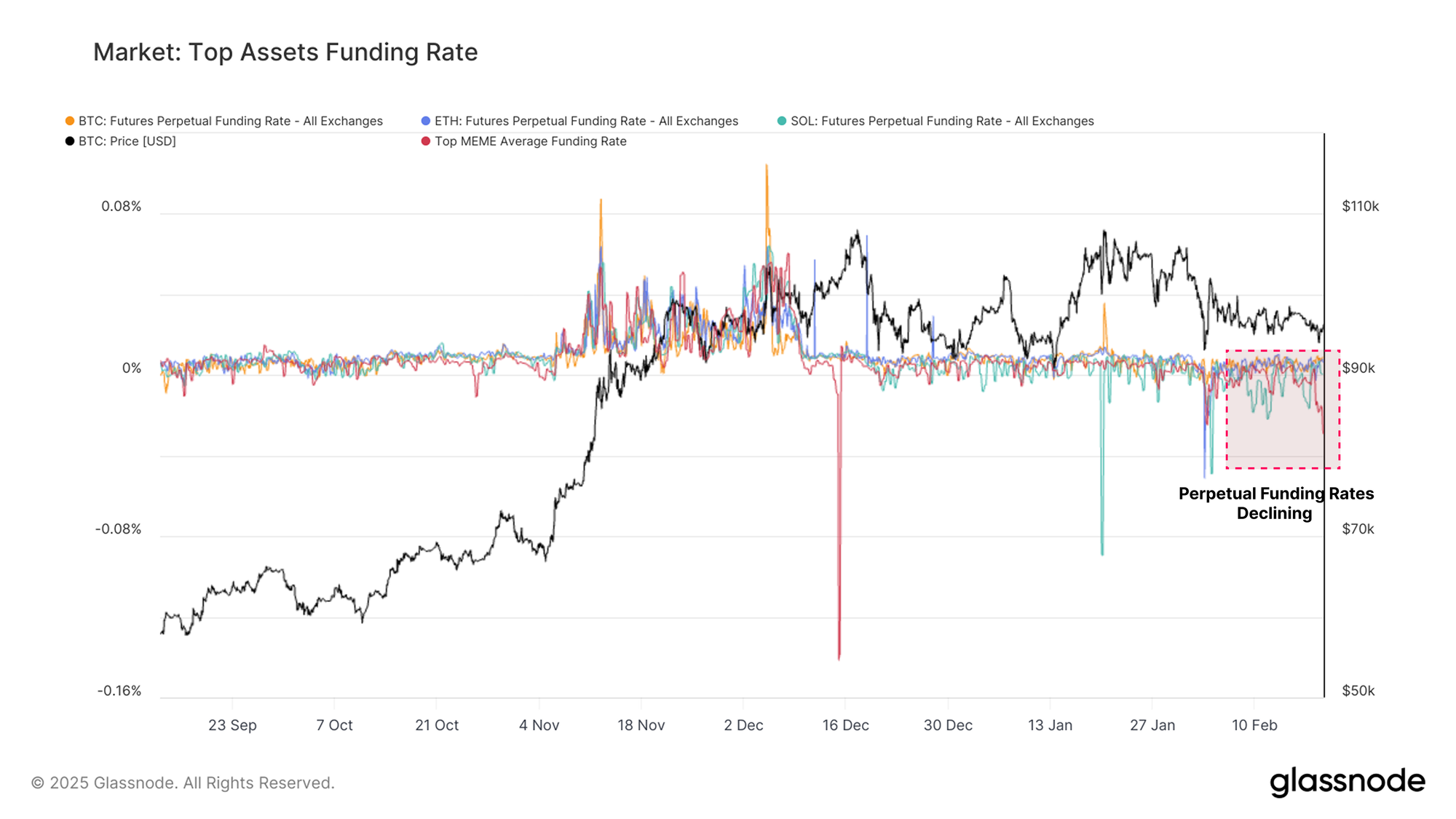
The weakening in open interest is further reinforced by a decline in perpetual futures funding rates. This reflects a shift toward more bearish sentiment and an unwinding of leveraged positions, particularly in riskier assets.

  • Bitcoin and Ethereum funding rates remain slightly positive, and their deeper liquidity profile tends to see positive funding rates except during sharp leverage wash-out events.
  • Solana funding rate have edged lower and have traded negative in recent weeks, signalling a cooling off of demand for long speculative positions.
  • Memecoins have seen funding rates turn very negative, indicating that shorts now dominate in these highly speculative assets, and many traders are closing their positions (or being liquidated).

Negative funding rates for Solana and Memecoins suggest a net shift towards bearish sentiment in higher-risk assets and a closing out of excessive long-sided leverage.
Live Chart

ETF Flows and Market Impact

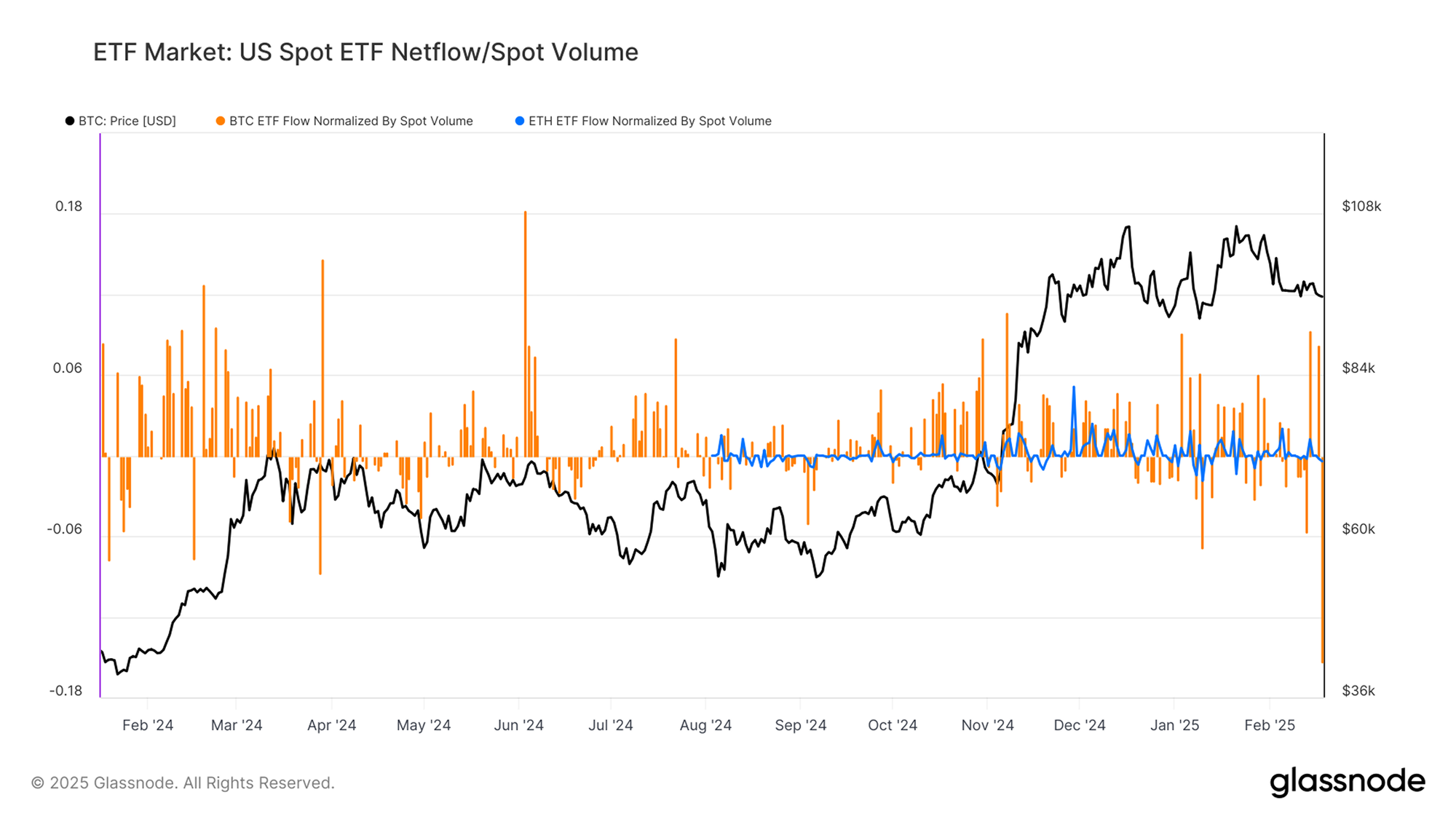
With the market in a contraction phase, institutional interest in Bitcoin and Ethereum has slowed based on spot ETF flows. By normalizing net inflows against each asset’s native spot volume, we can gauge the weight and influence of the ETFs on market dynamics.

  • Bitcoin ETFs saw several outflows exceeding $200M/day last week, however this was followed by a strong rebound in buy-side activity, exceeding 8% of global spot volume, and highlighting institutional demand (akin to ‘buy the dip’ behavior).
  • Ethereum ETF demand has cooled significantly and remains much smaller in scale compared to Bitcoin. ETF activity for ETH is hovering close to zero in terms of net flows in and out, suggesting a lack of strong traditional investor demand and participation.

This divergence has been a theme of this market cycle thus far and reinforces Bitcoin’s dominant role within the institutional asset mix. Ethereum continues to struggle to attract large, sustained inflows, which further explains its relative underperformance in recent years.
Live Chart

A Key Bull-Bear Threshold

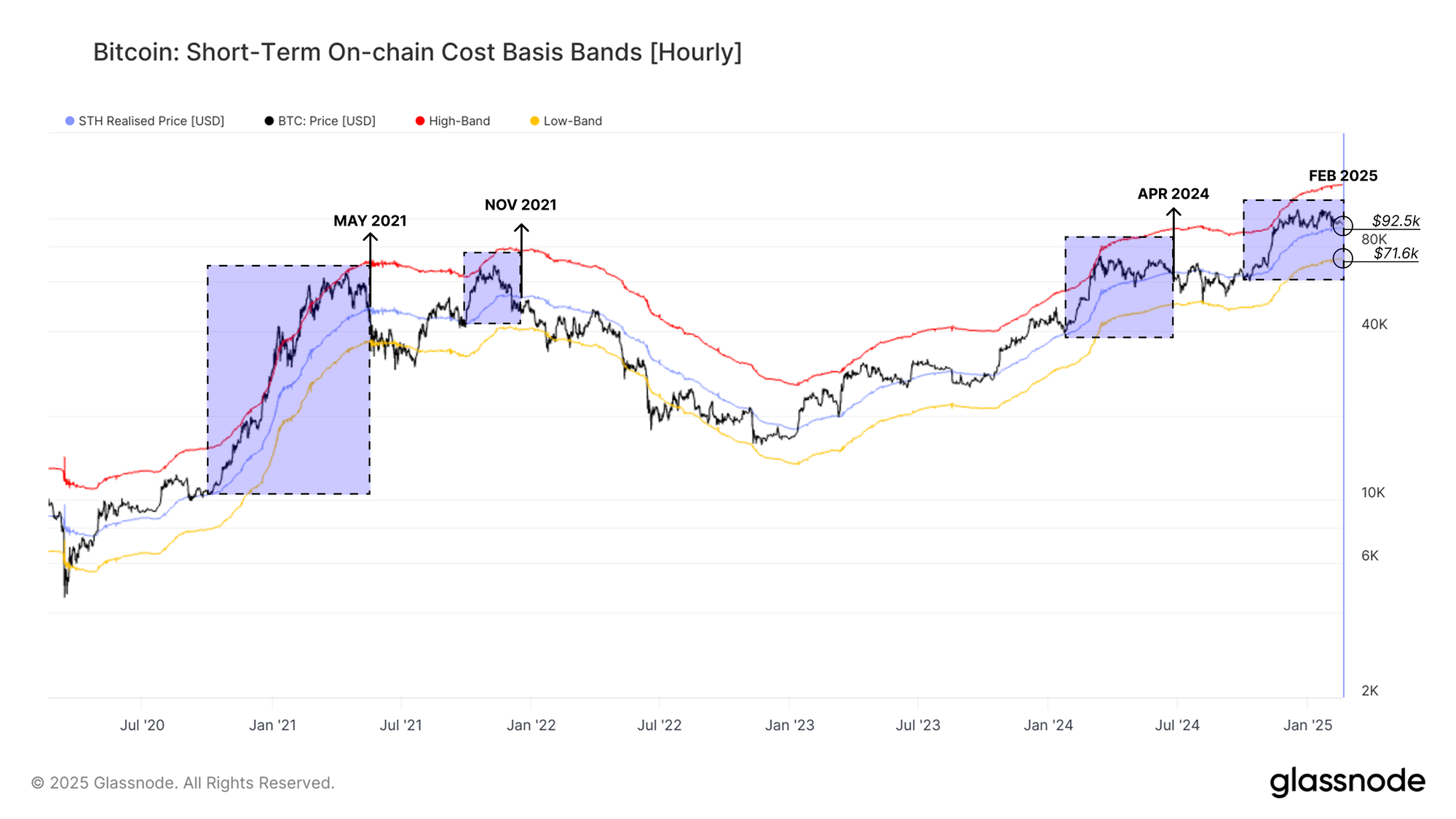
Bitcoin is currently trading $1k-$5k above the Short-Term Holder (STH) cost basis, located at $92.5k. Historically, this level has served as a key pivot point between local scale bull and bear phases, being the pivot point where the average recent buyer moves between a state of unrealized profit and loss.

Reviewing previous instances where Bitcoin reached a new ATH and then corrected lower, we can see a similar pattern in May 2021, Nov 2021, April 2024, and Feb 2024.

In each of these cases, the downtrend extended toward the lower band of the STH cost basis model, specifically -1 standard deviation (σ) below the cost basis. Currently, this lower band sits at $71.6K, helping frame up the potential downside risks should these historical patterns repeat.
Live Chart

Post ATH Consolidation

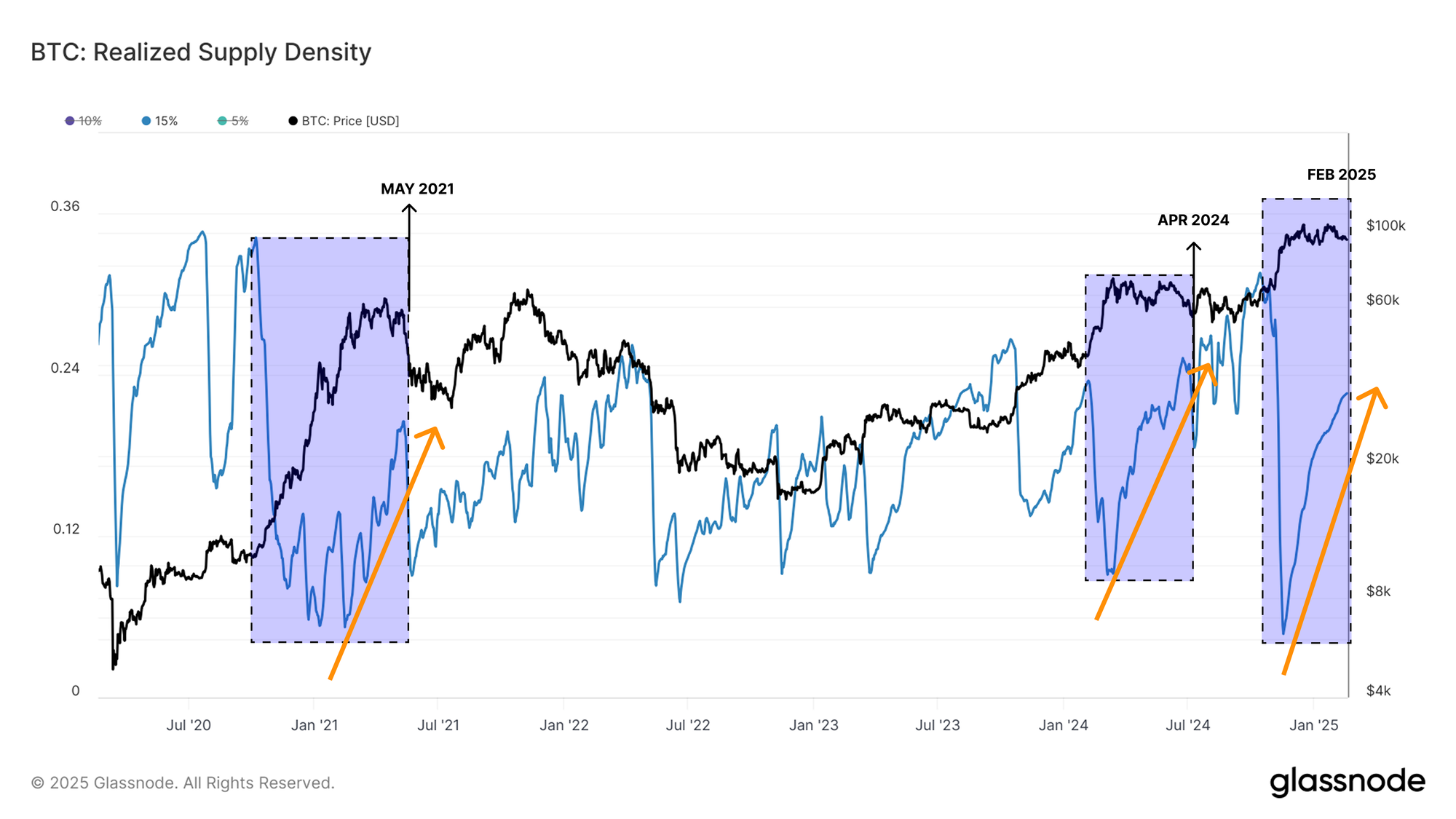
In prior instances where Bitcoin has reached a new ATH, we observe a consistent post-rally pattern, where a surge in realized supply density occurs within ±15% of the spot price. This results from the market transitioning from an aggressive uptrend into price consolidation, as the market trades within a relatively narrow range.

This behaviour is evident in previous cycle tops, where:

  • As the market rallies within price discovery, the realized supply density crashes lower all the way up to the price peak.
  • Market participants then begin redistributing coins as the market enters a correction or consolidation phase.
  • This often occurs close to the STH cost basis, as the conviction and demand profile of new investors is tested.

The current realized supply density aligns with a typical post-ATH consolidation phase, where buyers and sellers try to establish a new equilibrium before the next major trend unfolds.
Live Chart

Approaching a Decisive Market Moment

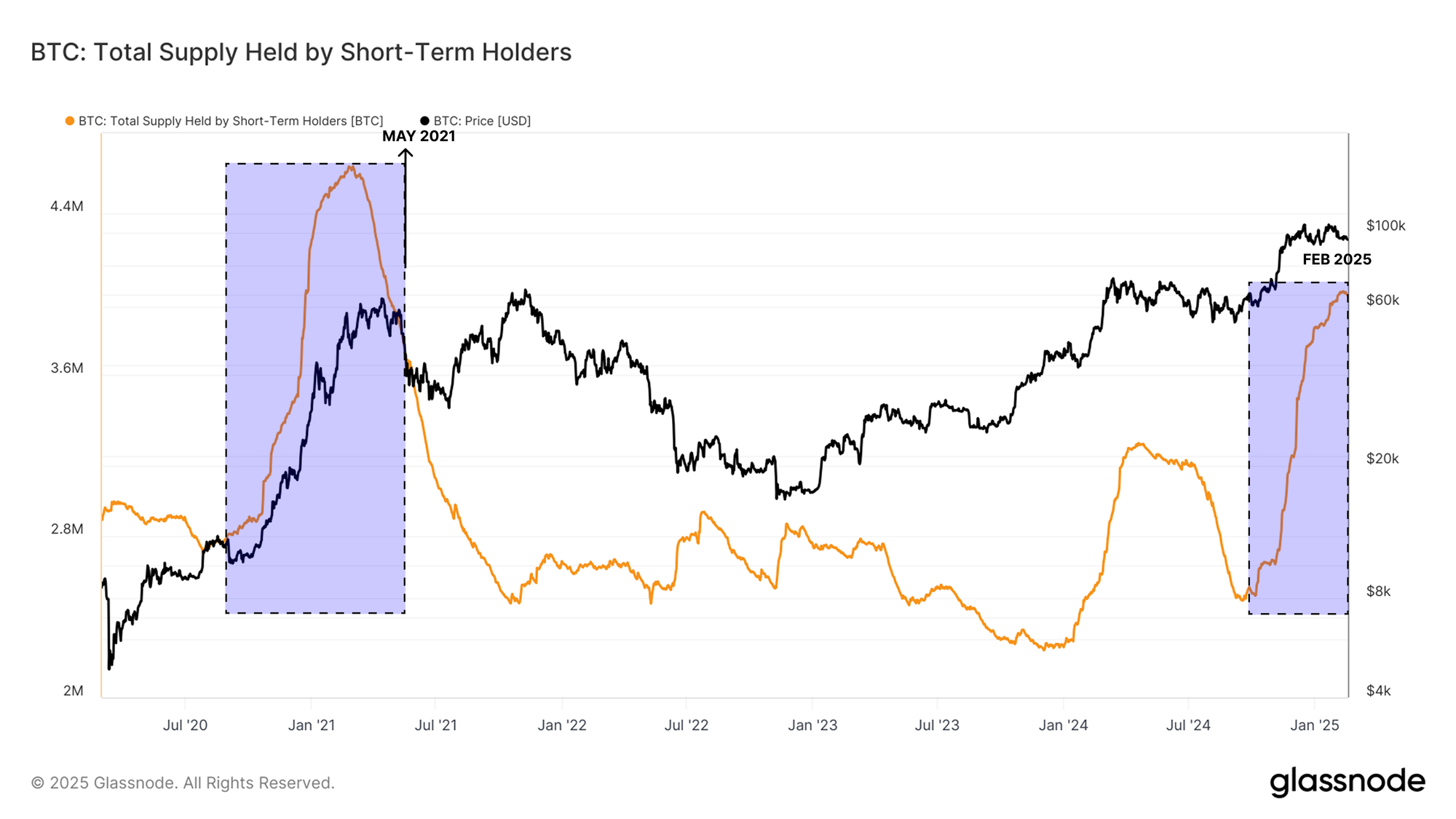
To better understand how sensitive the market is due to this supply density, we can analyze the supply held by short-term holders (STH) in recent post-ATH distribution phases. This helps gauge the patterns of new investor accumulation and whether current conditions resemble past cycle peaks.

When comparing STH supply changes, we observe:

  • The recent accumulation phase closely mirrors May 2021, suggesting a similarly large amount of supply, and investors will be sensitive to a price decline below $92.5k.
  • In April 2024, new investors also accumulated aggressively, but the magnitude of the STH supply uptrend in the current cycle structurally aligns more with May 2021 rather than 2024.

Given these similarities, we are now very close to a decisive moment in the market—a phase where price action is primed for uncoiling. If demand remains strong, Bitcoin could establish a new range above ATHs. However, a lack of sustained buy pressure could lead to a deeper distribution-driven correction, similar to prior post-ATH phases. This would likely be driven by panic amongst recent buyers who see their recently acquired coins move from being in profit to holding an unrealized loss.
Live Chart

Conclusion & Summary

Bitcoin has been consolidating around $95k for several weeks and is trading within a relatively stable range. The same cannot be said for the wider digital asset landscape, with Ethereum, Solana, and Memecoins all seeing significant drawdowns from their cyclical highs. In particular, Memecoins have seen a significant cool-off of demand, as evidenced by capital outflows, sharp price declines, and bearish sentiment in futures markets.

For Bitcoin, the key level to watch is the Short-Term Holder cost basis around $92.5k. This is a pivot point where a large proportion of recent buyers will see their holdings move into an unrealized loss. This could precipitate more downside as panic sets in. In either case, the current consolidation phase appears to be nearing its later stages, and the market looks ready to trend in one direction once again.


Disclaimer: This report does not provide any investment advice. All data is provided for information and educational purposes only. No investment decision shall be based on the information provided here and you are solely responsible for your own investment decisions.

Exchange balances presented are derived from Glassnode’s comprehensive database of address labels, which are amassed through both officially published exchange information and proprietary clustering algorithms. While we strive to ensure the utmost accuracy in representing exchange balances, it is important to note that these figures might not always encapsulate the entirety of an exchange’s reserves, particularly when exchanges refrain from disclosing their official addresses. We urge users to exercise caution and discretion when utilizing these metrics. Glassnode shall not be held responsible for any discrepancies or potential inaccuracies. Please read our Transparency Notice when using exchange data.


Похожее

When Futu Turns into a Matchmaking Corner: Overseas Identity Becomes the Hard Currency for the Middle Class

When Futu Becomes a Matchmaking Corner: Overseas Status as the New Hard Currency for China's Middle Class Following a severe penalty announcement from Chinese regulators on May 22nd targeting offshore brokerages like Futu, its app community unexpectedly transformed into an impromptu matchmaking platform. Users posted相亲 (matchmaking) requests, explicitly seeking partners with overseas residency or citizenship, revealing a stark new reality: for China's middle class, an overseas identity has become a crucial asset. The regulatory crackdown, which restricts mainland Chinese residents from opening new accounts to buy overseas securities like US stocks, has sharply escalated the value of a foreign passport or permanent residency. This status now acts as a gateway to global asset allocation—including US equities, offshore property, and foreign currency deposits—effectively becoming a new form of "hard currency." Its scarcity, non-transferability (except through marriage, inheritance, etc.), and role as a hedge against domestic uncertainty have driven its premium. The article traces the evolution of how China's middle class views overseas resources: from an investment for opportunity (2000s), to risk diversification (2010s), and now to a mandatory "insurance policy" for financial access. With the regulatory window closing for many, the demand is shifting towards securing such status for the next generation through international education. The surreal scene of high-performing investors posting dating resumes underscores a 2026 where financial talent can be secondary to the right passport.

marsbit14 мин. назад

When Futu Turns into a Matchmaking Corner: Overseas Identity Becomes the Hard Currency for the Middle Class

marsbit14 мин. назад

Understanding Bound in One Article: The "Multi-signature + Timelock" Escape Mechanism and the Off-Chain Matching Black Box

**Title**: Understanding Bound: The Escape Mechanism of "Multi-Sig + Time Lock" and the Off-Chain Matching Black Box **Summary**: Bound Exchange, evolved from the earlier radFi platform, introduces a novel approach to Bitcoin trading by combining self-custody security with exchange-like speed. Its core mechanism relies on a 2-of-2 multi-signature (multi-sig) address for user deposits. One private key is held by the user via a passkey, and the other is held by Bound. This setup requires both keys to sign any transaction, preventing Bound from unilaterally accessing user funds (non-custodial). To address the risk of Bound becoming unavailable, a 3-month timelock is integrated into the Bitcoin script. After this period, users can withdraw their assets with just their single signature, ensuring an escape hatch. For trading, Bound operates a concentrated liquidity AMM. However, as Bitcoin L1 lacks smart contracts, the AMM curve, liquidity management, and trade price calculations occur off-chain in Bound's backend database. On-chain Bitcoin transactions serve only as final settlement receipts for pre-determined amounts. This creates a centralization point: the critical sequence of trade execution—which determines the exact price along the curve for each order—is managed off-chain by Bound in a non-transparent "black box." While the 2-of-2 setup protects user本金 (principal), the pricing and ordering of trades introduce potential operational MEV risks, as the order processing is invisible and unverifiable on-chain. In practice, users can also connect external wallets (like Unisat) for fully self-custodied trading, but this requires manually signing every transaction. The platform currently supports deposits of BTC and Runes only.

marsbit19 мин. назад

Understanding Bound in One Article: The "Multi-signature + Timelock" Escape Mechanism and the Off-Chain Matching Black Box

marsbit19 мин. назад

Amid Internal and External Challenges, Is Ethereum's Neutral Route Still Viable?

"Ethereum is facing a dual crisis of market pressure and internal challenges. Its native token ETH is in a mid-term downtrend, with negative sentiment prevailing, weak price action, and significant outflows from ETFs. The ETH/BTC ratio has hit a ten-month low, and institutional holdings have shrunk. Concurrently, the Ethereum Foundation has seen a major exodus of core personnel following its commitment to a neutral, non-commercial development roadmap focused on censorship resistance, openness, privacy, and security (CROPS). This stance has sparked debate. Critics, including former members, argue that the ecosystem lacks a dedicated, well-funded entity to promote ETH's commercial value and compete with rival chains. Proposals suggest creating a new, independent body to drive adoption and token value, forming a dual-model with the Foundation. While some investors view the personnel changes as normal turnover and remain bullish on Ethereum's long-term fundamentals, the immediate path forward is unclear. Analysts believe Ethereum must execute its technical roadmap (like upcoming upgrades), clarify governance, and focus on high-value sectors like DeFi and tokenization to convert its technological edge into a compelling investment thesis. The current downturn tests whether its decentralized model can adapt to balance core principles with commercial competitiveness."

marsbit25 мин. назад

Amid Internal and External Challenges, Is Ethereum's Neutral Route Still Viable?

marsbit25 мин. назад

Technology Has No Barriers, 24/7 Trading is the Key to Hyperliquid's Success

The article argues that Hyperliquid's competitive edge lies not in technological superiority but in its 24/7 trading model, which fundamentally challenges traditional finance's fixed market hours. Based in Singapore with an 11-person team, Hyperliquid has generated significant revenue and trading volume. Its core advantage is the ability to facilitate trading continuously, including during weekends when major exchanges like the CME are closed. This was demonstrated when Hyperliquid listed a SpaceX pre-IPO perpetual contract on a Sunday, allowing the market to price the company hours before traditional institutions opened. This disruption has drawn regulatory scrutiny from traditional giants like CME and ICE, who cite risks like lack of KYC and market manipulation. However, the article suggests their concern stems from Hyperliquid eroding the "time monopoly" of established markets. The piece contrasts Hyperliquid's synthetic derivatives—pure price-betting contracts with no underlying asset or centralized issuer—with other models like PreStocks (dependent on real股权) and Ondo (licensed but targetable). Hyperliquid's code-based, decentralized structure makes it resilient to takedowns, even if founders face legal action. Ultimately, the author concludes that while it raises legitimate regulatory questions, Hyperliquid's "unforgeable" competitive barrier is the time advantage of non-stop trading, a feature legacy systems cannot replicate.

marsbit25 мин. назад

Technology Has No Barriers, 24/7 Trading is the Key to Hyperliquid's Success

marsbit25 мин. назад

New Information Laundering in Prediction Markets: How Secrets Blend into Investment Signals

"The New Information Laundering in Prediction Markets: How Secrets Infiltrate Investment Signals In late February 2026, nine linked anonymous wallets on Polymarket placed over 80 bets on specific details of a US-Iran war, winning over $2.4 million with a 98% win rate. This exemplifies 'information laundering'—a destructive flaw inherent to prediction markets. These markets function by aggregating trader supply and demand on an order book to set prices, which represent collective probability estimates. This makes them valuable real-time sentiment indicators for institutions. However, the system cannot distinguish between public information and stolen secrets. Confidential information enters one end, and 'clean' market prices—bearing no trace of their illicit origin—emerge from the other. For example, an insider knowing of an imminent strike can buy contracts at low odds, pushing the price up and disguising the secret as a savvy market signal, then profit massively when the event occurs. Analysts can sometimes uncover these schemes due to the blockchain's transparency, as seen with Bubblemaps. Paradoxically, this same transparency can inadvertently broadcast secrets to adversarial observers, providing them with low-cost intelligence. Current laws, like insider trading regulations focused on corporate information, fail to address this issue, especially concerning events like military actions with no 'issuer.' Jurisdictional challenges are amplified as platforms operate offshore, easily bypassing national bans with VPNs. Recent US congressional investigations and proposed bills aim to ban war betting and trading on non-public information by officials. The core issue is that information laundering is not a bug but a feature: a market that perfectly converts knowledge into price will inherently reward those with the best information, including those who obtained it illicitly. As prediction markets grow, potentially reaching hundreds of billions in volume, society must confront whether it can tolerate a machine that profitably transforms its most guarded secrets into public, tradable numbers."

链捕手34 мин. назад

New Information Laundering in Prediction Markets: How Secrets Blend into Investment Signals

链捕手34 мин. назад

Торговля

Спот
Фьючерсы

Популярные статьи

Тест по Bitcoin Биткоина

HTX Learn: Изучите Bitcoin halving и Заработаете Токены USDT

3.0k просмотров всегоОпубликовано 2024.04.16Обновлено 2024.04.16

Тест по Bitcoin  Биткоина

Что такое $BITCOIN

ЦИФРОВОЕ ЗОЛОТО ($BITCOIN): Комплексный анализ Введение в ЦИФРОВОЕ ЗОЛОТО ($BITCOIN) ЦИФРОВОЕ ЗОЛОТО ($BITCOIN) — это проект на основе блокчейна, работающий в сети Solana, который стремится объединить характеристики традиционных драгоценных металлов с инновациями децентрализованных технологий. Хотя он носит имя Биткойн, часто называемого “цифровым золотом” из-за его восприятия как средства хранения ценности, ЦИФРОВОЕ ЗОЛОТО является отдельным токеном, предназначенным для создания уникальной экосистемы в ландшафте Web3. Его цель — позиционировать себя как жизнеспособный альтернативный цифровой актив, хотя детали его применения и функциональности все еще развиваются. Что такое ЦИФРОВОЕ ЗОЛОТО ($BITCOIN)? ЦИФРОВОЕ ЗОЛОТО ($BITCOIN) — это токен криптовалюты, специально разработанный для использования в блокчейне Solana. В отличие от Биткойна, который выполняет широко признанную роль хранения ценности, этот токен, похоже, сосредоточен на более широких приложениях и характеристиках. Примечательные аспекты включают: Инфраструктура блокчейна: Токен построен на блокчейне Solana, известном своей способностью обрабатывать высокоскоростные и недорогие транзакции. Динамика предложения: ЦИФРОВОЕ ЗОЛОТО имеет максимальное предложение, ограниченное 100 квадриллионами токенов (100P $BITCOIN), хотя детали о его обращающемся предложении в настоящее время не раскрыты. Утилита: Хотя точные функциональные возможности не описаны, есть указания на то, что токен может быть использован для различных приложений, потенциально связанных с децентрализованными приложениями (dApps) или стратегиями токенизации активов. Кто создатель ЦИФРОВОГО ЗОЛОТА ($BITCOIN)? На данный момент личность создателей и команды разработчиков, стоящих за ЦИФРОВЫМ ЗОЛОТОМ ($BITCOIN), остается неизвестной. Эта ситуация типична для многих инновационных проектов в области блокчейна, особенно тех, которые связаны с децентрализованными финансами и феноменом мем-криптовалют. Хотя такая анонимность может способствовать культуре, ориентированной на сообщество, она усиливает опасения по поводу управления и ответственности. Кто инвесторы ЦИФРОВОГО ЗОЛОТА ($BITCOIN)? Доступная информация указывает на то, что у ЦИФРОВОГО ЗОЛОТА ($BITCOIN) нет известных институциональных спонсоров или значительных венчурных капиталовложений. Проект, похоже, функционирует по модели пирингового взаимодействия, сосредоточенной на поддержке и принятии сообществом, а не на традиционных путях финансирования. Его активность и ликвидность в основном сосредоточены на децентрализованных биржах (DEX), таких как PumpSwap, а не на устоявшихся централизованных торговых платформах, что еще больше подчеркивает его подход, ориентированный на grassroots. Как работает ЦИФРОВОЕ ЗОЛОТО ($BITCOIN) Операционные механизмы ЦИФРОВОГО ЗОЛОТА ($BITCOIN) можно подробно описать на основе его дизайна блокчейна и характеристик сети: Механизм консенсуса: Используя уникальный механизм доказательства истории (PoH) Solana в сочетании с моделью доказательства доли (PoS), проект обеспечивает эффективную валидацию транзакций, что способствует высокой производительности сети. Токеномика: Хотя конкретные дефляционные механизмы не были подробно описаны, большое максимальное предложение токенов подразумевает, что оно может быть предназначено для микротранзакций или нишевых случаев использования, которые еще предстоит определить. Интероперабельность: Существует потенциал для интеграции с более широкой экосистемой Solana, включая различные платформы децентрализованных финансов (DeFi). Однако детали относительно конкретных интеграций остаются неуточненными. Хронология ключевых событий Вот хронология, которая подчеркивает значимые вехи, касающиеся ЦИФРОВОГО ЗОЛОТА ($BITCOIN): 2023: Первоначальное развертывание токена происходит в блокчейне Solana, отмеченное его адресом контракта. 2024: ЦИФРОВОЕ ЗОЛОТО приобретает видимость, когда оно становится доступным для торговли на децентрализованных биржах, таких как PumpSwap, позволяя пользователям обменивать его на SOL. 2025: Проект наблюдает спорадическую торговую активность и потенциальный интерес к инициативам, возглавляемым сообществом, хотя на данный момент не зафиксировано никаких значительных партнерств или технических достижений. Критический анализ Сильные стороны Масштабируемость: Основная инфраструктура Solana поддерживает высокие объемы транзакций, что может повысить полезность $BITCOIN в различных сценариях транзакций. Доступность: Потенциально низкая цена торговли за токен может привлечь розничных инвесторов, способствуя более широкому участию благодаря возможностям дробного владения. Риски Отсутствие прозрачности: Отсутствие публично известных спонсоров, разработчиков или процесса аудита может вызвать скептицизм относительно устойчивости и надежности проекта. Волатильность рынка: Торговая активность сильно зависит от спекулятивного поведения, что может привести к значительной волатильности цен и неопределенности для инвесторов. Заключение ЦИФРОВОЕ ЗОЛОТО ($BITCOIN) является интригующим, но неоднозначным проектом в быстро развивающейся экосистеме Solana. Хотя он пытается использовать нарратив “цифрового золота”, его отход от установленной роли Биткойна как средства хранения ценности подчеркивает необходимость более четкого различения его предполагаемой утилиты и структуры управления. Будущее принятие и усвоение, вероятно, будут зависеть от решения текущей непрозрачности и более четкого определения его операционных и экономических стратегий. Примечание: Этот отчет охватывает синтезированную информацию, доступную на октябрь 2023 года, и с тех пор могут произойти события.

99 просмотров всегоОпубликовано 2025.05.13Обновлено 2025.05.13

Что такое $BITCOIN

Fractal Bitcoin: масштабирование Биткоина с помощью рекурсивной системы

Fractal Bitcoin — масштабное Layer-1-решнение, созданное на базе кода Биткоина, позволяющего достигать бесконечного масштабирования с помощью рекурсивного подхода.

2.3k просмотров всегоОпубликовано 2025.06.30Обновлено 2025.06.30

Fractal Bitcoin: масштабирование Биткоина с помощью рекурсивной системы

Обсуждения

Добро пожаловать в Сообщество HTX. Здесь вы сможете быть в курсе последних новостей о развитии платформы и получить доступ к профессиональной аналитической информации о рынке. Мнения пользователей о цене на BTC (BTC) представлены ниже.

活动图片