$1 Billion in Iranian Cryptocurrency Seized by the U.S., Could It Be Added to the U.S. Strategic Bitcoin Reserve?

marsbitОпубликовано 2026-06-02Обновлено 2026-06-02

Введение

US Treasury Secretary Scott Bessent announced the seizure of approximately $1 billion in Iranian cryptocurrency assets. The critical unanswered questions are the specific assets seized (e.g., Bitcoin vs. stablecoins like USDT) and their precise legal status (frozen vs. formally forfeited). According to a 2025 executive order, only Bitcoin that has undergone complete judicial forfeiture can be placed into a permanent, non-saleable Strategic Bitcoin Reserve. Other forfeited digital assets go to a separate US Digital Asset Reserve. Currently, only $344 million in USDT frozen by Tether is publicly confirmed. The remaining $656 million in assets lack public details. The assets' final disposition hinges on three factors: 1) Asset type, 2) Completion of the forfeiture process, and 3) Whether funds are used for victim restitution, law enforcement costs, or other exemptions before treasury transfer. Without confirmed forfeiture of Bitcoin, the seizure may primarily demonstrate stable币 regulatory compliance rather than augmenting the US Bitcoin reserve.

Written by: Gino Matos

Compiled by: Saoirse, Foresight News

Key Takeaways

  • Treasury Secretary Scott Bessent stated that the U.S. seized approximately $1 billion in Iranian crypto assets but did not disclose the relevant wallet addresses or token composition.
  • Asset category is crucial: Bitcoins legally forfeited can be transferred to the Trump Strategic Bitcoin Reserve; other tokens will be handled separately.
  • It remains unclear whether the assets are frozen, seized, or officially forfeited. Their legal status directly determines if the funds can be added to the reserve.

Treasury Secretary Scott Bessent stated at the Reagan National Economic Forum that the United States has seized approximately $1 billion in Iranian crypto assets. This seizure of Iranian assets serves as the first practical test following the implementation of the Trump administration's crypto reserve policy. Bessent added that the U.S. "directly took control of the wallets involved." According to a CBS report, he characterized these funds as money stolen from the Iranian people. However, Bessent did not disclose the asset types or corresponding wallet information—key details that precisely determine whether the funds can flow into the Strategic Bitcoin Reserve established by Trump.

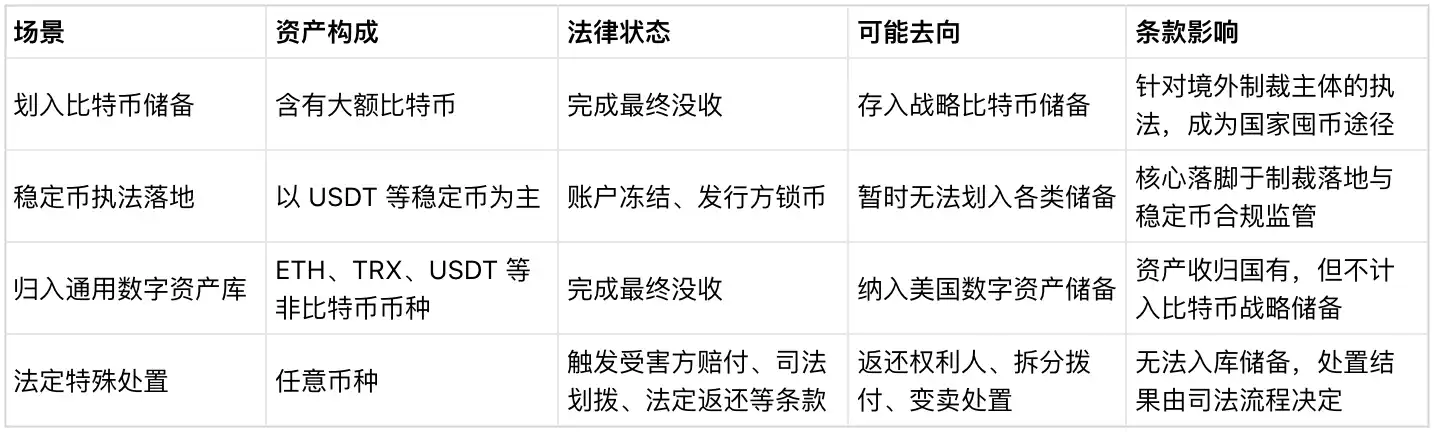
According to an executive order signed by Trump in 2025, U.S. government-owned digital assets are divided into two separate accounts: The Strategic Bitcoin Reserve, specifically designated to hold bitcoins forfeited through civil or criminal judicial proceedings or collected as civil monetary penalties. The order explicitly states that government bitcoins deposited into this account are permanently prohibited from being sold. The other account is the U.S. Digital Asset Reserve, which holds non-bitcoin digital assets that have undergone final forfeiture proceedings. This classification framework makes the current seizure of Iranian crypto assets a practical test case: Only bitcoins that complete the final forfeiture process can be added to the Strategic Bitcoin Reserve; all other remaining tokens will be placed into the U.S. Digital Asset Reserve.

If the seized Iranian assets include bitcoin and the legal forfeiture is successfully completed, they can be incorporated into the reserve. If they consist of stablecoins or other types of tokens, they will likely be transferred to the Digital Asset Reserve. Another possibility is that the assets are merely in a frozen state, in which case the U.S. has not yet obtained legal ownership.

Clarifying the Actual Legal Meaning of "Seizure"

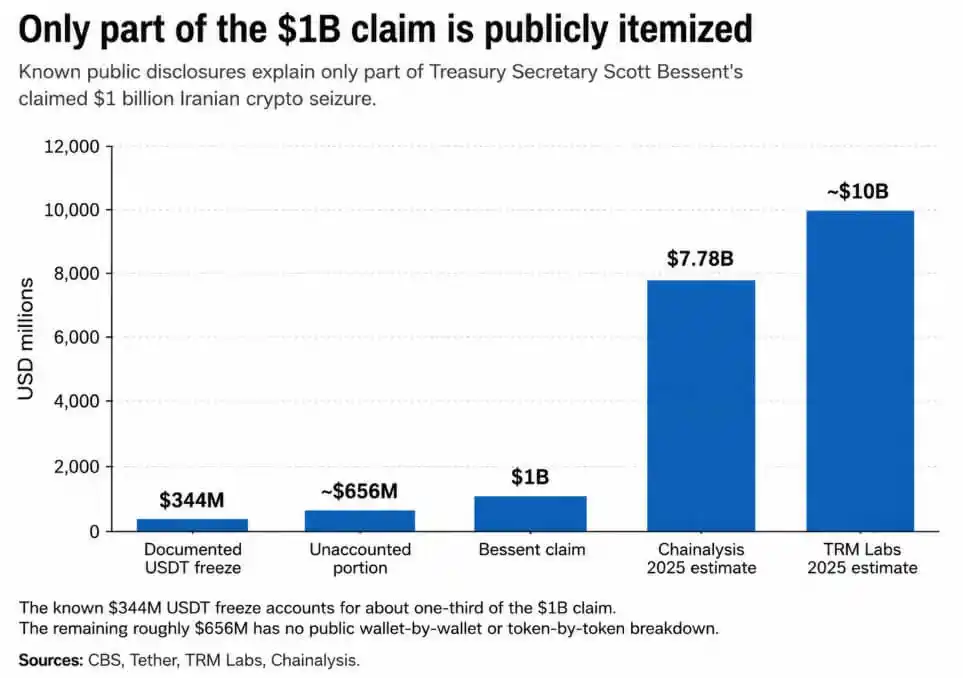
As early as April, the U.S. Treasury Department imposed sanctions on multiple Iran-linked wallets. Tether simultaneously disclosed that it cooperated with U.S. regulators to freeze a total of $344 million USDT across two addresses. Blockchain risk management firm TRM Labs confirmed that these wallets were linked to the Central Bank of Iran, the IRGC Quds Force, and Lebanon's Hezbollah. For the remaining approximately $656 million in assets, there is no publicly available breakdown by wallet or token type.

"Physical seizure" does not equal "legal ownership." OFAC sanctions rules clearly state that blocked assets are only subject to account freezing; the U.S. does not automatically gain ownership rights. Taking stablecoins like USDT as an example, issuers cooperating with regulators to lock addresses constitutes a sanction freeze, not a judicial forfeiture in the criminal law sense. Seizure at the enforcement level only represents the government's temporary control of the assets; ownership still awaits the outcome of forfeiture litigation.

Final forfeiture is a mandatory threshold for assets to enter the reserve: After assets complete the forfeiture process, deductions are made for victim compensation, specialized enforcement expenses, allocations to local law enforcement agencies, legally exempted returns, etc. Only the remaining assets are eligible for transfer into the reserve or the reserve account. Bessent's public statements leave the legal status of these assets entirely uncertain.

At the current Bitcoin price of approximately $73,000, if the entire $1 billion consisted of Bitcoin, it would be equivalent to about 13,632 BTC. According to 2025 statistics, the U.S. government has accumulated about 200,000 compliant bitcoins through past judicial proceedings. If this amount of BTC is fully deposited, the increment would represent 6.8% of the existing reserve volume. In current public records, only the $344 million USDT freeze is documented; details regarding the remaining $656 million in assets—their token types and legal forfeiture progress—are not publicly disclosed. No assets have completed the statutory forfeiture process.

The Industry Basis for the $1 Billion Seizure Figure

Considering the scale of Iran's crypto industry, the $1 billion seizure figure is reasonable, but the asset composition remains opaque.

Chainalysis estimates: In 2025, Iran's annual crypto transfer volume reached $7.78 billion. In Q4 2025, funds flows related to the Iranian Revolutionary Guard accounted for half of the country's total crypto transaction volume. TRM Labs estimates Iran's total annual crypto activity to be nearly $10 billion. Iran's leading exchange, Nobitex, has 11 million users, handling 70% of the country's crypto transactions. Investigations show that this platform has long processed transfers worth hundreds of millions of dollars for sanctioned entities like the Central Bank of Iran and the Revolutionary Guard.

Combining the above industry data, multiple rounds of U.S. enforcement actions plus issuer freezes totaling $1 billion in locked assets is plausible from an industry logic perspective, but the specific asset breakdown cannot be verified. The publicly announced $344 million USDT constitutes only 33% of the total, leaving 65.6% of the funds unaccounted for.

The known $344 million USDT freeze accounts for only 33% of the $1 billion in Iranian cryptocurrency that Bessent claims was seized, leaving $656 million publicly unaccounted for.

Projecting the Token Composition and Destination of the Seized Assets

If the $1 billion includes a significant amount of Bitcoin, and the U.S. completes the ownership forfeiture with no need for victim compensation and no diversion for enforcement expenses, the corresponding Bitcoin would enter the non-saleable strategic reserve. Crypto assets originally used by Iran to evade U.S. financial blockades would be transformed into a sovereign book reserve for the U.S. through sanction enforcement.

Currently, the only confirmed assets are $344 million USDT, frozen by Tether in cooperation with regulatory address freezes. If the remaining $656 million is also primarily stablecoins, the entire event essentially becomes a case of stablecoin regulatory compliance enforcement. Frozen USDT would remain locked; non-bitcoin assets, after forfeiture, would be transferred to the Digital Asset Reserve, with subsequent disposal plans determined entirely by the Treasury Secretary. A complete list of wallets and token types would directly change the nature of the event: it could either represent the implementation of U.S. sovereign Bitcoin accumulation or merely stablecoin regulatory compliance. Bessent has not disclosed any details at this stage.

The executive order also stipulates that forfeited assets can be returned to rightful victim claimants, allocated for case expenses, shared with state law enforcement agencies, or legally exempted from return. Any of these scenarios would prevent the assets from entering the reserve. These provisions represent multiple layers of hurdles for assets transitioning from "seized" to "treasury reserve," which can be triggered at any point before or after forfeiture.

The institutional framework established by Trump's reserve decree turns all future crypto seizures targeting adversarial nations into a matter of U.S. sovereign asset management.

In the future, each U.S. crypto enforcement action against sanctioned entities like Iran and North Korea will involve three determinations: token type, legal status, and which treasury account to assign them to. Only by simultaneously meeting three conditions—the asset being Bitcoin, completing statutory forfeiture, and having no applicable compensation or allocation exemptions—can these Iranian assets potentially supplement the U.S. strategic reserve. As long as they successfully pass the two major hurdles of the forfeiture process and legal exemptions, crypto assets originally intended to circumvent U.S. financial controls would, in turn, become part of U.S. sovereign assets.

Связанные с этим вопросы

QWhat are the two distinct accounts designated by the 2025 executive order for U.S. government digital assets, and what is the primary difference between them?

AThe two accounts are the Strategic Bitcoin Reserve and the U.S. Digital Asset Reserve. The Strategic Bitcoin Reserve is specifically for holding Bitcoin that has been legally forfeited or collected via civil monetary penalties, and these Bitcoins are permanently prohibited from being sold. The U.S. Digital Asset Reserve holds other, non-Bitcoin digital assets that have undergone final forfeiture adjudication.

QWhat is the key legal distinction between 'freezing' or 'seizing' assets and 'forfeiting' them, as it relates to the potential transfer of the $1 billion in Iranian crypto assets to the U.S. Strategic Bitcoin Reserve?

AFreezing or seizing assets represents temporary control or blockage by authorities, but legal ownership remains with the original holder until a court order. Forfeiture is the final legal process that transfers permanent ownership to the government. Only assets that have been formally forfeited are eligible for transfer into the Strategic Bitcoin Reserve.

QAccording to the article, what are the three main factors that will determine the final disposition of the seized Iranian crypto assets?

AThe three main factors are: 1) The type of cryptocurrency (e.g., Bitcoin vs. stablecoins), 2) The legal status of the assets (whether they are merely frozen/seized or have been formally forfeited), and 3) Which government account they can be assigned to (Strategic Bitcoin Reserve or U.S. Digital Asset Reserve) based on the type and legal status.

QWhat are some of the potential financial obligations that could prevent seized assets from entering the U.S. Strategic Bitcoin Reserve, even after forfeiture?

AAfter forfeiture, assets may be allocated to: victim restitution, law enforcement investigative expenses, sharing proceeds with state and local law enforcement agencies, or being legally exempted and returned to claimants. Any of these allocations would prevent the assets from being deposited into the Strategic Bitcoin Reserve.

QWhat portion of the claimed $1 billion in seized Iranian crypto assets has been publicly identified, and what specific asset does it consist of?

AOnly $344 million of the claimed $1 billion has been publicly identified. This portion consists of USDT (Tether stablecoins) that were frozen in two wallets by Tether in coordination with U.S. sanctions. The composition and status of the remaining $656 million are not publicly disclosed.

Похожее

a16z Crypto's Latest Article: Why Do We Need Prediction Markets?

Prediction markets allow people to trade on the outcome of future events. They function as markets that aggregate dispersed information into a price signal, which represents the collective probability of an event occurring. By creating assets that pay out only if a specific outcome happens, these markets enable participants to bet based on their knowledge and beliefs. These markets have historical precedents, like 16th-century papal selection bets, and modern foundations in economics and market design. They offer advantages over traditional forecasting tools like polls: they provide direct probability estimates, update in real-time, and incentivize participants with real financial stakes to contribute accurate information. This can lead to more informed predictions, even for highly specific questions—such as which AI model performs best on certain tasks—that aren't covered by traditional commodity or stock markets. However, prediction markets face challenges. Infrastructure is needed to verify outcomes and ensure transparent, auditable operations. Market design must encourage participation from diverse, informed individuals while mitigating issues like insider trading or manipulation attempts aimed at distorting public perception. Despite these hurdles, with proper design focusing on transparency and participation management, prediction markets have significant potential as a core tool for forecasting the future.

marsbit2 ч. назад

a16z Crypto's Latest Article: Why Do We Need Prediction Markets?

marsbit2 ч. назад

Торговля

Спот
Фьючерсы

Популярные статьи

Тест по Bitcoin Биткоина

HTX Learn: Изучите Bitcoin halving и Заработаете Токены USDT

3.1k просмотров всегоОпубликовано 2024.04.16Обновлено 2024.04.16

Тест по Bitcoin  Биткоина

Что такое $BITCOIN

ЦИФРОВОЕ ЗОЛОТО ($BITCOIN): Комплексный анализ Введение в ЦИФРОВОЕ ЗОЛОТО ($BITCOIN) ЦИФРОВОЕ ЗОЛОТО ($BITCOIN) — это проект на основе блокчейна, работающий в сети Solana, который стремится объединить характеристики традиционных драгоценных металлов с инновациями децентрализованных технологий. Хотя он носит имя Биткойн, часто называемого “цифровым золотом” из-за его восприятия как средства хранения ценности, ЦИФРОВОЕ ЗОЛОТО является отдельным токеном, предназначенным для создания уникальной экосистемы в ландшафте Web3. Его цель — позиционировать себя как жизнеспособный альтернативный цифровой актив, хотя детали его применения и функциональности все еще развиваются. Что такое ЦИФРОВОЕ ЗОЛОТО ($BITCOIN)? ЦИФРОВОЕ ЗОЛОТО ($BITCOIN) — это токен криптовалюты, специально разработанный для использования в блокчейне Solana. В отличие от Биткойна, который выполняет широко признанную роль хранения ценности, этот токен, похоже, сосредоточен на более широких приложениях и характеристиках. Примечательные аспекты включают: Инфраструктура блокчейна: Токен построен на блокчейне Solana, известном своей способностью обрабатывать высокоскоростные и недорогие транзакции. Динамика предложения: ЦИФРОВОЕ ЗОЛОТО имеет максимальное предложение, ограниченное 100 квадриллионами токенов (100P $BITCOIN), хотя детали о его обращающемся предложении в настоящее время не раскрыты. Утилита: Хотя точные функциональные возможности не описаны, есть указания на то, что токен может быть использован для различных приложений, потенциально связанных с децентрализованными приложениями (dApps) или стратегиями токенизации активов. Кто создатель ЦИФРОВОГО ЗОЛОТА ($BITCOIN)? На данный момент личность создателей и команды разработчиков, стоящих за ЦИФРОВЫМ ЗОЛОТОМ ($BITCOIN), остается неизвестной. Эта ситуация типична для многих инновационных проектов в области блокчейна, особенно тех, которые связаны с децентрализованными финансами и феноменом мем-криптовалют. Хотя такая анонимность может способствовать культуре, ориентированной на сообщество, она усиливает опасения по поводу управления и ответственности. Кто инвесторы ЦИФРОВОГО ЗОЛОТА ($BITCOIN)? Доступная информация указывает на то, что у ЦИФРОВОГО ЗОЛОТА ($BITCOIN) нет известных институциональных спонсоров или значительных венчурных капиталовложений. Проект, похоже, функционирует по модели пирингового взаимодействия, сосредоточенной на поддержке и принятии сообществом, а не на традиционных путях финансирования. Его активность и ликвидность в основном сосредоточены на децентрализованных биржах (DEX), таких как PumpSwap, а не на устоявшихся централизованных торговых платформах, что еще больше подчеркивает его подход, ориентированный на grassroots. Как работает ЦИФРОВОЕ ЗОЛОТО ($BITCOIN) Операционные механизмы ЦИФРОВОГО ЗОЛОТА ($BITCOIN) можно подробно описать на основе его дизайна блокчейна и характеристик сети: Механизм консенсуса: Используя уникальный механизм доказательства истории (PoH) Solana в сочетании с моделью доказательства доли (PoS), проект обеспечивает эффективную валидацию транзакций, что способствует высокой производительности сети. Токеномика: Хотя конкретные дефляционные механизмы не были подробно описаны, большое максимальное предложение токенов подразумевает, что оно может быть предназначено для микротранзакций или нишевых случаев использования, которые еще предстоит определить. Интероперабельность: Существует потенциал для интеграции с более широкой экосистемой Solana, включая различные платформы децентрализованных финансов (DeFi). Однако детали относительно конкретных интеграций остаются неуточненными. Хронология ключевых событий Вот хронология, которая подчеркивает значимые вехи, касающиеся ЦИФРОВОГО ЗОЛОТА ($BITCOIN): 2023: Первоначальное развертывание токена происходит в блокчейне Solana, отмеченное его адресом контракта. 2024: ЦИФРОВОЕ ЗОЛОТО приобретает видимость, когда оно становится доступным для торговли на децентрализованных биржах, таких как PumpSwap, позволяя пользователям обменивать его на SOL. 2025: Проект наблюдает спорадическую торговую активность и потенциальный интерес к инициативам, возглавляемым сообществом, хотя на данный момент не зафиксировано никаких значительных партнерств или технических достижений. Критический анализ Сильные стороны Масштабируемость: Основная инфраструктура Solana поддерживает высокие объемы транзакций, что может повысить полезность $BITCOIN в различных сценариях транзакций. Доступность: Потенциально низкая цена торговли за токен может привлечь розничных инвесторов, способствуя более широкому участию благодаря возможностям дробного владения. Риски Отсутствие прозрачности: Отсутствие публично известных спонсоров, разработчиков или процесса аудита может вызвать скептицизм относительно устойчивости и надежности проекта. Волатильность рынка: Торговая активность сильно зависит от спекулятивного поведения, что может привести к значительной волатильности цен и неопределенности для инвесторов. Заключение ЦИФРОВОЕ ЗОЛОТО ($BITCOIN) является интригующим, но неоднозначным проектом в быстро развивающейся экосистеме Solana. Хотя он пытается использовать нарратив “цифрового золота”, его отход от установленной роли Биткойна как средства хранения ценности подчеркивает необходимость более четкого различения его предполагаемой утилиты и структуры управления. Будущее принятие и усвоение, вероятно, будут зависеть от решения текущей непрозрачности и более четкого определения его операционных и экономических стратегий. Примечание: Этот отчет охватывает синтезированную информацию, доступную на октябрь 2023 года, и с тех пор могут произойти события.

99 просмотров всегоОпубликовано 2025.05.13Обновлено 2025.05.13

Что такое $BITCOIN

Fractal Bitcoin: масштабирование Биткоина с помощью рекурсивной системы

Fractal Bitcoin — масштабное Layer-1-решнение, созданное на базе кода Биткоина, позволяющего достигать бесконечного масштабирования с помощью рекурсивного подхода.

2.3k просмотров всегоОпубликовано 2025.06.30Обновлено 2025.06.30

Fractal Bitcoin: масштабирование Биткоина с помощью рекурсивной системы

Обсуждения

Добро пожаловать в Сообщество HTX. Здесь вы сможете быть в курсе последних новостей о развитии платформы и получить доступ к профессиональной аналитической информации о рынке. Мнения пользователей о цене на BTC (BTC) представлены ниже.

活动图片