Bitcoin Bull Market Confirmation Will Be Completed Once This Level Is Reclaimed, Analyst

bitcoinistPublished on 2026-05-19Last updated on 2026-05-19

Abstract

Bitcoin is testing a key technical level that could signal the start of a new bull market, according to analyst Crypflow. The focus is on the "bull-bear ribbon," formed by the 21-week moving average (21 WMA) and the 21-week simple moving average (21 SMA) on a two-week chart. Historically, a crossover where the 21 WMA moves above the 21 SMA has confirmed bull markets, while the opposite crossover has confirmed bear markets. Bitcoin recently experienced a bear market confirmation in 2025 after its peak above $126,000. Currently, the price is attempting to push back into this critical ribbon but faces rejection at the 21 WMA, located around $81,974. Although BTC briefly touched $82,000 last week, it has since pulled back, trading near $76,914 at the time of writing and remaining below both moving averages. According to the analyst, a sustained reclaim of the 21 WMA is needed to begin the next bull market confirmation phase.

Bitcoin’s latest rebound has reached an important point on the 2-week chart, where analyst Crypflow says the next bull market confirmation will begin to take shape.

His analysis focuses on the 21 WMA and 21 SMA ribbon, a moving-average structure that has repeatedly separated Bitcoin’s major bull and bear phases across past cycles. The Bitcoin price is slowly pushing back into this ribbon after the 2025 bear market confirmation, but the price is still being rejected at the 21 WMA around $81,974.

Bitcoin Is Pushing Into The Bull-Bear Ribbon Again

Timing the start of a Bitcoin bull market is never straightforward. Every cycle comes with failed breakouts, sudden selloffs, and bear traps. However, a single crossover has reliably separated Bitcoin’s bull markets from its bear markets for over 10 years.

This crossover is known to occur on BTC’s 2-week candlestick chart, where the 21 WMA and 21 SMA have acted as a long-term divider between bull and bear market phases. Crypto analyst Crypflow described the signal as a simple crossover setup, where the 21 WMA moving above the 21 SMA confirms a bull market, and the 21 WMA moving below the 21 SMA confirms a bear market.
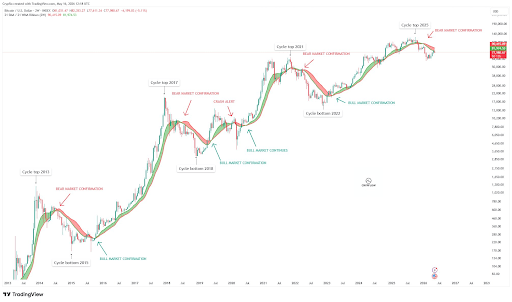
Source: Chart from Crypflow on X

The first bearish crossover came after the 2013 cycle top, before the long correction into the 2015 bottom. The bullish flip that followed in 2015 then confirmed the start of a new expansion. A similar structure played out after the 2017 top, where the bearish crossover preceded the decline into the 2018 cycle bottom, followed by a bullish confirmation in 2019.

The same moving-average structure also gave a warning during the 2020 crash, before the bull market resumed when BTC reclaimed the ribbon. Again in the 2021 cycle, the bearish crossover came after the market top and remained part of the broader downtrend into the 2022 bottom. The next bullish flip in 2023 then marked the confirmation phase that supported Bitcoin’s climb into the 2025 cycle top.

BTC Needs To Reclaim This Level

Bitcoin’s most recent signal, which was the bear market confirmation in 2025, came as Bitcoin rolled over from its most recent peak price above $126,000. That confirmation was the start of the current corrective phase.

Now, the important thing is that BTC is trying to push back above the bear market confirmation. The red band on the chart still shows bearish control, and the price action is currently sitting below the moving averages.

The level to watch on the 2-week candlestick chart is the 21 WMA. The indicator is shown around $81,974, while the 21 SMA is higher at about $90,415. Bitcoin’s latest candle is still below both, with the chart showing BTC near $77,980 at the time of the analysis.

BTC recently pushed above the 21 WMA by touching $82,000 last week, but is now back to trading at $76,914 at the time of writing. This gap explains why the analyst said Bitcoin is pushing into the ribbon again but still getting rejected at the 21 WMA.

BTC trading at $76,772 on the 1D chart | Source: BTCUSDT on Tradingview.com

Related Questions

QAccording to analyst Crypflow, which indicator has reliably separated Bitcoin's bull and bear markets for over 10 years?

AThe crossover of the 21-week moving average (21 WMA) and the 21 simple moving average (21 SMA) on Bitcoin's 2-week candlestick chart.

QWhat price level does the analyst identify as the key 21 WMA that Bitcoin needs to reclaim for bull market confirmation?

AThe key level of the 21 WMA is around $81,974.

QWhat was the most recent major signal given by this moving-average ribbon, and when did it occur?

AThe most recent major signal was the bear market confirmation, which occurred in 2025 after Bitcoin rolled over from its peak above $126,000.

QDid Bitcoin recently break above the key 21 WMA level, and what is its current price according to the article?

ABitcoin briefly pushed above the 21 WMA by touching $82,000 last week but is currently trading at $76,914 (at the time of writing in the article).

QWhat is the general rule described by Crypflow for the moving-average crossover signals confirming bull and bear markets?

AThe rule is that when the 21 WMA moves above the 21 SMA, it confirms a bull market. When the 21 WMA moves below the 21 SMA, it confirms a bear market.

Related Reads

Agents Capital Markets: How Will Autonomous Agents Get Funded?

"Agents Capital Markets: How Autonomous Agents Will Raise Capital" Within a decade, specialized capital markets will emerge for AI Agents—software entities with legal personhood that perform work, earn revenue, and need capital. Unlike today's AI companies (like Sierra or Harvey) backed by traditional VC, these future *Agent companies* will be autonomous, legally-recognized entities (e.g., Wyoming memberless LLCs) that directly own assets, sign contracts, and incur liabilities. The driving forces are fourfold: 1) **Overwhelming economics** (Agent companies can deliver services at 85-90% lower cost than human firms); 2) **Proven demand** (current Agent operators already generate billions in revenue); 3) **Existing legal frameworks** enabling algorithmically-managed companies; and 4) **Massive, yield-seeking capital pools** (e.g., private credit) looking for new, uncorrelated assets. Agent capital markets won't rely on one model but a multi-layered "stack" matching different growth stages: 1) VC equity for early human-led builders; 2) Programmatic working capital advances (like Stripe Capital); 3) Revenue-based financing (RBF); 4) Slate financing (pooled funds for many Agents, similar to Hollywood); and 5) Tokenization as a secondary settlement layer, not a primary funding source. The ultimate shift is from funding constrained by human decision-makers to capital flowing algorithmically based on an Agent's auditable performance, contract book, and cash flows. This transition will be enabled by standardized infrastructure—rating methodologies, contracts, indices—turning Agents from software experiments into a foundational, financeable sector of the economy. The constraints are loosening; the opportunity is here.

链捕手19m ago

Agents Capital Markets: How Will Autonomous Agents Get Funded?

链捕手19m ago

The Warsh Storm Approaches

The article "The Warsh Storm Approaches" analyzes the potential market impact of Kevin Warsh becoming the new Federal Reserve Chairman, succeeding Jerome Powell. It argues that the current AI-driven stock market rally, concentrated in high-valuation tech giants, relies on a crucial premise: that long-term interest rates will eventually fall. This premise is now under threat as the 30-year Treasury yield remains persistently high, exceeding 5%, due to sticky inflation, worsening U.S. fiscal deficits, and deteriorating Treasury supply-demand dynamics. The core vulnerability is that high long-term rates pressure valuations by increasing the discount rate for future earnings. The article warns that Warsh's policy stance could intensify this pressure. Unlike Powell, Warsh is seen as more tolerant of market stress, more committed to quantitative tightening (QT/shrinking the Fed's balance sheet), and less inclined to provide implicit market support. His tenure at the Fed during the 2008 crisis shaped his skepticism about prolonged quantitative easing, believing it fuels asset bubbles without sufficiently boosting the real economy. While strong AI-driven earnings growth could theoretically offset higher rates, the narrative is currently concentrated in a few firms and hasn't yet translated into broad-based productivity gains for the wider economy. Therefore, the AI boom may not be enough to counter the valuation pressures from sustained high yields. Warsh's leadership could force the market to confront a new reality where the old supports—low long-term rates and a reliably supportive Fed—are no longer guaranteed, potentially triggering a reassessment of sky-high stock valuations.

marsbit36m ago

The Warsh Storm Approaches

marsbit36m ago

Trading

Spot
Futures

Hot Articles

Discussions

Welcome to the HTX Community. Here, you can stay informed about the latest platform developments and gain access to professional market insights. Users' opinions on the price of S (S) are presented below.

活动图片