Top-Tier MEV Bot Loses $7.5 Million: Is 'Approval' the Most Overlooked Fatal Risk On-Chain?

marsbitPublished on 2026-06-24Last updated on 2026-06-24

Abstract

The article discusses a sophisticated attack on a prominent Ethereum MEV (Miner Extractable Value) bot, Jaredfromsubway.eth, resulting in a loss exceeding $7.5 million. Unlike typical exploits involving key leaks or smart contract bugs, this attack was a carefully orchestrated "reverse hunt." The attacker spent weeks deploying fake tokens and liquidity pools that mimicked legitimate assets like WETH and USDC. These pools were designed to appear as profitable arbitrage opportunities, tricking the automated bot's trading logic. During its normal operation, the bot was induced to grant ERC-20 token approvals to the malicious contracts. Once sufficient permissions were accumulated, the attacker drained the bot's funds by calling these pre-approved allowances. This incident highlights the often-underestimated risks associated with token approvals in Web3. The article explains that approvals are a fundamental mechanism, allowing smart contracts (like DEXs) to move a user's tokens on their behalf. However, risks arise from practices like granting infinite approvals, the persistence of approvals even after disconnecting from a dApp, and the potential for a once-trusted contract to become compromised later. The piece concludes with advice for managing approval risks: users should adopt the principle of least privilege (approving only the needed amount), use separate wallets for storage versus interactions, and regularly audit and revoke unnecessary approvals using tools like Revoke....

Author: imToken

A long-running MEV bot that hunted ordinary traders on Ethereum finally fell into a 'custom-made' trap worth $7.5 million.

On June 21, the well-known Ethereum sandwich arbitrage bot Jaredfromsubway.eth was attacked, with assets including WETH and USDC transferred from its address. Preliminary statistics show losses exceeding $7.5 million (though public reports on the exact loss figure still vary).

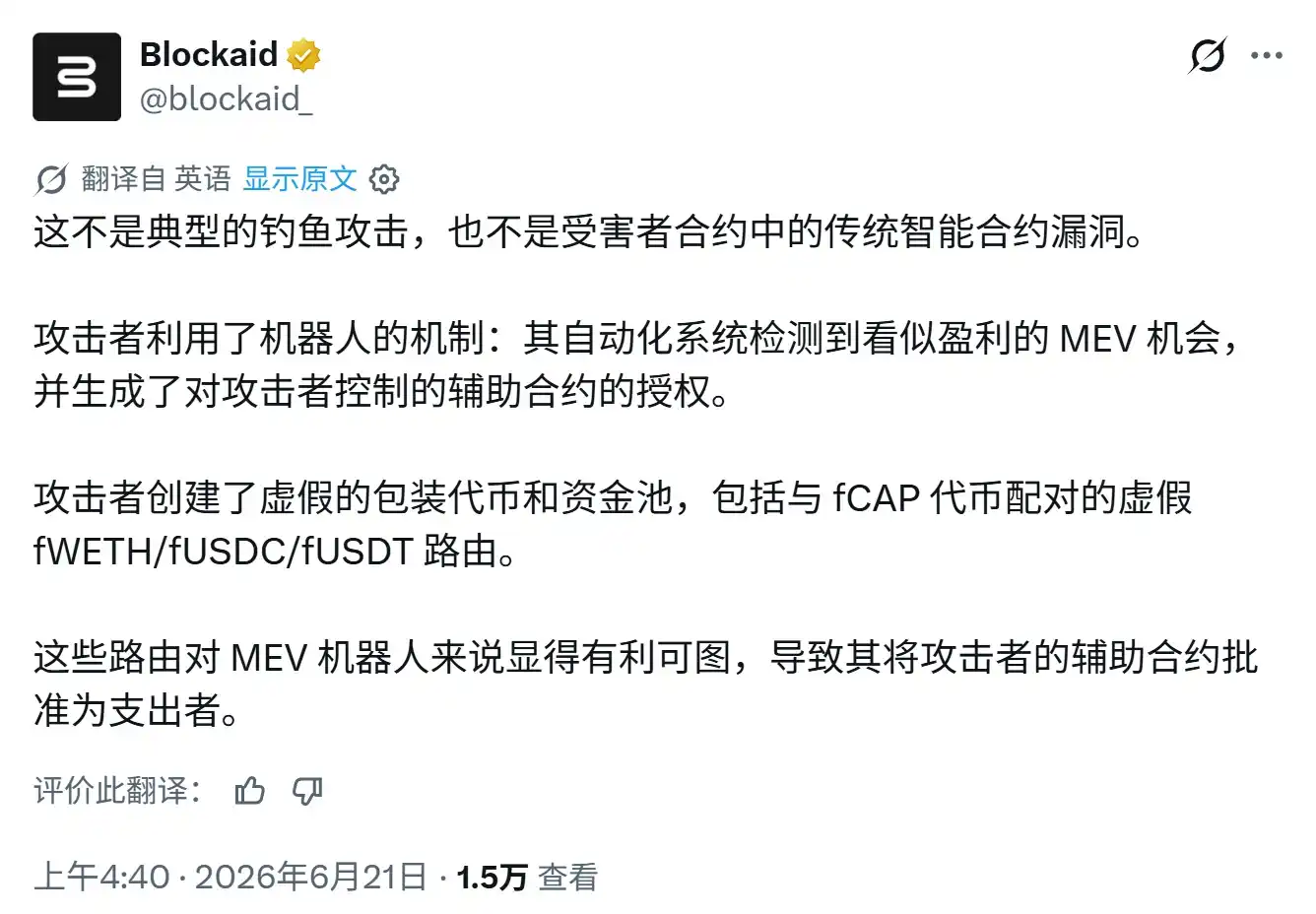
Interestingly, this attack was neither due to private key leakage nor the exploitation of traditional smart contract vulnerabilities. Instead, the attacker deployed a large number of fake tokens, liquidity pools, and auxiliary contracts in advance, packaging them as trading paths with potential arbitrage opportunities. This lured the bot into automatically granting ERC-20 Approvals to malicious contracts during execution, ultimately allowing the assets to be 'legally' transferred away.

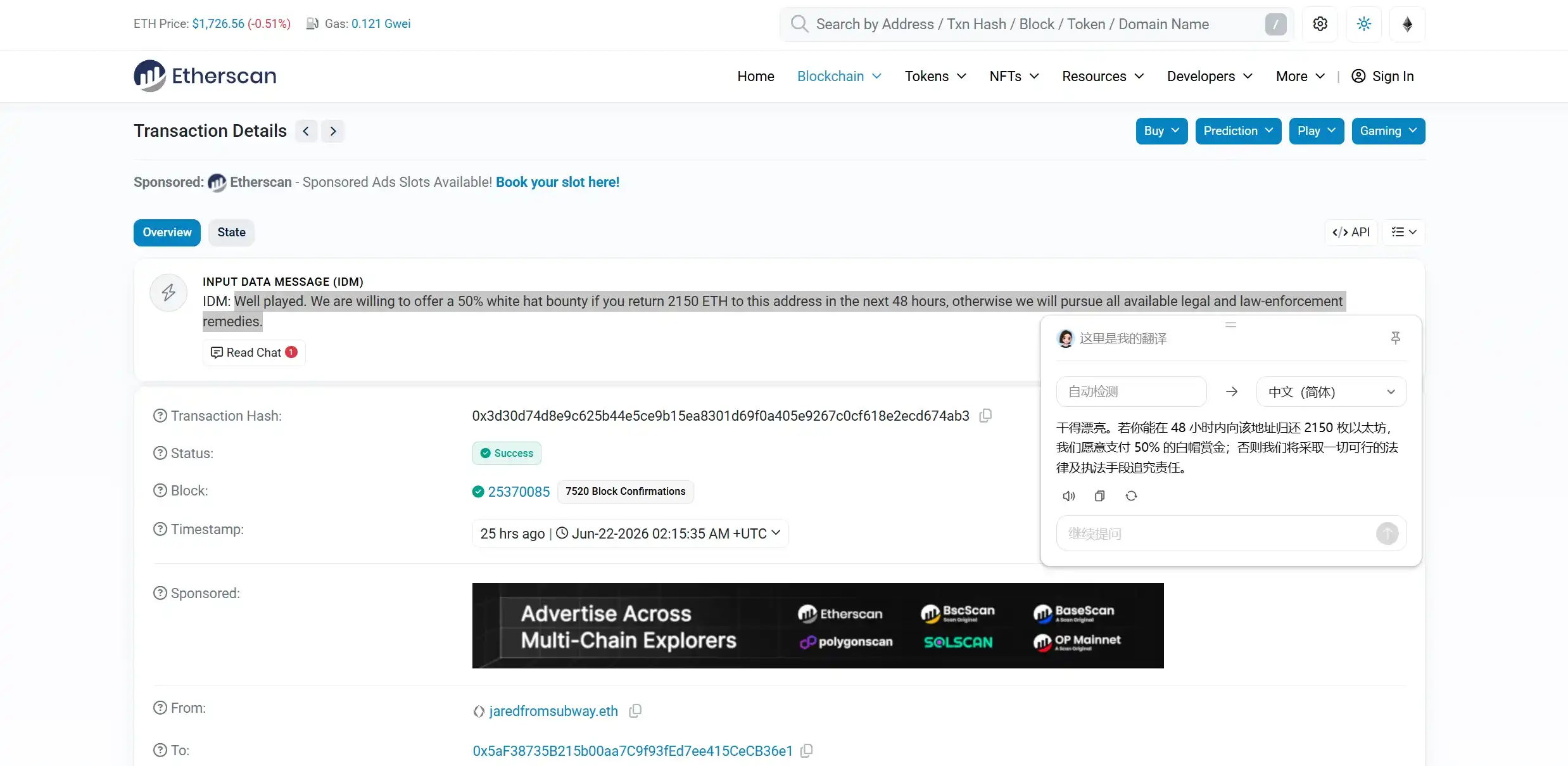
As of publication, Jaredfromsubway.eth has publicly messaged the attacker on-chain, stating, 'If 2150 ETH is returned within 48 hours, we are willing to offer a 50% white hat bounty. Otherwise, we will pursue all available legal and law enforcement actions.'

However, if even a highly specialized, code-driven MEV bot can stumble over an Approval, it forces us to re-examine how dangerous the 'Approval' action we use every day truly is.

I. A Reverse Hunt Designed Specifically for an MEV Bot

A careful review of this attack reveals it was not an accidentally triggered flaw but a long-term hunt designed around Jaredfromsubway.eth's trading logic.

Jaredfromsubway.eth has long been one of the most famous sandwich arbitrage bots on Ethereum. Simply put, a sandwich attack involves the bot spotting an impending on-chain transaction, buying ahead of the user to push the price up, waiting for the user to complete their transaction at a worse price, and then immediately selling to pocket the difference.

Consequently, this strategy requires the bot to continuously scan the mempool, identify arbitrage opportunities at extreme speed, and construct transaction paths calling various tokens and contracts. This also means the faster the speed and the broader the asset and protocol coverage, the more opportunities the bot can capture.

Yet, this very aspect became the entry point for this incident.

Based on post-mortem analysis, the attacker did not directly attack the bot's fund contract. Instead, they spent weeks constructing a trading environment that appeared profitable:

  • Step One: Deploy numerous fake tokens and liquidity pools. These tokens mimicked common assets like WETH, USDC, and USDT in name, interface, and trading behavior, tricking the bot's automated identification system into believing it had discovered normal trading paths.
  • Step Two: Gradually gain the bot's trust. In early tests, the approvals granted by the bot were consumed normally during transactions. Once the bot's system began repeatedly executing similar paths, the attacker adjusted the contract logic. This left some of the approvals generated by the bot unconsumed and not reset to zero after transactions, causing them to persist.
  • Finally, the attacker centrally invoked the still-valid approval limits to transfer the real WETH, USDC, and USDT from the bot's contract.

In essence, the entire attack precisely targeted the operational characteristics of MEV bots: first, create an environment that matches their profit-judgment rules; then, exploit their mechanism of pursuing automated execution of trading paths, making the system proactively hand over asset-calling permissions.

This also explains why even a highly specialized MEV bot could be tricked.

It knows how to calculate price differences, Gas costs, and transaction ordering, but may not conduct thorough identity verification for every newly appearing contract. From this perspective, the problem for ordinary users is 'confirming without understanding,' while the problem for automated bots is 'executing automatically without confirmation.'

Superficially, the two are entirely different, but the underlying risk is quite similar: both treat approval as just an ordinary step before completing a transaction, without clearly recognizing how high its hidden risk can be.

II. Why is Approval Always Underestimated?

As is well known, in the ERC-20 standard of Ethereum and EVM-compatible chains, Approve (authorization) is a fairly low-level design.

However, when users directly transfer tokens via their wallet, they typically call `transfer`, which generally doesn't involve Approve. Only in smart contract scenarios like DEXes, lending, staking, or adding liquidity—where users need a smart contract to call tokens on their behalf—does Approval come into play.

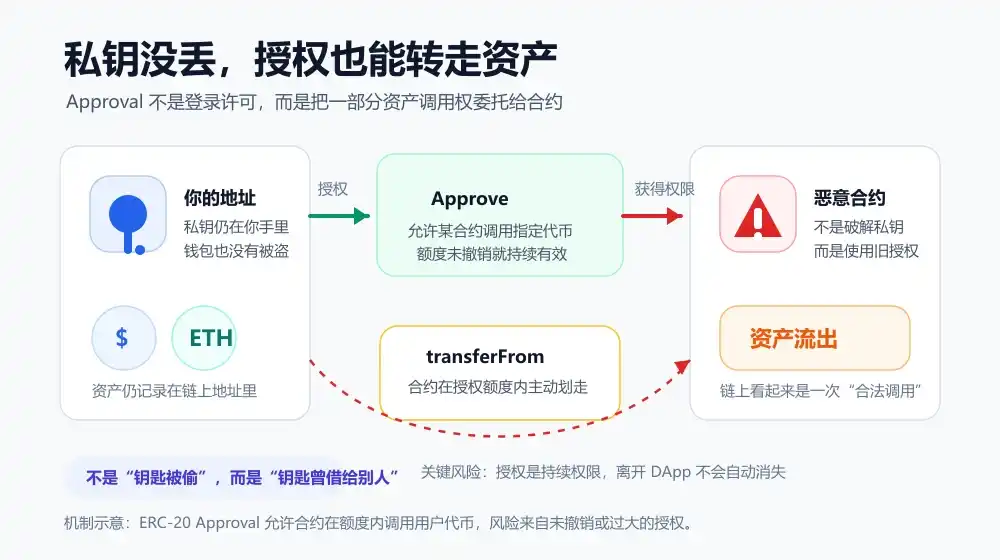
For example, when we want to swap USDT for ETH on Uniswap, Uniswap's smart contract cannot directly take USDT from your wallet. It must first execute an Approve to tell the system, 'I allow Uniswap to withdraw X amount of USDT from my wallet.'

Only after the approval is granted can the authorized contract, via `transferFrom`, call the user's USDT within the set limit, allowing the subsequent Swap to proceed smoothly.

In other words, Approval itself is not a vulnerability; it's a fundamental basis for DeFi's normal operation. The problem, however, is that it's somewhat like automatic debit permissions on Alipay/WeChat Pay:

The user hasn't given their account password to the merchant, but they have allowed the merchant to initiate debits within an agreed range. As long as the authorization remains valid, subsequent debits don't require the user to re-enter a password or confirm each transaction individually. This inherently creates issues.

First, there's the issue of infinite approval—turning a one-time transaction into long-term permission. Mainly to reduce operational and Gas costs from repeated approvals, many DApps default to requesting an extremely large approval limit, commonly known as 'infinite approval.'

A user might have only intended to use 100 USDC for a single transaction but ended up allowing the contract to potentially use all USDC in their address in the future. As long as this approval isn't revoked, even if the user's wallet only held a small amount of assets at the time, future deposits of USDC could continue to be affected.

Second, approvals don't disappear by default when you leave a DApp. Many users confuse 'disconnecting a wallet' with 'revoking approval.' In reality, disconnecting only temporarily prevents the webpage from reading or requesting the current wallet; it doesn't change the Approval already written to the blockchain.

Closing the webpage, deleting the DApp, clearing browser cache, or even changing wallet applications won't automatically invalidate it.

Finally, even legitimate contracts can become dangerous in the future. Many approval risks don't only come from phishing sites that were malicious from the start, as seen in this hunt. A user might grant permission to a protocol that was normal at the time, but later, the protocol's contract could be hacked, admin keys leaked, upgradeable logic replaced, or issues could arise with its called router contracts.

For the user, the assets remain in their address, but from a permissions perspective, another contract always retains the ability to call those assets. Therefore, Approval risk isn't just about 'did I authorize a bad actor,' but also includes 'could the entity I authorized have problems later?'

III. So, How Can We Manage Approval Risk?

Faced with Approval risk, the simplest advice is 'don't grant infinite approval.'

However, in real-world DeFi usage, completely refusing approval is impractical. As mentioned, approval itself is not a flaw; it's the basic method for on-chain applications to call assets.

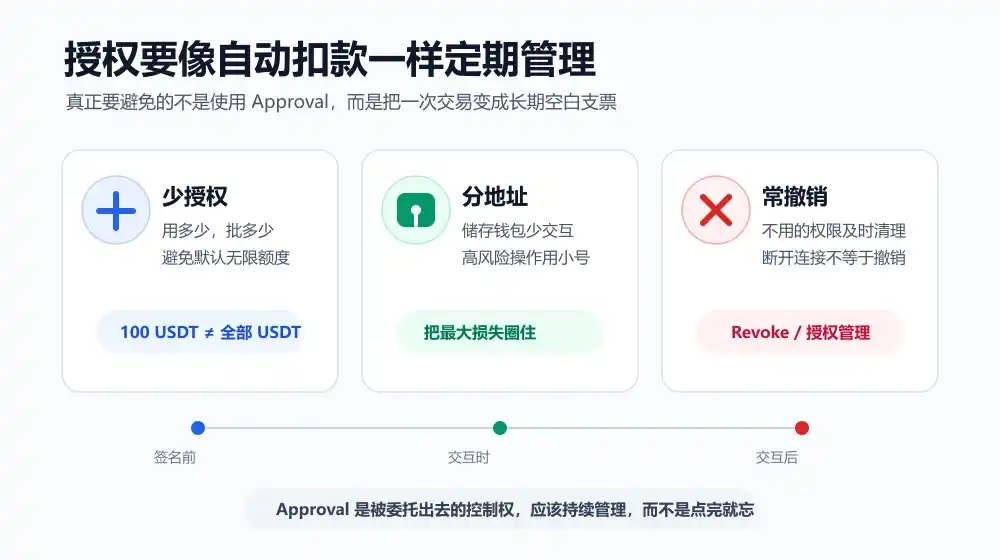
What truly needs to change is transforming Approval from a one-time confirmation action into an ongoing permission management mechanism.

For ordinary users, first, it's essential to establish a few basic habits:

  • First, follow the 'principle of least privilege.' When a wallet pops up an approval prompt, try to set the limit based on the actual needs of the current interaction. For example, if you only plan to use 100 USDT, try to approve only an amount close to 100 USDT, rather than directly granting unlimited permission.
  • Second, separate storage wallets from interaction wallets. Avoid frequently connecting addresses holding large long-term assets to unfamiliar DApps. For activities like airdrops, minting, new projects, and high-risk DeFi interactions, use a separate address to limit potential losses to a smaller scope.
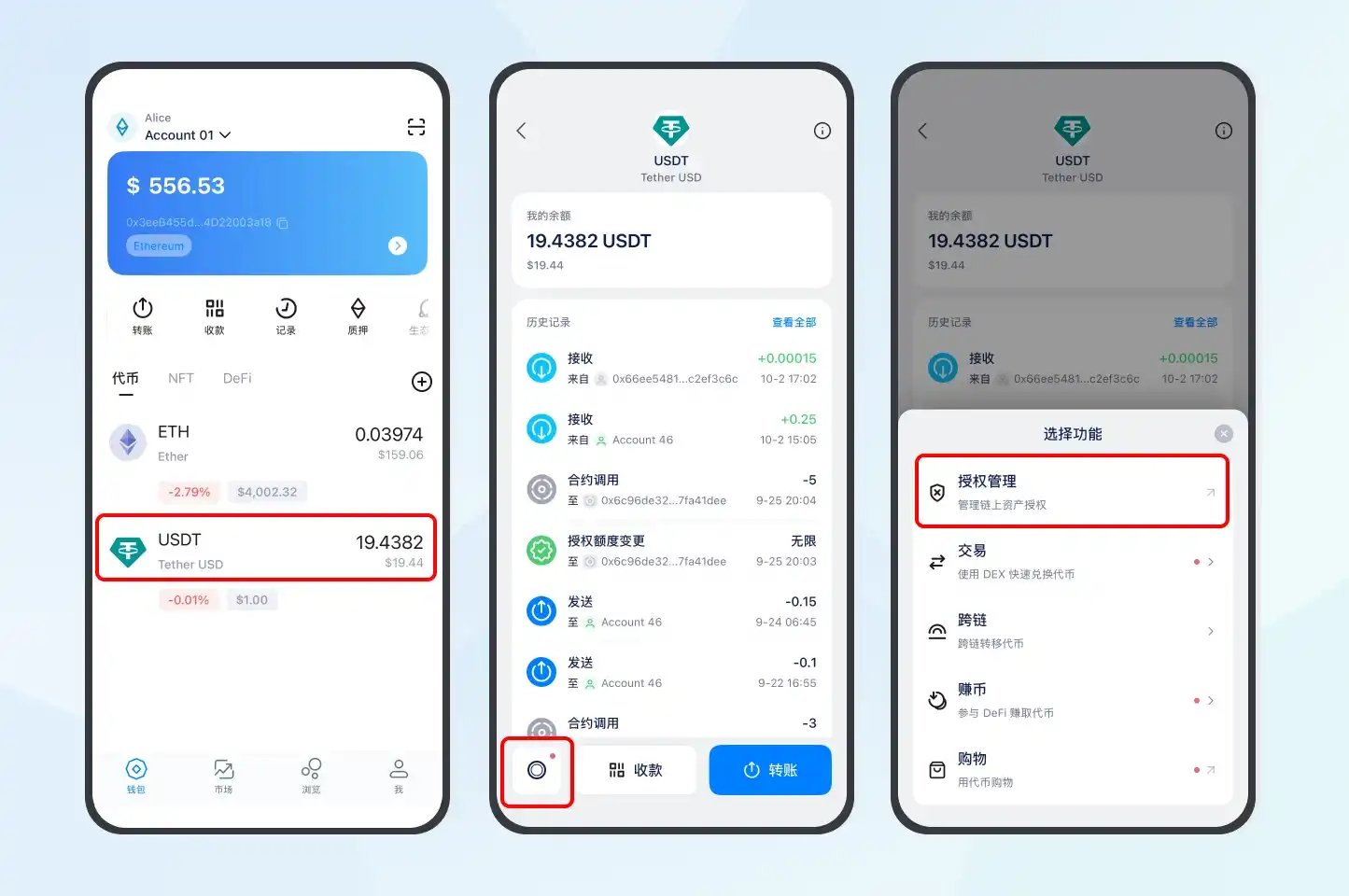
  • Third, regularly check and revoke approvals no longer needed. Users can utilize tools like Revoke.cash or, within imToken, navigate to the corresponding token page, click 'Token Function' in the bottom left, then select 'Authorization Management' to view approval targets, tokens, and amounts for that address. Revoke permissions that are no longer used or of unknown origin (further reading: Step-by-Step Guide to Using Revoke.cash for Authorization Management).

Of course, at the end of the day, facing unpredictable approval attacks, relying solely on user security awareness and regular checks isn't enough. After all, most users find it difficult to distinguish who a string of contract addresses belongs to or judge whether a particular approval amount is reasonable.

Therefore, as the first line of defense for users entering Web3, wallets must provide active defense in their product capabilities.

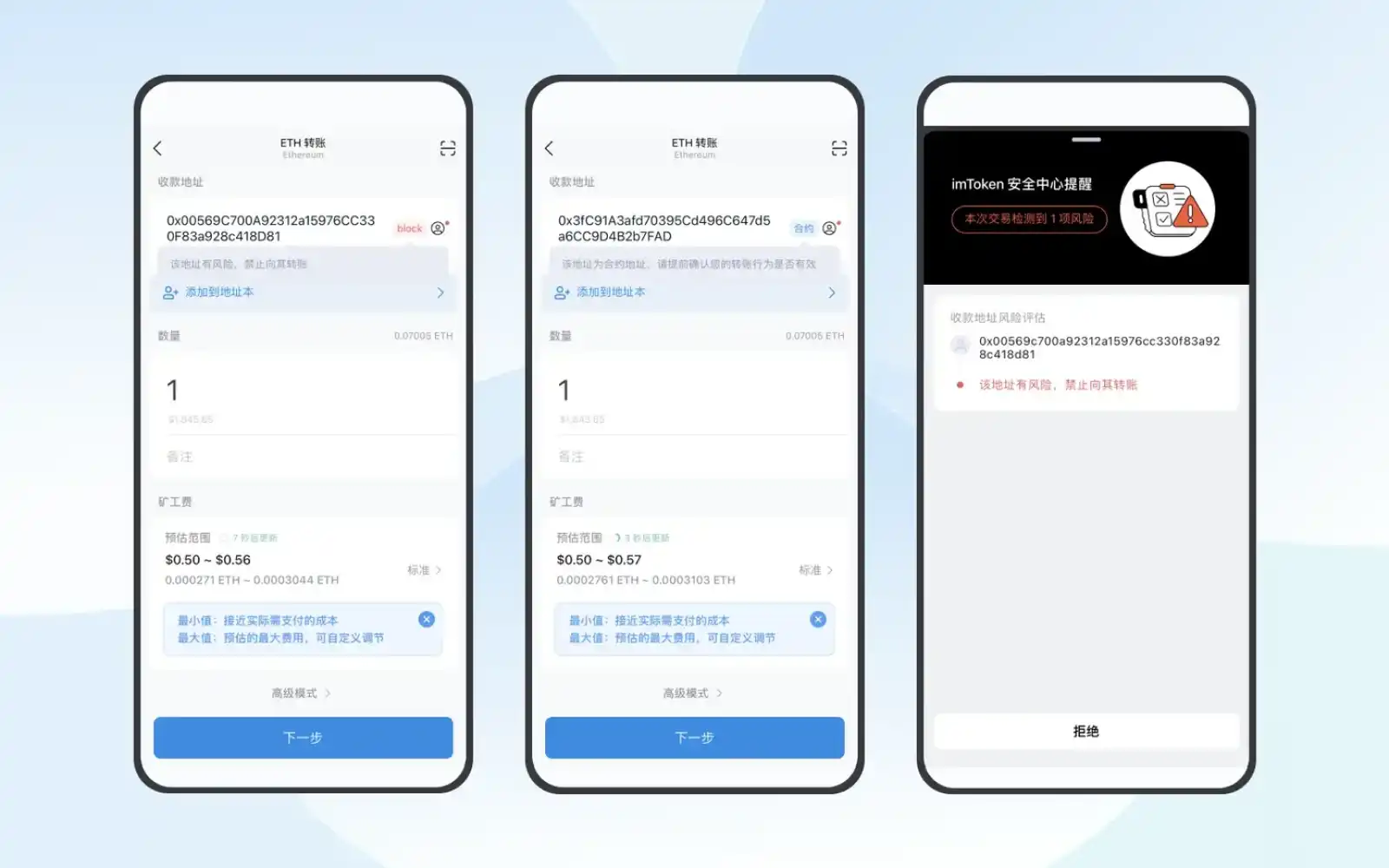
Taking imToken as an example, it marks or blocks identified risky tokens, addresses, and DApps. When users grant token permissions to ordinary external accounts or make direct transfers to contract addresses, targeted risk warnings are also provided. These warnings cannot replace user judgment but at least add a necessary safety buffer before actual signing.

Additionally, imToken performs structured parsing and human-readable presentation of signature content during key processes like DApp login, transfers, token swaps, and approvals. This aims to help users understand what they are agreeing to before confirmation, ensuring that the content users sign must be consistent with the behavior they see, rather than being compressed into an indistinguishable hash string.

With the further advancement of standards like ERC-7730 (Clear Signing), this 'What You See Is What You Sign' readable presentation is expected to gradually evolve from a single wallet's product capability into an industry standard shared among wallets, DApps, and smart contracts.

Overall, private keys determine who owns an account, while Approvals determine who else can call the assets within that account. They are not the same thing but are equally important.

This also means that wallet security cannot stop at 'has the private key been leaked.' This requires joint effort from users to wallets: For users, it's about seeing the object and amount before approving, and promptly cleaning up unnecessary permissions after interactions end. For wallets, it's about making these permissions—originally hidden within contracts—more visible, easier to understand, and more convenient to limit and revoke.

After all, what's truly dangerous might not be the transfer that just happened, but an approval long forgotten yet never invalidated.

Trending Cryptos

Related Questions

QHow did the attacker manage to steal $7.5 million from the Jaredfromsubway.eth MEV bot, and what was the core vulnerability exploited?

AThe attacker did not exploit a private key leak or a traditional smart contract vulnerability. Instead, they spent weeks creating a 'honeypot' environment by deploying numerous fake tokens and liquidity pools that mimicked legitimate assets like WETH and USDC. This setup tricked the MEV bot's automated system into identifying these as profitable arbitrage paths. During its execution, the bot was induced to grant Approvals to the malicious contracts. Once the approvals were in place and the bot had accumulated a certain level of trust through repeated interactions, the attacker called the still-valid approval limits to legally transfer the bot's real WETH, USDC, and USDT assets. The core vulnerability exploited was the bot's automated and insufficiently verified granting of ERC-20 token approvals.

QWhat are the three main reasons why Approval risks are often underestimated by users in DeFi, according to the article?

AAccording to the article, Approval risks are underestimated due to three main reasons: 1. **Unlimited Approvals**: Users often grant extremely high or infinite approval amounts to DApps to save on gas fees and repeated confirmations for future transactions, exposing all current and future tokens of that type. 2. **Persistence of Approvals**: Users commonly mistake disconnecting a wallet from a DApp interface with revoking an approval. Approvals are recorded on-chain and remain valid until explicitly revoked, regardless of closing the website or switching wallets. 3. **Future Risk of Approved Contracts**: A contract that was safe at the time of approval can later become dangerous due to exploits, admin key leaks, logic upgrades, or issues with downstream contracts it calls, posing an ongoing risk.

QWhat practical steps can ordinary users take to manage and mitigate their Approval-related risks?

AOrdinary users can take several practical steps to manage Approval risks: 1. **Principle of Least Privilege**: Only approve the specific amount needed for the current transaction, avoiding unlimited approvals whenever possible. 2. **Separate Wallets**: Use a dedicated 'hot' wallet for frequent interactions with new or high-risk DApps, and a separate 'cold' wallet for storing significant long-term assets to limit potential exposure. 3. **Regular Review and Revocation**: Periodically use tools like Revoke.cash or wallet-built-in features (e.g., imToken's 'Token Function' -> 'Authorization Management') to review all active approvals and revoke those that are no longer needed or from unknown sources.

QWhat role do wallets like imToken play in helping users defend against Approval risks, beyond user education?

AWallets like imToken provide proactive defense mechanisms at the product level: 1. **Risk Identification and Warnings**: They mark or block known risky tokens, addresses, and DApps, and provide specific risk warnings when users attempt actions like granting token approvals to external accounts or transferring directly to contract addresses. 2. **Clear Signing (Structured Transaction Decoding)**: They parse and present the content of signature requests (for logins, transfers, swaps, approvals) in a human-readable, structured format. This helps users understand what they are agreeing to before signing, ensuring 'What You See Is What You Sign' and preventing confusion with raw hash data. 3. **Support for Industry Standards**: They support the development and adoption of standards like ERC-7730 (Clear Signing) to make this safety feature a shared industry standard across wallets, DApps, and smart contracts.

QAccording to the article's conclusion, how does the importance of managing Approvals compare to protecting private keys, and what is the required approach for overall wallet security?

AThe article concludes that managing Approvals is equally as important as protecting private keys, but they address different aspects of security. The private key determines **who owns the account**, while Approvals determine **who else can move the assets within that account**. Therefore, wallet security cannot be solely focused on 'whether the private key is leaked.' A comprehensive approach requires effort from both users and wallet providers: Users must carefully review approval requests, grant minimal necessary permissions, and regularly clean up unused approvals. Wallet providers must make these on-chain permissions more visible, understandable, and easier to limit and revoke through better user interfaces and proactive safety features.

Related Reads

Stablecoin Salaries: Why Are They Becoming the First Choice for Cross-Border Workers?

Stablecoin Salaries: Why They're Becoming the Top Choice for Global Remote Workers The traditional global salary system carries hidden exchange rate risks for freelancers in countries like India, Argentina, and Turkey who earn in USD but spend in local currencies. When salaries are instantly converted to local currency, workers lose purchasing power if that currency depreciates against the dollar. For instance, an Indian designer converting a $2000 monthly salary to rupees lost over 10% in purchasing power last year due to the rupee's decline. Holding even a portion of income in USD or USD-pegged stablecoins can preserve value. Stablecoins offer a solution by breaking down barriers to holding dollars. Opening foreign USD bank accounts is difficult, and international wire transfers incur high fees (averaging 6.5%) and delays. In contrast, stablecoin transfers are fast and low-cost. Furthermore, many countries with high inflation and depreciating currencies restrict citizens' access to foreign currency. Self-custody stablecoin wallets enable workers to hold dollar-equivalent assets without needing bank approval, bypassing these limits. These wallets integrate multiple functions: they allow users to convert only what's needed for daily expenses into local currency, keep the remainder in stablecoins, connect to on-chain lending or yield products, and even link to payment cards for direct spending. While challenges remain—such as the lack of deposit insurance and evolving regulatory frameworks—the trend is clear. Reports indicate a growing preference for USD or stablecoin payments among freelancers in high-inflation countries. This shift represents a fundamental restructuring of salary functions: payment currency, asset storage, yield generation, spending, and cross-border flow. It offers the freedom and flexibility that are core to money's purpose, signaling a profound change in the global financial landscape.

Foresight News13m ago

Stablecoin Salaries: Why Are They Becoming the First Choice for Cross-Border Workers?

Foresight News13m ago

Don't Just Focus on Layoffs, The New Structure of the Ethereum Foundation is More Worthy of Appreciation

The Ethereum Foundation (EF) has undergone a significant organizational restructuring, with the most notable change being a strategic refocusing of its priorities rather than just a 20% staff reduction (approximately 54 people). The new structure clearly prioritizes the Protocol and Access layers, which now comprise the largest teams (57 and 34 people, respectively). This signals EF's intent to concentrate its core resources on fundamental, hard-to-outsource aspects of Ethereum: protocol evolution, security, privacy, client development, and the foundational access layer. Key areas within the Protocol layer, led by an architecture group including Vitalik Buterin and Justin Drake, receive heightened emphasis. These include post-quantum security, zkEVM, formal verification, and long-term roadmap development ("Strawmap"). This reflects a shift towards tackling complex, interdependent challenges like scalability, privacy, and future-proofing the protocol, potentially moving from a pure "redundant security" multi-client model towards more specialized clients aided by AI-assisted formal verification. Financially, EF's budget is being reduced by approximately 40%. The goal is to transition from spending about 15% of its remaining funds annually to a more sustainable 5% rate, akin to a long-term endowment, ensuring its longevity. Concurrently, the restructuring involves pushing certain responsibilities—such as application development, adoption, and ecosystem coordination—to external organizations like EthLabs, the Ethereum Apps Guild, and others. This "multi-node" model aims to increase ecosystem resilience by decentralizing functions beyond the EF, though it introduces new coordination challenges. In essence, the reorganization represents EF consciously narrowing its scope to focus on the hardest, most critical protocol-level problems while fostering a more distributed and sustainable ecosystem structure for Ethereum's future growth.

Foresight News41m ago

Don't Just Focus on Layoffs, The New Structure of the Ethereum Foundation is More Worthy of Appreciation

Foresight News41m ago

Report Analysis: What Is Coherent Planning as CPO Booms?

Title: Report Interpretation: What Moves Is Coherent Making Amid the CPO Boom? Summary: JP Morgan analyst Samik Chatterjee reiterates an Overweight rating on Coherent (COHR), citing undervalued growth potential across three core areas: data center optical transceivers, co-packaged optics (CPO) chips, and industrial lasers/thermal management. COHR's 1.6T data center transceivers are in high demand, with pricing remaining firm. The rise of CPO is seen not as a threat but as a catalyst, creating higher demand for sophisticated optical components, an area where COHR holds a competitive edge with its comprehensive portfolio (lasers, isolators, VCSELs, thermoelectric coolers). Each CPO chip offers significantly greater revenue potential than traditional transceivers. Furthermore, its Optical Circuit Switch (OCS) technology targets a potential $4B market with reliability and power advantages. The company is expanding its InP (Indium Phosphide) device capacity fourfold within two years, securing substrate supply and transitioning to more cost-effective 6-inch wafers. As one of only two major suppliers of high-quality pump lasers—currently in severe shortage—COHR can now move up the value chain from components to complete line cards/systems, boosting ASP over tenfold. Gross margin targets (>42%) may be revised upward due to high-end product premiums, cost improvements from the wafer transition, and contributions from new high-margin products like CPO and OCS. Its efficient thermadite thermal material also offers long-term growth. Industrial segment revenue grows at a steady 5-10%, supported by semiconductor equipment orders. Changes in Apple's Face ID protocol present a re-competition opportunity for 3D sensing. Overall, Coherent is positioned as a key infrastructure provider, with AI-driven compute demand fueling the need for high-speed optical interconnectivity. Growth from CPO/OCS, stable industrial performance, and margin improvement support the bullish thesis. *Disclaimer: This summary interprets a third-party analyst report from JP Morgan. It does not constitute investment advice.*

marsbit1h ago

Report Analysis: What Is Coherent Planning as CPO Booms?

marsbit1h ago

After Laying Off 20% of Staff, What Are the Key Points of EF's New Structure?

Following the completion of a months-long organizational restructuring, the Ethereum Foundation (EF) announced a 20% workforce reduction (approximately 54 employees) on June 23rd. It reorganized its teams into five new core clusters: Protocol, Access, User, Community, and Institutional (plus Operations/Management support units). Officially, this move implements the EF's 2026 Mandate and 2025 Treasury Management Policy, aiming to create a more focused and "self-sovereign" organization. The restructuring prioritizes the CROPS principles—Censorship Resistance, Openness & Freedom, Privacy, and Security—as foundational organizational tenets. The Protocol cluster will focus on core protocol R&D, including MEV reduction and zkEVM. The Access cluster emphasizes preserving user "zero option" for non-custodial, permissionless interaction. The User, Community, and Institutional clusters will manage external engagement, with the latter handling institutional and regulatory matters. While offering enhanced severance and transition support for affected employees, the EF did not disclose budget allocations or specific KPIs for the new clusters. This has led to market uncertainty about the impact on project funding and development priorities. Analysts note the announcement's positive tone of mission focus contrasts with a backdrop of recent EF leadership changes and broader ecosystem pressures. The true impact—whether this signifies strategic realignment or reactive contraction—will become clearer as the new structure's resource allocation and project prioritization are revealed in the coming months.

marsbit1h ago

After Laying Off 20% of Staff, What Are the Key Points of EF's New Structure?

marsbit1h ago

Trading

Spot
Futures

Hot Articles

Discussions

Welcome to the HTX Community. Here, you can stay informed about the latest platform developments and gain access to professional market insights. Users' opinions on the price of ETH (ETH) are presented below.

活动图片