‘The Big Short’ Prototype Doubles Down on AI Crash Bets: Continues Shorting Nvidia and Palantir, While Buying Software Stocks

marsbitPublished on 2026-05-09Last updated on 2026-05-09

Abstract

Michael Burry, the investor made famous by "The Big Short" for betting against the subprime mortgage bubble, is now building a comprehensive portfolio to bet against the AI rally. He maintains and has increased his bearish bets on AI beneficiaries Nvidia and Palantir, while expanding his short positions to include semiconductor ETF SOXX, Nasdaq 100 ETF QQQ, and Oracle. Concurrently, he is buying shares of traditional software companies like Adobe, Autodesk, Salesforce, and Veeva Systems, which have seen their prices decline amid the AI frenzy. Burry's core thesis is that an "AI infrastructure overbuild" is creating a bubble, drawing parallels to the dot-com era. He argues that major cloud customers are extending GPU depreciation schedules to inflate profits and that current capital expenditures are based on overly optimistic demand forecasts. While his short on Palantir is currently profitable, his Nvidia put options are underwater as the stock nears all-time highs. The combination of shorting high-flying AI stocks and buying depressed "AI victim" stocks forms a market-neutral hedge. Burry is betting that a repricing of the AI narrative will punish the former group while benefiting the latter.

Author: Claude, Shenchao TechFlow

Shenchao Insight: As the Nasdaq hits consecutive record highs and Nvidia's market cap nears $5.3 trillion, Michael Burry, the investor who famously shorted the subprime mortgage market during the 2008 financial crisis and was immortalized in the movie "The Big Short," is doubling down on a contrarian bet.

He is not only maintaining his bearish bets on Nvidia and Palantir but also expanding his short positions to include semiconductor and Nasdaq ETFs. Simultaneously, he is buying traditional software stocks that have been pressured by the AI narrative, constructing a complete portfolio betting on a "re-pricing of the AI bubble."

The Nasdaq index set new record highs this week, closing at around 26,247 points on May 8, with the S&P 500 also hitting a record the same day. The Philadelphia Semiconductor Index has risen about 55% since Q2, and Nvidia's stock price is nearing its all-time high of $217.80, with its market cap surpassing $5.2 trillion. The AI-driven tech stock frenzy is at its most fervent stage.

Yet, at the market's most euphoric moment, an investor famous for his contrarian bets is heavily increasing his wager in the opposite direction.

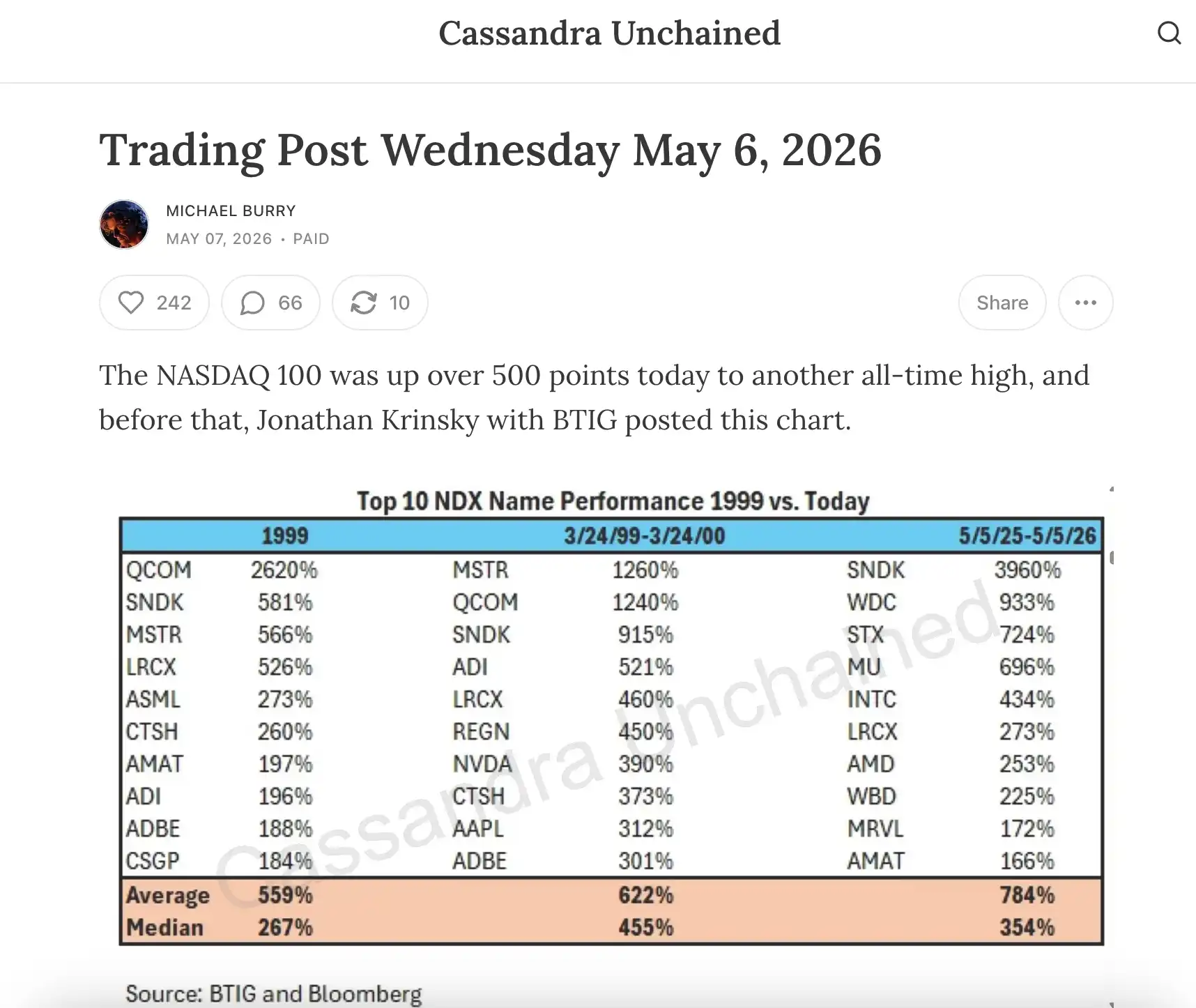
According to a Foreign Policy Journal report on May 7, hedge fund manager Michael Burry, whose prediction of the 2008 crisis was adapted into "The Big Short," disclosed his latest portfolio adjustments in his Substack column "Cassandra Unchained" this week:

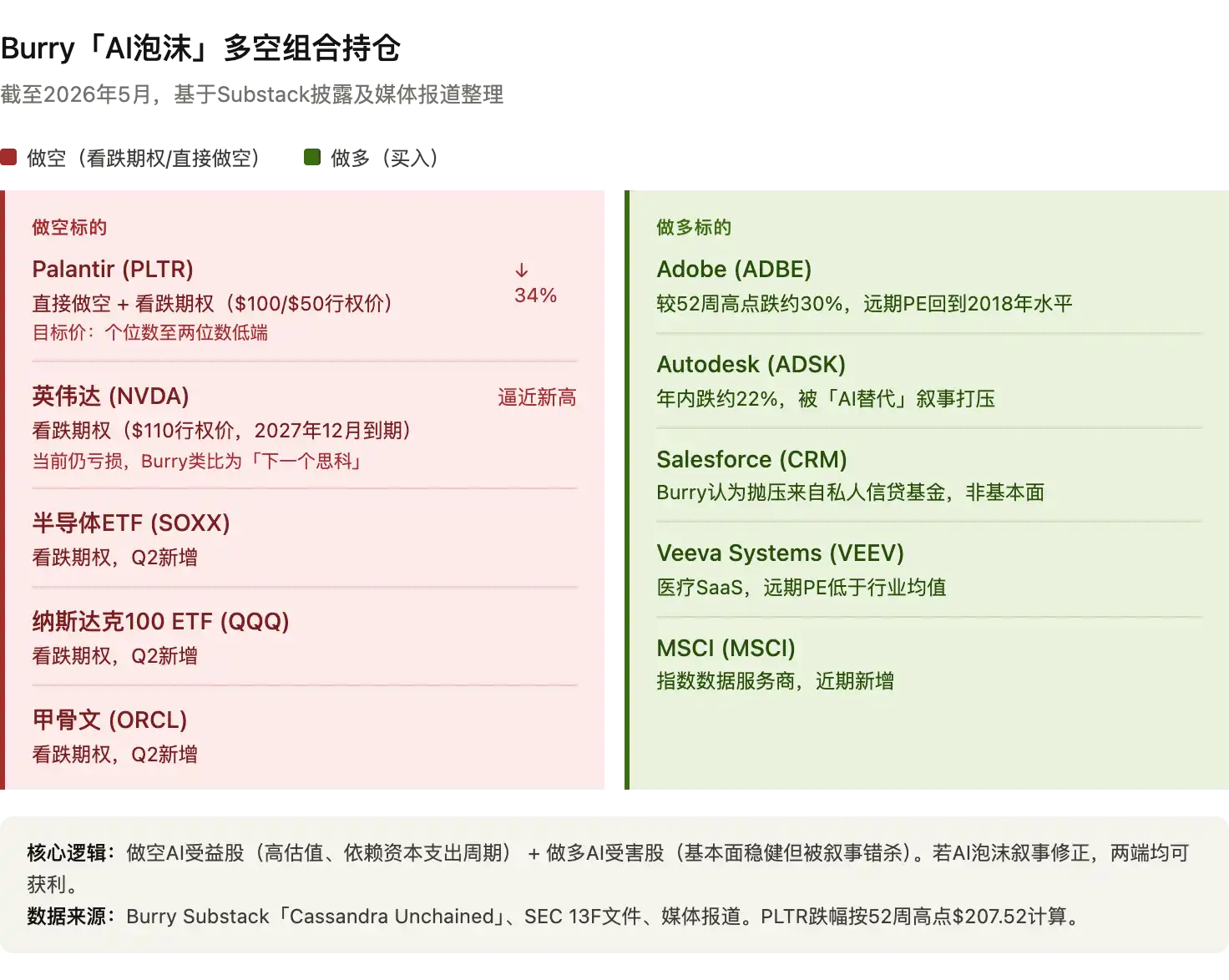
He not only maintained his put options on Nvidia and Palantir but also added a direct short position on Palantir and increased his bearish bets on the semiconductor ETF (SOXX), the Nasdaq 100 ETF (QQQ), and Oracle.

At the same time, he began buying a batch of traditional software companies marginalized by the AI hype, such as Adobe, Autodesk, Salesforce, and Veeva Systems, arguing that their stock price declines stem from panic selling rather than deteriorating fundamentals.

Thus, a complete "Big Short" hedge portfolio has emerged, with a core logic of shorting AI beneficiaries and longing AI casualties.

Starting with the $1.1 Billion Bet Last November

Burry's shorting of the AI sector began in Q3 2025.

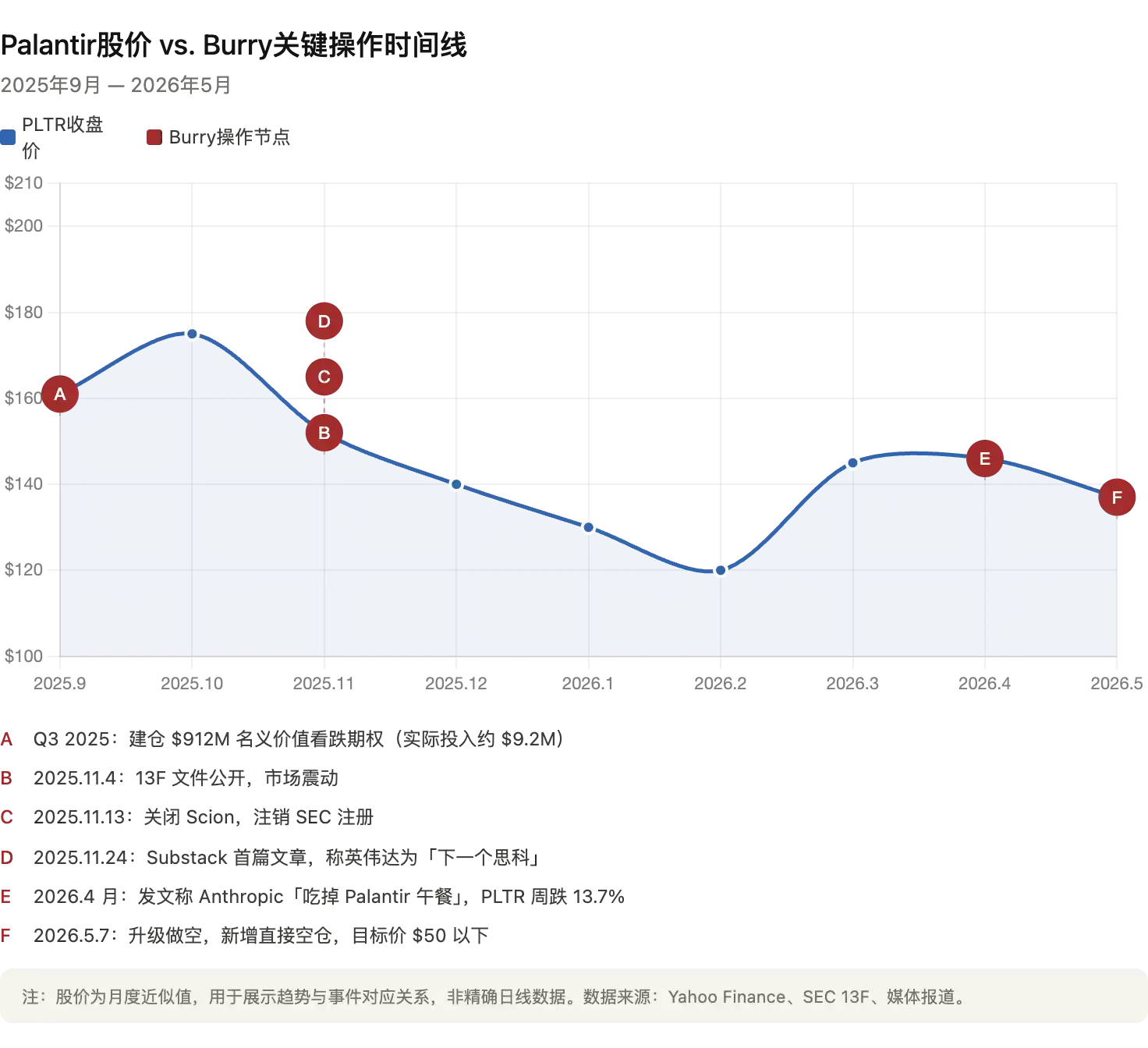
At that time, the 13F filing of his hedge fund, Scion Asset Management, showed he had purchased put options on Palantir with a notional value of about $912 million and on Nvidia with a notional value of about $187 million. When this news was released last November, it shook the market, putting pressure on Palantir and Nvidia's stock prices.

However, Burry later clarified on platform X that his actual capital outlay was about $9.2 million, not the widely reported $912 million—the latter being the notional value of the option contracts, a difference of nearly 100 times. This detail is crucial: the notional value in 13F filings is often misread as the actual invested capital, thereby exaggerating the trade's size.

Shortly after the disclosure, Burry announced the closure of Scion Asset Management and deregistered with the SEC, ending his career of managing external funds.

He subsequently transitioned to being a personal investor and opened a column named "Cassandra Unchained" on Substack (Cassandra being the Greek mythological prophetess who foretold the truth but was never believed), where he continues to publish market analysis.

Palantir Short is Paying Off, But Burry Says "Hasn't Fallen Enough"

In terms of trading results, Burry's Palantir bet is currently profitable. Palantir's stock price has fallen from around $161 when he entered to around $137 currently, down about 34% from its 52-week high of $207. Despite the company recently releasing stellar Q1 2026 earnings (revenue up 85% year-over-year), its stock price actually declined after the report.

Burry has not taken profits. According to his Substack disclosure, he currently holds put options expiring in December 2026 with a strike price of $100, and put options expiring in June 2027 with a strike price of $50, indicating he expects Palantir to fall more than 60% from current levels within the next year. He explicitly stated in a post that Palantir's fair valuation is only in the "single digits to low double digits."

In April this year, Burry posted on Substack stating that Anthropic is "eating Palantir's lunch," noting that this AI safety company's revenue growth rate has exceeded an annualized $300 billion level, and its more user-friendly, lower-cost AI integration tools are replacing Palantir's complex enterprise deployment solutions. After the post, Palantir's stock fell 13.7% in a week, and Burry later deleted it. Wedbush analyst Dan Ives dismissed this view as "fiction," and Palantir CEO Alex Karp had previously publicly stated he "could not understand" Burry's short stance.

Nvidia Short is Still Losing, But Burry Insists "AI is the Bubble"

Compared to the victory with Palantir, Burry's situation with Nvidia is completely different.

Nvidia's stock price closed around $215 on May 8, nearing its all-time high of $217.80, with a market cap of about $5.3 trillion. It is reported that Burry holds Nvidia put options with a strike price of $110, expiring in December 2027, which are currently in deep loss. However, he has not reduced his position; instead, he continued adding to it in his recent portfolio adjustments.

The core logic behind Burry's Nvidia short is "overbuilding of AI infrastructure." In his first Substack article last November, he compared the current AI investment frenzy to the internet bubble of the late 1990s, likening Nvidia to Cisco back then. Cisco's stock rose 3,800% between 1995 and 2000, once becoming the world's most valuable company, before plummeting over 80% during the dot-com bust.

Burry's key arguments include: Hyperscale customers like Microsoft, Google, Meta, Amazon, and Oracle are extending GPU depreciation schedules to beautify their financial reports; he estimates that between 2026 and 2028, these accounting treatments will cumulatively understate approximately $176 billion in depreciation expenses, inflating the entire industry's profits. Furthermore, he argues that the massive capital expenditure on current AI infrastructure is built on overly optimistic demand forecasts, mirroring the situation when telecom companies frantically laid fiber optic cables around 2000.

This viewpoint drew a direct rebuttal from Nvidia. According to CNBC, Nvidia privately distributed a seven-page memo to Wall Street sell-side analysts, responding point-by-point to Burry's allegations, specifically citing Burry's X platform posts as sources of information needing refutation. Nvidia stated in the memo that its customers set GPU depreciation periods at four to six years based on actual useful life, and early products (like the A100 released in 2020) still maintain high utilization rates. Burry responded, "I'm not saying Nvidia is Enron," but stood by his analysis.

Going Long on AI-Pressured Software Stocks: A Complete Bubble Hedge Portfolio

Perhaps the most noteworthy aspect of Burry's portfolio adjustments is not the shorts themselves, but his long positions.

He recently bought stocks like Adobe, Autodesk, Salesforce, Veeva Systems, and MSCI. The common characteristic of these companies is: their business fundamentals remain robust, but their stock prices have suffered significant declines due to the market narrative of "being disrupted by AI" and forced selling by private credit funds.

Adobe is currently down about 30% from its 52-week high, Autodesk is down about 22% year-to-date, and both have seen their forward P/E ratios fall back to 2018-2019 levels.

Burry explained on Substack that he "does not believe the technical selling pressure from private credit and software debt is sufficient to impact these stocks in the long term." In other words, he believes the market is over-penalizing companies labeled "AI losers" and over-praising those labeled "AI winners"—and he is betting on a correction of this mispricing.

Looking at both the short and long sides together, Burry has constructed a typical long/short hedge portfolio: If the AI bubble narrative bursts, high-valuation beneficiaries like Nvidia and Palantir will bear the brunt, while wrongly punished traditional software stocks may see valuation recovery. Even if the overall market declines, this structure could potentially achieve positive returns.

In his letter to investors when closing Scion, Burry admitted: "My judgments on the value of securities have been out of sync with the market for a long time now." This statement is both self-reflection and seems like his consistent manifesto.

At the peak of the AI frenzy, he chooses to stand against the crowd.

Related Questions

QWho is Michael Burry and what is his current investment stance regarding the AI sector?

AMichael Burry is the hedge fund manager famously portrayed in the movie 'The Big Short' for his successful bet against the subprime mortgage market. He is now adopting a contrarian position against the AI sector. His strategy involves shorting AI-beneficiary stocks like Nvidia and Palantir, as well as related ETFs like SOXX and QQQ. Simultaneously, he is buying undervalued traditional software stocks like Adobe, Autodesk, Salesforce, and Veeva Systems, which have been sold off due to the AI narrative. He views the current AI investment surge as a bubble comparable to the dot-com era.

QWhat are the key details of Michael Burry's bearish bets on Palantir?

AMichael Burry's bearish bets on Palantir involve both put options and direct short positions. He holds put options with a strike price of $100 expiring in December 2026 and a strike price of $50 expiring in June 2027. This indicates he expects Palantir's stock to fall significantly from its current price of around $137. He has stated that Palantir's fair valuation is in the 'single digits to low double digits.' Despite Palantir reporting strong Q1 2026 earnings, Burry's position is currently profitable as the stock has declined from his entry point.

QWhat is the core reasoning behind Michael Burry's short position on Nvidia?

AMichael Burry's core argument for shorting Nvidia is his belief in an 'AI infrastructure overbuild' bubble. He compares the current AI investment boom to the dot-com bubble and likens Nvidia to Cisco during that period. His key points include: 1) Major cloud customers (Microsoft, Google, Meta, Amazon, Oracle) are extending the depreciation life of GPUs to artificially boost their earnings, which he estimates could inflate industry profits by $176 billion between 2026-2028. 2) The massive capital expenditure on AI infrastructure is based on overly optimistic demand forecasts, similar to the telecom fiber overbuild in the early 2000s. He believes this will lead to a significant correction.

QWhich companies is Michael Burry buying as part of his 'AI bubble re-pricing' strategy, and why?

AMichael Burry is buying traditional software companies like Adobe, Autodesk, Salesforce, Veeva Systems, and MSCI. He is investing in them because he believes these stocks have been unfairly punished by the market's 'AI disruption' narrative and technical selling pressure from private credit funds, despite their fundamentally sound businesses. Their stock prices and forward P/E ratios have fallen to levels seen in 2018-2019. Burry's thesis is that the market has over-penalized these 'AI losers' and over-hyped the 'AI winners,' creating a mispricing he aims to profit from when the narrative corrects.

QWhat is the overall structure of the portfolio Michael Burry is building, and what is its intended purpose?

AMichael Burry is building a long/short hedge portfolio designed to profit from a potential correction in the AI narrative. The structure is: Short side: Betting against high-valuation AI beneficiary stocks (Nvidia, Palantir) and related ETFs (SOXX, QQQ). Long side: Buying undervalued traditional software stocks (Adobe, Autodesk, Salesforce, Veeva) that have been sold off as 'AI losers.' The intended purpose is that if the AI bubble narrative bursts, the short positions would profit from the decline of overvalued stocks, while the long positions could benefit from a valuation rebound in the oversold stocks. This structure aims to generate positive returns even if the overall market declines.

Related Reads

Stable Vaults Are the Final Piece in Aave's Mass Commercialization Puzzle

Aave's introduction of "Stable Vaults" aims to bridge the gap between complex DeFi protocols and mainstream users by offering a simplified, predictable savings product. The core innovation is a fixed-yield layer built atop Aave's volatile underlying lending pools. Partnering platforms (like digital banks or wallets) can offer users a guaranteed interest rate (e.g., 4%), shielding them from market fluctuations. The partner absorbs the risk and profit/loss from the difference between this fixed rate and Aave's variable rate. From the user's perspective, Stable Vaults provide ease of use, predictable returns, and familiar services like customer support and account recovery, addressing key barriers like wallet management and volatility. However, users pay a price: they cap their potential earnings (forgoing higher market yields), add counterparty risk from the partner platform, and may lack transparency into the true spread being captured. For partners, Stable Vaults turn idle user funds into a revenue stream via the yield spread. For Aave, this strategy attracts sticky, "sticky" capital from mass-market applications, providing a stable fee revenue stream crucial for its tokenomics (e.g., buyback mechanisms), especially in bear markets. The article contrasts this approach with direct DeFi interaction, where users keep all yield but face complexity and volatility. It argues that Stable Vaults align with proven consumer behavior: most users prioritize convenience, safety, and predictability over maximizing returns, willingly paying a "peace of mind" premium. Examples like Coinbase and Robinhood offering similar "savings" products validate this demand. Thus, Stable Vaults represent Aave's strategic move to commercialize by catering to fundamental human preferences for simplicity and stability in finance.

marsbit34m ago

Stable Vaults Are the Final Piece in Aave's Mass Commercialization Puzzle

marsbit34m ago

Support Rate Less Than 1%, BIP-110 Still Pushes Bitcoin Towards a Soft Fork?

Title: BIP-110 Pushes Bitcoin Towards a Soft Fork Despite Less Than 1% Approval With its August mandatory activation window approaching, the controversial BIP-110 proposal is back in the spotlight. Proposed in December 2025 by Dathon Ohm and supported by Bitcoin Core developer Luke Dashjr, BIP-110 aims to impose a one-year limit on arbitrary/non-monetary data in Bitcoin transactions, primarily targeting large data storage like Ordinals and Bitcoin NFTs, to reduce network "spam" and refocus Bitcoin on its monetary function. However, the proposal faces overwhelming opposition. To activate, BIP-110 requires a 55% threshold, yet current miner support is below 1%. Of the 102,674 network nodes, only 14.64% (15,035) signal readiness to enforce it. Despite this lack of consensus, BIP-110 has a contentious "mandatory window" mechanism: if the threshold isn't met by block height 961,632, supporting nodes will begin rejecting non-compliant blocks from height 961,632 to 963,647, attempting to force activation by block 965,664. This could lead to a chain split in early August between a minority chain enforcing BIP-110 and the main chain. Proponents, led by Luke Dashjr (founder of Ocean mining pool), argue that inscriptions constitute an "attack" on Bitcoin, congesting block space and raising transaction fees, thereby undermining Bitcoin's primary use as money. They view BIP-110 not as a change but as a reversal of a harmful change. Opponents, including figures like Adam Back, Jameson Lopp, and Michael Saylor, contend that BIP-110 fails to solve the spam problem while creating new risks. They warn it could stifle future innovation (e.g., impacting BitVM), introduce transaction censorship—eroding Bitcoin's neutrality—and potentially cause a damaging chain split that fragments developer resources, hash power, and monetary consensus. They argue market-based fee pressure and block size limits already manage congestion effectively. Potential outcomes post-activation include: 1) The BIP-110 chain stalling due to insufficient hash power; 2) The BIP-110 chain becoming the longest chain if it gains majority miner support (though currently, Ocean holds only 2.6% of hash power vs. opponents like F2Pool at 13.6%); or 3) A persistent minority chain that remains economically unviable, potentially leading to a permanent fork. Most analysts and prediction markets deem BIP-110's success unlikely, with one market giving only a 10% probability that it will become the accepted longest chain by September 2026.

marsbit39m ago

Support Rate Less Than 1%, BIP-110 Still Pushes Bitcoin Towards a Soft Fork?

marsbit39m ago

Mining Stocks Are Moving Further Away from Crypto

Title: Mining Stocks Are Drifting Away from Crypto Summary: Despite Bitcoin (BTC) falling approximately 46% over the past year, leading Bitcoin mining stocks (e.g., HUT, WULF, IREN) have surged significantly. This divergence stems from a fundamental shift in how the market values these companies. Their stock prices are no longer tied primarily to crypto prices, mining output, or hash rates. Instead, investors are now pricing them as AI infrastructure plays. Mining companies possess critical assets for AI data centers: pre-permitted land, grid-connected power capacity, and operational expertise for high-load facilities—resources facing severe shortages and long lead times for new entrants. For example, CleanSpark signed a 20-year, ~$6.6 billion infrastructure lease for an AI data center, while Marathon Digital acquired a project with up to 2 GW of planned power capacity. Analysts note a strong correlation between a mining company's market valuation and its contracted or potential AI power capacity in North America. CoinShares predicts that by year-end, up to 70% of revenue for listed miners could come from AI/HPC, compared to about 30% at the start of 2026. However, this re-rating introduces new risks: 1) Valuation volatility linked to the broader AI/semiconductor sector, 2) Potentially low baseline return rates (estimated at 4-5% for some firms), and 3) Execution risks including massive financing needs, regulatory permits, and tenant quality. This strategic pivot is also changing miner behavior. They are selling BTC holdings more aggressively to fund AI capex, meaning selling pressure may persist regardless of Bitcoin's price. Furthermore, once power and sites are locked into long-term AI contracts, they are unlikely to return to Bitcoin mining, potentially altering the network's hash rate dynamics long-term. In essence, mining firms are being valued for what they are becoming—AI infrastructure providers—rather than pure-play crypto miners.

链捕手45m ago

Mining Stocks Are Moving Further Away from Crypto

链捕手45m ago

Trading

Spot
活动图片