# Stablecoins Related Articles

HTX News Center provides the latest articles and in-depth analysis on "Stablecoins", covering market trends, project updates, tech developments, and regulatory policies in the crypto industry.


Digital Banks No Longer Rely on Banking for Profit; The Real Goldmines Are Stablecoins and Identity Verification

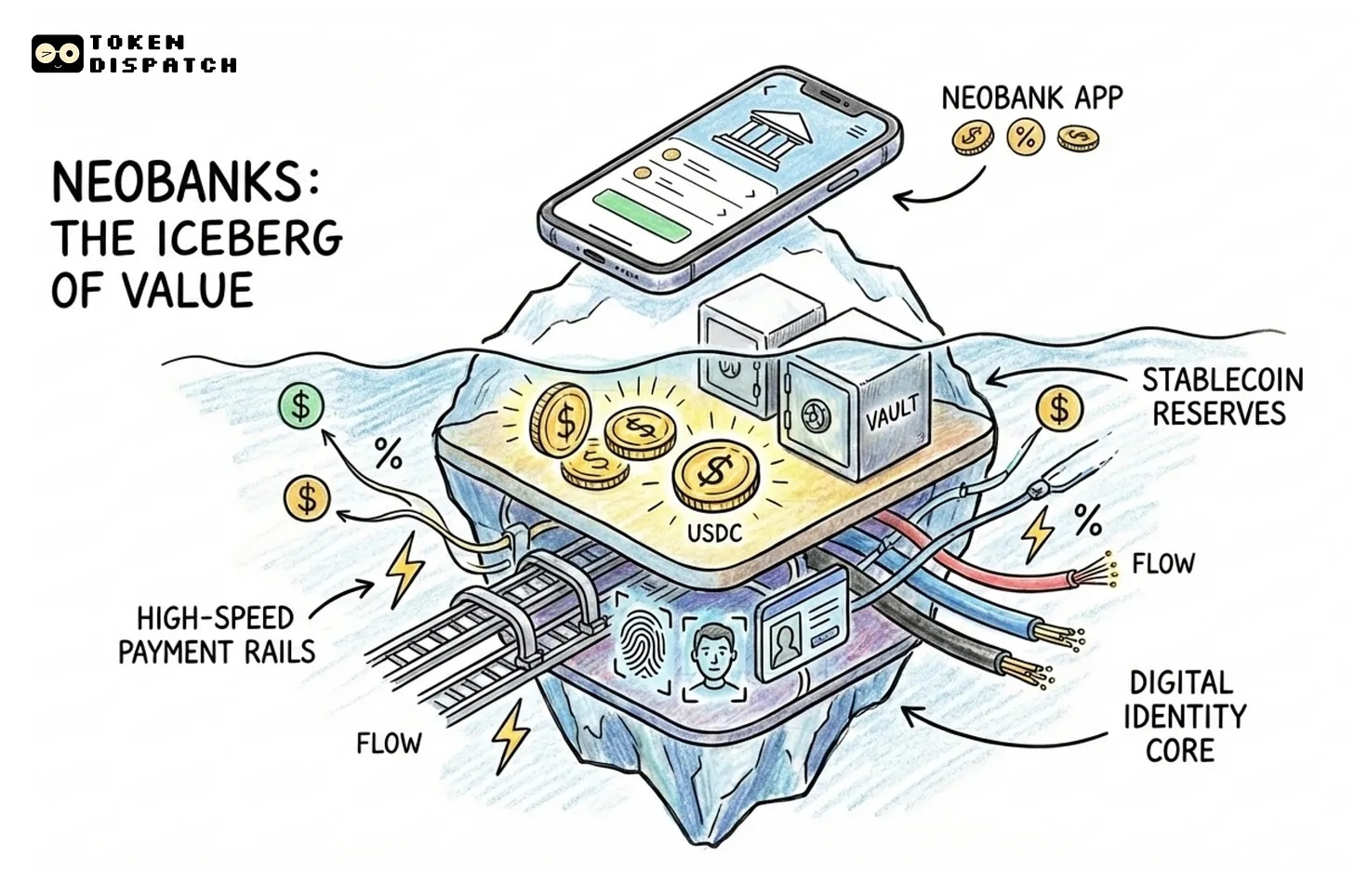
Digital banks are no longer competing on user scale but on revenue per customer, as seen in Revolut's diversified income streams versus Nubank's reliance on credit. The real value lies in stablecoins and identity authentication. Stablecoins, especially those backed by reserves, generate profit from interest on assets like treasury bonds—a revenue stream captured by issuers, not front-end platforms. This has pushed firms like Stripe and Circle to build proprietary settlement networks (e.g., Tempo, Arc) to control profitability, privacy, and transaction efficiency. Stablecoins disrupt traditional payment systems by enabling direct, low-cost transfers, forcing digital banks to integrate stablecoin channels or become obsolete. Simultaneously, identity authentication is evolving into a portable, cross-platform system. Initiatives like the EU Digital Identity Wallet and crypto projects (Worldcoin, Gitcoin Passport, Polygon ID) aim to create reusable digital identities, reducing redundant KYC processes. This shifts digital banks from controlling identity to becoming service providers within a trusted identity framework. Future digital banks will succeed by focusing on one of three models: 1. **Interest-driven**: Profit from user deposits via stablecoin interest and staking. 2. **Payment flow-driven**: Generate revenue from high transaction volumes as the default transfer channel. 3. **Infrastructure-driven**: Control stablecoin issuance, reserves, and settlement for the highest profitability. The market will split between consumer-facing apps (low switching costs) and infrastructure players (high stickiness, core to value flow).

marsbit12/15 10:05

Digital Banks No Longer Rely on Banking for Profit; The Real Goldmines Are Stablecoins and Identity Verification

marsbit12/15 10:05

Digital Banks Are No Longer in the Banking Business; The Real Gold Mine Lies in Stablecoins and Identity Verification

The article argues that the core value of digital banking has shifted away from traditional models. Valuation is no longer driven by user numbers but by revenue per customer, as seen with Revolut's diversified income streams versus Nubank's reliance on credit. The true "gold mines" are now stablecoins and identity verification. For stablecoins, the primary profit is the interest earned on reserve assets (like Treasury bills), a revenue stream captured by the issuer (e.g., Circle) rather than the consumer-facing digital bank. This is leading to vertical integration, with companies like Stripe and Circle building proprietary settlement networks (Tempo, Arc) to control this profitable infrastructure and ensure privacy. Stablecoins are disrupting the old, multi-layered payment system by enabling direct, peer-to-peer transfers, forcing digital banks to become efficient routing layers for these transactions or risk obsolescence. Simultaneously, identity is becoming the new account core. The trend is moving away from siloed KYC processes towards portable, verifiable credentials (e.g., EU's Digital Identity Wallet, Worldcoin, Polygon ID). This will allow a user's identity to travel across platforms, simplifying compliance and making the crypto wallet the central hub for assets and identity. The article concludes that user count, cards, and UI are no longer competitive advantages. Future successful digital banks will be "wallet-first" systems, falling into one of three models: 1. **Interest-driven:** Profit from holding user stablecoin balances and earning yield on reserves. 2. **Payment-flow-driven:** Profit from facilitating a high volume of stablecoin transactions. 3. **Stablecoin infrastructure-driven:** The most profitable model, controlling the issuance, reserves, and settlement of stablecoins itself. The market will split between simple consumer apps and powerful infrastructure providers that control the core of the financial stack.

深潮12/15 09:52

Digital Banks Are No Longer in the Banking Business; The Real Gold Mine Lies in Stablecoins and Identity Verification

深潮12/15 09:52

Market Liquidity Survey: Under Diminishing Liquidity, Retail Investors 'Buy Lottery Tickets', Main Players 'Purchase Insurance'

Following the sharp market decline on October 11, the crypto market has entered a period of low activity and structural divergence. Analysis of order book depth, derivatives data, and stablecoin flows reveals a clear trend: liquidity is deteriorating, institutional players are adopting defensive strategies, while retail investors remain in a wait-and-see mode. Order book depth on major exchanges like Binance has weakened significantly, with both bid and ask liquidity thinning out. Altcoin open interest and trading volumes have also declined, indicating a lack of retail participation and speculative interest. A notable shift is observed in the options market. Bitcoin options now dominate trading activity, with put options—particularly those concentrated around the $85,000 strike—carrying significantly higher premiums than calls. This suggests that while retail traders are buying cheap, out-of-the-money call options (like “lottery tickets”), institutions are paying high premiums for downside protection, reflecting a bearish or defensive stance. The max pain point for December is around $100,000, indicating a key level where option sellers would profit most. Stablecoin data further highlights this divide. USDT reserves on exchanges have reached an all-time high, suggesting available capital from retail and non-compliant players waiting to enter. In contrast, USDC—predominantly used by U.S. institutions—has seen a sharp 40% withdrawal from exchanges, signaling institutional exodus or de-risking. Overall, the market shows fragile liquidity, major capital fleeing or hedging, and a cautious retail crowd. A break below the $85,000 support—where institutional puts are concentrated—may be more critical than any push toward $100,000.

marsbit12/15 09:29

Market Liquidity Survey: Under Diminishing Liquidity, Retail Investors 'Buy Lottery Tickets', Main Players 'Purchase Insurance'

marsbit12/15 09:29

活动图片