# Stablecoins Related Articles

HTX News Center provides the latest articles and in-depth analysis on "Stablecoins", covering market trends, project updates, tech developments, and regulatory policies in the crypto industry.

Central Bank Responds to Call to 'Exit the Sandbox' and Allows Stablecoins

Sberbank CEO Herman Gref expressed the bank's hope for the authorization of stablecoins for domestic transactions in Russia, stating that Sber is actively discussing this possibility with the Bank of Russia. He emphasized the need to move beyond the current regulatory "sandbox" and allow basic transactional functionality with stablecoins, primarily ruble-denominated tokens for internal use. However, the Bank of Russia maintains its position that stablecoins are a form of cryptocurrency and excludes their use for domestic payments. Kirill Pronin, head of the central bank's financial market infrastructure department, argued that Russia's digital payment ecosystem is already highly developed, making such authorization unnecessary. The article notes that Russia currently operates with Digital Financial Assets (DFAs), which are tokenized versions of real assets issued on approved blockchain platforms. Some foreign digital rights, including compliant stablecoins, can be classified as DFAs. The first such recognized asset was a Kyrgyzstani ruble stablecoin, permitted only for foreign economic activity. Pronin also mentioned that the central bank is considering allowing banks and token issuers to directly issue digital assets in public blockchains, as the current method of transferring domestically issued tokens to open networks has not gained significant traction. This shift could reduce operational costs and cybersecurity risks.

RBK-crypto12/11 20:33

Central Bank Responds to Call to 'Exit the Sandbox' and Allows Stablecoins

RBK-crypto12/11 20:33

17 Most Anticipated Things in the Cryptocurrency Space in 2026

17 Key Crypto Developments to Watch in 2026 Stablecoin on/off ramps will mature, connecting digital dollars to local payment systems and enabling new behaviors like real-time cross-border payments and merchant adoption without bank accounts. Stablecoins will evolve into a foundational internet settlement layer. RWA tokenization will shift toward crypto-native approaches like perpetual futures for deeper liquidity. Stablecoins will see more native issuance rather than tokenization, and on-chain native debt issuance will reduce costs and improve accessibility. Banks will leverage stablecoins to innovate without overhauling legacy systems. The internet itself will become a banking layer as value moves programmatically via smart contracts and new primitives like x402. Wealth management will become personalized and automated for everyone via tokenized assets and AI-driven portfolio management. DeFi tools and tokenized private markets will expand access. AI agents will require identity verification (KYA - Know Your Agent) and new economic models to compensate content creators as agents scrape the open web. AI will also enable new research methodologies via layered, reasoning agents. Privacy will become crypto's key moat, creating strong network effects as bridging between private and public chains risks metadata leakage. Decentralized, quantum-resistant messaging will rise, emphasizing user ownership. "Secrets-as-a-service" will emerge for programmable data access control. DeFi security will evolve from "code is law" to "specification is law" with runtime enforcement of invariants. Prediction markets will expand with more contracts, AI-powered oracles, and decentralized governance. "Staked media" will rise, where commentators back arguments with verifiable, on-chain commitments. SNARKs will become efficient enough (~10,000x overhead) for verifiable cloud computing, moving beyond blockchain. Finally, crypto market structure regulation could align legal and technical frameworks, enabling networks to operate as truly open, decentralized systems.

marsbit12/11 20:32

17 Most Anticipated Things in the Cryptocurrency Space in 2026

marsbit12/11 20:32

"The Market in Russia is Only Just Emerging": Anton Popov on Sber's Crypto Strategy

Sberbank is increasing its activity in the digital finance sector, offering clients investment products linked to crypto assets and developing its own blockchain platform. In an interview, Deputy Chairman Anatoly Popov discussed the bank's strategy, which is focused on expanding its range of digital financial assets (DFAs), participating in the development of regulations for decentralized finance (DeFi), and integrating with public blockchains. Sber is in constant dialogue with Russian regulators to build a secure infrastructure. It currently offers qualified investors products like structured bonds and DFAs that provide exposure to cryptocurrencies like Bitcoin and Ethereum within the Russian legal framework, with a total issuance volume of 1.5 billion rubles. The bank sees these regulated, ruble-based products as a safer alternative to direct purchases on unregulated crypto exchanges. While Sber plans to be an active player and liquidity provider on future regulated crypto platforms, it will act conservatively, prioritizing client interests and financial system stability. It does not view crypto as a vehicle for its own speculative investments. Looking forward, Sber believes a key trend is the convergence of traditional finance and DeFi. Its in-house blockchain lab has evolved into a full product unit, and its proprietary platform for issuing DFAs is already operational. The bank is exploring tokenization of real-world assets like movable property and shares in LLCs, pending new legislation. For the future, Sber anticipates the institutionalization of blockchain technology. Bitcoin will likely remain a core asset, while networks like Ethereum will form the technological base for tokenization and smart contracts. A crucial step is the legalization of a broad range of blockchain-based digital assets, starting with pilot projects to demonstrate utility and manage risks. The bank is interested in stablecoins and their potential future use in the Russian legal field, emphasizing the need for collaborative work with the central bank.

RBK-crypto12/11 11:16

"The Market in Russia is Only Just Emerging": Anton Popov on Sber's Crypto Strategy

RBK-crypto12/11 11:16

Regulatory Crossroads: The United States, Europe, and the Future of Crypto Assets

The article "Regulatory Crossroads: The US, Europe, and the Future of Crypto Assets" examines the divergent regulatory paths shaping the cryptocurrency landscape. It begins by contrasting Bitcoin’s origins as a decentralized, anti-establishment innovation with its current status as a heavily industrialized, energy-intensive asset. The piece draws parallels between the unregulated pre-1933 US stock market and today's crypto space, arguing that a shift from a libertarian "wild west" to a compliant asset class is inevitable. The US approach is portrayed as increasingly pragmatic and institutionally friendly. Key developments include the GENIUS Act, which mandates 1:1 Treasury backing for stablecoins, the repeal of restrictive accounting rules, and a perceived regulatory "regime change" at the SEC under Paul Atkins. This framework aims to integrate crypto into traditional finance, with major banks like JPMorgan now offering crypto-backed loans and the Treasury viewing stablecoins as tools for extending dollar hegemony. In stark contrast, the EU’s Markets in Crypto-Assets (MiCA) regulation is criticized as a risk-averse, innovation-stifling "bureaucratic masterpiece." Its high compliance burdens, treatment of crypto founders like sovereign banks, and effective ban on non-euro stablecoins like USDT are seen as creating a "regulatory moat" that drives talent and startups to more favorable jurisdictions like Switzerland and the UAE. The article concludes that the US is poised to become the dominant global crypto financial center by normalizing DeFi, while Europe risks becoming a "financial museum" due to its oppressive regulatory framework. It calls for urgent, decisive action to build a functional crypto industry that protects investors and allows for safe institutional capital entry before the window of opportunity closes.

深潮12/10 03:43

Regulatory Crossroads: The United States, Europe, and the Future of Crypto Assets

深潮12/10 03:43

Where Will the Money for the Next Bull Market Come From?

Where Will the Money for the Next Crypto Bull Run Come From? Bitcoin's sharp decline from $126,000 to $90,000 has caused panic and a liquidity crunch. However, structural tailwinds are emerging: the SEC plans an "Innovation Exemption" rule, the Fed is expected to begin a rate-cutting cycle, and global institutional pathways are maturing. The myth of Digital Asset Treasuries (DATs) is fading. Their buying power is insufficient (under 5% of the crypto market) and they can become net sellers during downturns. The real catalysts are institutional. The end of Fed quantitative tightening and potential rate cuts could inject liquidity. A crypto-friendly Fed leadership could further open the banking system to crypto. The SEC's shifting stance, moving crypto from a "threat" to a regulated asset class, reduces compliance barriers. Three key pipelines could deliver the next wave of capital: 1. **Institutional Entry:** Global Bitcoin and Ethereum ETFs provide a standardized entry point. Mature custody and settlement infrastructure (e.g., from BNY Mellon) enables efficient capital deployment. Even a 1-3% allocation from pensions and sovereign wealth funds would represent trillions. 2. **Real-World Assets (RWA):** Tokenizing traditional assets (bonds, real estate) creates a bridge to TradFi. The RWA market, projected to grow 50x to multi-trillions by 2030, offers massive, stable, yield-bearing assets for DeFi (e.g., MakerDAO's use of U.S. Treasuries). 3. **Infrastructure Upgrades:** Layer 2 solutions reduce costs and speed up transactions for institutional use. Stablecoins, with a $166B market cap and $4T in on-chain volume, have become a pillar for compliant, efficient settlements. The money is expected to arrive in phases: a short-term policy-driven rebound (2025-2026), followed by gradual institutional allocation (2026-2027), and finally long-term structural growth powered by RWA integration (2027-2030). The next bull run will be built not on retail speculation, but on institutional trust and infrastructure.

深潮12/09 09:36

Where Will the Money for the Next Bull Market Come From?

深潮12/09 09:36

From 'Criminal Cycle' to Value Return: Four Major Opportunities in the 2026 Crypto Market Outlook

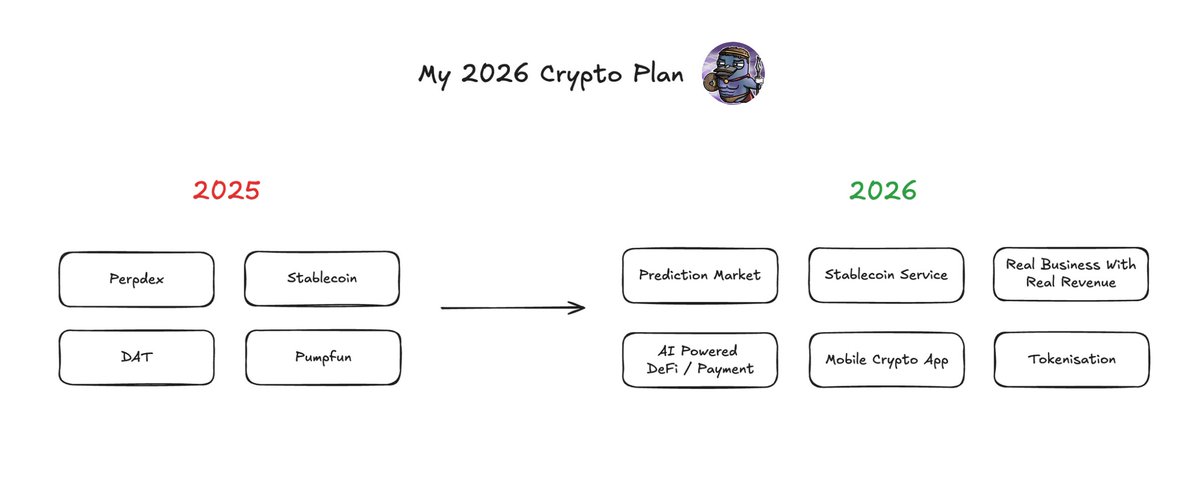
The crypto market is undergoing a necessary "purification" phase, shifting from a "crime cycle" of high-FDV, low-utility projects and pump-and-dump schemes towards value-driven growth. Key 2025 trends included maturation of regulated stablecoins (with over $100B in net growth), the rise of PerpDEXs (reaching $230B open interest), and Digital Asset Trusts (DATs) attracting TradFi interest. However, many DATs and airdrops faltered, highlighting the need for real utility and sustainable tokenomics. Looking ahead to 2026, four major opportunities are identified: 1. **Prediction Markets:** Platforms like Polymarket and Kalshi, backed by institutional interest and mainstream distribution, are set to grow significantly. 2. **Stablecoin Payments:** Supported by clear regulations (e.g., the Genius Act) and adoption by giants like Visa and Stripe, stablecoin transaction volumes are surging. 3. **Mobile dApps:** With improved user onboarding and growing mobile transaction trends, apps like Fomo App are driving accessibility and adoption. 4. **Real Revenue and Value Accrual:** Protocols generating actual income (e.g., via buybacks) and sharing profits with token holders will thrive. The focus shifts from speculation to sustainable business models in trading, yield, and payments. The industry is evolving towards practical applications, genuine revenue, and clearer value propositions, making 2026 a pivotal year for crypto's maturation.

深潮12/09 06:01

From 'Criminal Cycle' to Value Return: Four Major Opportunities in the 2026 Crypto Market Outlook

深潮12/09 06:01

活动图片