# Sovereignty Related Articles

HTX News Center provides the latest articles and in-depth analysis on "Sovereignty", covering market trends, project updates, tech developments, and regulatory policies in the crypto industry.

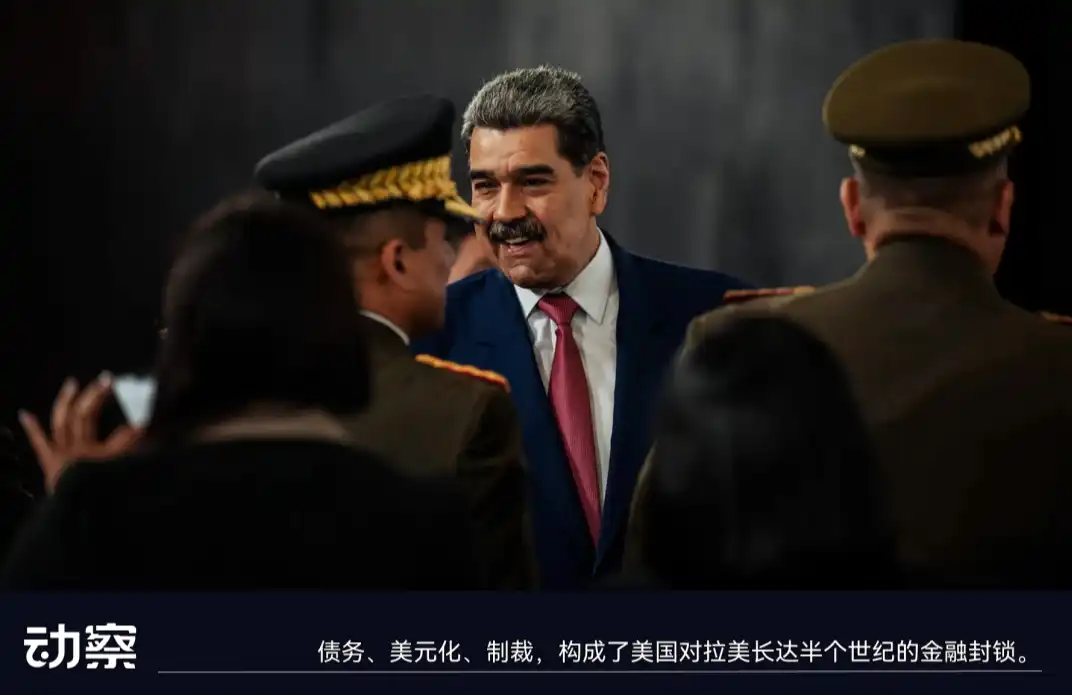
The U.S. Can No Longer Control Latin America, So They Took Maduro

US influence over Latin America is waning, as evidenced by the recent US military operation to extract Venezuelan President Maduro. For decades, the US maintained control through three key financial tools: debt, dollarization, and sanctions. In the 1980s, Latin America’s foreign debt reached 50% of GDP, but today it stands at just 20%, partly due to China’s rise as a major lender and trading partner since the 2000s. Countries like Brazil and Argentina used commodity-driven revenue to pay off IMF debts and reduce dependency. Dollarization, once a means of control, has evolved into “de-Americanized dollarization”—people use the dollar for stability but reject US political influence. Meanwhile, extreme sanctions, such as those imposed on Venezuela, backfired. Instead of crushing resistance, they spurred the growth of a parallel financial ecosystem. This new system includes: - Stablecoins like USDT, used for 80% of Venezuela’s oil revenue - Local fintech platforms (e.g., Brazil’s Pix and Nubank) serving millions - Non-dollar trade channels, such as currency swaps with China - A thriving underground economy and crypto markets US policies—like proposed taxes on remittances and Wall Street’s “de-risking”—have unintentionally accelerated this shift. As the US tightens control, dollar usage becomes more decentralized, echoing the historical decline of the British pound. The very tools meant to enforce dominance are now fueling its erosion.

marsbit01/05 04:03

The U.S. Can No Longer Control Latin America, So They Took Maduro

marsbit01/05 04:03

Lighthouses Guide the Way, Torches Claim Sovereignty: A Hidden War Over AI Allocation Rights

The article "Lighthouse Guides Direction, Torch Fights for Sovereignty: A Hidden War Over AI Allocation" by Zhixiong Pan examines the underlying power struggle in AI development, moving beyond superficial metrics like model size and performance rankings. It identifies two coexisting paradigms: the "Lighthouse," representing state-of-the-art (SOTA), centralized AI systems controlled by tech giants like OpenAI and Google, which push cognitive boundaries but are resource-intensive and create dependency risks; and the "Torch," symbolizing open-source, locally deployable models (e.g., DeepSeek, Mistral) that democratize access, ensure data sovereignty, and enable private, customizable AI assets. The Lighthouse drives innovation and sets technical directions but poses risks in accessibility, control, and single-point failures. The Torch, while shifting security and responsibility to users, offers resilience, cost stability, and compliance for critical applications in sectors like healthcare and finance. The interplay between these models forms a symbiotic relationship: Lighthouses expand capabilities, while Torches disseminate and stabilize these advances, collectively elevating AI’s baseline. Ultimately, the conflict is over AI allocation rights—defining default intelligence, managing externalities, and determining individual control. A dual strategy—using Lighthouses for frontier tasks and Torches for private, reliable deployment—is proposed as the pragmatic path forward, balancing extreme capability with broad, sovereign access. The true measure of the AI era lies not in raw power but in whether individuals possess "a light they don’t have to borrow from anyone."

marsbit12/22 11:13

Lighthouses Guide the Way, Torches Claim Sovereignty: A Hidden War Over AI Allocation Rights

marsbit12/22 11:13

Bitcoin's Financial War: How Digital Gold is Disrupting the Traditional Banking System?

In "The Financial War of Bitcoin: How Digital Gold is Disrupting the Traditional Banking System," the author frames the global financial landscape as a conflict between two forces: the "Financialists" and the "Sovereignists." The "Financialists"—central banks, major financial institutions, and old banking families—are described as having controlled the global financial system for over a century through a complex web of debt, derivatives, and credit instruments. Their power stems not from owning assets, but from controlling the claims on them. In contrast, the "Sovereignists"—nation-states, corporations, and individuals seeking autonomy—are turning to Bitcoin as an escape from this system. The pivotal moment in this "war" was not Bitcoin's creation, but MicroStrategy's demonstration that Bitcoin could function as collateral within the traditional capital markets through its innovative financial product, STRC. STRC, a regulated, yield-bearing product backed by Bitcoin, offers significantly higher returns than traditional savings accounts. More importantly, it creates a self-reinforcing "flywheel": investor funds flow in, MicroStrategy buys more Bitcoin, reducing supply and increasing its price, which in turn boosts the value of its collateral and attracts more investors. The article details the "synthetic counterattack" from traditional finance, such as J.P. Morgan raising margin requirements on MicroStrategy stock and later launching synthetic Bitcoin products like leveraged notes. This is characterized as a desperate attempt to control the "rails" of the new financial system by creating claims on Bitcoin, as they have with gold and other assets, rather than owning the underlying asset itself. The core argument is that Bitcoin represents a fundamental shift because it is a scarce, hard asset that cannot be synthetically multiplied like traditional collateral (e.g., dollars, gold certificates, or bonds). While Wall Street is now embracing Bitcoin through ETFs and structured products to capture fees and control, the author concludes that individuals don't need these synthetic versions. The real power lies in owning the actual, scarce asset itself, bypassing the traditional banking system entirely. Those who understand this early will be the winners in this financial transformation.

链捕手12/14 14:25

Bitcoin's Financial War: How Digital Gold is Disrupting the Traditional Banking System?

链捕手12/14 14:25

AI + Crypto: The 2025 Guide to the Rise of the Super Individual

"AI + Crypto: The Rise of the Super-Individual in 2025" explores the convergence of artificial intelligence and cryptocurrency, which is empowering individuals to become the central creators of value, surpassing traditional institutions. A "Super-Individual" is defined as a self-sufficient creator, investor, and narrative builder who leverages AI as a cognitive extension and uses crypto for financial sovereignty. The article outlines three primary paths to becoming a Super-Individual: 1. **Content Creator (KOL):** Using AI to enhance research, content creation, and distribution, while leveraging influence for early access to projects ("KOL rounds"). 2. **Web3 Builder:** Utilizing AI to drastically reduce the cost and complexity of development, enabling solo founders to build MVPs and launch projects efficiently. 3. **Trader:** Employing "Vibe Coding" (using natural language to instruct AI) to automate trading strategies and analysis, freeing up time for higher-level decision-making. Four core competencies are identified as essential: content production, on-chain analytics proficiency, AI collaboration skills, and independent judgment. The piece highlights "Vibe Coding" as a key example, demonstrating how individuals with no coding experience can use AI to build and deploy applications from scratch. The conclusion argues that overcoming market anxiety comes from becoming a "value creator" rather than just a "value holder." By mastering AI tools and crypto sovereignty, individuals can build security through their created value, not just speculative gains. This shift towards AI-powered productivity and Web3-based ownership is presented as an irreversible trend to be embraced.

marsbit12/12 10:10

AI + Crypto: The 2025 Guide to the Rise of the Super Individual

marsbit12/12 10:10

活动图片