Author: Wang Lijie
"Financialists": An Empire Built on Debt Stacking
First, let's get to know one faction—the "Financialists." Who are they? They include the Federal Reserve, JPMorgan Chase, the historic banking families of Europe, and the complex derivatives markets that support them. It can be said that since secretly establishing the skeleton of a synthetic monetary system in a small room in 1913, they have controlled the world for over a century.
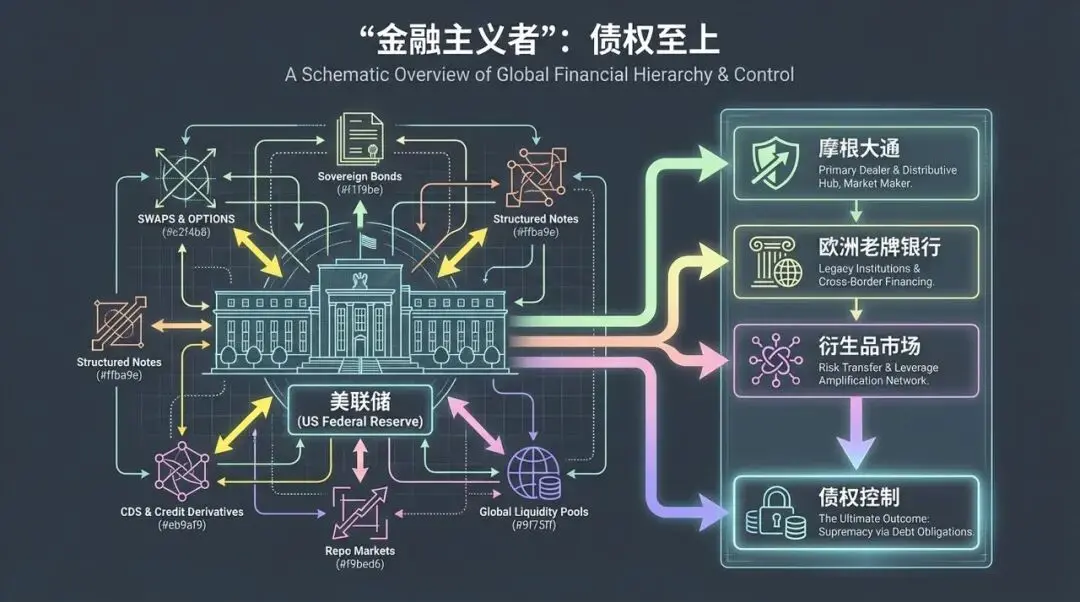
Their core means of controlling the world is not through direct ownership of assets, but through the continuous circulation and accumulation of "debt."
-
Collateral -
Yield -
Price Signals -
Credit System -
Eurodollars, Swaps, Futures, Repo
These tools are layered and interconnected like a tightly packed Luohan formation, firmly gripping the entire financial轨道 and monetary flow. They are like "behind-the-scenes assassins" in the financial world, building a vast financial empire with debt.
"Sovereignists": Seeking a Way Out
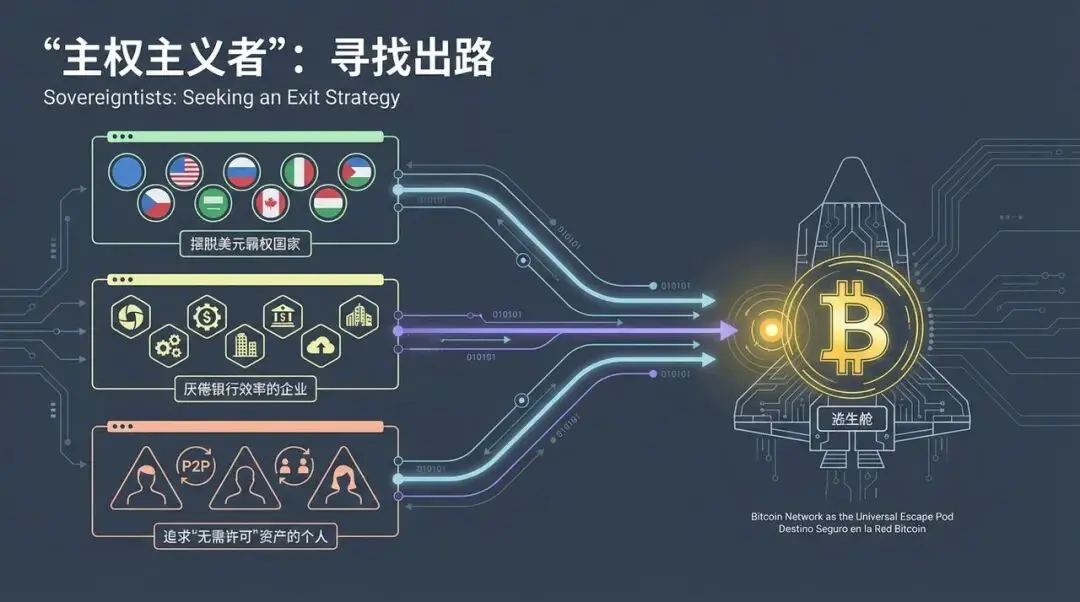
In stark contrast to the "Financialists" is another emerging force—the "Sovereignists." They include:
-
Nations trying to break free from the钳制 of dollar hegemony -
Enterprises tired of the inefficiency and层层盘剥 of the banking system -
And ordinary people like you and me, who choose to firmly control their wealth in their own hands and pursue "permissionless" assets
Although their motivations differ, their core诉求殊途同归: they all渴望 to find a way out of the old, constantly吸血 financial system. And Bitcoin has become the first "escape pod" they see.
Bitcoin's "Fuse" and MicroStrategy's Qualitative Change
Initially, what ignited this war was not Bitcoin itself. Bitcoin was more like a fuse; it shook people's perceptions and demonstrated another financial possibility. However, what truly撼动 the power foundation of the old world was MicroStrategy. This company proved through its actions that Bitcoin can serve as collateral and be deeply integrated into the capital markets—a qualitative change in its status within the financial system.
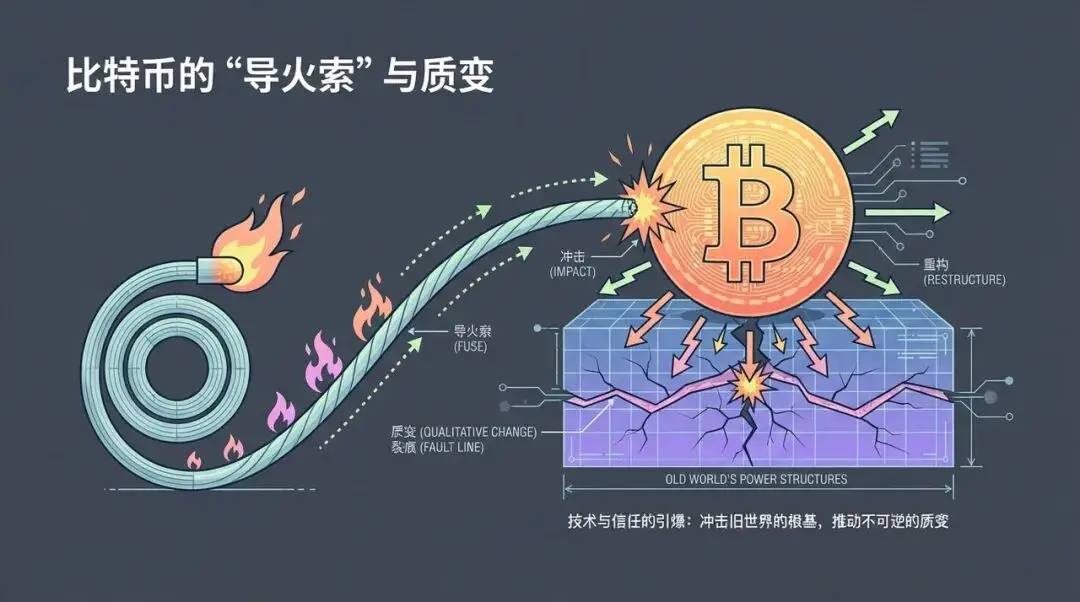
This is not a simple price fluctuation, but the true prologue to a financial war. It reveals that Bitcoin is no longer a marginalized digital currency, but a key collateral with the potential to impact the core of traditional finance.
To understand this transformation more clearly, we must mention a product that sounds quite hardcore—STRC. STRC is not an ordinary bond, nor is it a typical new financial product; it wasn't even created out of thin air by MicroStrategy.
STRC: A Disruptive Bitcoin Financial Engine
STRC is the world's first regulated financial engine collateralized by Bitcoin. What does this mean? It means that ordinary savers can now openly purchase, within their brokerage accounts, a yield-generating product backed by Bitcoin. You don't need a bank account, nor do you need to venture into the complex shadow banking system. Even more notably, the current STRC yield can reach up to 10.75%, starkly contrasting with traditional bank savings interest rates, which typically range from 0.1% to 1%.

However, what is most remarkable about STRC is not just its high yield, but the monetary feedback loop it embodies—this is the fundamental reason why the "Financialists" are restless.
-
Investors buy STRC: Funds flow into MicroStrategy. -
MicroStrategy uses these funds to buy real Bitcoin: The supply of Bitcoin in the market tightens. -
Bitcoin price rises: As supply decreases and demand increases. -
The value of Bitcoin as collateral increases: MicroStrategy's borrowing costs decrease accordingly. -
Lower costs attract more investors to buy STRC: Forming a virtuous cycle, the company needs to buy more Bitcoin.
This is a perfect self-reinforcing flywheel, a perpetual motion machine of ever-increasing scarcity! This is the core of what truly frightens the traditional financial giants.
The traditional banking system cannot run this mechanism. They cannot accept Bitcoin as collateral, cannot use Bitcoin for settlement, cannot凭空 "print" Bitcoin, and cannot easily freeze it. In the past, they could control everything because they could无限创造 "debt"; now, Bitcoin is a physical thing, a hard currency.
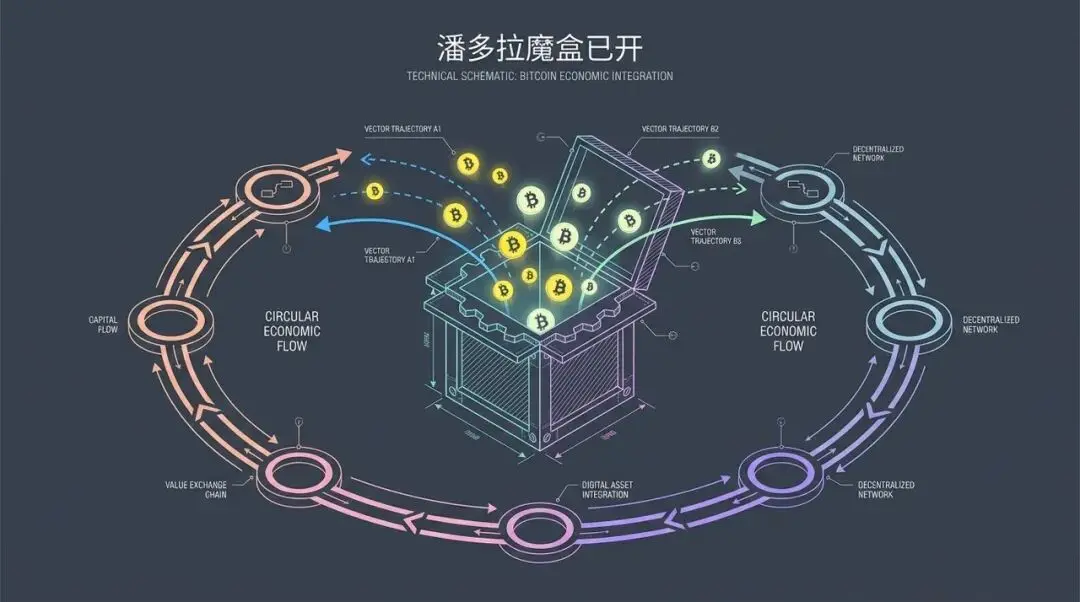
This is the first time in human history that ordinary individuals can, within a regulatory framework, bypass the banking system and directly participate in the循环 of capital. When this Pandora's box was opened, the first offensive quietly arrived.
JPMorgan's Sniper Attack and the "Synthetic Counterattack"
In July 2025, JPMorgan's "Prime Brokerage" department suddenly announced that it would significantly increase MicroStrategy's margin requirement from 50% to 95%. This means that if you want to buy $100,000 worth of MSTR stock, you now need to put up $95,000 in cash, almost堵死了 the possibility of leveraged trading.
This is not a normal market adjustment.要知道, JPMorgan did not take similar action against high-volatility stocks like Tesla, Nvidia, or Coinbase. MSTR became the sole target. Behind this, it's clearly not simple market competition, but更像 a预谋ed, coordinated suppression campaign.

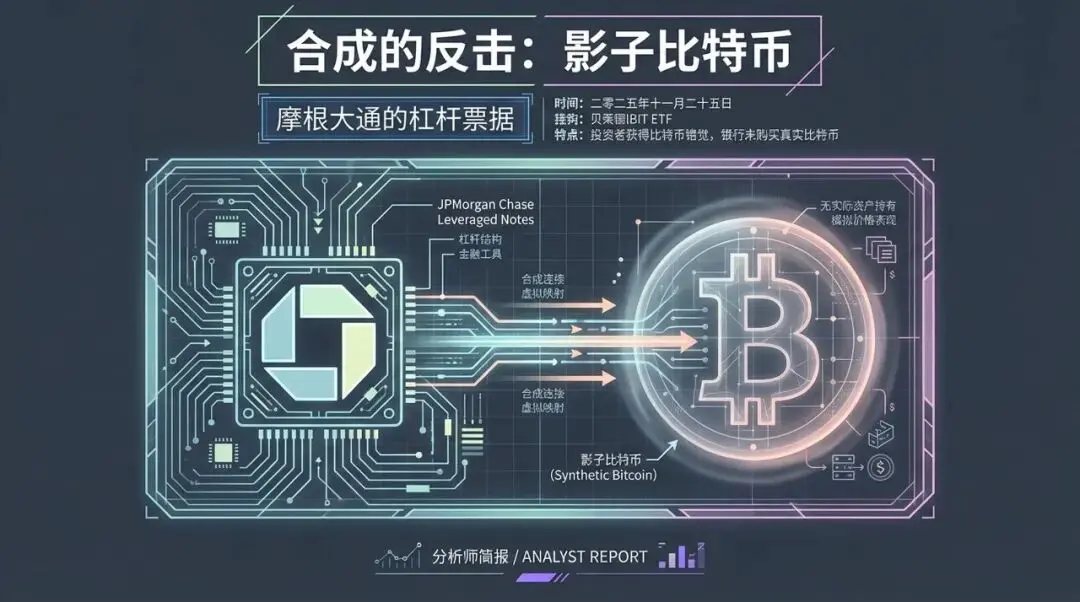
紧接着, the "synthetic counterattack" followed. On November 25, 2025, JPMorgan filed with the SEC to launch a leveraged Bitcoin-linked structured note tied to BlackRock's IBIT ETF. This is a textbook demonstration of Wall Street's "old tricks."
Wall Street doesn't control assets; they control the "claims" on assets. They never owned gold, yet controlled synthetic gold; no silver, yet could control synthetic silver; synthetic treasuries, synthetic credit. So, naturally, they now want to manufacture "synthetic Bitcoin" on this soil.
History Repeats: The Unreplicable "Monetary Physics"
Looking back at history, whether it was the transition of the US from agricultural finance to industrial finance in the early 20th century, or the patterns of power concentration and narrative control over the past century, we find惊人 similarities. Whenever the old system is threatened, the response is always to concentrate power, control the narrative, and suppress everything that doesn't fit the new standards.
However, the script cannot be reused this time. Because the real war has already surpassed Bitcoin vs. the dollar, or even Bitcoin vs. Wall Street. It is about the争夺 of "轨道"—those systems that channel value into Bitcoin and create credit from Bitcoin. Whoever controls these轨道 controls the future monetary system.
MicroStrategy, through its STRC product, has exposed a secret Wall Street doesn't want the world to know: Bitcoin *can* function as flawless collateral in the capital markets!
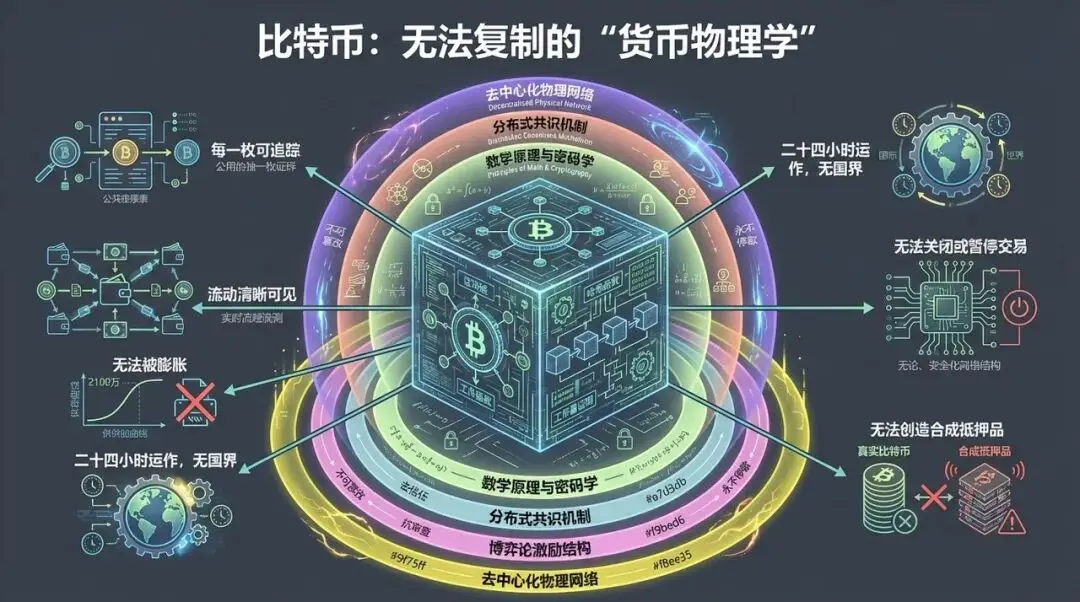
Once this fact surfaced, the model of the "Financialists" began to瓦解. For over a hundred years, their power was rooted in the ability to multiply collateral: gold could have a 100:1 paper claim system built upon it, dollars were infinitely multiplied through fractional reserve banking, and treasuries were repeatedly rehypothecated within the banking system. However, Bitcoin breaks all these advantages. You can create synthetic Bitcoin exposure, but you cannot create synthetic Bitcoin collateral!
Wall Street's Demand: Submission and争夺
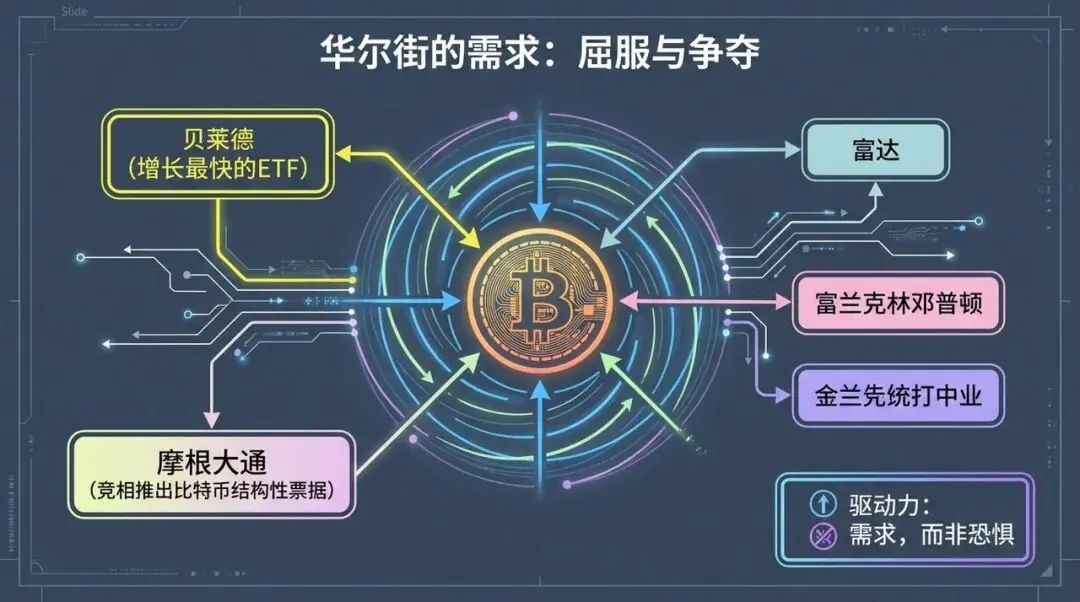
Wall Street's own behavior is the best proof. BlackRock launched the fastest-growing ETF in history, and its underlying asset is not bonds, stocks, or gold, but Bitcoin! Fidelity, Franklin Templeton followed suit. Even JPMorgan, which had raised margin requirements for MicroStrategy and specifically targeted Bitcoin-related companies, is now racing to launch Bitcoin-linked structured notes. This makes one reflect: "Why?"
The answer is simple: they深知 Bitcoin is becoming what—a new collateral layer that will absorb more liquidity than any other asset in the financial system.
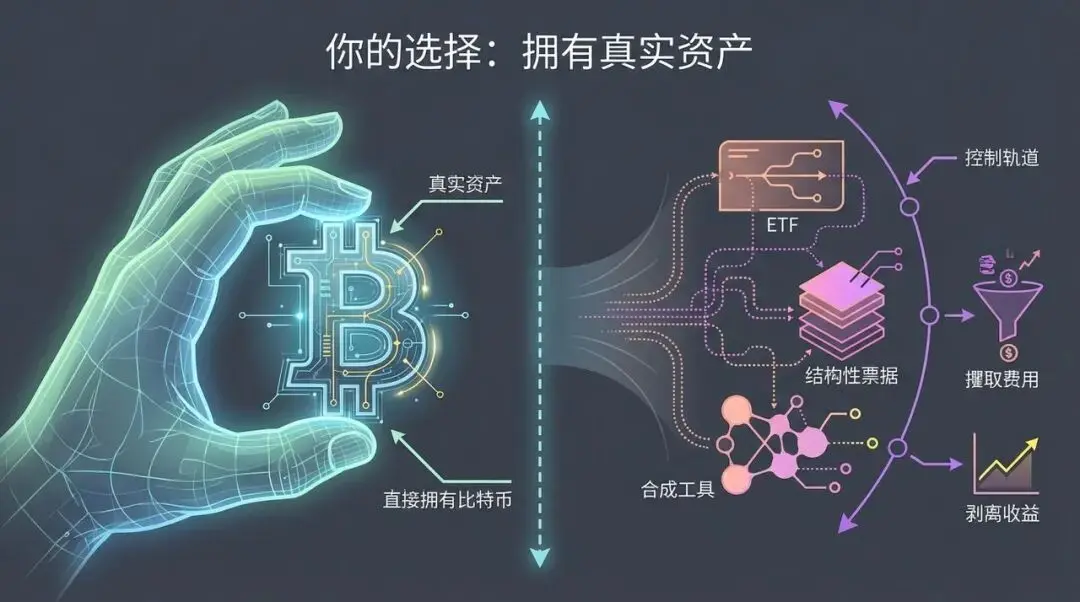
This is not out of fear, but a profound market demand from the world's largest financial institutions. What they don't want us to understand is that in every Wall Street product they launch, whether ETFs, structured notes, or synthetic instruments, they are controlling the轨道, grabbing fees,掌控 convexity, and榨取 the upside profits. You might get some exposure, but they capture most of the economic benefits.
Your Choice: Own the Real Asset
However, you don't need to buy these synthetic versions at all. You don't need banks to act on your behalf, nor do you need those structured notes, third-party custodians, or derivative desks. You can directly own Bitcoin—this real asset, this scarce collateral—which is exactly what Wall Street is scrambling to package, repackage, and try to strip from your hands! This is the real return.
The "Financialists" are not fighting against Bitcoin because it poses a threat; they are fighting to get a piece of the pie because they realize Bitcoin is the cornerstone of the next system. They try to control the轨道 because they know where the flow of liquidity is going. But you, you don't need their轨道. Bitcoin has already provided its own轨道 for you.
Those who can understand this early and prepare before this transformation becomes一目了然 will be the true winners in this era of change. The choice is now in your hands.
Recommended Reading:
Why Isn't Asia's Largest Bitcoin Treasury Company Metaplanet Buying the Dip?
Multicoin Capital: The Era of Fintech 4.0 Has Arrived
a16z's Heavily Funded Web3 Unicorn Farcaster Forced to Pivot, Is Web3 Social a False Proposition?
Trending Cryptos












Related Questions
QWhat is the core mechanism through which the 'Financialists' maintain control over the global financial system, according to the article?
AThe 'Financialists' maintain control through the continuous circulation and accumulation of 'credit' or debt instruments, using tools like collateral, yield, price signals, credit systems, Eurodollars, swaps, futures, and repos to tightly control the entire financial track and monetary flow.
QWhat specific product does the article credit with causing a qualitative change in Bitcoin's role within the financial system?
AThe article credits the STRC (a regulated financial engine collateralized by Bitcoin) with causing a qualitative change. It proved Bitcoin could function as legitimate collateral and be deeply integrated into capital markets, creating a self-reinforcing monetary feedback loop.
QHow did J.P. Morgan allegedly attempt to suppress MicroStrategy (MSTR) in July 2025, as described in the text?
AJ.P. Morgan's prime brokerage division abruptly raised the margin requirement for MicroStrategy (MSTR) stock from 50% to 95%, effectively stifling leveraged trading by requiring nearly the full value in cash for a purchase.
QWhat fundamental advantage does Bitcoin possess that the article argues traditional 'Financialists' cannot replicate with their synthetic instruments?
ABitcoin's fundamental advantage is that it is a real, scarce, physical hard asset. While 'Financialists' can create synthetic exposure to Bitcoin (like ETFs or structured notes), they cannot create synthetic Bitcoin *collateral*, which breaks their traditional model of multiplying collateral (e.g., gold, dollars, treasuries) to maintain power.
QWhat is the ultimate choice the article presents to the individual regarding participation in the new financial system centered around Bitcoin?
AThe article presents the choice to directly own the real Bitcoin asset itself, rather than relying on synthetic versions (ETFs, structured notes, derivatives) offered by traditional banks and financial institutions. It argues that individuals do not need the 'tracks' controlled by Wall Street because Bitcoin provides its own.
Related Reads




Trading
Hot Articles
Hot Tokens Learning Week 14: Glamsterdam Set to Be Ethereum's Most Closely Watched Upgrade in 2026
Ordinals/Runes continue to drive block fee revenue and developer activity, and are seen as the starting point for Bitcoin's "native asset issuance".
29.2k Total ViewsPublished 2026.04.29Updated 2026.04.29

Hot Tokens Learning Week 19: RWA and Infrastructure Stay in Focus; Pump Platform's Daily Trading Volume Returns to Recent Highs
Recently, Robinhood Chain adopted Chainlink as its official oracle and CCIP provider.
61.2k Total ViewsPublished 2026.07.22Updated 2026.07.24

Hot Tokens Learning Month 20: This AI Memory Cycle Is Different, And UNI's Fundamentals Are Turning Heads
Wall Street remains strongly bullish on Micron as a core beneficiary of AI memory demand, emphasizing that "this cycle is different."
45.9k Total ViewsPublished 2026.08.06Updated 2026.08.06

Discussions

Top Questions
- How can investors avoid hype driven by Elon Musk’s tweets?07/07 11:39
- What are analysts predicting for Bitcoin’s next support level?01/16 19:13
- How are Trump’s sons building a crypto empire?01/16 19:13
- Is Ethereum’s on-chain surge challenging Bitcoin’s dominance?11/07 02:18
- What is Trump’s connection to Binance and the crypto industry?11/07 02:18
