# Sovereignty Related Articles

HTX News Center provides the latest articles and in-depth analysis on "Sovereignty", covering market trends, project updates, tech developments, and regulatory policies in the crypto industry.

Vitalik: What We Need to Do Is Not Fight AI, But Create Sanctuaries

Vitalik Buterin, in an a16z podcast, addresses the core challenge of the AI era: not to fight AI, but to build "sanctuary technologies" that protect humans without stripping away privacy and agency. He argues the greatest risk is not super-intelligent AI, but humans becoming passive passengers who outsource decisions to centralized systems and AI, leading to a disempowering safety. He redefines Ethereum/crypto's mission as creating such a sanctuary—a parallel, optional space for free coordination, not a fix for the existing system. This becomes crucial as AI and corporate power centralize. Reflecting on his journey from a 19-year-old on "autopilot" to an active "pilot," Vitalik emphasizes that the world reinvents itself every 5-10 years, demanding proactive adaptation. He stresses that active learning is 10x more effective than passive learning, even with equal time. His key advice is to intentionally maintain "manual mode" amidst powerful AI: do tasks yourself, engage in active learning, and avoid total cognitive outsourcing to prevent mental atrophy. For builders, the focus should be on creating tools that preserve human sovereignty, foster serendipity, and keep strategic control. In summary, the AI era demands greater human initiative. True value lies not in computational power, but in active, sovereign individuals who use technology as a tool for agency, not a replacement for it.

marsbit05/18 01:44

Vitalik: What We Need to Do Is Not Fight AI, But Create Sanctuaries

marsbit05/18 01:44

Vitalik: We Need to Create Sanctuaries, Not Fight AI

In a recent interview, Vitalik Buterin, founder of Ethereum, addresses the central anxiety of the AI era. He argues the primary risk isn't AI's intelligence, but human passivity—ceding decisions, privacy, and agency to centralized systems or "super AIs" for a sense of "disempowering safety." His solution is not to fight AI, but to build "sanctuary technologies." These are optional, non-totalizing spaces that protect users while preserving their sovereignty and privacy. Ethereum is presented as a prime example, offering a parallel financial system one can freely choose, not a fix for the old one. Reflecting on his journey from a 19-year-old on "autopilot" to an active "pilot," Vitalik notes the world reinvents itself every 5-10 years. To keep up, individuals must actively pilot their lives, not be passive passengers. He stresses that active learning vastly outperforms passive learning, even with equal time invested. His practical advice for builders and individuals in the AI age includes: periodically forcing oneself to do tasks manually to keep the mind engaged; prioritizing active learning and verification over outsourcing answers; building tools that help retain human agency; not outsourcing all strategic thinking to AI; and preserving serendipity through real-world interactions. Ultimately, Buterin redefines Ethereum/crypto's role: not to win against or fix the old world, but to provide a free, optional alternative. The core message is that as AI grows more powerful, the truly scarce resource will be proactive humans who retain their sovereignty, privacy, and capacity for independent thought. The era demands not less tool use, but more intentional and active use of technology.

链捕手05/17 02:57

Vitalik: We Need to Create Sanctuaries, Not Fight AI

链捕手05/17 02:57

From OpenClaw to the History of the Web: When AI Gains Sovereignty, What Remains for Humanity?

From Web1 to Web4: A History of Power and Ownership in the Digital Age This article examines the evolution of the web not as a series of technical upgrades, but as a fundamental shift in power—specifically, who owns data, controls wealth, and wields productive force. **Web1 (Read-Only):** Characterized by one-way communication. Platforms like Yahoo owned all content and users were merely passive consumers, or "traffic," with no digital assets. **Web2 (Read-Write):** Users became content creators, but platforms like Facebook and TikTok established a "panoptic dictatorship." They harvested user data to create immense value, but users retained only usage rights, not ownership, of their digital assets and social presence. **Web3 (Read-Write-Own):** A movement to reclaim digital rights through cryptography and decentralization. It enables true digital ownership (e.g., via private keys) and trustless systems (e.g., DAOs, smart contracts). However, it remains a wild frontier with significant legal and security challenges, lacking a capable "workforce" to realize its full potential. **Web4 (Agent Economy):** The convergence of AI Agents and Crypto. AI Agents (autonomous, task-completing AIs) use Crypto as their native currency for machine-to-machine transactions. This shifts power from humans to algorithms, creating independent AI economic actors. This raises critical legal questions, such as liability for AI errors. The future could lead to two extremes: a utopia of liberated human creativity or a dystopia of extreme inequality if AI power is monopolized by a few. **Survival Guide for Web4:** * **Work:** Become a director and risk-manager for AI, not an executor. * **Invest:** Focus on projects with genuine utility, not hype-driven "air tokens." * **Risk Management:** Prioritize robust legal and compliance frameworks for AI operations. The conclusion emphasizes that understanding the transfer of power and assets is key to navigating the future, urging innovation within the boundaries of regulation.

marsbit03/23 13:32

From OpenClaw to the History of the Web: When AI Gains Sovereignty, What Remains for Humanity?

marsbit03/23 13:32

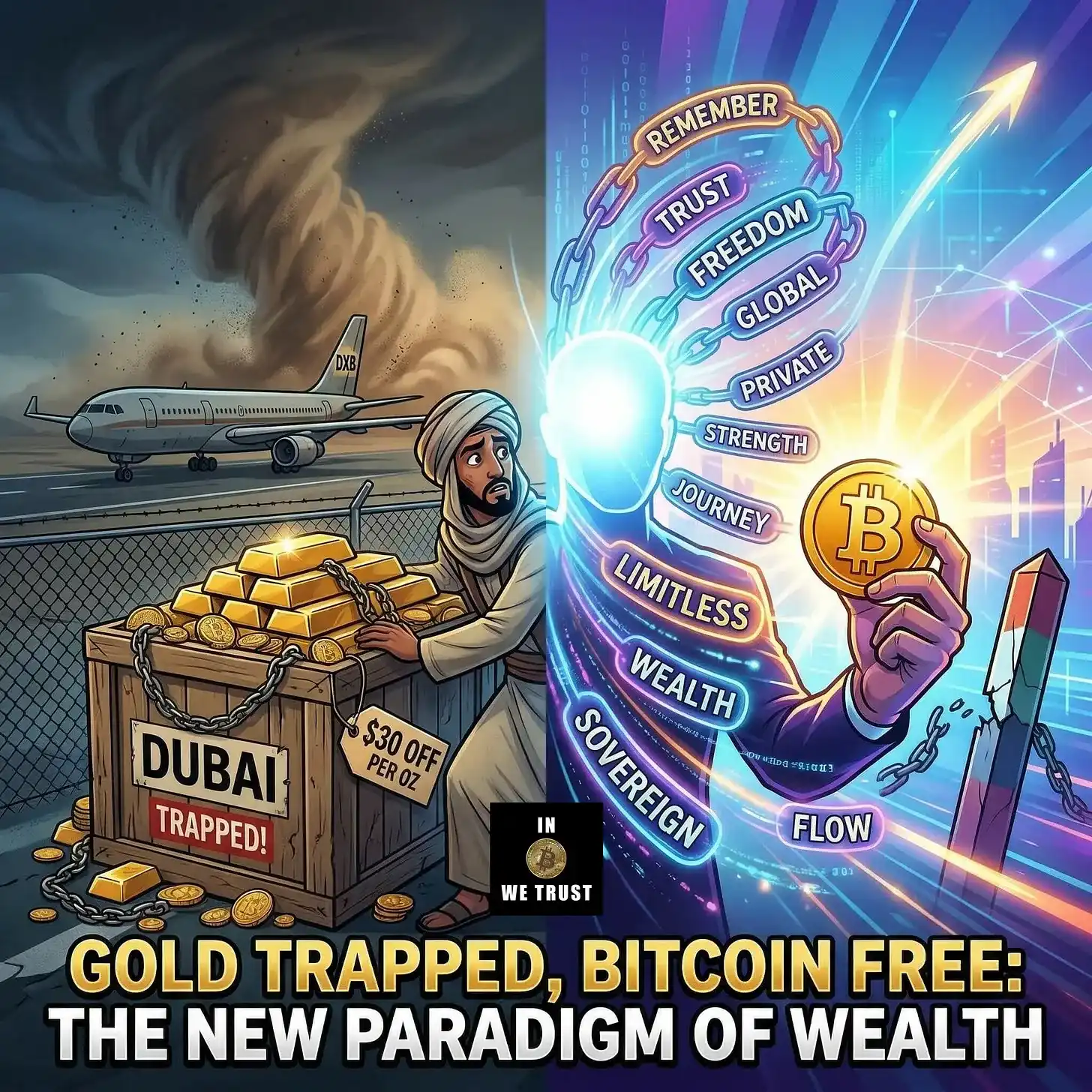
Gold Trapped in the Desert, Borderless Bitcoin: The New Paradigm of Wealth in an Era of War

Title: Gold Trapped in the Desert, Borderless Bitcoin: A New Paradigm of Wealth in Times of War The recent escalation of geopolitical tensions in the Middle East, particularly involving the U.S., Israel, and Iran, has led to a severe disruption at Dubai International Airport—a critical global hub for trade and logistics. This crisis has exposed a significant vulnerability in the traditional financial system: the complete paralysis of physical gold transportation. Gold, often regarded as the ultimate safe-haven asset, relies on an intricate and high-security logistics network, including specialized transport, armed guards, and multi-million-dollar insurance policies. However, during times of war, this system collapses. Flights are grounded, airspace becomes unsafe, and gold suppliers are unable to move their inventories. As a result, gold traders in Dubai are forced to sell at discounts of up to $30 per ounce to avoid mounting storage costs, insurance premiums, and opportunity costs—highlighting the irony of a避险资产 becoming a financial burden. In contrast, Bitcoin demonstrates unparalleled resilience in such crises. While its price may experience volatility during geopolitical turmoil, its true value lies in its non-physical, censorship-resistant nature. Unlike gold, Bitcoin does not require physical transport, is not subject to confiscation at borders, and can be transferred across the globe instantly with just a 12- or 24-word seed phrase. This makes it an ideal store of value for individuals and businesses caught in conflict zones, where traditional financial systems and physical assets fail. The Dubai gold crisis underscores a broader shift in the paradigm of wealth preservation. Physical gold, despite its historical prestige, is constrained by its materiality and dependence on centralized infrastructure. Bitcoin, as a decentralized digital asset, offers a solution that transcends borders, governments, and physical limitations. In an era of increasing geopolitical instability, the ability to carry one’s wealth seamlessly and securely—without the constraints of weight, logistics, or censorship—positions Bitcoin as the modern embodiment of financial sovereignty.

marsbit03/13 08:11

Gold Trapped in the Desert, Borderless Bitcoin: The New Paradigm of Wealth in an Era of War

marsbit03/13 08:11

Written at the UAE-Oman Border: Survival Insights for Crypto Natives After Crossing Through the Fire

Authored by brother bing, co-founder of MegaETH, this article reflects on the relationship between technology and civilization after the author witnessed missile attacks and defense systems at the UAE-Oman border. The author argues that technology acts as an amplifier of a civilization’s inherent trajectory—enhancing productivity and coordination in healthy cycles, while fueling addiction and conflict in periods of decline. Applying this lens to crypto, the author observes that the industry has drifted from its original cypherpunk ideals. Crypto was meant to be a parallel system offering borderless finance, low coordination costs, and individual sovereignty. However, the pursuit of legitimacy and integration with traditional finance (TradFi) has diluted its transformative potential. Many early, structurally meaningful use cases—such as unsecured microloans and cross-border savings—have been sidelined in favor of financialization and speculative gains. The article calls for a return to crypto’s original mission: building infrastructure that enables genuine sovereignty rather than serving as middleware for legacy systems. It urges the community to resist short-term incentives, prioritize meaningful development, and realign with the values of openness, criticism, and independence. The author concludes by emphasizing the importance of individual agency and the courage to build alternative systems despite prevailing uncertainties.

marsbit03/03 07:36

Written at the UAE-Oman Border: Survival Insights for Crypto Natives After Crossing Through the Fire

marsbit03/03 07:36

活动图片