# Inflation Related Articles

HTX News Center provides the latest articles and in-depth analysis on "Inflation", covering market trends, project updates, tech developments, and regulatory policies in the crypto industry.

U.S. National Debt Approaches $40 Trillion in 5 Months, Bitcoin Debate Gains Momentum

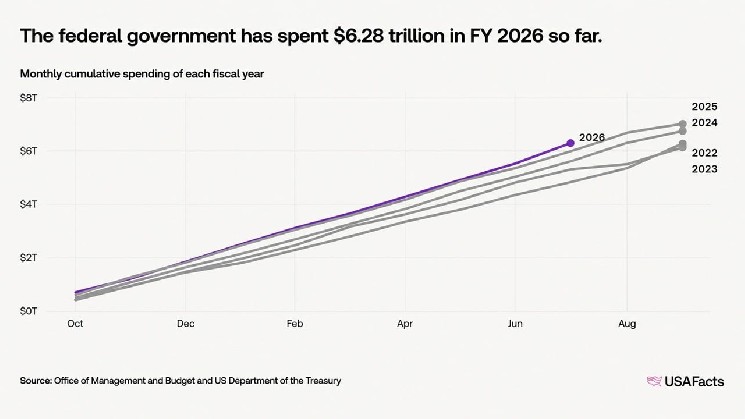
The US national debt has surged to nearly $40 trillion in just five months, the fastest trillion-dollar increase on record. The debt's growth has accelerated dramatically over time, from taking 192 years to reach the first $1 trillion in 1981 to adding the latest $1 trillion in only five months. The federal budget deficit for the fiscal year is already over $1.8 trillion, exceeding last year's total, and net interest payments on the debt have surpassed $1 trillion, now exceeding defense or Medicare spending. This rapid debt accumulation is fueling arguments within the cryptocurrency industry that Bitcoin serves as a hedge against government-backed currencies and fiscal irresponsibility. Proponents, including some lawmakers and industry leaders, argue Bitcoin could act as a "hard currency" fiscal control mechanism. Legislation has even been proposed for the Treasury to acquire Bitcoin to help reduce the national debt. The International Monetary Fund has warned that global public debt could hit 100% of world GDP by 2029 if current trends continue, with the US and China as primary drivers. Some analyses suggest a sovereign debt crisis could drive capital into alternative assets like Bitcoin, similar to past regional banking crises. However, skeptics point out that both Bitcoin and gold have fallen in price at times during 2026 despite record debt, indicating the depreciation hedge theory may operate over a much longer timeframe than short-term price action.

cryptonews.ru08/17 12:01

U.S. National Debt Approaches $40 Trillion in 5 Months, Bitcoin Debate Gains Momentum

cryptonews.ru08/17 12:01

Glassnode: Consumer Confidence Falls as AI-Related Stocks Rise, Bitcoin Lags Behind

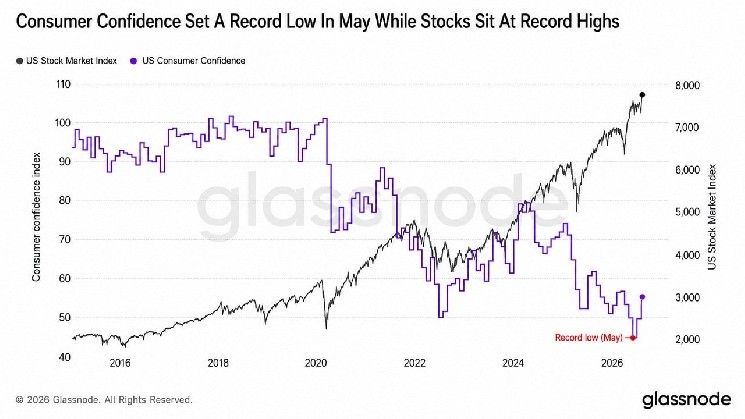
According to Glassnode, consumer confidence remains at one of its lowest levels in a decade, despite two consecutive months of improvement. This has not stopped households from moving money out of cash, as they expect further cost-of-living increases and a broader economic slowdown. The key question is where this capital is flowing. US stocks hit a new all-time high in early August, primarily driven by trading in AI-related stocks rather than a broad market rally. Bitcoin, historically seen as a hedge against declining trust in traditional finance, has not participated in this movement. Spot Bitcoin ETFs saw outflows of $389.7 million in one week, coinciding with rising equity markets—a divergence that aligns with Glassnode's data on capital flows. Bitcoin is currently trading at roughly half its October 2025 peak, stuck in a narrow range. Meanwhile, AI-related trading continues to attract fresh capital from retail traders, hedge funds, and even crypto-native institutional investors, who are redirecting funds into AI stocks and tokens. The macroeconomic backdrop has not been hostile to Bitcoin, with core inflation at a moderate 2.5% in July. However, Bitcoin's muted response to favorable inflation data is seen as a concerning signal, given its supposed role as a hedge against currency debasement. Spot Bitcoin exchange trading volume has fallen to its lowest since 2019, and recent ETF inflows are only a "fraction of any prior accumulation wave," suggesting institutional buying may have paused. This trend extends beyond trading: some Bitcoin miners are repurposing their power contracts and data center capacity for AI workloads. This appears to be a structural shift that could pressure Bitcoin's status as the default destination for capital leaving cash. The fundamental arguments for Bitcoin as a hedge against inflation or scarcity are not invalidated, but their expected impact has not materialized within the timeline anticipated by crypto optimists this summer.

cryptonews.ru08/17 09:55

Glassnode: Consumer Confidence Falls as AI-Related Stocks Rise, Bitcoin Lags Behind

cryptonews.ru08/17 09:55

Peter Todd's Remarks on Emissions Spark Debate Over Bitcoin Inflation

Peter Todd's recent speech on "Tail Emissions and Demurrage" has reignited the intense debate around Bitcoin's 21 million supply cap. He argues that after block subsidies end around 2140, a fee-only model could create security risks by enabling powerful miners to perform chain reorganizations. His proposed solution is a small, fixed "tail emission" of new coins per block or a demurrage fee on dormant coins to provide predictable miner income. The backlash was swift and severe across social media. Critics denounced the proposals as "inflation by another name" and a violation of Bitcoin's foundational social contract of absolute scarcity. They argue that tinkering with the fixed monetary policy undermines Bitcoin's core value proposition versus fiat currencies. Alternatives like relying on Layer-2 solutions and a robust fee market were emphasized as the correct path forward. While a few figures like Starkware's Eli Ben-Sasson have expressed sympathy for limited permanent emission to offset lost coins, Todd acknowledges a hard-fork implementing his idea is highly unlikely in the near future. The consensus remains that any change to the 21 million limit faces insurmountable opposition from the ecosystem of node operators, miners, and holders. The debate underscores that Bitcoin's security budget challenge will ultimately be tested by future halvings and the organic development of its transaction fee economy.

cryptonews.ru08/16 20:46

Peter Todd's Remarks on Emissions Spark Debate Over Bitcoin Inflation

cryptonews.ru08/16 20:46

Large-scale Long-Term Bond Sell-off Forces a Severe Budgetary Reassessment

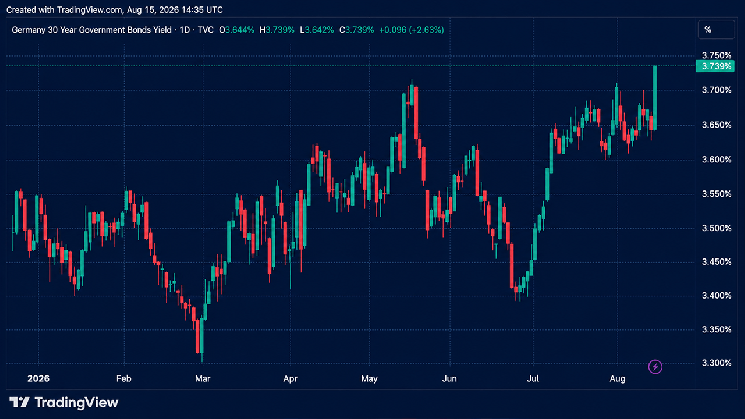
Large-scale sell-offs in long-term government bonds have forced a major budget reassessment. Yields on key bonds surged to levels not seen in years or even decades: US 30-year Treasuries hit around 5.25% (highest since 2001), while German 30-year Bunds approached 3.73% (highest since 2011). French long-term yields returned to levels last seen during the global financial crisis, and Japan's 5-year government bond yields broke above 2.14%, signaling a departure from years of ultra-loose monetary policy. The era of ultra-cheap money, sustained by central bank stimulus post-2008 and during the pandemic, is ending. Investors now demand higher compensation for lending over decades, seeking protection against inflation, heavy bond issuance, and currency devaluation. Market patience with fiscal dysfunction is wearing thin, as seen in soaring yields for highly indebted European nations like France. The pressure stems from widening fiscal gaps in major economies (US, France, Japan), which face rising spending on defense, infrastructure, energy, and aging populations. In the US, annual federal interest payments now exceed $1 trillion. As central banks reduce bond holdings via quantitative tightening, they are withdrawing as major buyers. Governments are flooding the market with new debt, forcing private investors to demand higher yields—a rising term premium. The impact extends beyond government budgets: higher long-term yields push up mortgage rates, increase borrowing costs for corporations, pressure stock valuations, and redistribute resources away from entities accustomed to cheap money.

cryptonews.ru08/15 20:01

Large-scale Long-Term Bond Sell-off Forces a Severe Budgetary Reassessment

cryptonews.ru08/15 20:01

Grayscale Forecasts Increase in Scarcity for Ethereum and Solana

Grayscale Research predicts that Ethereum (ETH) and Solana (SOL) could become scarcer assets due to proposed tokenomics changes in their respective blockchains. According to analyst Zach Pandl, both networks are considering protocol adjustments that would reduce the annual issuance rate of their native tokens. The report compares projected annual supply inflation over the next five years, estimating it could fall to around 0.4% for Ethereum and 1.1% for Solana by 2031, lower than gold's estimated 1.8% annual supply growth. Pandl notes that while the changes are still under community discussion, Solana's proposals have broader support and a higher chance of implementation. Reduced inflation would directly impact network stakers, as their rewards are funded by new token issuance. While stakers would receive fewer new tokens, the potential scarcity could support the market price of ETH and SOL. Non-staking holders could benefit directly from the decreased supply. For Ethereum, the debate on scarcity includes proposals like EIP-8363, which would burn a portion of staking rewards. Pandl concludes that the proposed changes would increase the scarcity of both assets and could create upward pressure on their prices. The analysis also notes Solana's ongoing infrastructure development, including the Alpenglow upgrade to speed up transaction finalization and significant growth in its tokenized asset ecosystem.

cryptonews.ru08/15 12:53

Grayscale Forecasts Increase in Scarcity for Ethereum and Solana

cryptonews.ru08/15 12:53

Crypto Market Declines Amid Halt in U.S. Price Growth: Fresh Review

Crypto Market Declines Amid Stalled US Inflation: A Review (August 7-14, 2026) The crypto market faced downward pressure as US inflation data for July showed prices stagnating but remaining above the Federal Reserve's 2% target. This reduced expectations for a September interest rate cut, dampening investor risk appetite. Bitcoin (BTC) fell 2.39% over the week, with low volatility. Spot BTC ETFs saw a weekly outflow of $332.08 million. Major holders like Strategy (formerly MicroStrategy) continued selling BTC, citing debt obligations, while mining firms faced unfavorable conditions. Ethereum (ETH) dropped 1.71%, struggling near $1,900. Despite the price decline, network activity saw a recovery. Spot ETH ETFs recorded a minor outflow of $2.26 million after five weeks of inflows. ETH remains slightly inflationary. Ripple (XRP) fell 1.7%, briefly dropping below $1 for the first time in 20 months, negatively impacted by a hack on the Coreum bridge that stole 200,000 XRP. However, spot XRP ETFs saw their fifth consecutive week of inflows. Cardano (ADA) plunged 9.53% after Grayscale withdrew its application for a spot ADA ETF. Monero (XMR) was a positive outlier, rising 5.32% alongside a significant 28% increase in derivatives market open interest, briefly surpassing $400. Technical analysis for BTC and ETH indicated consolidation within defined ranges. The Crypto Fear & Greed Index remained at 29, signaling persistent fear. The primary catalyst for the market's negative performance was the persistently high US inflation, suggesting a continued restrictive monetary policy from the Fed.

cryptonews.ru08/15 12:31

Crypto Market Declines Amid Halt in U.S. Price Growth: Fresh Review

cryptonews.ru08/15 12:31

QCP Capital Analysts Explained Why Bitcoin Stalled at $63,000

QCP Capital's latest report explains that Bitcoin has stalled around $63,000, testing the lower boundary of its recent trading range ($62,500–$64,000). The retreat wasn't due to a single catalyst but stems from several cross-market pressures: heightened geopolitical risks, rising oil prices, uncertainty around global liquidity, and a muted reaction to positive U.S. macroeconomic data. While U.S. inflation and jobs data softened, reducing expectations of imminent Fed tightening, Bitcoin's price response has been subdued. This highlights the importance of other factors like trader positioning, liquidity conditions, and overall risk appetite. The regulatory landscape is progressing on two tracks: congressional legislation (like the CLARITY Act) is delayed, but SEC rulemaking continues. Corporate treasury activity, exemplified by Strategy's new Bitcoin monetization program, now creates a potential two-way flow, adding complexity to supply dynamics. Geopolitical tensions around the Strait of Hormuz keep oil prices elevated, impacting crypto indirectly through inflation expectations and financial conditions. Historical seasonality shows August and September are typically weak for Bitcoin, but this is descriptive, not predictive, in today's ETF-driven market. In conclusion, Bitcoin has shown resilience by absorbing multiple negative forces without a decisive breakdown. However, it has failed to convert improving macro fundamentals into sustained upward momentum. The market awaits key events like the U.S. PCE data, the Jackson Hole symposium, and the September FOMC meeting for a potential catalyst to break the current range.

cryptonews.ru08/15 08:06

QCP Capital Analysts Explained Why Bitcoin Stalled at $63,000

cryptonews.ru08/15 08:06

活动图片