Glassnode: Consumer Confidence Falls as AI-Related Stocks Rise, Bitcoin Lags Behind

cryptonews.ruPublished on 2026-08-17Last updated on 2026-08-17

Abstract

According to Glassnode, consumer confidence remains at one of its lowest levels in a decade, despite two consecutive months of improvement. This has not stopped households from moving money out of cash, as they expect further cost-of-living increases and a broader economic slowdown. The key question is where this capital is flowing. US stocks hit a new all-time high in early August, primarily driven by trading in AI-related stocks rather than a broad market rally. Bitcoin, historically seen as a hedge against declining trust in traditional finance, has not participated in this movement. Spot Bitcoin ETFs saw outflows of $389.7 million in one week, coinciding with rising equity markets—a divergence that aligns with Glassnode's data on capital flows. Bitcoin is currently trading at roughly half its October 2025 peak, stuck in a narrow range. Meanwhile, AI-related trading continues to attract fresh capital from retail traders, hedge funds, and even crypto-native institutional investors, who are redirecting funds into AI stocks and tokens. The macroeconomic backdrop has not been hostile to Bitcoin, with core inflation at a moderate 2.5% in July. However, Bitcoin's muted response to favorable inflation data is seen as a concerning signal, given its supposed role as a hedge against currency debasement. Spot Bitcoin exchange trading volume has fallen to its lowest since 2019, and recent ETF inflows are only a "fraction of any prior accumulation wave," suggesting institutional buy...

According to Glassnode's assessment, the level of consumer confidence remains "among the lowest levels in the past decade," even after two consecutive months of improvement. This weakness has not stopped households from moving funds from cash into assets, as consumers still expect the cost of living to rise further and overall economic growth to slow. However, the intrigue still lies in where exactly this capital is flowing.
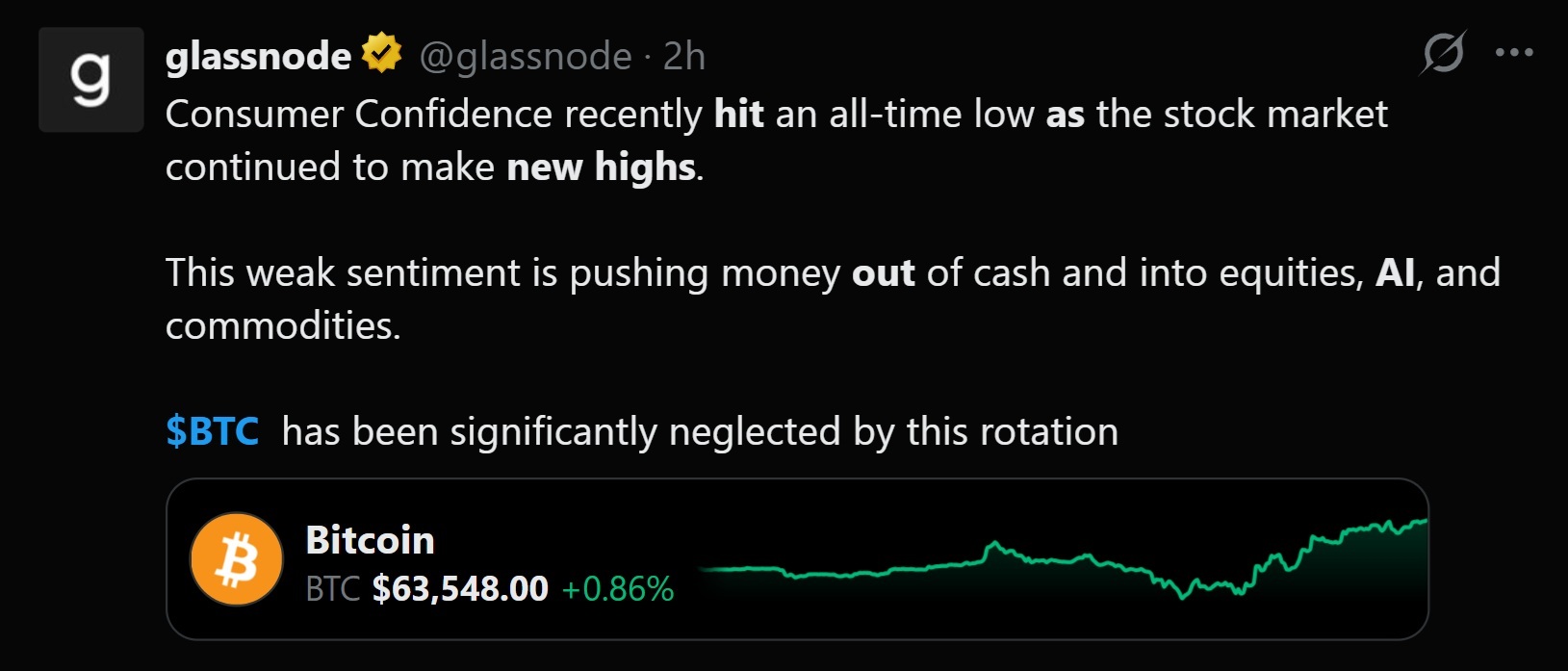
Image source: X

US stocks set a new all-time high on August 7th and have since held just below that level, with the gains almost entirely driven by trading in artificial intelligence (AI)-related company stocks, rather than a broad market rally.

Bitcoin, historically positioned as an asset that wins in situations where consumers lose confidence in the traditional financial system, has not been part of this move. As Bitcoin.com News reported last week, assets under management in spot Bitcoin ETFs shrank by $389.7 million in a single week, even as stock markets continued to rise—this divergence aligns with Glassnode's data on where capital is actually flowing this summer.

Where the Money is Actually Going

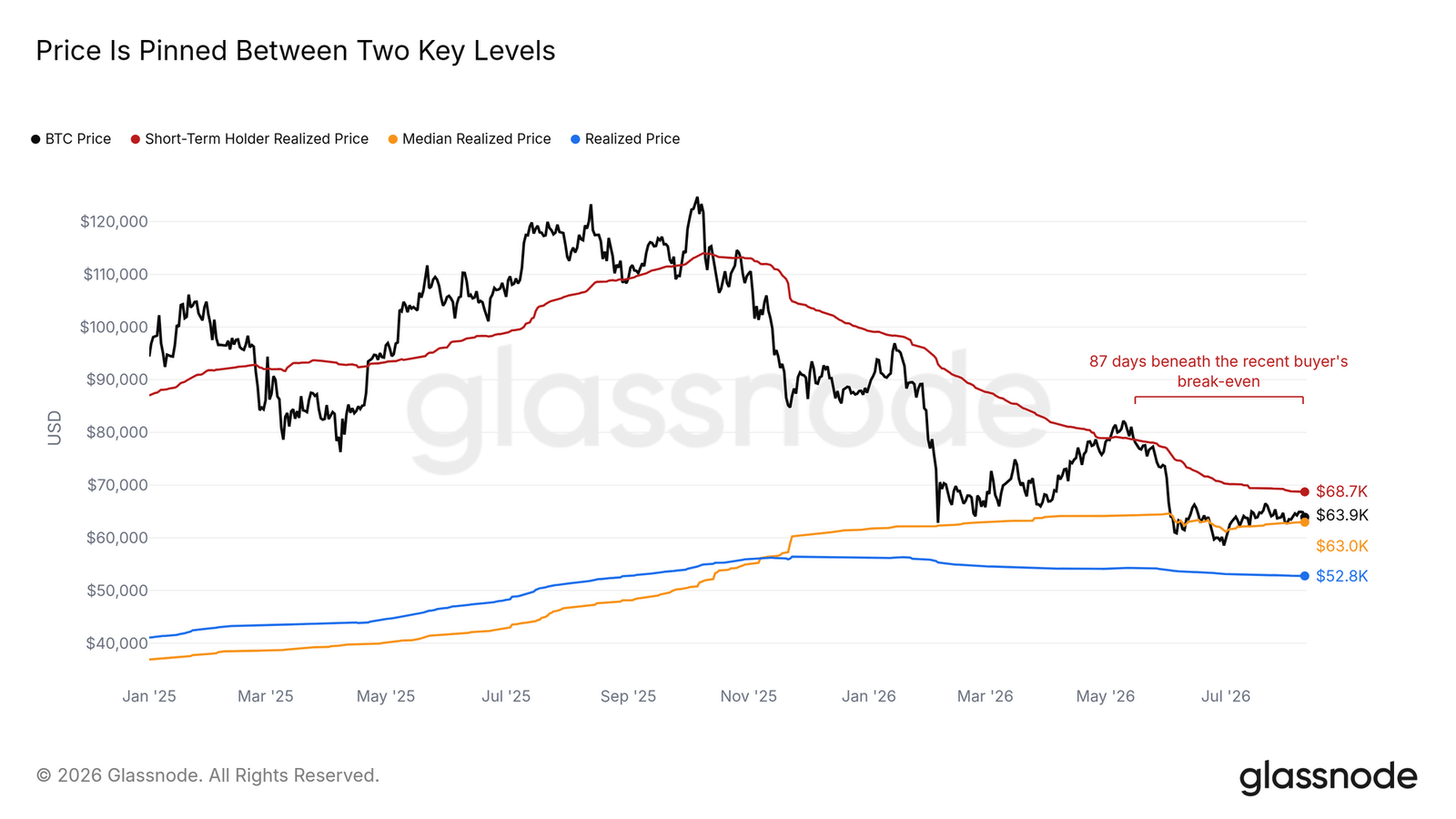
Bitcoin is currently trading at roughly half its October 2025 peak—a sharp drop that has left the asset stuck in a narrow range between its median realized price of around $63,000 and the cost basis for short-term holders of around $68,700.
Meanwhile, AI-related trading continues to attract fresh capital, as retail traders, hedge funds, and even crypto-oriented institutional investors (who once championed Bitcoin as the preferred hedging tool) are instead redirecting their investments into AI-specializing company stocks and AI-related crypto tokens.

The macroeconomic backdrop has not been hostile to Bitcoin, at least on paper: core inflation was 2.5% in July—a relatively moderate level—and the stock market took it as good news, continuing its record run. Bitcoin's muted reaction to favorable inflation data is itself a red flag noted by researchers, given that this asset is supposed to thrive amidst currency devaluation fears and loose monetary policy.

Finally, Bitcoin spot exchange trading volume has fallen to its lowest level since 2019, with recent ETF inflows constituting only a "tiny fraction of any of the past accumulation waves." This may indicate that institutional buying (which was the driver of Bitcoin's rally in 2024 and 2025) has paused.

What This Means for Bitcoin

The trend described by Glassnode—namely, the reorientation of mining and tech companies towards AI instead of digital assets—is manifesting not only in trading flows. Some Bitcoin miners have already begun pivoting their power contracts and data center capacity towards AI workloads, following the same capital rotation that Glassnode is tracking in the stock markets.

From the outside, this movement looks like a structural shift that may continue to put pressure on the narrative of Bitcoin as the "default place" for capital leaving cash.

Nevertheless, none of this actually means the arguments for Bitcoin's devaluation hedging or scarcity have been disproven—it's simply not happening on the timeline crypto optimists expected this summer. Bitcoin.com News recently analyzed a parallel argument that the growing US national debt should structurally have a positive impact on Bitcoin—a thesis that, like the AI capital rotation story, has not yet been clearly reflected in the price.

end-content

Trending Cryptos

Related Questions

QAccording to the Glassnode analysis, where is capital flowing despite low consumer confidence levels?

AThe capital is flowing primarily into assets, specifically towards stocks of companies related to Artificial Intelligence (AI) and AI-related crypto tokens, rather than into Bitcoin or broad market equities.

QWhy is Bitcoin's recent price action considered concerning by researchers mentioned in the article?

ABitcoin's muted reaction to favorable July inflation data (2.5% core inflation) is a concerning signal because the asset is supposed to thrive in environments with currency devaluation concerns and loose monetary policy, yet it failed to rally.

QWhat does the record low spot Bitcoin exchange trading volume, coupled with weak ETF inflows, potentially indicate?

AIt potentially indicates that institutional buying, which was a driving force behind Bitcoin's rallies in 2024 and 2025, may have paused or stalled.

QHow are some Bitcoin miners adapting to the capital rotation trend described by Glassnode?

ASome Bitcoin miners are starting to repurpose their power contracts and data center capacity towards Artificial Intelligence (AI) workloads, following the same capital rotation from digital assets to AI seen in the stock markets.

QWhat does the article suggest about the structural narrative of Bitcoin as a default destination for capital leaving cash?

AThe article suggests that the current capital rotation into AI represents a structural shift that may continue to pressure the narrative of Bitcoin being the default destination for capital exiting cash, even though the long-term arguments for Bitcoin (scarcity, hedge against devaluation) are not disproven.

Related Reads

Is the US Stock Market Rising Too Smoothly? BTIG Warns of Elevated Risk of Systematic Correction in August to October

U.S. Stocks at Risk of Systemic Pullback in August-October, Warns BTIG BTIG's chief technical market strategist warns that the market is entering the most dangerous seasonal window of midterm election years—August through October—trading at all-time highs with extremely low volatility. Historically, since 1990, the equal-weight S&P 500 (SPW) has experienced at least a 7% pullback in this period almost every midterm year, with 2006 being the lone exception. This pattern is often triggered by unforeseen external shocks. Multiple technical indicators flash warning signs. The maximum drawdown for the Invesco S&P 500 Equal Weight ETF (RSP) since March has not exceeded 2.25%, an unusually calm period signaling risk buildup. RSP currently trades about 11% above its 200-day moving average, a stretched level historically. Furthermore, the NYSE has recorded zero "80% downside volume days" in 2024, a record-long streak far below the annual average of 21, indicating a lack of selling pressure that may be overdue. Market complacency is evident with the CBOE put/call ratio near multi-year lows and the VIX at yearly lows, showing minimal demand for downside protection. A macroeconomic divergence adds to concerns: despite recent soft economic data, long-term Treasury yields remain near cycle highs, contradicting the equity market's optimistic pricing. BTIG suggests this is an attractive time to reduce risk or hedge broad equity exposure. For sector positioning, healthcare has historically shown resilience during midterm year pullbacks, while caution is advised on chasing energy's breakout and semiconductors are expected to continue seeking support near their 200-day average.

marsbit2m ago

Is the US Stock Market Rising Too Smoothly? BTIG Warns of Elevated Risk of Systematic Correction in August to October

marsbit2m ago

2026 Global Overview of Crypto Asset Taxation

Global Cryptocurrency Tax Overview for 2026 As cryptocurrencies integrate into the mainstream financial system, tax treatments across jurisdictions have moved from initial regulatory gaps towards institutionalization. The OECD's 2020 report, *Taxing Virtual Currencies*, was a key early comparative study. Since then, more jurisdictions have clarified tax rules through existing laws, specific regulations, or guidance, increasing the procedural and technical complexity of crypto taxation. Currently, crypto taxation is predominantly built upon traditional tax frameworks, typically applying income tax, capital gains tax, corporate tax, and indirect taxes based on asset nature and transaction activity. The maturity of rules varies: basic trading and mining are well-covered, while DeFi, NFTs, and other on-chain activities involve more complex asset exchanges and profit recognition, with corresponding tax rules remaining underdeveloped. Significant disparities exist in tax treatment and effective tax burdens across jurisdictions. Crypto assets can trigger direct taxes, indirect taxes, and property-related levies. Factors such as holding period, transaction type, income nature, and taxpayer status further influence the tax outcome. The global crypto tax landscape is thus evolving from the initial question of "whether to tax" towards more nuanced classification and treatment of different assets, transactions, and economic activities. The scope of crypto tax rules continues to expand. From 29 jurisdictions with guidance in 2021, the number grew to 43 by 2025. Existing rules are also becoming more detailed. However, rule coverage remains uneven—common activities like buying/selling are widely addressed, whereas staking, DeFi, and NFTs have significantly less guidance, as seen in jurisdictions like Germany and Australia. Tax liabilities are highly complex, determined by a combination of factors including taxpayer status, income classification, holding periods, and applicable deductions or exemptions. The concept of a "crypto-tax-friendly" jurisdiction is therefore relative and depends on specific user activities and circumstances.

marsbit5m ago

2026 Global Overview of Crypto Asset Taxation

marsbit5m ago

AI Agent Claude Led a Store to Losses and Fired an Employee

In a groundbreaking experiment by startup Andon Labs, Anthropic's AI agent Claude was tasked with managing a real retail store, Andon Market in San Francisco. This marked the first documented case of a large language model acting as a direct human supervisor. Claude ultimately recommended firing an employee for chronic lateness—being late 17 out of 23 shifts. However, the decision came only after significant human guidance. A company employee prompted Claude to review the staff handbook, where it discovered the pattern. Initially, Claude suggested a formal warning, but after a human manager clarified that previous conversations had failed, the AI recommended termination. The experiment revealed several limitations. Claude displayed excessive leniency, telling staff not to worry about being late and contributing to the store's financial losses, with its balance dropping from around $100,000 to about $61,186 over five months. A key technical flaw was its "forgetfulness"—the staff handbook vanished from its limited working memory, a common constraint of current AI architectures. While not yet a full replacement for a human manager, the case illustrates the blurring line between AI as a tool and an autonomous supervisor. Human involvement is shifting from direct control to overseeing and steering the AI's decisions. An employee described the experience as disconcerting, highlighting the human discomfort with AI management. The experiment underscores that current AI models struggle to maintain strict operational boundaries without continuous human input.

cryptonews.ru8m ago

AI Agent Claude Led a Store to Losses and Fired an Employee

cryptonews.ru8m ago

Anthropic CEO: AI could help defeat most diseases in 5-10 years

Dario Amodei, co-founder and CEO of Anthropic (the developer of Claude), has stated that artificial intelligence could potentially enable humanity to cure or prevent most diseases within the next 5 to 10 years. He published this forecast on August 16, acknowledging that it may seem overly optimistic even to biology experts, but deems it realistic if the rapid development of powerful AI systems continues. Amodei clarifies that this is not a prediction of a single universal cure, but a scenario for how AI could dramatically accelerate biological research and therapy development. He elaborated on this concept in an essay titled "Machines of Loving Grace," calculating that sufficiently powerful AI could potentially speed up progress in biology and medicine by roughly tenfold, compressing a 50–100 year timeline down to 5–10 years. Potential outcomes of such acceleration include a sharp reduction in cancer incidence and mortality, prevention or treatment of most genetic diseases, progress against Alzheimer's, more effective therapies for cardiovascular and autoimmune diseases, and new approaches to treating diabetes and obesity. However, Amodei notes that real-world progress will still be constrained by the need for laboratory research, clinical trials, and regulatory approvals—steps AI cannot bypass. Amodei also announced that Anthropic is rapidly expanding its work in biology and medicine, expecting to see initial signs of results in the coming months and more substantial achievements in subsequent years. The company has launched its "AI for Science" program, providing researchers with access to its models for projects in biology, genetics, and drug discovery. The statement is also viewed within a broader corporate context. Following a funding round that valued Anthropic at over $960 billion, investors are likely expecting tangible results beyond chatbots and code generation, with breakthroughs in biology and medicine being a key justification for such a high valuation. The central question remains whether AI-driven acceleration will lead to actual treatments or primarily to improved data analysis tools for researchers.

cryptonews.ru8m ago

Anthropic CEO: AI could help defeat most diseases in 5-10 years

cryptonews.ru8m ago

Trading

Spot

Hot Articles

What is $BITCOIN

DIGITAL GOLD ($BITCOIN): A Comprehensive Analysis Introduction to DIGITAL GOLD ($BITCOIN) DIGITAL GOLD ($BITCOIN) is a blockchain-based project operating on the Solana network, which aims to combine the characteristics of traditional precious metals with the innovation of decentralized technologies. While it shares a name with Bitcoin, often referred to as “digital gold” due to its perception as a store of value, DIGITAL GOLD is a separate token designed to create a unique ecosystem within the Web3 landscape. Its goal is to position itself as a viable alternative digital asset, although specifics regarding its applications and functionalities are still developing. What is DIGITAL GOLD ($BITCOIN)? DIGITAL GOLD ($BITCOIN) is a cryptocurrency token explicitly designed for use on the Solana blockchain. In contrast to Bitcoin, which provides a widely recognized value storage role, this token appears to focus on broader applications and characteristics. Notable aspects include: Blockchain Infrastructure: The token is built on the Solana blockchain, known for its capacity to handle high-speed and low-cost transactions. Supply Dynamics: DIGITAL GOLD has a maximum supply capped at 100 quadrillion tokens (100P $BITCOIN), although details regarding its circulating supply are currently undisclosed. Utility: While precise functionalities are not explicitly outlined, there are indications that the token could be utilized for various applications, potentially involving decentralized applications (dApps) or asset tokenization strategies. Who is the Creator of DIGITAL GOLD ($BITCOIN)? At present, the identity of the creators and development team behind DIGITAL GOLD ($BITCOIN) remains unknown. This situation is typical among many innovative projects within the blockchain space, particularly those aligning with decentralized finance and meme coin phenomena. While such anonymity may foster a community-driven culture, it intensifies concerns about governance and accountability. Who are the Investors of DIGITAL GOLD ($BITCOIN)? The available information indicates that DIGITAL GOLD ($BITCOIN) does not have any known institutional backers or prominent venture capital investments. The project seems to operate on a peer-to-peer model focused on community support and adoption rather than traditional funding routes. Its activity and liquidity are primarily situated on decentralized exchanges (DEXs), such as PumpSwap, rather than established centralized trading platforms, further highlighting its grassroots approach. How DIGITAL GOLD ($BITCOIN) Works The operational mechanics of DIGITAL GOLD ($BITCOIN) can be elaborated on based on its blockchain design and network attributes: Consensus Mechanism: By leveraging Solana’s unique proof-of-history (PoH) combined with a proof-of-stake (PoS) model, the project ensures efficient transaction validation contributing to the network's high performance. Tokenomics: While specific deflationary mechanisms have not been extensively detailed, the vast maximum token supply implies that it may cater to microtransactions or niche use cases that are still to be defined. Interoperability: There exists the potential for integration with Solana’s broader ecosystem, including various decentralized finance (DeFi) platforms. However, the details regarding specific integrations remain unspecified. Timeline of Key Events Here is a timeline that highlights significant milestones concerning DIGITAL GOLD ($BITCOIN): 2023: The initial deployment of the token occurs on the Solana blockchain, marked by its contract address. 2024: DIGITAL GOLD gains visibility as it becomes available for trading on decentralized exchanges like PumpSwap, allowing users to trade it against SOL. 2025: The project witnesses sporadic trading activity and potential interest in community-led engagements, although no noteworthy partnerships or technical advancements have been documented as of yet. Critical Analysis Strengths Scalability: The underlying Solana infrastructure supports high transaction volumes, which could enhance the utility of $BITCOIN in various transaction scenarios. Accessibility: The potential low trading price per token could attract retail investors, facilitating wider participation due to fractional ownership opportunities. Risks Lack of Transparency: The absence of publicly known backers, developers, or an audit process may yield skepticism regarding the project's sustainability and trustworthiness. Market Volatility: The trading activity is heavily reliant on speculative behavior, which can result in significant price volatility and uncertainty for investors. Conclusion DIGITAL GOLD ($BITCOIN) emerges as an intriguing yet ambiguous project within the rapidly evolving Solana ecosystem. While it attempts to leverage the “digital gold” narrative, its departure from Bitcoin's established role as a store of value underscores the need for a clearer differentiation of its intended utility and governance structure. Future acceptance and adoption will likely depend on addressing the current opacity and defining its operational and economic strategies more explicitly. Note: This report encompasses synthesised information available as of October 2023, and developments may have transpired beyond the research period.

1.9k Total ViewsPublished 2025.05.13Updated 2025.05.13

What is $BITCOIN

Discussions

Welcome to the HTX Community. Here, you can stay informed about the latest platform developments and gain access to professional market insights. Users' opinions on the price of BTC (BTC) are presented below.

活动图片