Strategy Goes Cash With Latest Raise, No Bitcoin Buys For Now

bitcoinistPublished on 2025-12-24Last updated on 2025-12-24

Abstract

Strategy, the business intelligence firm founded by Michael Saylor, has raised approximately $747.8 million through the sale of 4.5 million shares of Class A common stock. Notably, the company did not purchase any Bitcoin during the week of December 15-21, leaving its holdings unchanged at 671,268 BTC. This marks a shift in capital allocation, prioritizing cash accumulation over Bitcoin buys. The firm's cash reserve has grown to about $2.19 billion, which is intended to cover dividend payments on preferred stock and interest on debt. This move comes amid market speculation that Strategy might face pressure to meet its financial obligations and could potentially sell a portion of its Bitcoin holdings in a prolonged bear market.

Strategy, the business intelligence company founded by Michael Saylor, has added hundreds of millions of dollars to its balance sheet after completing a sizable stock sale, while staying on the sidelines in the Bitcoin (BTC) market. The latest disclosure shows the firm prioritizing cash generation over Bitcoin accumulation as it evaluates its next steps. This change in capital allocation comes as rumors spread that Strategy could sell a significant portion of its Bitcoin holdings.

Strategy Prioritizes Cash Reserve Over Bitcoin Buys

Strategy has released a new financial update showing a clear shift toward US dollar accumulation, stepping back from its previous pattern of aggressive Bitcoin buys. Saylor shared the report on X this Monday, outlining the company’s most recent capital activity. The filing focuses on equity sales, Strategy’s bitcoin holdings and activity, and its cash reserves.

During the week of December 15 to December 21, Strategy raised significant funds through its ATM equity program. The business intelligence firm did not sell any of its preferred stock offerings within this period, leaving billions of dollars in remaining issuance capacity. Notably, the filing shows that the STRK preferred stock program still holds more than $20 billion in available capacity.
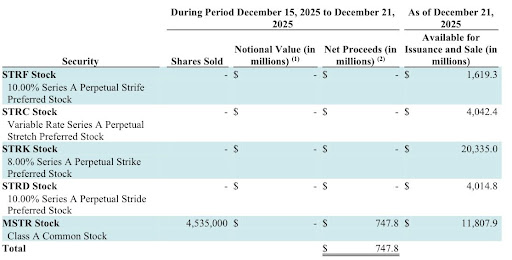
Source: Chart from Strategy

Instead of preferred shares, Strategy had tapped its common stock program. The company sold 4.5 million shares of Class A common stock, generating roughly $747.8 million in net proceeds after fees. Even after this raise, Strategy still has approximately $11.8 billion of common stock available for future issuance.

While the business intelligence firm has increased its cash position, it paused Bitcoin purchases for the week. The filing reported that no new Bitcoin purchases were made during the week of December 15 to December 21, keeping its total holdings unchanged at 671,268 BTC. Those holdings carry an aggregate purchase cost of about $50.33 billion, with an average price near $74,972 per coin.

Update On Strategy’s US Dollar Reserve

Strategy’s latest addition to its cash reserve this past week builds a larger cushion to cover the company’s financial obligations. The firm started the month with a reserve of $1.14 billion and increased it to approximately $2.19 billion by December 21. This growth suggests a deliberate move to secure liquidity amid ongoing market activity.

The boost in cash comes after rumors circulated that Strategy could face pressure to meet dividend obligations on its preferred shares. Additionally, there has been speculation that the business intelligence firm may sell its over $50 billion Bitcoin holdings if the market continues to trend downward for a prolonged period.

According to the filing, the primary purpose of the Strategy’s US dollar reserve is to cover dividend payments on preferred stock and interest payments on outstanding debt. Because the company holds a large amount of Bitcoin, selling a significant portion to fund these dividends could disrupt the market, especially during periods of volatility. This underscores the importance of maintaining a cash reserve for easy liquidity.

BTC trading at $86,803 on the 1D chart | Source: BTCUSDT on Tradingview.com

Related Questions

QWhat significant change did Strategy make in its capital allocation strategy according to the latest disclosure?

AStrategy has shifted toward prioritizing cash accumulation over Bitcoin purchases, stepping back from its previous pattern of aggressive Bitcoin buys.

QHow much money did Strategy raise through its common stock sales during December 15-21, and how many shares were sold?

AStrategy sold 4.5 million shares of Class A common stock, generating approximately $747.8 million in net proceeds after fees.

QDid Strategy make any new Bitcoin purchases during the reported week, and what is their total Bitcoin holding?

ANo new Bitcoin purchases were made during the week of December 15 to December 21, keeping Strategy's total holdings unchanged at 671,268 BTC.

QWhat is the primary purpose of Strategy's US dollar reserve as stated in the filing?

AThe primary purpose of the US dollar reserve is to cover dividend payments on preferred stock and interest payments on outstanding debt.

QWhat rumors have been circulating about Strategy that might explain its increased focus on cash reserves?

ARumors have circulated that Strategy could face pressure to meet dividend obligations on its preferred shares and may need to sell its Bitcoin holdings if the market continues for a prolonged downturn.

Related Reads

20 Billion Valuation, Alibaba and Tencent Competing to Invest, Whose Money Will Liang Wenfeng Take?

DeepSeek, an AI startup founded by Liang Wenfeng, is reportedly in talks with Alibaba and Tencent for an external funding round that could value the company at over $20 billion. This marks a significant shift, as DeepSeek had previously relied solely on funding from its parent company,幻方量化 (Huanfang Quantitative), and had resisted external investment. The potential valuation would place DeepSeek among the top-tier AI model companies in China, comparable to competitors like MoonDark (valued at ~$18 billion) and ahead of recently listed firms like MiniMax and Zhipu. The funding—which could range from $600 million (for a 3% stake) to $2 billion (for 10%)—is seen as a move to secure resources for model development, retain talent, and support infrastructure needs, particularly as competition in inference models and AI agents intensifies. Both Alibaba and Tencent are eager to invest, not only for financial returns but also to integrate DeepSeek into their broader AI ecosystems. However, DeepSeek’s leadership is cautious about maintaining independence and may prefer financial investors over strategic ones to avoid being locked into a specific tech ecosystem. Alternative options, such as state-backed funds, offer longer-term capital and policy support but may come with slower decision-making and potential constraints on global expansion. With competing AI firms accelerating their IPO plans, DeepSeek’s window for securing optimal terms may be narrowing. The final decision will reflect a trade-off between capital, resources, and strategic independence.

marsbit1h ago

20 Billion Valuation, Alibaba and Tencent Competing to Invest, Whose Money Will Liang Wenfeng Take?

marsbit1h ago

After Losing 97% of Its Market Value, iQiyi Attempts to Use AI to Forcefully Extend Its Lifespan

After losing 97% of its market value since its 2018 peak, iQiyi is aggressively pivoting to AI in a desperate attempt to survive. At its 2026 World Conference, CEO Gong Yu announced an "AI Artist Library" with over 100 virtual performers and a new AIGC platform, "NaDou Pro," promising faster production and lower costs. This shift comes as the company faces severe financial distress: its market cap sits near delisting thresholds at $1.36 billion, with significant losses, declining membership revenue, and depleted cash flow. The AI strategy has sparked controversy. Top actors have issued legal threats against unauthorized digital replicas, while in Hengdian, over 134,000 background actors are seeing their already scarce job opportunities vanish as AI replaces them for background roles. iQiyi's move represents a fundamental shift from being a high-cost content buyer to a landlord" to becoming a "platform capitalist" that transfers production risk to creators. This contrasts with competitors like Douyin (TikTok's Chinese counterpart), which is investing heavily in *real* actor-led short dramas, betting that authentic human connection retains users better than AI-generated content. The article draws a parallel to the 1920s transition to "talkies," which made cinema musicians obsolete but ultimately enriched the art form. In contrast, iQiyi's AI drive is framed not as an artistic evolution but as a cost-cutting measure that could degrade storytelling, replacing genuine human emotion with algorithmically calculated stimulation and potentially numbing audiences' capacity for empathy. The core question remains: can a company focused solely on financial survival preserve the art of storytelling?

marsbit1h ago

After Losing 97% of Its Market Value, iQiyi Attempts to Use AI to Forcefully Extend Its Lifespan

marsbit1h ago

Trading

Spot
Futures

Hot Articles

What is $BITCOIN

DIGITAL GOLD ($BITCOIN): A Comprehensive Analysis Introduction to DIGITAL GOLD ($BITCOIN) DIGITAL GOLD ($BITCOIN) is a blockchain-based project operating on the Solana network, which aims to combine the characteristics of traditional precious metals with the innovation of decentralized technologies. While it shares a name with Bitcoin, often referred to as “digital gold” due to its perception as a store of value, DIGITAL GOLD is a separate token designed to create a unique ecosystem within the Web3 landscape. Its goal is to position itself as a viable alternative digital asset, although specifics regarding its applications and functionalities are still developing. What is DIGITAL GOLD ($BITCOIN)? DIGITAL GOLD ($BITCOIN) is a cryptocurrency token explicitly designed for use on the Solana blockchain. In contrast to Bitcoin, which provides a widely recognized value storage role, this token appears to focus on broader applications and characteristics. Notable aspects include: Blockchain Infrastructure: The token is built on the Solana blockchain, known for its capacity to handle high-speed and low-cost transactions. Supply Dynamics: DIGITAL GOLD has a maximum supply capped at 100 quadrillion tokens (100P $BITCOIN), although details regarding its circulating supply are currently undisclosed. Utility: While precise functionalities are not explicitly outlined, there are indications that the token could be utilized for various applications, potentially involving decentralized applications (dApps) or asset tokenization strategies. Who is the Creator of DIGITAL GOLD ($BITCOIN)? At present, the identity of the creators and development team behind DIGITAL GOLD ($BITCOIN) remains unknown. This situation is typical among many innovative projects within the blockchain space, particularly those aligning with decentralized finance and meme coin phenomena. While such anonymity may foster a community-driven culture, it intensifies concerns about governance and accountability. Who are the Investors of DIGITAL GOLD ($BITCOIN)? The available information indicates that DIGITAL GOLD ($BITCOIN) does not have any known institutional backers or prominent venture capital investments. The project seems to operate on a peer-to-peer model focused on community support and adoption rather than traditional funding routes. Its activity and liquidity are primarily situated on decentralized exchanges (DEXs), such as PumpSwap, rather than established centralized trading platforms, further highlighting its grassroots approach. How DIGITAL GOLD ($BITCOIN) Works The operational mechanics of DIGITAL GOLD ($BITCOIN) can be elaborated on based on its blockchain design and network attributes: Consensus Mechanism: By leveraging Solana’s unique proof-of-history (PoH) combined with a proof-of-stake (PoS) model, the project ensures efficient transaction validation contributing to the network's high performance. Tokenomics: While specific deflationary mechanisms have not been extensively detailed, the vast maximum token supply implies that it may cater to microtransactions or niche use cases that are still to be defined. Interoperability: There exists the potential for integration with Solana’s broader ecosystem, including various decentralized finance (DeFi) platforms. However, the details regarding specific integrations remain unspecified. Timeline of Key Events Here is a timeline that highlights significant milestones concerning DIGITAL GOLD ($BITCOIN): 2023: The initial deployment of the token occurs on the Solana blockchain, marked by its contract address. 2024: DIGITAL GOLD gains visibility as it becomes available for trading on decentralized exchanges like PumpSwap, allowing users to trade it against SOL. 2025: The project witnesses sporadic trading activity and potential interest in community-led engagements, although no noteworthy partnerships or technical advancements have been documented as of yet. Critical Analysis Strengths Scalability: The underlying Solana infrastructure supports high transaction volumes, which could enhance the utility of $BITCOIN in various transaction scenarios. Accessibility: The potential low trading price per token could attract retail investors, facilitating wider participation due to fractional ownership opportunities. Risks Lack of Transparency: The absence of publicly known backers, developers, or an audit process may yield skepticism regarding the project's sustainability and trustworthiness. Market Volatility: The trading activity is heavily reliant on speculative behavior, which can result in significant price volatility and uncertainty for investors. Conclusion DIGITAL GOLD ($BITCOIN) emerges as an intriguing yet ambiguous project within the rapidly evolving Solana ecosystem. While it attempts to leverage the “digital gold” narrative, its departure from Bitcoin's established role as a store of value underscores the need for a clearer differentiation of its intended utility and governance structure. Future acceptance and adoption will likely depend on addressing the current opacity and defining its operational and economic strategies more explicitly. Note: This report encompasses synthesised information available as of October 2023, and developments may have transpired beyond the research period.

363 Total ViewsPublished 2025.05.13Updated 2025.05.13

What is $BITCOIN

Discussions

Welcome to the HTX Community. Here, you can stay informed about the latest platform developments and gain access to professional market insights. Users' opinions on the price of BTC (BTC) are presented below.

活动图片















