Why Did Strategy Sell 32 Bitcoin? CEO Reveals The Real Reason

bitcoinistPublished on 2026-06-11Last updated on 2026-06-11

Abstract

Strategy CEO Phong Le explained that the company's sale of 32 Bitcoin was not due to liquidity needs or a shift in its long-term accumulation strategy. Instead, the primary reasons were to demonstrate to the market that the firm is willing and able to sell BTC when necessary and to test its internal execution processes for selling. Le emphasized that Strategy remains a net buyer of Bitcoin, having purchased over 1,500 BTC recently. The sale, its first since 2022, was a small operational test and did not fund dividends, which are covered by other capital-raising activities. Le acknowledged some frustration from retail investors but stated the company must balance the interests of all stakeholders, including common stockholders, preferred stockholders, debt holders, and Bitcoin holders. He noted institutional shareholders were not concerned by the minor sale.

Strategy CEO Phong Le said the company’s recent sale of 32 Bitcoin was not driven by liquidity needs, but by a deliberate effort to show the market that the firm can sell BTC when necessary and to test its internal execution process. The comments came after Strategy bought more than 1,500 BTC roughly a week after the small sale, its first disposal since 2022.

Speaking on CNBC’s Power Lunch, Le pushed back against the idea that the sale marked a shift in Strategy’s long-running accumulation strategy. BTC was trading around $61,000 during the segment, roughly flat on the day but down more than 20% over the past month, after recently falling below $60,000 for the first time since October 2024.

“We’re net purchasers of Bitcoin,” Le said, pointing to the company’s purchase of about 1,500 BTC over the past month. “Why the sale? A few reasons. One, we thought it was good to inoculate the market to understand that we are willing to sell Bitcoin when we need to. We haven’t needed to, but it’s an important thing to do.”

Le added that buying BTC is operationally easier for Strategy than selling it, making the 32 BTC transaction a useful live test of the company’s processes. He also said the company may, over time, be able to capture tax-loss assets on its balance sheet related to sales, given that Strategy has bought BTC at prices ranging from $10,000 to $125,000.

Crucially, Le said the sale was not required to fund dividends. “One reason we didn’t sell our Bitcoin, we did not need to sell our Bitcoin to satisfy our dividends,” he said. “We’re able to do that through other capital-raising activities.”

Strategy Says It Remains A Net Bitcoin Buyer

The sale attracted attention because Strategy has built its public-market identity around aggressive BTC accumulation. Le acknowledged the frustration among some investors and holders who interpreted the transaction as a breach of the company’s “never sell” posture, but argued that Strategy has a broader set of stakeholders than Bitcoin maximalist retail investors.

“We have a set of constituents that we have to be able to answer to,” Le said. “One is our common stock, our MSTR shareholders. Second is our preferred stock, our STRC shareholders. Third are our debt holders, and fourth are our Bitcoin holders. Not necessarily in that order.”

He continued: “And when it makes sense for our common stockholders for us to sell our Bitcoin, we will. We actually did it in 2022, and so we’re going to do it now. Again, if you’re a Bitcoin holder, we’re the largest holder of Bitcoin in the world. We’re the largest purchaser of Bitcoin in the world. We’ll continue to be.”

Pressed again on why the company sold, Le reduced the explanation to two points: “We sold because we wanted to inoculate the market and we sold because we wanted to test our processes.” Asked what Strategy learned, he replied: “We learned that everything works.”

Le also suggested the reaction was more pronounced among retail holders than among institutions. “The question is, why does the sale of 32 BTC get so much attention?” he said. “Our institutional shareholders that we talk to don’t seem to be unnerved by it. I think the unnerving is the retail community that has views on never selling your Bitcoin that are crypto anarchist. And frankly, we have a lot more than just them as constituents.”

At press time, BTC traded at $62,672.
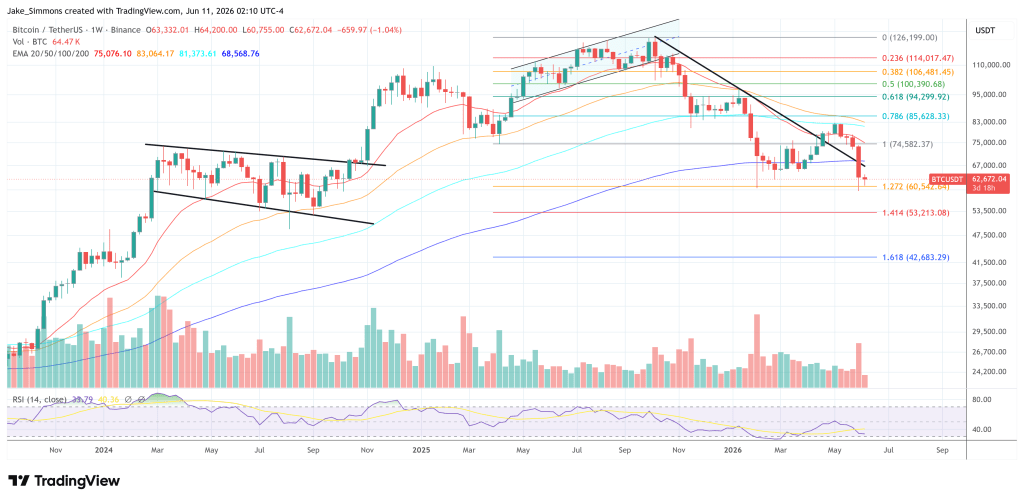
BTC trades below the 200-week EMA, 1-week chart | Source: BTCUSDT on TradingView.com

Trending Cryptos

Related Questions

QAccording to the article, what were the two main reasons CEO Phong Le gave for Strategy selling 32 Bitcoin?

AThe two main reasons given were: 1) To inoculate the market by showing that the company is willing to sell Bitcoin when necessary, and 2) To test the company's internal execution processes for selling BTC, which is operationally more complex than buying it.

QDid Strategy's recent sale of 32 BTC signal a change in its long-term Bitcoin accumulation strategy, according to its CEO?

ANo, it did not signal a change. The CEO emphasized that Strategy remains a 'net purchaser of Bitcoin,' a point reinforced by the company's purchase of approximately 1,500 BTC shortly after the small sale.

QWho did CEO Phong Le say was primarily 'unnerved' by the sale of 32 BTC, and who was not?

ALe said the 'unnerving' reaction was more pronounced among the retail investor community who hold 'never sell' or 'crypto anarchist' views. In contrast, he stated that the institutional shareholders they spoke to did not seem to be unnerved by the transaction.

QWhat reason did the CEO explicitly rule out as the motivation for selling the 32 Bitcoin?

AThe CEO explicitly ruled out that the sale was required to fund dividends, stating, "we did not need to sell our Bitcoin to satisfy our dividends. We're able to do that through other capital-raising activities."

QHow many Bitcoin did Strategy buy shortly after the small sale of 32 BTC, according to the article?

AStrategy bought more than 1,500 Bitcoin roughly a week after the sale of 32 BTC.

Related Reads

Top 11 NFT games to play in July 2026

NFT games provide players with true ownership of in-game assets through blockchain technology, unlike traditional games. Here are the top 11 NFT games for July 2026: 1. **RavenQuest:** A free-to-play MMORPG with player-driven economy, housing NFTs, and guild wars. 2. **Decentraland:** A user-owned Ethereum-based virtual world for socializing, gaming, and buying digital real estate (LAND NFTs). 3. **Axie Infinity:** A pioneering play-to-earn game where players collect, breed, and battle NFT creatures called Axies. 4. **Pixels:** A free-to-play Ronin-based game focused on farming, crafting, and managing Pixelmon avatars in a player-driven economy. 5. **Gods Unchained:** A free-to-play strategy card game where every card is an NFT, built on Ethereum with Immutable X. 6. **My DeFi Pet:** Combines pet collection, breeding, and battling with DeFi mechanics, using the DPET token. 7. **Alien Worlds:** A fast-paced, decentralized metaverse game where players (explorers) mine resources and compete for the TLM token. 8. **The Sandbox:** A blockchain metaverse where users buy LAND NFTs and create, own, and monetize gaming experiences. 9. **Wreck League:** A mech fighting game with customizable NFT parts, featuring a hybrid Web2/Web3 model and strategic combat. 10. **Undeads Game:** A zombie apocalypse-themed game where players choose to be humans or zombies, with all assets as tradable NFTs. 11. **Shrapnel:** A first-person shooter set in 2043 where players battle for a resource called Sigma, with weapons and gear as NFTs. NFT games offer innovative formats and true digital ownership, but players should research each game before committing.

ambcrypto55m ago

Top 11 NFT games to play in July 2026

ambcrypto55m ago

Bitcoin Consolidation Underway: Selling Pressure from Long-Term Holders Eases, ETF Outflows Slow

Bitcoin is in the process of bottoming out, with key dynamics shifting. Long-term holder capitulation has cooled from its peak, and profit-taking has largely subsided. The sell-off at the June lows was absorbed by broad-based buying. The price is now recovering and testing towards key overhead resistance around the short-term holder cost basis near $69,000, where significant supply pressure is expected. Macro drivers are evolving: Bitcoin is increasingly reacting inversely to the US dollar and showing a more positive response to favorable economic data like soft inflation reports, while its correlation with equities has weakened. On-chain data shows that long-term holders are now mainly selling at a loss, a classic late-cycle signal. This primary source of sell-side pressure is no longer expanding. ETF outflows have slowed but haven't reversed, indicating institutional selling has paused but not turned into buying. In derivatives markets, bearish bets are being unwound as seen in falling put/call ratios and reduced crash protection costs, though this positioning adjustment hasn't yet translated into strong spot market buying. Volatility has compressed to yearly lows, a potential calm before the next decisive move. While the foundation for a recovery is being laid with seller exhaustion and demand absorption at lows, confirmation is still missing. A sustainable uptrend requires spot-driven buying to decisively break and hold above the short-term holder cost basis. Failure to do so, or a reacceleration of long-term holder losses, would signal a return to range-bound trading.

marsbit1h ago

Bitcoin Consolidation Underway: Selling Pressure from Long-Term Holders Eases, ETF Outflows Slow

marsbit1h ago

Trading

Spot

Hot Articles

What is $BITCOIN

DIGITAL GOLD ($BITCOIN): A Comprehensive Analysis Introduction to DIGITAL GOLD ($BITCOIN) DIGITAL GOLD ($BITCOIN) is a blockchain-based project operating on the Solana network, which aims to combine the characteristics of traditional precious metals with the innovation of decentralized technologies. While it shares a name with Bitcoin, often referred to as “digital gold” due to its perception as a store of value, DIGITAL GOLD is a separate token designed to create a unique ecosystem within the Web3 landscape. Its goal is to position itself as a viable alternative digital asset, although specifics regarding its applications and functionalities are still developing. What is DIGITAL GOLD ($BITCOIN)? DIGITAL GOLD ($BITCOIN) is a cryptocurrency token explicitly designed for use on the Solana blockchain. In contrast to Bitcoin, which provides a widely recognized value storage role, this token appears to focus on broader applications and characteristics. Notable aspects include: Blockchain Infrastructure: The token is built on the Solana blockchain, known for its capacity to handle high-speed and low-cost transactions. Supply Dynamics: DIGITAL GOLD has a maximum supply capped at 100 quadrillion tokens (100P $BITCOIN), although details regarding its circulating supply are currently undisclosed. Utility: While precise functionalities are not explicitly outlined, there are indications that the token could be utilized for various applications, potentially involving decentralized applications (dApps) or asset tokenization strategies. Who is the Creator of DIGITAL GOLD ($BITCOIN)? At present, the identity of the creators and development team behind DIGITAL GOLD ($BITCOIN) remains unknown. This situation is typical among many innovative projects within the blockchain space, particularly those aligning with decentralized finance and meme coin phenomena. While such anonymity may foster a community-driven culture, it intensifies concerns about governance and accountability. Who are the Investors of DIGITAL GOLD ($BITCOIN)? The available information indicates that DIGITAL GOLD ($BITCOIN) does not have any known institutional backers or prominent venture capital investments. The project seems to operate on a peer-to-peer model focused on community support and adoption rather than traditional funding routes. Its activity and liquidity are primarily situated on decentralized exchanges (DEXs), such as PumpSwap, rather than established centralized trading platforms, further highlighting its grassroots approach. How DIGITAL GOLD ($BITCOIN) Works The operational mechanics of DIGITAL GOLD ($BITCOIN) can be elaborated on based on its blockchain design and network attributes: Consensus Mechanism: By leveraging Solana’s unique proof-of-history (PoH) combined with a proof-of-stake (PoS) model, the project ensures efficient transaction validation contributing to the network's high performance. Tokenomics: While specific deflationary mechanisms have not been extensively detailed, the vast maximum token supply implies that it may cater to microtransactions or niche use cases that are still to be defined. Interoperability: There exists the potential for integration with Solana’s broader ecosystem, including various decentralized finance (DeFi) platforms. However, the details regarding specific integrations remain unspecified. Timeline of Key Events Here is a timeline that highlights significant milestones concerning DIGITAL GOLD ($BITCOIN): 2023: The initial deployment of the token occurs on the Solana blockchain, marked by its contract address. 2024: DIGITAL GOLD gains visibility as it becomes available for trading on decentralized exchanges like PumpSwap, allowing users to trade it against SOL. 2025: The project witnesses sporadic trading activity and potential interest in community-led engagements, although no noteworthy partnerships or technical advancements have been documented as of yet. Critical Analysis Strengths Scalability: The underlying Solana infrastructure supports high transaction volumes, which could enhance the utility of $BITCOIN in various transaction scenarios. Accessibility: The potential low trading price per token could attract retail investors, facilitating wider participation due to fractional ownership opportunities. Risks Lack of Transparency: The absence of publicly known backers, developers, or an audit process may yield skepticism regarding the project's sustainability and trustworthiness. Market Volatility: The trading activity is heavily reliant on speculative behavior, which can result in significant price volatility and uncertainty for investors. Conclusion DIGITAL GOLD ($BITCOIN) emerges as an intriguing yet ambiguous project within the rapidly evolving Solana ecosystem. While it attempts to leverage the “digital gold” narrative, its departure from Bitcoin's established role as a store of value underscores the need for a clearer differentiation of its intended utility and governance structure. Future acceptance and adoption will likely depend on addressing the current opacity and defining its operational and economic strategies more explicitly. Note: This report encompasses synthesised information available as of October 2023, and developments may have transpired beyond the research period.

834 Total ViewsPublished 2025.05.13Updated 2025.05.13

What is $BITCOIN

Discussions

Welcome to the HTX Community. Here, you can stay informed about the latest platform developments and gain access to professional market insights. Users' opinions on the price of BTC (BTC) are presented below.

活动图片