Recession fears rise as Bitcoin chops at $70K – Is an H2 rally forming?

ambcryptoPublished on 2026-03-26Last updated on 2026-03-26

Abstract

Amid ongoing Middle East tensions and rising recession fears, Bitcoin continues to trade choppily around the $70,000 mark, reflecting broader market uncertainty. Analysts highlight concerns that prolonged conflict could drive oil prices higher, potentially crushing demand and pushing the economy into a recession. In response, traders are displaying mixed strategies: some are flocking to safe havens like Tether Gold (XAUT), which recently saw record-high perpetual volume on Binance, while long-term Bitcoin investors continue accumulating, with exchange outflows reducing reserves to multi-year lows. This accumulation suggests confidence in Bitcoin’s long-term prospects, especially if interest rate cuts materialize in response to economic stress. Despite short-term volatility, the market appears to be positioning for potential gains in the second half of the year, leveraging fear as an opportunity for outsized returns.

The line between volatility and opportunity is thin, and it shows up when the market’s stuck in a bear phase.

Right now, that’s exactly the kind of setup we’re seeing.

The market is heading into the fourth week of the Middle East conflict, and with Iran flat-out rejecting the U.S.’ “15-point” peace proposal, there’s no end in sight. The result? Macro factors “continue” to keep investors on edge.

On the technical side, oil keeps shaking things up, gold keeps breaking down, and Bitcoin [BTC] chops around the $70k mark like it’s stuck in limbo.

In short, the market is testing investors: Will you HODL, sell, or buy the “dip”? Every move counts because the market isn’t giving easy answers right now.
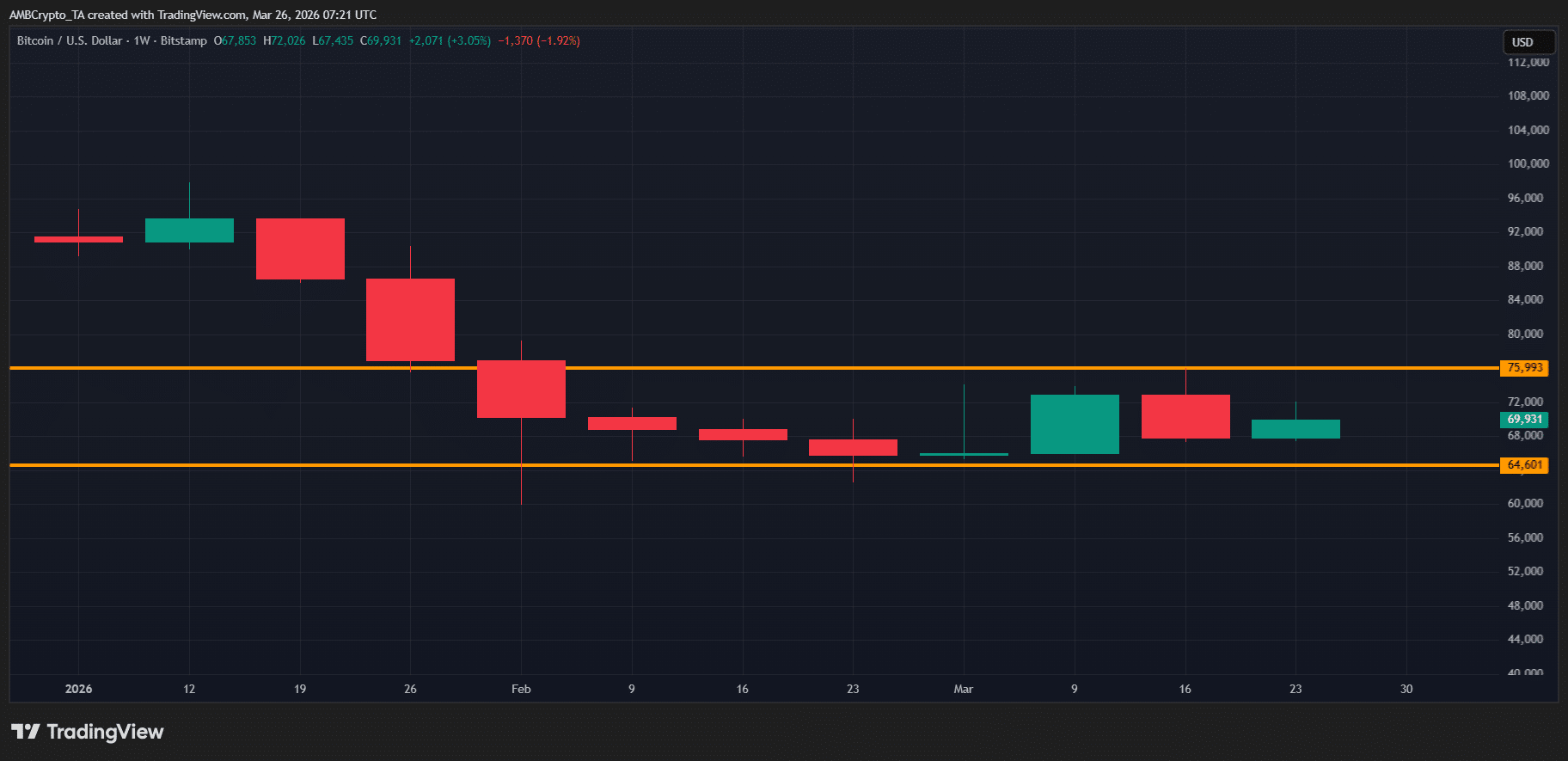
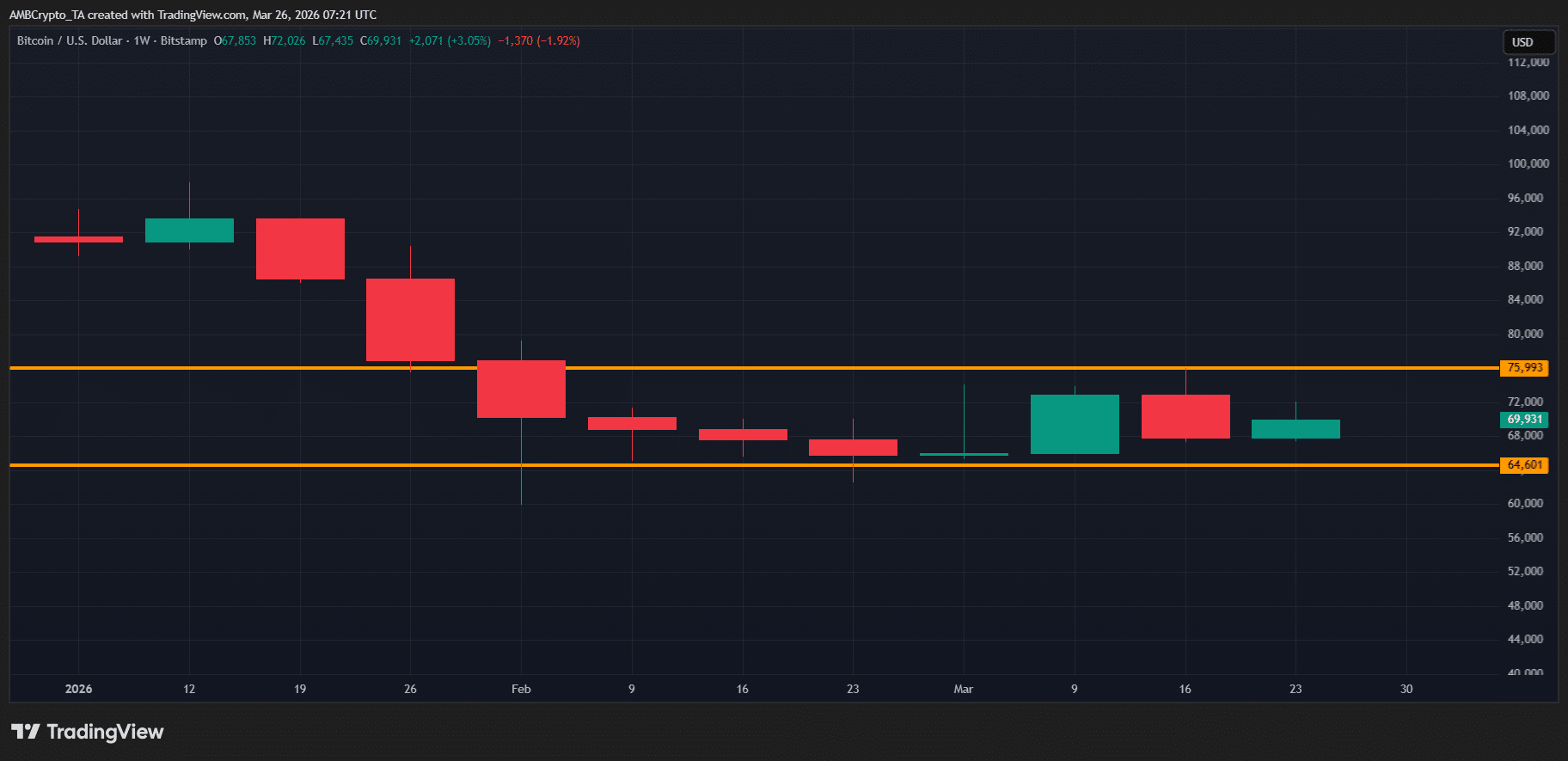
Source: TradingView (BTC/USDT)

That said, there’s one common theme most analysts are circling: The long-term impact of this conflict.

Notably, the big debate is whether the war’s fallout could tip the economy into recession.

BlackRock CEO Larry Fink, for instance, is one of the voices out there, pointing to how rising oil prices could crush demand, push up unemployment, and trigger a feedback loop that keeps the economy under pressure.

What’s the fix?

Chief Economist Peter Schiff sees an interest rate cut coming. For Bitcoin traders, that’s where the “opportunity” kicks in: Volatility spikes, macro fears run high, and the market tests positions, but making the right moves now could set up big wins later.

Naturally, the question is: Is the current market fear exactly where Bitcoin investors are leaning in, hinting at long-term setups, hedging activity, and potential short-squeeze conditions that could light up an H2 rally?

Bitcoin and XAUT flows reveal where traders are putting their bets

Across every level, Bitcoin traders are signaling how they’re playing this volatility.

On the macro side, volatility keeps traders on their toes, pushing them toward quick gains and safer bets. That’s why Tether Gold (XAUT) is getting so much attention.

CryptoQuant showed its daily perpetual volume on Binance just hit a fresh all-time high, highlighting how aggressively traders are stacking positions.

At the same time, accumulation is holding strong.

Since the war started, Bitcoin’s exchange outflows haven’t slowed, with around 80k BTC moving off exchanges. That’s pushed reserves down to a multi-year low of 2.7 million, showing that long-term holders are quietly stacking while traders work the swings.
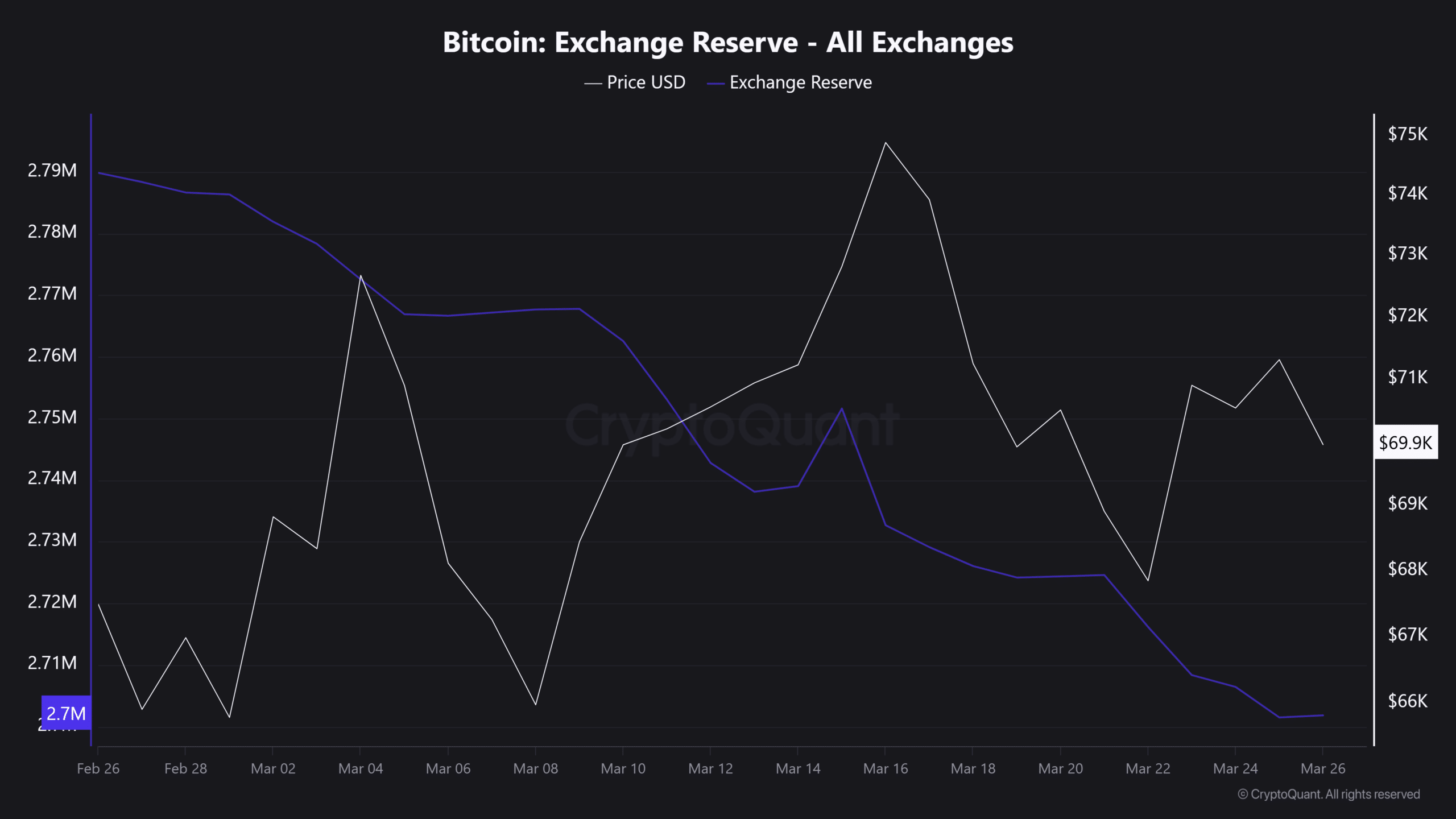
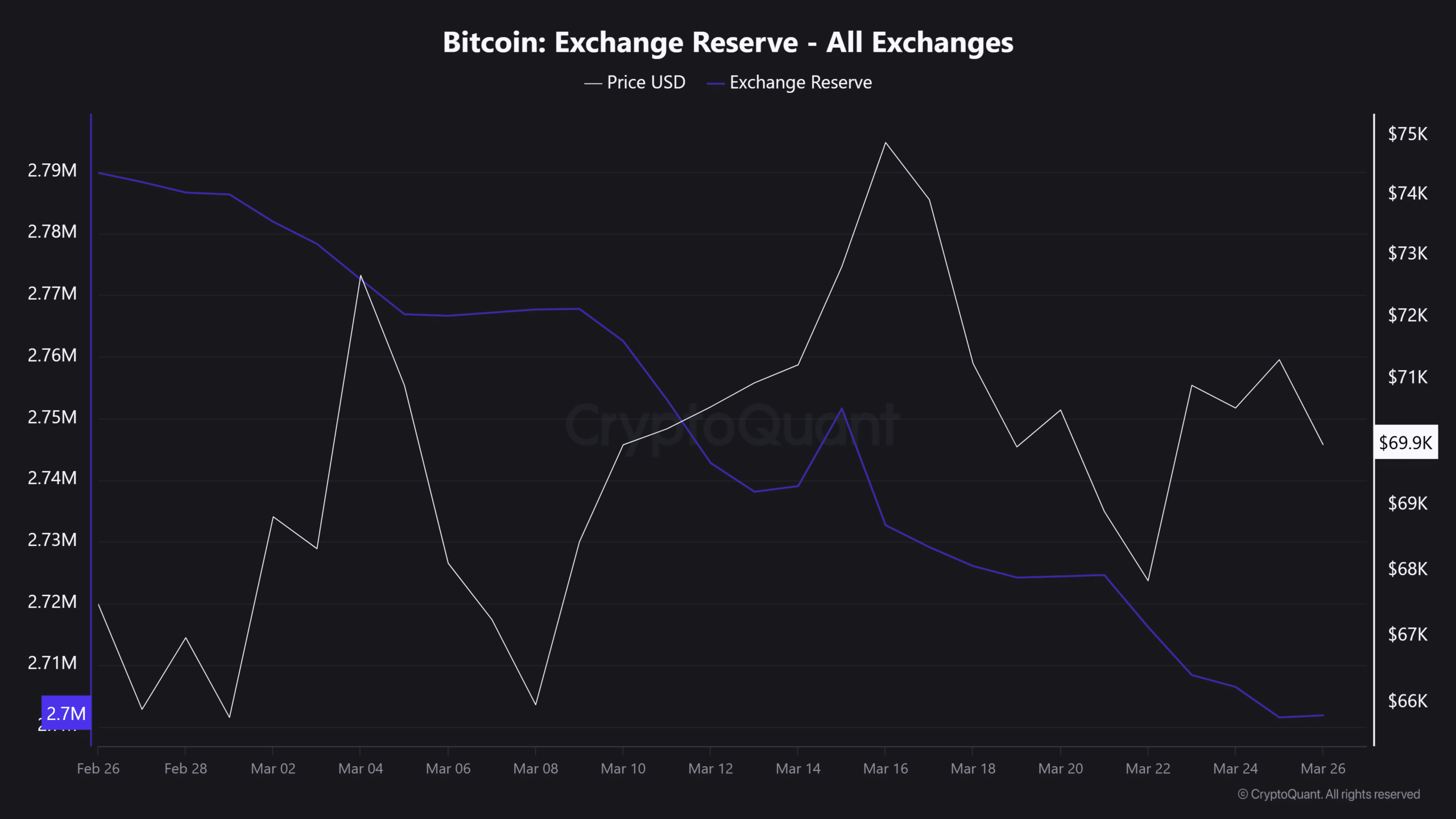
Source: CryptoQuant

Put simply, Bitcoin investors are treating fear like opportunity, aiming for outsized gains.

Combine that with recession headlines, and the logic becomes clear.

Short-term volatility keeps traders chasing quick wins, but long-term investors are positioning for economic stress that could eventually push the Fed to loosen monetary conditions, while those XAUT bets get squeezed in the process.

In this context, Bitcoin’s chop around $70k isn’t just noise. With recession fears on the rise and holders quietly stacking, traders are turning the bear phase into an opportunity, setting the stage for a potential H2 rally when rate cuts finally hit.


Final Summary

  • Bitcoin holders keep stacking while XAUT sees record perp activity, showing positioning for outsized gains despite short-term volatility.
  • Rising recession risks suggest the market is quietly laying the groundwork for a potential rally once interest rate cuts arrive.


Trending Cryptos

Related Questions

QWhat is the main concern regarding the economy as discussed in the article?

AThe main concern is that the fallout from the ongoing Middle East conflict, particularly rising oil prices, could crush demand, push up unemployment, and potentially tip the economy into a recession.

QHow are Bitcoin traders and long-term holders behaving differently in the current market?

ATraders are chasing quick gains and moving into safer assets like Tether Gold (XAUT), while long-term Bitcoin holders are quietly accumulating, as shown by significant exchange outflows pushing reserves to a multi-year low.

QWhat potential event does the article suggest could set the stage for a Bitcoin rally in the second half of the year (H2)?

AThe article suggests that potential interest rate cuts by the Fed, in response to economic stress and recession risks, could be the catalyst that sets the stage for a Bitcoin rally in the second half of the year (H2).

QWhat does the record-high daily perpetual volume of Tether Gold (XAUT) on Binance indicate?

AIt indicates that traders are aggressively seeking safer-haven assets and positioning for short-term gains due to the high market volatility and macro fears.

QAccording to the article, what is the significance of Bitcoin's price 'chopping' around the $70,000 mark?

AIt signifies that the market is in a volatile, indecisive phase where it is testing investors, but this activity is not just noise; it is part of a setup where long-term investors are accumulating, potentially laying the groundwork for a future rally.

Related Reads

Upbit is Anxious: A Hasty Counterattack Aimed at Regaining Stablecoin Market Share

Title: Upbit's Rushed Counterattack to Reclaim Stablecoin Market Share Facing a dramatic shift in South Korea's stablecoin market, leading exchange Upbit launched a promotional campaign from July 26 to August 9, waiving the 0.05% trading fee for stablecoins paired with the Korean Won (KRW) and rapidly listing new stablecoins like RLUSD and USDG. This move is a direct response to its plummeting market share in this sector. Historically a duopoly with Bithumb, the market has been reshaped since October 2025 when Coinone permanently removed fees for USDC trading. By June 2026, Coinone led with 34.8% of stablecoin volume, followed by Bithumb (31.1%) and Upbit (30.1%). This contrasts sharply with the overall crypto market, where Upbit commands 60%. The data shows stablecoin demand is highly sensitive to fees, as users primarily buy them to transfer capital overseas for derivatives trading or forex arbitrage. South Korean exchanges have seen a net outflow of stablecoins for 18 consecutive months, totaling approximately 14.9 trillion KRW, underscoring their role as a cross-border capital conduit. Upbit's limited-time promotion initially boosted its daily stablecoin volume by 162%, but the surge was almost entirely in USDT (98.1% of volume). The newly listed stablecoins saw negligible, fleeting interest. Furthermore, the promotional effect quickly waned in the second week, with volume dropping 33% on weekdays. A concurrent weakening of the KRW also contributed to the trading spike, independent of the fee waiver. The analysis suggests that once the promotion ends, Upbit is unlikely to retain its temporary gains unless it matches Coinone's permanent zero-fee policy, forcing a choice between market share and fee revenue. Upbit's strategic push may be less about immediate profit and more about preparing for future regulatory shifts. With South Korea's *Digital Asset Basic Act* on the horizon, which will regulate KRW-backed stablecoins, and following Dunamu's (Upbit's parent) integration into Naver Financial to build a payment ecosystem, securing a dominant position in the dollar stablecoin distribution channel holds long-term strategic value. However, potential regulatory conflicts could prevent Upbit from listing a future Naver-issued KRW stablecoin, making the current fight for dollar stablecoin flow even more critical.

marsbit14m ago

Upbit is Anxious: A Hasty Counterattack Aimed at Regaining Stablecoin Market Share

marsbit14m ago

Michael Saylor Compares Bitcoin and Gold!

Michael Saylor, founder of MicroStrategy, argues that Bitcoin fundamentally changes how wealth is stored and transferred by transforming digital scarcity into economic value. He describes Bitcoin as the first digital monetary network, combining computers, digital networks, and cryptography. It digitizes monetary assets, allowing their supply to be controlled by public protocols rather than institutions, thus converting economic value into information transmissible over global networks. Comparing Bitcoin to gold, Saylor states that while increasing Bitcoin's supply is harder, its integration with software and transfer is easier. He highlights Bitcoin's proof-of-work mechanism, which ties it to the physical world by consuming real energy to secure the ledger, making past transactions immutable. This creates a shared security system involving miners, energy companies, and investors. Saylor suggests "digital monetary energy" is a more accurate term than "digital gold." He emphasizes that the Bitcoin network is an adaptive ecosystem of miners, nodes, developers, and users. Its core design is intentionally simple, focused on maintaining a secure ledger for scarce digital assets, with complex functionalities built in higher-layer applications. This architecture allows Bitcoin to serve as a foundation for transmitting value and fostering innovation in payments and financial services. Saylor notes Bitcoin's deeper impact lies in creating digital sovereignty, where private keys give individuals permissionless control over their economic power, with ownership verified mathematically, not by institutions. He concludes that while gold's physical scarcity makes it money, Bitcoin's digital scarcity does the same, characterizing Bitcoin as the monetary energy of the digital age.

cryptonews.ru1h ago

Michael Saylor Compares Bitcoin and Gold!

cryptonews.ru1h ago

Trading

Spot

Hot Articles

What is $BITCOIN

DIGITAL GOLD ($BITCOIN): A Comprehensive Analysis Introduction to DIGITAL GOLD ($BITCOIN) DIGITAL GOLD ($BITCOIN) is a blockchain-based project operating on the Solana network, which aims to combine the characteristics of traditional precious metals with the innovation of decentralized technologies. While it shares a name with Bitcoin, often referred to as “digital gold” due to its perception as a store of value, DIGITAL GOLD is a separate token designed to create a unique ecosystem within the Web3 landscape. Its goal is to position itself as a viable alternative digital asset, although specifics regarding its applications and functionalities are still developing. What is DIGITAL GOLD ($BITCOIN)? DIGITAL GOLD ($BITCOIN) is a cryptocurrency token explicitly designed for use on the Solana blockchain. In contrast to Bitcoin, which provides a widely recognized value storage role, this token appears to focus on broader applications and characteristics. Notable aspects include: Blockchain Infrastructure: The token is built on the Solana blockchain, known for its capacity to handle high-speed and low-cost transactions. Supply Dynamics: DIGITAL GOLD has a maximum supply capped at 100 quadrillion tokens (100P $BITCOIN), although details regarding its circulating supply are currently undisclosed. Utility: While precise functionalities are not explicitly outlined, there are indications that the token could be utilized for various applications, potentially involving decentralized applications (dApps) or asset tokenization strategies. Who is the Creator of DIGITAL GOLD ($BITCOIN)? At present, the identity of the creators and development team behind DIGITAL GOLD ($BITCOIN) remains unknown. This situation is typical among many innovative projects within the blockchain space, particularly those aligning with decentralized finance and meme coin phenomena. While such anonymity may foster a community-driven culture, it intensifies concerns about governance and accountability. Who are the Investors of DIGITAL GOLD ($BITCOIN)? The available information indicates that DIGITAL GOLD ($BITCOIN) does not have any known institutional backers or prominent venture capital investments. The project seems to operate on a peer-to-peer model focused on community support and adoption rather than traditional funding routes. Its activity and liquidity are primarily situated on decentralized exchanges (DEXs), such as PumpSwap, rather than established centralized trading platforms, further highlighting its grassroots approach. How DIGITAL GOLD ($BITCOIN) Works The operational mechanics of DIGITAL GOLD ($BITCOIN) can be elaborated on based on its blockchain design and network attributes: Consensus Mechanism: By leveraging Solana’s unique proof-of-history (PoH) combined with a proof-of-stake (PoS) model, the project ensures efficient transaction validation contributing to the network's high performance. Tokenomics: While specific deflationary mechanisms have not been extensively detailed, the vast maximum token supply implies that it may cater to microtransactions or niche use cases that are still to be defined. Interoperability: There exists the potential for integration with Solana’s broader ecosystem, including various decentralized finance (DeFi) platforms. However, the details regarding specific integrations remain unspecified. Timeline of Key Events Here is a timeline that highlights significant milestones concerning DIGITAL GOLD ($BITCOIN): 2023: The initial deployment of the token occurs on the Solana blockchain, marked by its contract address. 2024: DIGITAL GOLD gains visibility as it becomes available for trading on decentralized exchanges like PumpSwap, allowing users to trade it against SOL. 2025: The project witnesses sporadic trading activity and potential interest in community-led engagements, although no noteworthy partnerships or technical advancements have been documented as of yet. Critical Analysis Strengths Scalability: The underlying Solana infrastructure supports high transaction volumes, which could enhance the utility of $BITCOIN in various transaction scenarios. Accessibility: The potential low trading price per token could attract retail investors, facilitating wider participation due to fractional ownership opportunities. Risks Lack of Transparency: The absence of publicly known backers, developers, or an audit process may yield skepticism regarding the project's sustainability and trustworthiness. Market Volatility: The trading activity is heavily reliant on speculative behavior, which can result in significant price volatility and uncertainty for investors. Conclusion DIGITAL GOLD ($BITCOIN) emerges as an intriguing yet ambiguous project within the rapidly evolving Solana ecosystem. While it attempts to leverage the “digital gold” narrative, its departure from Bitcoin's established role as a store of value underscores the need for a clearer differentiation of its intended utility and governance structure. Future acceptance and adoption will likely depend on addressing the current opacity and defining its operational and economic strategies more explicitly. Note: This report encompasses synthesised information available as of October 2023, and developments may have transpired beyond the research period.

1.9k Total ViewsPublished 2025.05.13Updated 2025.05.13

What is $BITCOIN

Discussions

Welcome to the HTX Community. Here, you can stay informed about the latest platform developments and gain access to professional market insights. Users' opinions on the price of BTC (BTC) are presented below.

活动图片