Berkshire Hathaway's Q2 13F Portfolio Reshuffle: Increased Stakes in Google and Delta Air Lines, Consecutive Quarter of Cutting Bank of America

marsbitPublished on 2026-08-16Last updated on 2026-08-16

Abstract

Berkshire Hathaway's second-quarter 13F filing, released August 14th, reveals significant portfolio shifts under new leadership. The total portfolio value rose to approximately $299.3 billion. Key highlights include a major increase in Alphabet (Google) holdings. Berkshire's stake in Google-A surged 45.24% to $28.16 billion, while its Google-C holdings jumped 658% to $9.61 billion, making Alphabet the firm's third-largest combined holding after Apple and American Express. Conversely, Bank of America was the largest reduction, with shares cut by 5.89% for the second consecutive quarter, though it remains the fifth-largest holding. Berkshire also increased positions in Delta Air Lines (up 44%) and homebuilder Lennar, while initiating a small new position in D.R. Horton. The consumer sector saw Constellation Brands completely sold off. Overall, the portfolio reflects a continued move toward technology and specific cyclical sectors like housing and airlines, while trimming some financial and consumer stakes. Apple remains the top holding at 22% of the portfolio.

Author: Wall Street News

Following 'Oracle of Omaha' Warren Buffett's resignation as CEO, Berkshire Hathaway has released its second 13F filing.

According to documents disclosed on August 14, Eastern Time, Berkshire's 13F equity portfolio value was approximately $299.3 billion at the end of the second quarter, an increase of 12.09% from approximately $263.1 billion at the end of the first quarter. Overall, Berkshire initiated a position in 1 new stock, added to 7 stocks, reduced holdings in 6 stocks, and completely exited 1 stock in the second quarter.

It is evident that under the leadership of Greg Abel, Berkshire has been continuously increasing its bets on Alphabet, housing, and airlines, while gradually trimming traditional financials and some consumer holdings.
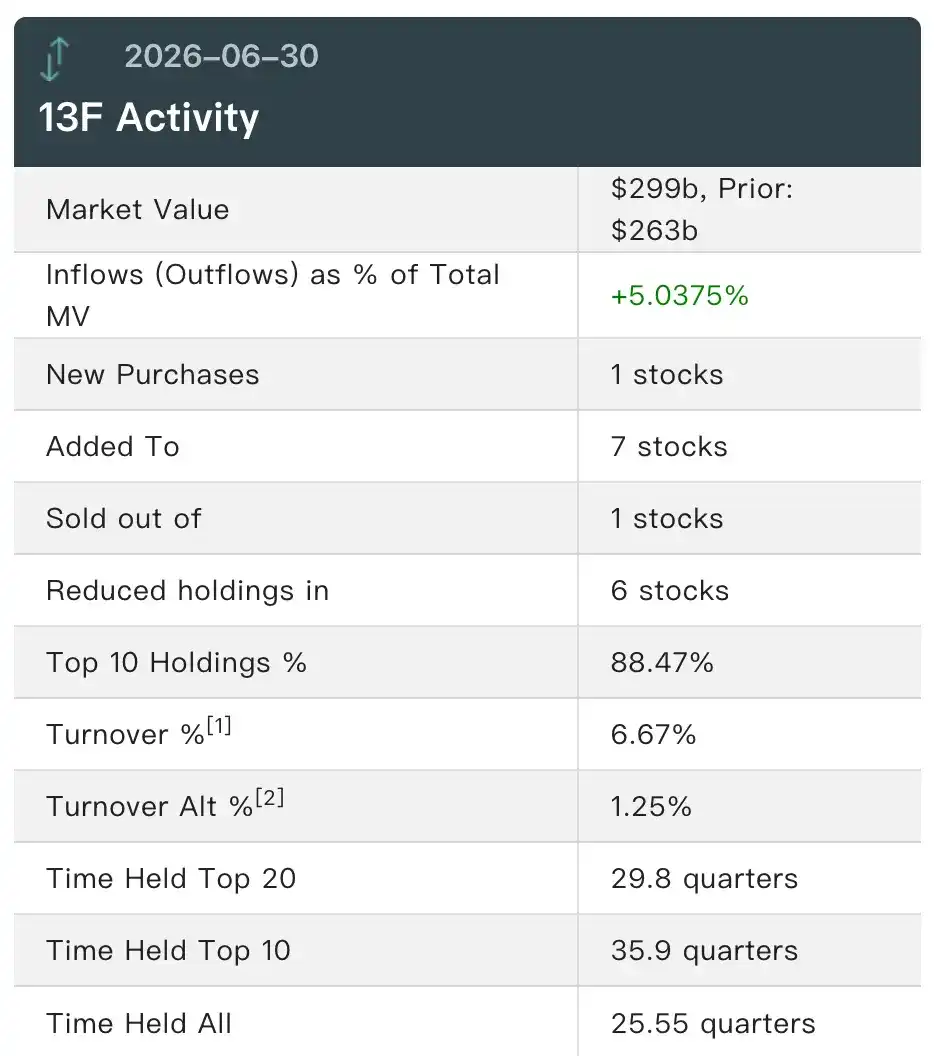
When consolidating Alphabet's two share classes, Berkshire's current top ten holdings are Apple, American Express, Alphabet, Coca-Cola, Bank of America, Chevron, Occidental Petroleum, Chubb, Moody's, and Kraft Heinz.
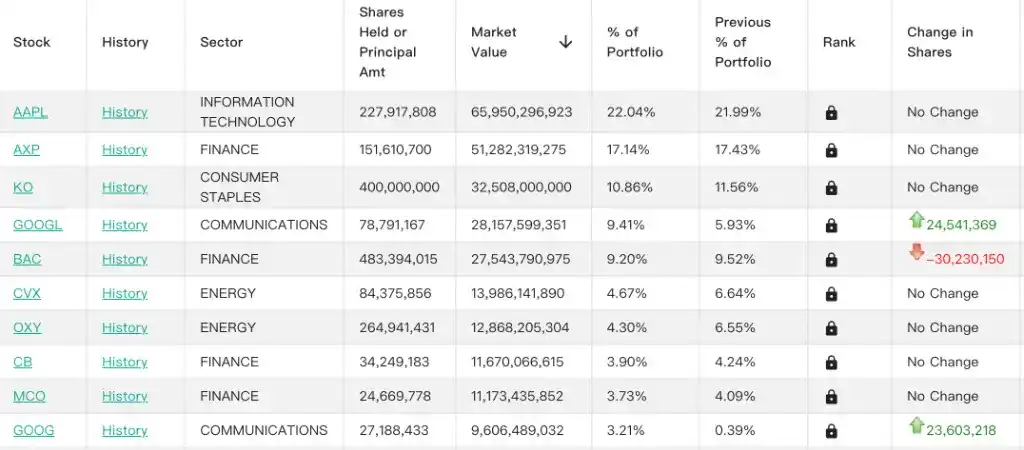
Apple remains Berkshire's largest holding, with a portfolio value of approximately $65.950 billion, accounting for about 22% of the 13F portfolio value. American Express ranks second with a value of approximately $51.282 billion, a 17.14% share. The combined Alphabet holds the third position. Coca-Cola and Bank of America rank fourth and fifth, respectively.

In the second quarter of this year, Berkshire continued to significantly increase its stake in Alphabet (Google's parent company). Berkshire added approximately 24.54 million shares of Alphabet-A, an increase of 45.24%, bringing the total holding to about 78.79 million shares valued at approximately $28.158 billion. It also added approximately 23.60 million shares of Alphabet-C, a staggering increase of 658.35%, bringing the total holding to about 27.19 million shares valued at approximately $9.606 billion.

This brings the combined value of Alphabet-A and Alphabet-C to approximately $37.764 billion at the end of Q2, representing about 12.62% of the 13F portfolio value, surpassing Coca-Cola to become Berkshire's third-largest holding after Apple and American Express on a consolidated basis.

Additionally, among the top ten holdings, the only stock that was reduced was Bank of America. In the quarter, Berkshire sold approximately 30.20 million shares (based on the period-end price, the reduction was about 30.23 million shares), a decrease of 5.89%, representing a reduction in value of approximately $1.72 billion. This made Bank of America the largest reduction for the quarter. At quarter-end, Berkshire still held 483 million shares of Bank of America valued at approximately $27.544 billion, accounting for 9.2% of the 13F portfolio value, making it the fifth-largest holding. Bank of America remains a significant investment for Berkshire but has now been reduced for two consecutive quarters.

Otherwise, Berkshire's holdings in the remaining top ten stocks remained unchanged in the second quarter.

Regarding other additions, in the second quarter of this year, Berkshire increased its stake in Delta Air Lines by approximately 17.51 million shares, an increase of about 44%, bringing the total holding to 57.32 million shares valued at approximately $5.369 billion. It added about 3.01 million shares of Lennar Corporation Class A, an increase of nearly 30%, and also added about 60,000 shares of Lennar Corporation Class B. Berkshire increased its stake in Macy's by approximately 4.31 million shares, a 141.82% increase. It slightly added about 550,000 shares of The New York Times Company.

The only new position initiated by Berkshire in the second quarter was D.R. Horton, with a small initiation of 3,564 shares worth approximately $580,000.

Regarding reductions, apart from Bank of America, Berkshire also reduced holdings in Ally Financial, Capital One Financial, kidney dialysis service provider DaVita, grocer Kroger, and steel manufacturer Nucor. The alcoholic beverage producer Constellation Brands, which was significantly reduced in the first quarter, was completely sold off by Berkshire in the second quarter.


Trending Cryptos

Related Questions

QAccording to the 13F filing, which company became Berkshire Hathaway's third largest holding when Google's Class A and C shares are combined?

AAlphabet (Google's parent company) became Berkshire Hathaway's third largest holding, with a combined value of approximately $37.764 billion, surpassing Coca-Cola.

QWhat were the main categories of stocks that saw increased investment from Berkshire Hathaway in Q2 under Greg Abel's leadership?

AUnder Greg Abel's leadership, Berkshire Hathaway increased investments in technology (Alphabet), housing (Lennar, Horton), and airlines (Delta Air Lines).

QWhich stock was the largest reduction for Berkshire Hathaway in Q2 2024, and was this part of a trend?

ABank of America was the largest reduction, with approximately 30.23 million shares sold (worth about $1.72 billion). This was part of a trend, as it was the second consecutive quarter of减持.

QWhat was the total market value of Berkshire Hathaway's 13F stock portfolio at the end of Q2 2024, and how did it change from the previous quarter?

AThe total market value was approximately $299.3 billion at the end of Q2 2024, representing an increase of 12.09% from the approximately $263.1 billion at the end of Q1.

QWhich company did Berkshire Hathaway completely exit (sell its entire position in) during the second quarter of 2024?

ABerkshire Hathaway completely exited its position in Constellation Brands during the second quarter of 2024.

Related Reads

Upbit is Anxious: A Hasty Counterattack Aimed at Regaining Stablecoin Market Share

Title: Upbit's Rushed Counterattack to Reclaim Stablecoin Market Share Facing a dramatic shift in South Korea's stablecoin market, leading exchange Upbit launched a promotional campaign from July 26 to August 9, waiving the 0.05% trading fee for stablecoins paired with the Korean Won (KRW) and rapidly listing new stablecoins like RLUSD and USDG. This move is a direct response to its plummeting market share in this sector. Historically a duopoly with Bithumb, the market has been reshaped since October 2025 when Coinone permanently removed fees for USDC trading. By June 2026, Coinone led with 34.8% of stablecoin volume, followed by Bithumb (31.1%) and Upbit (30.1%). This contrasts sharply with the overall crypto market, where Upbit commands 60%. The data shows stablecoin demand is highly sensitive to fees, as users primarily buy them to transfer capital overseas for derivatives trading or forex arbitrage. South Korean exchanges have seen a net outflow of stablecoins for 18 consecutive months, totaling approximately 14.9 trillion KRW, underscoring their role as a cross-border capital conduit. Upbit's limited-time promotion initially boosted its daily stablecoin volume by 162%, but the surge was almost entirely in USDT (98.1% of volume). The newly listed stablecoins saw negligible, fleeting interest. Furthermore, the promotional effect quickly waned in the second week, with volume dropping 33% on weekdays. A concurrent weakening of the KRW also contributed to the trading spike, independent of the fee waiver. The analysis suggests that once the promotion ends, Upbit is unlikely to retain its temporary gains unless it matches Coinone's permanent zero-fee policy, forcing a choice between market share and fee revenue. Upbit's strategic push may be less about immediate profit and more about preparing for future regulatory shifts. With South Korea's *Digital Asset Basic Act* on the horizon, which will regulate KRW-backed stablecoins, and following Dunamu's (Upbit's parent) integration into Naver Financial to build a payment ecosystem, securing a dominant position in the dollar stablecoin distribution channel holds long-term strategic value. However, potential regulatory conflicts could prevent Upbit from listing a future Naver-issued KRW stablecoin, making the current fight for dollar stablecoin flow even more critical.

marsbit8m ago

Upbit is Anxious: A Hasty Counterattack Aimed at Regaining Stablecoin Market Share

marsbit8m ago

Michael Saylor Compares Bitcoin and Gold!

Michael Saylor, founder of MicroStrategy, argues that Bitcoin fundamentally changes how wealth is stored and transferred by transforming digital scarcity into economic value. He describes Bitcoin as the first digital monetary network, combining computers, digital networks, and cryptography. It digitizes monetary assets, allowing their supply to be controlled by public protocols rather than institutions, thus converting economic value into information transmissible over global networks. Comparing Bitcoin to gold, Saylor states that while increasing Bitcoin's supply is harder, its integration with software and transfer is easier. He highlights Bitcoin's proof-of-work mechanism, which ties it to the physical world by consuming real energy to secure the ledger, making past transactions immutable. This creates a shared security system involving miners, energy companies, and investors. Saylor suggests "digital monetary energy" is a more accurate term than "digital gold." He emphasizes that the Bitcoin network is an adaptive ecosystem of miners, nodes, developers, and users. Its core design is intentionally simple, focused on maintaining a secure ledger for scarce digital assets, with complex functionalities built in higher-layer applications. This architecture allows Bitcoin to serve as a foundation for transmitting value and fostering innovation in payments and financial services. Saylor notes Bitcoin's deeper impact lies in creating digital sovereignty, where private keys give individuals permissionless control over their economic power, with ownership verified mathematically, not by institutions. He concludes that while gold's physical scarcity makes it money, Bitcoin's digital scarcity does the same, characterizing Bitcoin as the monetary energy of the digital age.

cryptonews.ru1h ago

Michael Saylor Compares Bitcoin and Gold!

cryptonews.ru1h ago

Trading

Spot

Hot Articles

What is $BANK

Bank AI: A Revolutionary Step in the Future of Banking Introduction In an era marked by rapid advancements in technology, Bank AI stands at the intersection of artificial intelligence (AI) and banking services. This innovative project seeks to redefine the financial landscape, enhancing operational efficiency, security measures, and customer experiences through the power of AI. As we embark on this exploration of Bank AI, we will delve into what the project entails, its operational dynamics, its historical context, and significant milestones. What is Bank AI? At its core, Bank AI represents a transformative initiative aimed at integrating artificial intelligence into various banking operations. This project harnesses the capabilities of AI to automate processes, improve risk management protocols, and enhance customer interaction through personalized services. The primary objectives of Bank AI include: Automation of Banking Functions: By leveraging AI technologies, Bank AI aims to automate routine tasks, reducing the burden on human resources and enhancing efficiency. Enhanced Risk Management: The project utilises AI algorithms to predict and identify risks, thereby fortifying security measures against fraud and other threats. Personalization of Banking Services: Bank AI focuses on offering tailored financial products and services by analysing customer data and behaviours. Improving Customer Experience: The implementation of AI-driven solutions, such as chatbots and virtual assistants, aims to provide users with more human-like interactions, revolutionising the way customers engage with banks. With these goals, Bank AI positions itself as a crucial player in rendering banking more efficient, secure, and user-centric. Who is the Creator of Bank AI? Details regarding the creator of Bank AI remain unknown. As such, no specific individual or organisation has been identified in the available information. The anonymity surrounding the project's inception raises questions but does not detract from its ambitious vision and objectives. Who are the Investors of Bank AI? Similar to the project's creator, specific information regarding the investors or supporting organisations of Bank AI has not been disclosed. Without this information, it is challenging to outline the financial backing and institutional support that might be propelling the project forward. Nevertheless, the importance of having a robust investment foundation is pivotal for sustaining development in such an innovative field. How Does Bank AI Work? Bank AI operates on several innovative fronts, focusing on unique factors that differentiate it from traditional banking frameworks. Below are key operational features: Automation: By applying machine learning algorithms, Bank AI automates various manual processes within banks. This results in reduced operational costs and allows human workers to redirect their efforts towards more strategic activities. Advanced Risk Management: The integration of AI into risk management practices equips banks with tools to accurately predict potential threats such as fraud, ensuring that customer information and assets remain secure. Tailored Financial Recommendations: Through continuous learning from customer interactions, the AI systems develop a nuanced understanding of user needs, enabling them to offer tailored advice on financial decisions. Enhanced Customer Interactions: Utilizing chatbots and virtual assistants powered by AI, Bank AI enables a more engaging customer experience, allowing users to have their queries resolved quickly, thus reducing wait times and improving satisfaction levels. Together, these operational features position Bank AI as a pioneer in the banking sector, establishing new benchmarks for service delivery and operational excellence. Timeline of Bank AI Understanding the trajectory of Bank AI requires a look at its historical context. Below is a timeline highlighting important milestones and developments: Early 2010s: The conceptualization of AI integration into banking services began to gain attention as banking institutions recognised the potential benefits. 2018: A marked increase in the implementation of AI technologies occurred when banks started using AI tools like chatbots for basic customer service and risk management systems for improved security handling. 2023: The sophistication of AI continued to advance, with generative AI being introduced for more complex tasks such as document processing and real-time investment analysis. This year marked a significant leap in the capabilities afforded to banks by AI technology. 2024-Current Status: As of this year, Bank AI is on an upward trajectory, with ongoing research and developments poised to further enhance capabilities in banking operations. Continued exploration of AI applications hints at exciting developments yet to come. Key Points About Bank AI Integration of AI in Banking: Bank AI focuses on adopting artificial intelligence to streamline banking processes and improve user experiences. Automation and Risk Management Focus: The project strongly emphasizes these areas, aiming to shift the burden of routine tasks while enhancing security frameworks through predictive analytics. Personalized Banking Solutions: By harnessing customer data, Bank AI enables tailored banking services that cater to individual user needs. Commitment to Development: Bank AI remains committed to ongoing research and development efforts, ensuring its adaptability and ongoing relevance as technology continues to evolve. Conclusion In summary, Bank AI exemplifies a crucial step forward in the banking industry, leveraging artificial intelligence to reshape operational paradigms, enhance security, and promote customer satisfaction. Despite gaps in information surrounding the creator and investors, the clear objectives and functional mechanisms of Bank AI provide a strong foundation for its ongoing evolution. As AI technology continues to advance and merge with the banking sector, Bank AI is well-positioned to significantly impact the future of financial services, enhancing the way we understand and interact with banking.

1.8k Total ViewsPublished 2024.04.05Updated 2024.12.03

What is $BANK

How to Buy BANK

Welcome to HTX.com! We've made purchasing Lorenzo Protocol (BANK) simple and convenient. Follow our step-by-step guide to embark on your crypto journey.Step 1: Create Your HTX AccountUse your email or phone number to sign up for a free account on HTX. Experience a hassle-free registration journey and unlock all features.Get My AccountStep 2: Go to Buy Crypto and Choose Your Payment MethodCredit/Debit Card: Use your Visa or Mastercard to buy Lorenzo Protocol (BANK) instantly.Balance: Use funds from your HTX account balance to trade seamlessly.Third Parties: We've added popular payment methods such as Google Pay and Apple Pay to enhance convenience.P2P: Trade directly with other users on HTX.Over-the-Counter (OTC): We offer tailor-made services and competitive exchange rates for traders.Step 3: Store Your Lorenzo Protocol (BANK)After purchasing your Lorenzo Protocol (BANK), store it in your HTX account. Alternatively, you can send it elsewhere via blockchain transfer or use it to trade other cryptocurrencies.Step 4: Trade Lorenzo Protocol (BANK)Easily trade Lorenzo Protocol (BANK) on HTX's spot market. Simply access your account, select your trading pair, execute your trades, and monitor in real-time. We offer a user-friendly experience for both beginners and seasoned traders.

6.6k Total ViewsPublished 2025.05.09Updated 2026.06.02

How to Buy BANK

Discussions

Welcome to the HTX Community. Here, you can stay informed about the latest platform developments and gain access to professional market insights. Users' opinions on the price of BANK (BANK) are presented below.

活动图片